


Choosing the best Rice Harvesting Equipment in 2026 starts with the field, not the brochure. A high-capacity combine may suit broad, level paddies, while a compact reaper can be more practical for small plots. Field size, soil firmness, crop variety, and available labor all affect the choice. So does the harvest window. A machine that performs well on dry ground may struggle in soft, waterlogged soil.
Look beyond advertised capacity. Check cutting width, grain loss, fuel use, maintenance access, and the availability of local parts and service. Ask operators about performance in conditions like yours, and, where possible, inspect a machine working in a real paddy. Wet ground changes everything. Tire or track design can influence traction, soil compaction, and the risk of getting stuck. Those details are easy to miss in a specification sheet.
There is no single winner for every rice farm. The right equipment balances output with cost, repair needs, and field conditions. A larger machine can finish quickly, but may be an expensive mismatch for fragmented plots. Smaller equipment can improve access, though it may require more time or labor. The comparison in this guide considers these trade-offs and explains what to assess before buying. Specifications and prices can vary by market and configuration, so verify current details with manufacturers and local dealers. A careful choice matters more than a bold claim.
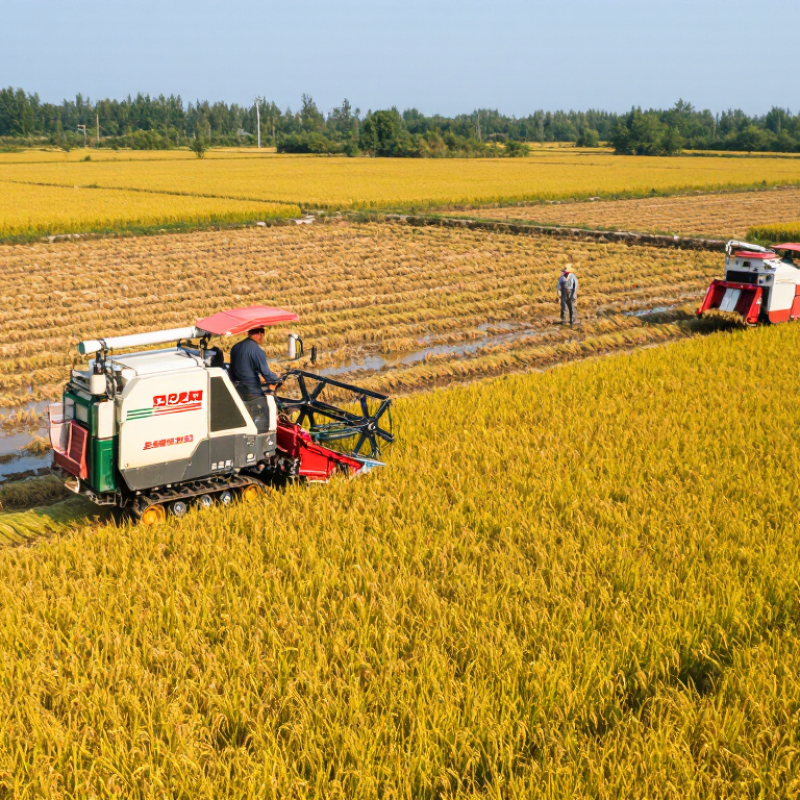
Rice harvesting equipment cuts mature stalks, separates grain, and moves it away from the field. A combine harvester performs these jobs in one pass. Its header gathers rice stalks, while a reel guides them toward the cutter bar. The crop then travels through a threshing system, where rotating parts loosen the grains from the panicles. Sieves and fans remove much of the straw and chaff before grain enters the storage tank. Small details matter. A poorly adjusted header can leave stalks behind or feed unevenly.
The right equipment depends on field size, soil firmness, crop condition, and access between plots. In small or waterlogged fields, a compact tracked machine may reduce sinking and crop damage. Larger, drier fields may suit a wider combine that covers more ground per hour. Operators watch grain loss, clogging, and engine load as conditions change. Wet straw, lodged plants, and uneven ground can slow even a capable machine. Not always. A machine with more power is not automatically the better choice; turning space and maintenance access count too. Before harvesting, check cutter height, threshing settings, and cleaning screens, then inspect grain samples for broken kernels and unthreshed heads. One setting rarely fits every field, and adjusting it takes judgment.

Rice harvesting equipment ranges from simple cutting machines to full-field combines. A reaper cuts standing rice, leaving bundling and threshing for separate work. It suits small plots and farms with limited access to larger machinery.
Reaper-binders add tying, producing sheaves that can be dried before threshing. More steps, but sometimes better control.
A combine harvester cuts, threshes, and cleans grain in one pass, reducing handling when fields are ready and dry enough. Combine types include wheeled models for firmer ground and crawler-track models for soft, muddy paddies. Compact combines can navigate narrow plots, though their smaller capacity may mean longer workdays.
IRRI’s Rice Knowledge Bank reports that well-managed combine harvesting can reduce losses to roughly 2–3%, while manual harvesting losses may reach 5–10%. These figures depend on crop maturity, machine settings, and operator skill; they are not guaranteed field results.
FAOSTAT recorded about 776 million tonnes of paddy rice worldwide in 2022, underscoring the scale of harvest operations. Still, the best machine is not always the fastest one. Field size, soil bearing capacity, labor availability, and grain moisture all matter. Even a technically suitable harvester can struggle in deep mud or lodged rice.
Rice harvester comparisons should start with crop conditions, not headline capacity. The International Rice Research Institute’s Rice Knowledge Bank places the usual harvest window at about 20–25% grain moisture. A machine must handle that crop without excessive shattering, uncut stalks, or clogged screens. Ask for measured grain loss and impurity rates in fields similar to yours. Test on uneven ground, too; a tidy demonstration plot can flatter almost any machine.
Next, compare throughput, fuel use, grain damage, adjustment time, and service access. FAO’s 2023 SDG Progress Report estimates that 13.2% of food was lost globally between harvest and retail in 2021; this is not rice-specific, but it shows why post-harvest handling deserves attention. Check whether the harvester can thresh gently and keep grain clean at realistic operating speeds. Small fields may reward maneuverability over maximum hourly capacity. Large fields may justify wider cutting widths, if transport and maintenance are manageable.
Then calculate total cost per harvested hectare, including operators, repairs, downtime, and seasonal storage. Request independent field-test results, and compare them with your own trial. I would not trust brochure capacity alone. It rarely tells the whole story. A machine that performs well in wet, lodged rice may disappoint in dry, standing crops, so keep some uncertainty in the decision.
Compare rice harvesters by indicative effective field capacity. Choose a machine that fits your field size, terrain, and harvesting schedule—not capacity alone.
How to read this chart: The bars show indicative planning ranges in hectares per hour, not guaranteed machine specifications. Actual capacity varies with crop yield and moisture, field size and layout, soil conditions, operator skill, and unloading time. Also compare grain loss, fuel use, maneuverability, maintenance access, and local parts availability.
What Is the Best Rice Harvesting Equipment in 2026?
The best rice harvesting equipment depends less on a headline capacity than on your fields. A large combine can cover broad, firm paddies quickly, but narrow gates and soft, waterlogged soil may limit access. For small or fragmented plots, a compact walk-behind reaper or small combine may be easier to maneuver. Small plots differ. Check turning space, bund strength, and field entry points before comparing machine sizes.
Field conditions matter at harvest. Wet ground can increase wheel sinkage and leave ruts, while lodged rice may need a cutting setup that gathers low stems reliably. Ask operators about ground clearance, track or tire options, header width, and expected losses in similar local conditions. Also consider transport between scattered fields, fuel use, repair access, and whether seasonal labor can operate the machine safely. A high-capacity model may sit idle if it cannot reach the fields. I would not choose from brochure figures alone; local demonstrations are more revealing, though one trial cannot represent every soil condition.
Tips: Walk the field after rain and measure the narrowest entrance. Compare actual harvesting time and grain loss during a local demonstration. Leave room in the budget for routine maintenance and wear parts. A slightly slower machine may prove more practical when access is tight.
The best choice depends on field size, soil bearing strength, plot layout, labor availability, and whether the crop will be bundled or threshed directly. Capacity figures below are indicative working ranges; actual results vary with crop yield, field shape, crop moisture, operator skill, and machine setup.
| Equipment type | Typical farm scale | Indicative field capacity | Suitable field conditions | Harvest method and labor | Main advantages | Limitations and selection notes |
|---|---|---|---|---|---|---|
| Hand sickle | Very small plots; commonly under 1 ha | About 0.01–0.03 ha per worker-hour | Small, irregular, terraced, or access-restricted plots; works on soft or uneven ground | Manual cutting; crop is gathered and threshed separately. Requires a large amount of labor. | Low equipment cost, precise cutting, and no need for machine access or fuel. | Slow and labor-intensive. Harvest timing can be difficult when labor is scarce or rain is approaching. |
| Walk-behind reaper | Small farms; roughly 1–5 ha, depending on plot layout | About 0.1–0.3 ha per hour | Relatively firm, level fields with narrow access; suitable for smaller plots that cannot accommodate larger machines | Cuts and lays crop in rows or swaths; gathering and threshing are separate operations. Usually needs an operator and field helpers. | More efficient than hand cutting and generally easier to transport between small plots than a combine. | Does not usually thresh or clean grain. Deep mud, lodged crop, uneven ground, and narrow bunds can reduce performance. |
| Reaper-binder | Small to medium farms; approximately 2–10 ha where plots are accessible | About 0.2–0.5 ha per hour | Level or gently sloping fields with sufficient traction and room for turning; crop should be reasonably upright | Cuts and ties crop into bundles; bundles must be collected and threshed separately. Needs an operator and additional handling labor. | Produces manageable bundles and can simplify drying, transport, and staged threshing. | Requires more handling than a combine. Wet, soft soil and heavily lodged rice can cause delays or poor binding. |
| Small crawler rice combine | Small to medium farms; roughly 2–20 ha, especially with fragmented plots | About 0.15–0.4 ha per hour | Wet paddy fields where tracks help distribute machine weight; useful for smaller plots and limited access routes | Cuts, threshes, and separates grain in one pass. Typically operated by one driver, with support for grain handling and transport. | Combines several harvesting steps and can work in softer paddy conditions than many wheeled machines. | Capacity is lower than that of larger combines. Check field access, turning space, track width, ground pressure, and local service availability. |
| Medium or large combine harvester | Medium to large farms; generally 10 ha and above, or shared/custom-hire operations | About 0.4–1.0 ha per hour | Broad, accessible fields with adequate turning space and soil firm enough for the machine’s weight | Harvests and threshes in one pass, with grain collected in a tank or discharged to transport. Requires an operator and organized grain handling. | High output in suitable fields; reduces separate cutting, bundling, and threshing operations. | May struggle in very soft soil, narrow terraces, small irregular plots, or fields with restricted entry. Transport and grain logistics must match its output. |
| Tracked combine harvester | Medium to large farms or contractors working across multiple wet-field sites | About 0.3–0.9 ha per hour | Soft or waterlogged paddy where lower ground pressure and flotation are priorities; still requires adequate access and turning room | Harvests and threshes in one pass. Grain unloading and transport need to be coordinated with field capacity. | Tracks can improve flotation and reduce the risk of getting stuck compared with many wheeled machines in soft paddy. | Tracks do not make every field passable. Deep mud, weak bunds, steep slopes, and limited access remain important constraints; track maintenance should be considered. |
In 2026, the best rice harvester is the one that matches field size, soil conditions, and local service access—not simply the machine with the most sensors. GPS guidance can reduce overlap, while yield and loss sensors help operators spot uneven feeding. Their readings need calibration, though. Wet straw, lodged crops, and muddy turns can still distort performance.
Harvest timing matters as much as onboard technology. The International Rice Research Institute’s Rice Knowledge Bank recommends harvesting at roughly 20–25% grain moisture, when about 80–85% of grains are straw-colored. FAO guidance commonly places safe storage near 13–14% moisture, so drying capacity belongs in the equipment budget. A fast combine cannot fix delayed drying. Small details matter.
Compare ownership cost per hectare, including fuel, repairs, operator time, downtime, and resale value. Custom-hire rates can be a useful local benchmark when annual use is low; prices vary too much by region for one global figure to be trustworthy. Before harvest, inspect cutter bars, belts, bearings, sieves, and threshing clearances. Clear chaff daily, and record grain loss from a measured field sample. I still find maintenance estimates easy to underestimate. A short pre-season test in representative wet and dry plots can reveal costly settings problems before peak harvest.


For those larger-sized parts, or smaller quantity runs, we have 2 independent powder coat booths and ovens. The quality, durability and affordability of today’s powder coating finishes make this the process of choice for world-class companies.
Powder coating advantages over other forms of coating are many. Materials used in the Powder coating process can be metals and non-metals that come in a multitude of thicknesses, textures, colors, etc. Another of Powder coating’s biggest advantages over conventional coatings is its ability to create finishes in many different textures. Powder Coating Booths allow us the ability to apply these advantages to large products.
Tri-State Fabricators runs a full-service conveyor line for painting. Wet painting can provide protection or decoration to many different part styles. From start to finish, every project is easier to undergo random and point-based inspection by our skilled painting team.
Advantages to our Wet Paint Line are these lines start with product prep and ends with a thorough inspection of a high quality finished product. Our ability to complete large and small projects with a superior finish and doing so in a timely and economical fashion. This passes along the savings in production to our customers. When powder coating ins not an option, our Wet Paint Line gets the job done right the first time.
When the parts get big and heavy we roll-out our custom paint racks and oversize booth. By utilizing our partnerships with all the major paint brands, we can match virtually any color with wet paint.
The advantages of having access to a Wet Paint Booth are many. Large projects of many different shapes can be loaded into the booth. The Wet Paint Booth offers an environment that is much more controlled than a typical parts painting operation.
Not only are they used because of their controlled environment, but they’re are also advantageous when it comes to applying paint to parts that are needed in industries that require specialty coatings such as medical, aerospace, etc.
Our military forces have some very high standards when it comes to the finish of their vehicles and equipment. From the first pre-treatment step to final coat, it takes a great deal of knowledge and experience to protect the men and women of our armed forces. They deserve only the best, and Tri-State Fabricators provides it.
All of our processes are closely monitored by our staff and management teams. Both of which are highly trained in the processes of metal fabrication and finishing. Tri-State Fabricators’ goal is to always fully satisfy each and every customer, including the military. We will always put a 110% into what we do.
Abrasive media blasting is an excellent way to remove old paint, rust, and increase the paint/powder adhesion. Glass beads produce a much smoother and brighter finish than angular abrasives; leaving the part clean yet without any dimensional change. Chemically inert and environmentally friendly, we can recycle our beads approximately 30 times; making them a more preferred method of metal cleaning or surface finishing.
Advantages to Glass Bead Blasting are many. Glass bead blast media is used when a project is needing rough surfaces need to become smooth for applications of coatings such as paint. It is typically used to clean paint and rust from a product surface without deforming the surface it is being used on. Overall, compared to many other blasting media, Glass Bead Blasting is a very economical choice and those savings are always passed on to our customers.
Tri-State Fabricators utilize a zinc phosphate wash to clean and etch the material to ensure the best paint adhesion possible. The unique design of our 3-stage wash system does the work like a 5-stage. From Cleaning and rinsing to conversion coating and post-treatment, Our Part Washing process is a complete service and works throughout the fabrication service and the finishing service.
Along with the previously mentioned benefits, Curing is a vital chemical reaction that leaves the product finish hard and relatively safe from mild abrasion and aggressive corrosion. This process can be done in more than one way; ambient air-dry or in curing ovens at temps that exceed 240°.
From fixing paint mistakes (someone else’s of course) to simply cleaning our paint line hooks, our burn-off oven is put to good use. After a quick burn-off, a little clean up, and a fresh coat of paint, your parts will look better than new.
Why does our Burn-Off Oven work so well? Because super heating the air around parts turns the materials into ashes. From paint and powder coatings to rubber and machining oils, high temps do the job without degrading the integrity of the part.
Masking is a vital part of producing high quality products. We have die-cut masking patterns to protect machined surfaces as well as a wide range of plugs and caps to protect threaded holes and bolts. We provide permanent and temporary masking.
Masking allows the selected sections of a product to be protected from a fabrication or finishing service. This can be with both chemicals when etching and tapes, paints when only finishing just a section of the product. Masking is great in aiding the customization process of a project.
Screen printing is a photographic process that transfers artwork onto a porous nylon screen which allows colored ink to flow through the screen and be deposited on an aluminum or plastic component. We can generally have just about any design created onto a screen for your parts.
Some of the advantages of Screen Printing are, brand recognition for your business displaying on your products, assembly instructions, product warnings/hazards, etc. Tri-State Fabricators produces Screen Printing of the highest quality so you know it’s durable.
Metal Finishing is the art of treating the exterior portion of product, often metal but can also be made of other materials, so that the surface is clean and free of any debris. Then the process of applying coats or either paint of powder coat takes place. This coating process improves the quality of the product in both appearance and resistance to wear and corrosion.
Tri-State Fabricators, Inc., understands that a project typically isn’t complete until a high-quality finish has been added to your product. This is why our painting and powder coating teams continuously inspect the products throughout the Metal Finishing process.

