


Choosing the best Ptfe Fuel Hose for 2026 is not simply a matter of selecting the highest pressure rating. Under the hood, heat rises around the fuel rail, fittings vibrate, and tight bends can strain a hose assembly. The liner, reinforcement, and end connections all matter. Small details count.
SAE International’s J30 Fuel and Oil Hoses standard offers a useful industry reference for hose performance and testing. It is not proof that every PTFE assembly meets the same requirements. Buyers should check the manufacturer’s stated test results, working-pressure limits, temperature range, and fuel compatibility. A shiny braided cover can look reassuring. It tells you little by itself.
Fuel composition deserves equal attention. The U.S. Environmental Protection Agency’s E15 fuel-registration guidance describes E15 as gasoline containing 10.5% to 15% ethanol. That variation makes it important to confirm compatibility with the fuels used in your vehicle, rather than relying on broad “fuel-safe” claims. Not automatically. For 2026, a sound comparison should weigh verified specifications, installation needs, and support from the hose maker. Product data sheets help, but they can leave practical questions unanswered, such as minimum bend radius or fitting compatibility. Those gaps deserve a closer look. The best choice is the assembly with clear evidence for your application—not the boldest packaging.
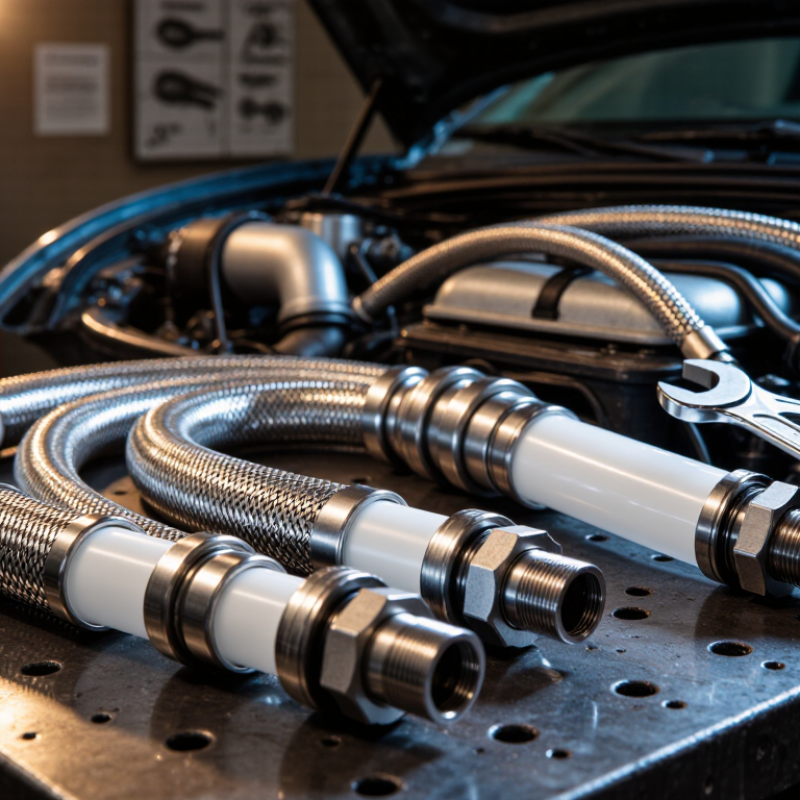
A PTFE fuel hose has a smooth fluoropolymer tube at its core. This liner carries fuel and resists many chemicals and high temperatures. Reinforcement around it, often stainless-steel braid or another specified material, helps the hose withstand pressure and resist damage. The outer layer does not determine fuel compatibility by itself. End fittings also matter: they must match the hose design and be assembled correctly. Details matter.
In service, the liner helps limit fuel permeation, while reinforcement supports the assembly under pressure. PTFE can feel less flexible than rubber hose, so tight bends may kink it or stress its connections. Check the maker’s specifications for fuel compatibility, temperature, working pressure, and minimum bend radius. A PTFE label alone does not confirm that a hose suits every vehicle or operating condition. Fit and routing need careful attention.

Choosing a PTFE fuel hose starts with the route, pressure, temperature, and fuel type—not the calendar year. Smooth-bore PTFE liners offer a clean interior that is easier to inspect and typically resists flow restriction. They suit direct, well-supported runs. Convoluted liners bend more readily around tight corners, but their ridges can make cleaning and flow less straightforward. There is no universal winner. A hose that fits neatly on a bench may kink once installed beside a hot engine component.
Reinforcement matters, too. Stainless-steel braid can protect against abrasion and support demanding applications, but it may be stiff in confined spaces. A suitable outer cover can help where the hose risks rubbing against a bracket. Check the hose maker’s pressure and temperature ratings for the complete assembly, not just the liner. Fittings must match the hose construction and connection type. A mismatched fitting can leak, even when both parts appear well made. Take time here.
Tips: Measure the installed route, including bends and movement. Keep the hose clear of sharp edges and heat sources, and follow the fitting maker’s assembly instructions. After installation, inspect for twisting, chafing, and seepage. Small details are easy to miss, and inspection intervals should reflect the operating conditions.
Evaluating Fuel Compatibility, Pressure, and Temperature Ratings
Choosing PTFE fuel hose starts with the actual fuel, not the word “compatible.” PTFE resists many hydrocarbon fuels and alcohol blends, but additives, exposure time, and hose construction still matter. SAE J30 provides fuel-hose performance requirements, while ASTM D471 describes methods for assessing material changes after liquid exposure. Ask for test results covering the fuel blend you use, not just a general compatibility chart. A small but important distinction.
Pressure ratings belong to the complete hose assembly. A liner’s strength does not establish the rating of its braid, fittings, or assembled connections. Check the manufacturer’s working-pressure rating at your operating temperature, and ask whether it accounts for pressure pulses and installation bends. Published fluoropolymer technical data commonly place PTFE’s continuous-use temperature near 260°C. That figure describes the material, not every finished hose. The braid and fittings may set a lower limit.
Inspect the temperature range alongside the pressure rating; heat can reduce an assembly’s safe pressure capacity. SAE J30 and ISO 7840 offer useful benchmarks for fuel-hose performance, but neither replaces the specific assembly data sheet. Look for documented fuel exposure, temperature derating, and pressure-test conditions. I would not choose by maximum pressure alone. It is easy to overlook routing near a hot engine part, especially when the hose feels cool during a brief inspection.
Choosing a PTFE fuel hose starts with your vehicle’s requirements, not the product photo. Check the fuel type, operating temperature, and maximum system pressure. The hose’s working-pressure rating should safely exceed the system’s demands. Match its internal diameter to the required fuel flow; a larger hose is not automatically better.
Check the details.
Look for a hose and fittings specifically designed to work together. Some PTFE hose assemblies require a conductive inner liner, so verify the manufacturer’s specifications rather than assuming every PTFE hose suits every fuel system.
Routing matters, too. Measure the path, allow for engine movement, and keep the hose clear of sharp edges, hot exhaust parts, and tight bends. A neat installation can still be wrong if it kinks under movement.
It is easy to focus on the braid and overlook the fittings. I would double-check their compatibility and assembly instructions before installation.
After fitting, inspect for leaks using the vehicle’s specified test procedure. Appearance alone tells you very little.
When choosing the best PTFE fuel hose in 2026, check the complete assembly, not just its liner. PTFE can tolerate a wide temperature range, but the hose’s actual limits depend on its braid, fittings, and construction. Ask for published working and burst pressures at the temperatures you expect. A pressure figure without a temperature condition is incomplete. SAE J30 offers useful fuel-hose test context, but it does not automatically certify a PTFE assembly. ASTM D4894 evaluates PTFE resin properties, not the finished hose. Small distinction. It matters.
Look for permeation data, bend-radius limits, and evidence of pressure-impulse testing. The U.S. EPA’s 40 CFR Part 1060 measures fuel-line permeation in grams per square meter per day; its requirements apply to specific equipment categories, not every vehicle or hose. Treat that test method as a comparison tool, not a universal pass mark. Check that the stated results match the fuel type, temperature, and fittings in your application. Tight bends near a hot engine can stress the line even when its pressure rating looks ample. A common mistake is focusing on maximum pressure alone. Ask for the test conditions and inspect the hose after installation. A datasheet can’t show every routing problem.


For those larger-sized parts, or smaller quantity runs, we have 2 independent powder coat booths and ovens. The quality, durability and affordability of today’s powder coating finishes make this the process of choice for world-class companies.
Powder coating advantages over other forms of coating are many. Materials used in the Powder coating process can be metals and non-metals that come in a multitude of thicknesses, textures, colors, etc. Another of Powder coating’s biggest advantages over conventional coatings is its ability to create finishes in many different textures. Powder Coating Booths allow us the ability to apply these advantages to large products.
Tri-State Fabricators runs a full-service conveyor line for painting. Wet painting can provide protection or decoration to many different part styles. From start to finish, every project is easier to undergo random and point-based inspection by our skilled painting team.
Advantages to our Wet Paint Line are these lines start with product prep and ends with a thorough inspection of a high quality finished product. Our ability to complete large and small projects with a superior finish and doing so in a timely and economical fashion. This passes along the savings in production to our customers. When powder coating ins not an option, our Wet Paint Line gets the job done right the first time.
When the parts get big and heavy we roll-out our custom paint racks and oversize booth. By utilizing our partnerships with all the major paint brands, we can match virtually any color with wet paint.
The advantages of having access to a Wet Paint Booth are many. Large projects of many different shapes can be loaded into the booth. The Wet Paint Booth offers an environment that is much more controlled than a typical parts painting operation.
Not only are they used because of their controlled environment, but they’re are also advantageous when it comes to applying paint to parts that are needed in industries that require specialty coatings such as medical, aerospace, etc.
Our military forces have some very high standards when it comes to the finish of their vehicles and equipment. From the first pre-treatment step to final coat, it takes a great deal of knowledge and experience to protect the men and women of our armed forces. They deserve only the best, and Tri-State Fabricators provides it.
All of our processes are closely monitored by our staff and management teams. Both of which are highly trained in the processes of metal fabrication and finishing. Tri-State Fabricators’ goal is to always fully satisfy each and every customer, including the military. We will always put a 110% into what we do.
Abrasive media blasting is an excellent way to remove old paint, rust, and increase the paint/powder adhesion. Glass beads produce a much smoother and brighter finish than angular abrasives; leaving the part clean yet without any dimensional change. Chemically inert and environmentally friendly, we can recycle our beads approximately 30 times; making them a more preferred method of metal cleaning or surface finishing.
Advantages to Glass Bead Blasting are many. Glass bead blast media is used when a project is needing rough surfaces need to become smooth for applications of coatings such as paint. It is typically used to clean paint and rust from a product surface without deforming the surface it is being used on. Overall, compared to many other blasting media, Glass Bead Blasting is a very economical choice and those savings are always passed on to our customers.
Tri-State Fabricators utilize a zinc phosphate wash to clean and etch the material to ensure the best paint adhesion possible. The unique design of our 3-stage wash system does the work like a 5-stage. From Cleaning and rinsing to conversion coating and post-treatment, Our Part Washing process is a complete service and works throughout the fabrication service and the finishing service.
Along with the previously mentioned benefits, Curing is a vital chemical reaction that leaves the product finish hard and relatively safe from mild abrasion and aggressive corrosion. This process can be done in more than one way; ambient air-dry or in curing ovens at temps that exceed 240°.
From fixing paint mistakes (someone else’s of course) to simply cleaning our paint line hooks, our burn-off oven is put to good use. After a quick burn-off, a little clean up, and a fresh coat of paint, your parts will look better than new.
Why does our Burn-Off Oven work so well? Because super heating the air around parts turns the materials into ashes. From paint and powder coatings to rubber and machining oils, high temps do the job without degrading the integrity of the part.
Masking is a vital part of producing high quality products. We have die-cut masking patterns to protect machined surfaces as well as a wide range of plugs and caps to protect threaded holes and bolts. We provide permanent and temporary masking.
Masking allows the selected sections of a product to be protected from a fabrication or finishing service. This can be with both chemicals when etching and tapes, paints when only finishing just a section of the product. Masking is great in aiding the customization process of a project.
Screen printing is a photographic process that transfers artwork onto a porous nylon screen which allows colored ink to flow through the screen and be deposited on an aluminum or plastic component. We can generally have just about any design created onto a screen for your parts.
Some of the advantages of Screen Printing are, brand recognition for your business displaying on your products, assembly instructions, product warnings/hazards, etc. Tri-State Fabricators produces Screen Printing of the highest quality so you know it’s durable.
Metal Finishing is the art of treating the exterior portion of product, often metal but can also be made of other materials, so that the surface is clean and free of any debris. Then the process of applying coats or either paint of powder coat takes place. This coating process improves the quality of the product in both appearance and resistance to wear and corrosion.
Tri-State Fabricators, Inc., understands that a project typically isn’t complete until a high-quality finish has been added to your product. This is why our painting and powder coating teams continuously inspect the products throughout the Metal Finishing process.

