


Choosing the best Powder Sieve Machine in 2026 depends less on a headline capacity and more on the powder itself. Fine, dry flour behaves differently from a damp, free-flowing mineral blend. Particle size, moisture, required mesh, and target throughput all affect screening performance. A machine that handles one material smoothly may clog or separate another poorly. Small details matter.
This guide compares key machine types and practical selection criteria, including screen area, vibration method, contact materials, noise, cleaning access, and replacement-screen availability. It also considers how operators feed the machine: an uneven pour can reduce screening consistency, even with suitable equipment. For food, chemical, or pharmaceutical production, verify that the design and documentation meet your facility’s requirements; specifications should be confirmed with the manufacturer. That step is easy to overlook.
There is no universal winner. A compact unit may suit product trials or limited batches, while continuous production may call for a larger, more automated system. Price alone is a poor shortcut. Compare usable capacity under your actual material conditions, not only the advertised maximum. Where possible, request a sample test and record the feed rate, separation quality, and cleaning time. Results can still vary between batches, so treat a single successful run with caution. The sections ahead explain what to check before deciding which Powder Sieve Machine best fits your process.
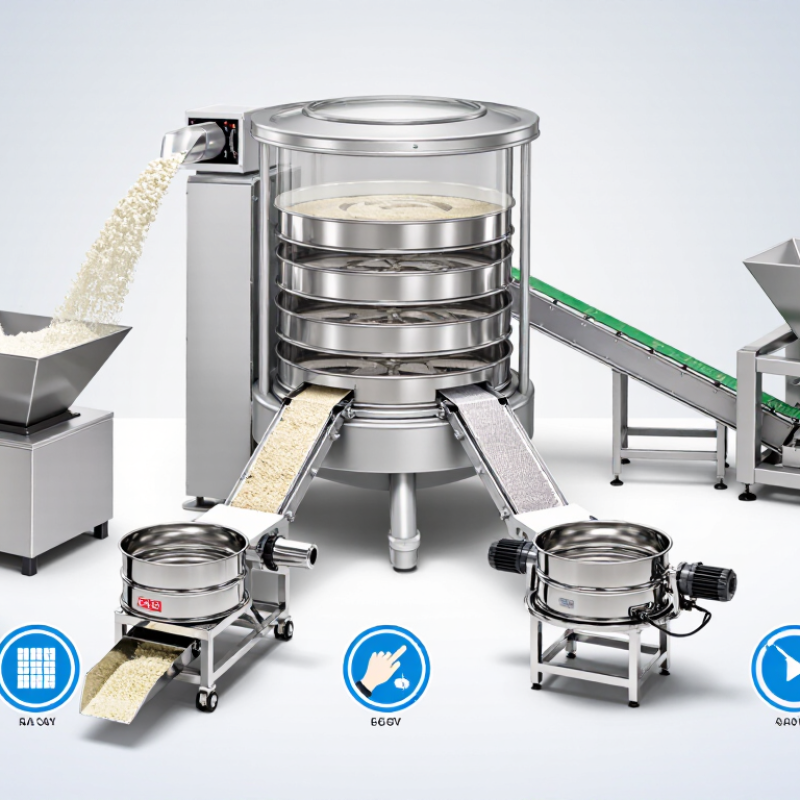
A powder sieve machine separates particles by size, using a mesh screen and controlled motion. Powder enters through the feed inlet, then vibration or rotation moves it across the screen. Smaller particles pass through the openings; larger particles remain above. Different screen sizes can sort powder into several fractions. The machine does not make particles smaller. It classifies them.
ASTM E11 specifies standard test sieve openings from 20 μm to 125 mm, giving operators a broad range for selecting a screen. In practice, the right opening depends on the product and the target particle-size distribution. A fine powder may cling to the mesh, while damp material can block openings. That changes throughput and results. USP General Chapter <786> also describes analytical sieving as a method for assessing particle-size distribution. Real production conditions can still differ from a laboratory test.
Tips: Match the mesh to your target cut size, and check it for damage before a run. Keep feed even; a thick layer can hide smaller particles. Watch for blinding. It is easy to miss. Record vibration settings and cleaning intervals, then compare samples from the beginning and end of a batch. One setting will not suit every powder.

Powder sieve machines separate particles by size, but their motion suits different materials. A vibrating sieve uses rapid oscillation to move powder across a mesh. It works well for dry, free-flowing ingredients and routine grading in food, mineral, and chemical processing. Operators can change screens to target a cut size. Fine dust can still escape unless the unit is properly enclosed.
A centrifugal sieve uses a rotating paddle or rotor to push material through a cylindrical screen. It can break soft lumps and handle higher feed rates, though heat-sensitive or fragile powders need careful trials. A gyratory, or tumbler, sieve follows a broad circular motion. It offers gentle separation across several decks, making it useful for quality checks and grading multiple fractions. That matters.
Ultrasonic sieving adds high-frequency vibration to the mesh, helping fine powders resist blinding and pass through smaller openings. It can suit cohesive materials, but it does not solve every feed problem; moisture and static charge may still cause clumping. Match the machine to particle size, required capacity, and cleaning needs. Test a representative sample before selection, and inspect the mesh after each run. Small details matter. A sieve that performs well in a short trial may behave differently during a long production shift.
| Machine Type | How It Works | Best Suited For | Main Advantages | Considerations | Common Uses |
|---|---|---|---|---|---|
| Circular Vibratory Sieve | A motor generates vibration that moves powder across one or more circular screen decks. | General-purpose screening, grading, and removal of oversized particles from free-flowing powders. | Versatile; available with multiple screen decks; suitable for separating material into different size fractions. | Very fine, cohesive, or electrostatically charged powders may blind the mesh unless suitable screen-cleaning measures are used. | Food ingredients, mineral powders, chemicals, and pharmaceutical ingredients. |
| Ultrasonic Vibratory Sieve | High-frequency ultrasonic vibration is applied to the screen mesh alongside mechanical vibration. | Fine powders and materials that tend to clog or adhere to the screen. | Can reduce mesh blinding and improve passage of fine, difficult-to-screen material. | More complex than a standard vibratory sieve; screen condition and process settings still affect performance. | Fine chemical powders, pharmaceutical powders, metal powders, and other materials requiring fine screening. |
| Tumbler Sieve | A low-frequency, three-dimensional gyratory motion gently spreads material over the screen surface. | Fragile, abrasive, or irregularly shaped particles where gentle handling or longer screening time is useful. | Gentle screening action; large screening area; can support multiple classification stages. | Typically occupies more floor space and may screen more slowly than high-energy vibratory designs. | Granules, abrasives, minerals, food products, and other materials requiring careful classification. |
| Centrifugal Sifter | A rotating internal rotor moves powder against a cylindrical screen; acceptable material passes through the mesh. | Continuous screening of dry powders and granules in enclosed process lines. | Compact, continuous operation; can be integrated with conveying and other production equipment. | Not ideal for every fragile or heat-sensitive material; screen and rotor selection must suit the product. | Food processing, plastics, chemicals, and powder reclaim or de-lumping applications. |
| Inline Pneumatic Sifter | Powder conveyed through a closed pipeline is screened within an inline separation unit. | Processes that need screening during pneumatic transfer or require enclosed material handling. | Can reduce open handling and fit into automated conveying systems. | Performance depends on conveying conditions, powder flow properties, and the design of the integrated system. | Closed-transfer powder production, bulk handling, and automated processing lines. |
| Static Safety Sieve | Powder passes through a fixed screen, commonly positioned at a material charging or transfer point. | Basic protection against foreign objects and large agglomerates rather than precise particle-size grading. | Simple construction; useful as a final safety check before downstream processing. | Usually provides limited separation control compared with powered screening machines. | Bag-dumping stations, ingredient charging, and bulk-bag discharge points. |
Selection guide: The best machine depends on powder flowability, particle size, moisture, required throughput, separation accuracy, and whether the process is batch or continuous. Test the actual material before final equipment selection.
Choosing a powder sieve machine in 2026 starts with the material, not a catalog headline. Record the target particle range, batch size, moisture level, and whether the powder clumps during handling. Dry, free-flowing powder may pass through a vibrating screen easily. Fine, humid powder can blind the mesh. Small details matter. Choose mesh openings using a representative sieve analysis, then check whether the required cut stays consistent at normal feed rates. Greater capacity is not always better; overloading can weaken separation and send usable material into rejects.
Compare screening methods against your product’s behavior. Vibratory units suit many routine grading tasks. Rotary or centrifugal designs may help with sticky or fine powders, but confirm performance through trials. Ask how quickly operators can change screens, inspect seals, and clean product-contact surfaces. Request throughput data from conditions similar to your own, including feed rate and moisture. Check noise, dust containment, screen availability, and access for routine maintenance. A technically impressive specification can still disappoint in daily use. Test with your own powder before committing, and record both output quality and cleaning time.
A powder sieve machine should be compared using your actual material, not only a catalogue capacity. Ask for throughput in kilograms per hour under conditions close to your process. Fine powders, damp material, and uneven feeding can all reduce output. Capacity is not a single number. Measure it on-site.
Accuracy depends on the screen opening, machine motion, and how consistently material is fed. Run a trial with a representative batch, then weigh the accepted and rejected fractions. Check several samples rather than relying on one clean test. Small changes in moisture or feed rate may affect separation. That matters. Keep records of the screen size, batch weight, and operating settings so comparisons remain fair.
Maintenance can change the real cost of ownership. Look for tool-free access to screens, straightforward gasket replacement, and surfaces that are easy to inspect and clean. Ask how long routine screen changes take, and whether operators can spot tears or loose fittings before production starts. A detailed checklist helps, though it may not capture every awkward step. Watch a cleaning and changeover in person. A machine that meets the target rate but takes too long to service may interrupt the schedule.
Choosing a powder sieve machine starts with the material, not the machine name. Is the powder dry and free-flowing, or does it cling to a scoop? Note its particle size, moisture, temperature, and tendency to form lumps. These details affect screening more than a headline capacity figure. A fine, static-prone powder may need a different setup from coarse granules that pass easily through a standard mesh.
Match the screen and motion to the job. Vibratory sifters suit many routine grading tasks, while rotary designs can handle some continuous processes. For sticky or very fine material, ask whether added screen-cleaning features are appropriate. Check the required mesh opening, actual feed rate, contact materials, and how quickly the machine can be opened and cleaned. A smooth interior helps, but seams and corners still deserve inspection. Small details matter.
Catalog numbers can mislead. Run a representative sample at the intended feed rate and inspect both the retained material and the undersize fraction. Ask operators to test loading, noise, dust control, and cleaning time. One awkward truth: a machine that meets a laboratory target may struggle during a long production shift. The best fit is the one that reliably meets product specifications within your space, maintenance capacity, and daily workflow.
Reference chart: nominal aperture sizes for commonly used ASTM E11 test sieves.
Choose a sieve machine by matching its screen aperture to your target particle cut, then consider required throughput, material characteristics, and cleaning needs. Aperture size is a reference—not a measure of machine capacity or separation performance. Values shown are nominal ASTM E11 sieve openings.


For those larger-sized parts, or smaller quantity runs, we have 2 independent powder coat booths and ovens. The quality, durability and affordability of today’s powder coating finishes make this the process of choice for world-class companies.
Powder coating advantages over other forms of coating are many. Materials used in the Powder coating process can be metals and non-metals that come in a multitude of thicknesses, textures, colors, etc. Another of Powder coating’s biggest advantages over conventional coatings is its ability to create finishes in many different textures. Powder Coating Booths allow us the ability to apply these advantages to large products.
Tri-State Fabricators runs a full-service conveyor line for painting. Wet painting can provide protection or decoration to many different part styles. From start to finish, every project is easier to undergo random and point-based inspection by our skilled painting team.
Advantages to our Wet Paint Line are these lines start with product prep and ends with a thorough inspection of a high quality finished product. Our ability to complete large and small projects with a superior finish and doing so in a timely and economical fashion. This passes along the savings in production to our customers. When powder coating ins not an option, our Wet Paint Line gets the job done right the first time.
When the parts get big and heavy we roll-out our custom paint racks and oversize booth. By utilizing our partnerships with all the major paint brands, we can match virtually any color with wet paint.
The advantages of having access to a Wet Paint Booth are many. Large projects of many different shapes can be loaded into the booth. The Wet Paint Booth offers an environment that is much more controlled than a typical parts painting operation.
Not only are they used because of their controlled environment, but they’re are also advantageous when it comes to applying paint to parts that are needed in industries that require specialty coatings such as medical, aerospace, etc.
Our military forces have some very high standards when it comes to the finish of their vehicles and equipment. From the first pre-treatment step to final coat, it takes a great deal of knowledge and experience to protect the men and women of our armed forces. They deserve only the best, and Tri-State Fabricators provides it.
All of our processes are closely monitored by our staff and management teams. Both of which are highly trained in the processes of metal fabrication and finishing. Tri-State Fabricators’ goal is to always fully satisfy each and every customer, including the military. We will always put a 110% into what we do.
Abrasive media blasting is an excellent way to remove old paint, rust, and increase the paint/powder adhesion. Glass beads produce a much smoother and brighter finish than angular abrasives; leaving the part clean yet without any dimensional change. Chemically inert and environmentally friendly, we can recycle our beads approximately 30 times; making them a more preferred method of metal cleaning or surface finishing.
Advantages to Glass Bead Blasting are many. Glass bead blast media is used when a project is needing rough surfaces need to become smooth for applications of coatings such as paint. It is typically used to clean paint and rust from a product surface without deforming the surface it is being used on. Overall, compared to many other blasting media, Glass Bead Blasting is a very economical choice and those savings are always passed on to our customers.
Tri-State Fabricators utilize a zinc phosphate wash to clean and etch the material to ensure the best paint adhesion possible. The unique design of our 3-stage wash system does the work like a 5-stage. From Cleaning and rinsing to conversion coating and post-treatment, Our Part Washing process is a complete service and works throughout the fabrication service and the finishing service.
Along with the previously mentioned benefits, Curing is a vital chemical reaction that leaves the product finish hard and relatively safe from mild abrasion and aggressive corrosion. This process can be done in more than one way; ambient air-dry or in curing ovens at temps that exceed 240°.
From fixing paint mistakes (someone else’s of course) to simply cleaning our paint line hooks, our burn-off oven is put to good use. After a quick burn-off, a little clean up, and a fresh coat of paint, your parts will look better than new.
Why does our Burn-Off Oven work so well? Because super heating the air around parts turns the materials into ashes. From paint and powder coatings to rubber and machining oils, high temps do the job without degrading the integrity of the part.
Masking is a vital part of producing high quality products. We have die-cut masking patterns to protect machined surfaces as well as a wide range of plugs and caps to protect threaded holes and bolts. We provide permanent and temporary masking.
Masking allows the selected sections of a product to be protected from a fabrication or finishing service. This can be with both chemicals when etching and tapes, paints when only finishing just a section of the product. Masking is great in aiding the customization process of a project.
Screen printing is a photographic process that transfers artwork onto a porous nylon screen which allows colored ink to flow through the screen and be deposited on an aluminum or plastic component. We can generally have just about any design created onto a screen for your parts.
Some of the advantages of Screen Printing are, brand recognition for your business displaying on your products, assembly instructions, product warnings/hazards, etc. Tri-State Fabricators produces Screen Printing of the highest quality so you know it’s durable.
Metal Finishing is the art of treating the exterior portion of product, often metal but can also be made of other materials, so that the surface is clean and free of any debris. Then the process of applying coats or either paint of powder coat takes place. This coating process improves the quality of the product in both appearance and resistance to wear and corrosion.
Tri-State Fabricators, Inc., understands that a project typically isn’t complete until a high-quality finish has been added to your product. This is why our painting and powder coating teams continuously inspect the products throughout the Metal Finishing process.

