


10 Best Portable Ring Lights for Every Budget

A good ring light should make a face look clear without turning a small room into a studio. For video calls, makeup, livestreams, and travel, a Portable Ring Light can offer useful fill light in a compact package. Yet “portable” means different things. One model clips onto a phone, while another needs a tabletop stand and a nearby outlet.

This guide compares ten options across different budgets, focusing on brightness control, color settings, mounting, power, and ease of carrying. These details matter when you are adjusting a light in a dim hotel room or trying to avoid glare on glasses. A lower-priced model may suit occasional calls, while frequent creators may value steadier output and a sturdier mount. No single option fits every setup.

Small trade-offs count. A lightweight light is easy to pack, but its stand may feel less secure. A larger ring can illuminate more evenly, though it takes up more space. Specifications help, but they do not tell the whole story; phone size, room lighting, and camera distance also affect the result. Some brightness claims are hard to compare across brands, so treat them as a starting point, not a guarantee. Not always. The picks below are organized to help you match practical features with your budget, without assuming that the most expensive light is automatically the best.
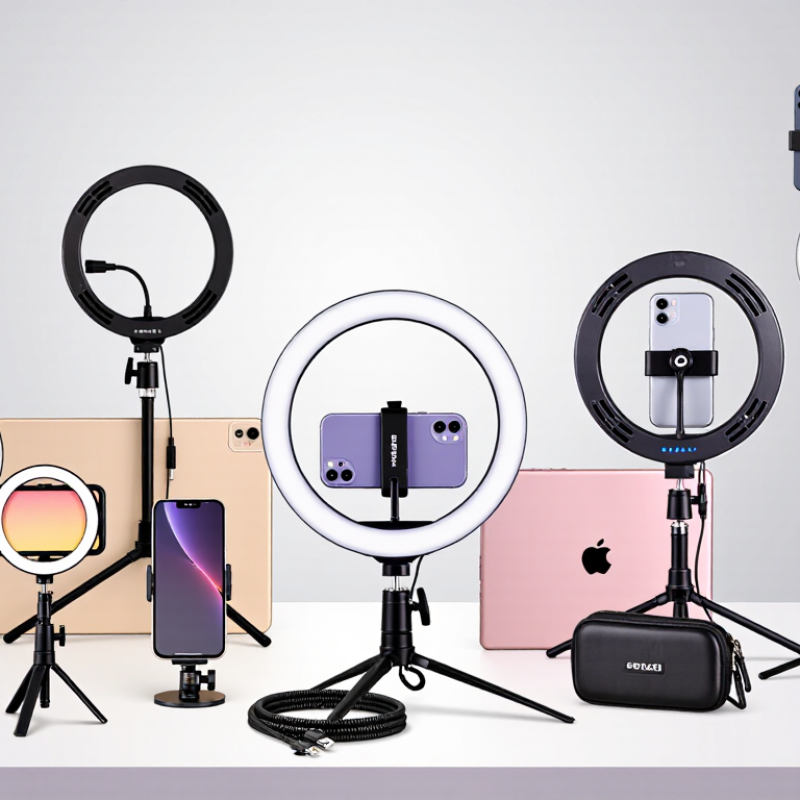
10 Best Portable Ring Lights for Every Budget

What Portable Ring Lights Are and How They Work

Portable ring lights are compact LED fixtures that create an even circle of light around a phone or camera. Their shape places light close to the lens, brightening the face while softening small shadows under the eyes and chin. LEDs convert electricity into light with relatively little heat, and many models offer brightness and color-temperature controls. That matters. A warmer setting can flatter skin indoors, while a cooler one may look cleaner near daylight. The U.S. Department of Energy reports that LEDs use at least 75% less energy than incandescent bulbs. They can also last up to 25 times longer (U.S. Department of Energy, “LED Lighting”). Those figures describe LED technology generally, not every portable ring light.

Portability comes from a lightweight frame, a folding stand, or a rechargeable battery; some lights instead draw power through USB. Check the battery runtime at your intended brightness, since maximum output drains it faster. A small diffuser can make the light gentler, but it cannot erase every harsh shadow or fix a dim room. Not quite. Ring lights may also leave a visible circular reflection in glasses or pupils. Try moving the light slightly above eye level and adjusting its distance before filming. Color accuracy varies, too, so look for published color-rendering information rather than trusting a bright-looking product photo. A low-cost light can work well for close-up calls, though its tiny controls and unstable clip may become annoying.


How Portable Ring Light Distance Affects Brightness

Moving a light farther away reduces the illuminance reaching the subject. These relative values use the inverse-square model, normalized to 100 at 0.25 m; actual results vary with the ring light and surroundings.

Key Features to Compare Before Choosing a Ring Light

Choosing a portable ring light means comparing useful light, not just diameter. In Wyzowl’s 2024 Video Marketing Statistics report, 91% of surveyed businesses said they use video marketing. Clear lighting matters, but that figure does not mean every creator needs a large light. Check brightness in lux at a stated distance; “high brightness” without a measurement tells you little. Specs can mislead.

Compare color temperature, color accuracy, and dimming control. A range around 3,200K to 5,600K helps match warm lamps or daylight from a window. A CRI of 90 or higher is a practical target for natural-looking skin tones, though it cannot guarantee pleasing results. Check the output. A 10-inch light may suit a desk, while a larger ring can spread light more evenly across a face. Look for stable phone mounting, a secure mini-tripod, and controls you can reach while recording. For battery models, compare stated runtime at full brightness, not just the longest advertised figure. USB power can be more reliable during long sessions.

Tips: Test the light at your usual camera distance. Watch for glare in glasses and harsh shadows under the chin. A soft diffuser helps, but it can reduce brightness. Honestly, a cheap light may work well; its weak point is often an unstable stand, not the LEDs.

10 Portable Ring Lights Across Different Budget Ranges

Portable ring lights span three useful budget ranges, and the differences show up in everyday handling. Entry-level models often use a small clip, a few brightness settings, and USB power. They can brighten a face for a video call, but may struggle to light a wider scene evenly.

Check that the clamp fits your phone and that its joints hold their angle. A loose mount gets annoying fast.

Midrange options usually offer smoother dimming, warmer and cooler color settings, and a sturdier stand or phone holder. These details help when daylight shifts or a desk lamp adds a yellow cast.

Look for controls you can reach while seated, plus a cable long enough to reach a nearby outlet. Battery-powered versions are convenient, though brightness may drop as the charge runs low. Test that at home.

Higher-priced portable lights may include a larger illuminated surface, better build quality, or a rechargeable battery with clearer charge indicators. Those features matter for frequent travel or longer recording sessions, not necessarily for occasional calls.

Compare weight, folded size, and the light’s stated color-rendering information; a brighter setting alone does not guarantee natural-looking skin.

I have found that compact stands can still wobble on a crowded desk. It is easy to overlook that. A ring light also creates a visible circular reflection in glasses, so adjust its height and angle before recording.

How the Selected Models Differ in Power, Mounting, and Controls

Portable ring lights differ less by shape than by how they deliver power. USB-powered models can run from a power bank, which helps during a short outdoor shoot. Battery-powered options avoid a cable, but their runtime may drop at higher brightness. Check whether a light lists usable brightness levels and charging details, not just a large power number. Small labels can be vague.

Mounting affects both framing and stability. A compact clip can attach to a laptop, but it may wobble when the screen moves. A tabletop stand gives more control over height, though it takes up space in a crowded bag. Flexible phone holders are handy for quick changes, yet a heavy phone can pull a lightweight mount off-center. That can be annoying.

Controls matter when the light is already positioned. Physical buttons are easy to find by touch, while a small remote can adjust brightness without reaching across the camera. Some models offer color temperature settings, useful for matching a warm desk lamp or cool window light. The adjustment range may feel limited in practice. Compare control layout, mount grip, and power options together; a bright light is not automatically the most useful one.

How to Match a Ring Light to Your Device and Use Case

Choosing a portable ring light starts with the device, not the price. A phone creator needs a secure, adjustable phone holder and a light that stays steady when the screen is tapped. For a webcam, check that the stand fits beside the monitor without blocking the lens. Tablets and larger cameras need stronger clamps or a separate mount. Tiny desk? A larger light can crowd your workspace. That trade-off is easy to miss.

Match brightness and color control to the setting. A dim bedroom may need adjustable output, while a bright window calls for enough power to soften facial shadows. For video calls, a compact light with simple controls is often more useful than a tall stand. For makeup or product close-ups, look for even illumination and adjustable color temperature. Check how the light is powered, too; a cable that cannot reach your desk quickly becomes annoying.

Use case matters because video is now a common format. HubSpot’s 2024 State of Marketing report found that 21% of marketers named short-form video their highest-ROI format. DataReportal’s Digital 2024 Global Overview reported average daily social-media use of 2 hours and 23 minutes worldwide. Neither figure guarantees a better image. Still, they make comfort and repeatable setup worth considering: can you position the light quickly, avoid screen glare, and keep it steady? Not glamorous, but useful.

10 Best Portable Ring Lights for Every Budget - How to Match a Ring Light to Your Device and Use Case

Portable ring-light type Typical price (USD) Common size Power and mounting Best device and use case What to check before buying
Basic clip-on selfie light $8–$15 2–3 in Built-in rechargeable battery; clips to a phone or laptop screen Phone selfies, video calls, and quick close-up lighting Check clip depth, charging port, and whether the clip blocks the camera or screen.
Compact USB clip light with adjustable color $12–$25 3–4 in USB-powered or rechargeable; clip mount Laptop meetings and phone recording at a desk Look for several brightness levels and warm-to-cool color settings.
Mini tabletop ring light $15–$30 4–6 in USB power; small desktop stand, often with a phone holder Phone livestreams, video calls, and desk-based tutorials Confirm that the stand is stable and the phone holder fits your device width.
Flexible-neck phone ring light $18–$35 4–6 in USB-powered; adjustable neck or compact phone stand Phone filming where the light needs to sit above or beside the screen Check the neck’s range of motion and whether it holds its position without sagging.
Pocket-size foldable ring light $20–$40 3–5 in when open Rechargeable battery; fold-out clip or stand Travel, mobile video calls, and occasional phone selfies Compare folded dimensions, charging time, and battery runtime at higher brightness.
6-inch portable ring light with tabletop tripod $25–$45 About 6 in Usually USB-powered; tabletop tripod and phone holder Phone tutorials, makeup videos, and small workspaces Check tripod height, phone-holder rotation, and whether a wall adapter is included.
8-inch USB ring light kit $30–$60 About 8 in USB power; compact tripod, often with a phone mount Phone livestreaming, creator videos, and seated presentations For travel, check packed size; for desk use, check tripod stability and cable length.
8–10-inch rechargeable ring light $40–$80 8–10 in Built-in battery; tabletop stand or compact tripod Creators who need cordless lighting for short indoor or outdoor sessions Compare stated runtime at different brightness levels and confirm battery replacement options.
10-inch ring light with adjustable tripod $45–$90 About 10 in USB or adapter power; folding floor tripod and phone holder Fuller face lighting for phone video, makeup, and online presentations Check maximum tripod height, folded length, and the power source required for full brightness.
Compact camera-compatible ring light kit $60–$120 6–10 in USB or rechargeable; tripod or compatible mounting adapter Phone or compact-camera video, product demos, and more adjustable setups Verify the mount thread and camera clearance; some kits are designed only for phones.

Prices are indicative USD ranges for common product types, not guaranteed current prices. Size, brightness, battery life, included accessories, and compatibility vary by model.

Powder Coat Booths

For those larger-sized parts, or smaller quantity runs, we have 2 independent powder coat booths and ovens. The quality, durability and affordability of today’s powder coating finishes make this the process of choice for world-class companies.

Powder coating advantages over other forms of coating are many. Materials used in the Powder coating process can be metals and non-metals that come in a multitude of thicknesses, textures, colors, etc. Another of Powder coating’s biggest advantages over conventional coatings is its ability to create finishes in many different textures. Powder Coating Booths allow us the ability to apply these advantages to large products.

Wet Paint Line

Tri-State Fabricators runs a full-service conveyor line for painting. Wet painting can provide protection or decoration to many different part styles. From start to finish, every project is easier to undergo random and point-based inspection by our skilled painting team.

Advantages to our Wet Paint Line are these lines start with product prep and ends with a thorough inspection of a high quality finished product. Our ability to complete large and small projects with a superior finish and doing so in a timely and economical fashion. This passes along the savings in production to our customers. When powder coating ins not an option, our Wet Paint Line gets the job done right the first time.

Wet Paint Booths

When the parts get big and heavy we roll-out our custom paint racks and oversize booth. By utilizing our partnerships with all the major paint brands, we can match virtually any color with wet paint.

The advantages of having access to a Wet Paint Booth are many. Large projects of many different shapes can be loaded into the booth. The Wet Paint Booth offers an environment that is much more controlled than a typical parts painting operation.

Not only are they used because of their controlled environment, but they’re are also advantageous when it comes to applying paint to parts that are needed in industries that require specialty coatings such as medical, aerospace, etc.

Military CARC

Our military forces have some very high standards when it comes to the finish of their vehicles and equipment. From the first pre-treatment step to final coat, it takes a great deal of knowledge and experience to protect the men and women of our armed forces. They deserve only the best, and Tri-State Fabricators provides it.

All of our processes are closely monitored by our staff and management teams. Both of which are highly trained in the processes of metal fabrication and finishing. Tri-State Fabricators’ goal is to always fully satisfy each and every customer, including the military. We will always put a 110% into what we do.

Glass-Bead Blasting

Abrasive media blasting is an excellent way to remove old paint, rust, and increase the paint/powder adhesion. Glass beads produce a much smoother and brighter finish than angular abrasives; leaving the part clean yet without any dimensional change. Chemically inert and environmentally friendly, we can recycle our beads approximately 30 times; making them a more preferred method of metal cleaning or surface finishing.

Advantages to Glass Bead Blasting are many. Glass bead blast media is used when a project is needing rough surfaces need to become smooth for applications of coatings such as paint. It is typically used to clean paint and rust from a product surface without deforming the surface it is being used on. Overall, compared to many other blasting media, Glass Bead Blasting is a very economical choice and those savings are always passed on to our customers.

Part Washing

Tri-State Fabricators utilize a zinc phosphate wash to clean and etch the material to ensure the best paint adhesion possible. The unique design of our 3-stage wash system does the work like a 5-stage. From Cleaning and rinsing to conversion coating and post-treatment, Our Part Washing process is a complete service and works throughout the fabrication service and the finishing service.

Along with the previously mentioned benefits, Curing is a vital chemical reaction that leaves the product finish hard and relatively safe from mild abrasion and aggressive corrosion. This process can be done in more than one way; ambient air-dry or in curing ovens at temps that exceed 240°.

Burn-Off Oven

From fixing paint mistakes (someone else’s of course) to simply cleaning our paint line hooks, our burn-off oven is put to good use. After a quick burn-off, a little clean up, and a fresh coat of paint, your parts will look better than new.

Why does our Burn-Off Oven work so well? Because super heating the air around parts turns the materials into ashes. From paint and powder coatings to rubber and machining oils, high temps do the job without degrading the integrity of the part.

Masking

Masking is a vital part of producing high quality products. We have die-cut masking patterns to protect machined surfaces as well as a wide range of plugs and caps to protect threaded holes and bolts. We provide permanent and temporary masking.

Masking allows the selected sections of a product to be protected from a fabrication or finishing service. This can be with both chemicals when etching and tapes, paints when only finishing just a section of the product. Masking is great in aiding the customization process of a project.

Screen Printing

Screen printing is a photographic process that transfers artwork onto a porous nylon screen which allows colored ink to flow through the screen and be deposited on an aluminum or plastic component. We can generally have just about any design created onto a screen for your parts.

Some of the advantages of Screen Printing are, brand recognition for your business displaying on your products, assembly instructions, product warnings/hazards, etc. Tri-State Fabricators produces Screen Printing of the highest quality so you know it’s durable.

Metal Finishing

Metal Finishing is the art of treating the exterior portion of product, often metal but can also be made of other materials, so that the surface is clean and free of any debris. Then the process of applying coats or either paint of powder coat takes place. This coating process improves the quality of the product in both appearance and resistance to wear and corrosion.

Tri-State Fabricators, Inc., understands that a project typically isn’t complete until a high-quality finish has been added to your product. This is why our painting and powder coating teams continuously inspect the products throughout the Metal Finishing process.
