


What Are the Best Pool Accessories from China?

Choosing the best Pool Accessories from China requires more than comparing prices. It requires evidence, testing, and practical poolside experience. Buyers should examine material grades, supplier audits, warranty terms, packaging quality, and replacement-part availability before placing an order.

Industry data supports this careful approach. Grand View Research’s Swimming Pool Equipment Market Report identifies rising demand for filtration, cleaning, heating, and water-management equipment worldwide. Its findings suggest that buyers increasingly value efficiency and dependable performance, not only low purchase costs. The Pool & Hot Tub Alliance’s 2024 industry reporting also highlights stronger attention to maintenance, water quality, safety, and professional installation. These priorities apply directly to Chinese-made ladders, covers, pumps, skimmers, robotic cleaners, lighting, and testing tools.

Joe Vassallo, a recognized pool-industry educator and president of Paragon Pools, often emphasizes a practical principle: “A pool is only as good as its maintenance.” That idea should guide every sourcing decision. A sleek LED light means little if its seal fails after one rainy season. A cheap vacuum is not a bargain when its hose cracks beside a busy hotel pool. Still, product selection is rarely perfect. Certifications can be misunderstood, specifications may be incomplete, and supplier photographs can hide weak finishing. This guide therefore compares function, compliance, durability, and total ownership cost. China offers broad manufacturing capability. Careful verification remains essential.
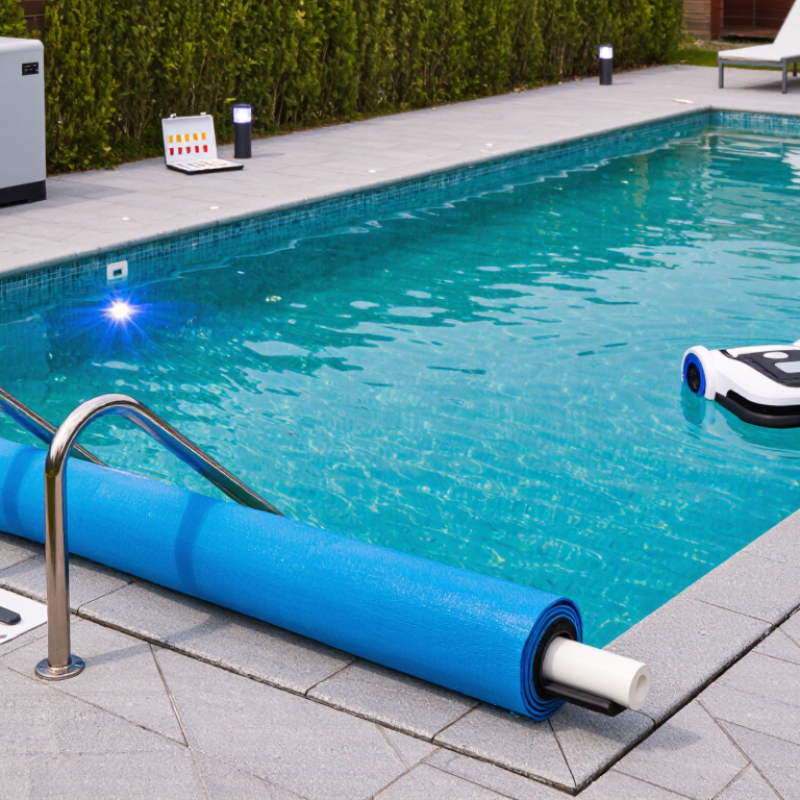
What Are the Best Pool Accessories from China?

Core Product Map: Pumps, Filters, Covers, Lights, and Safety Accessories

What Are the Best Pool Accessories from China?

China’s strongest pool accessory range covers pumps, filters, covers, lights, and safety equipment.

For pumps, variable-speed models deserve attention. The EPA ENERGY STAR program reports that certified pool pumps can use up to 65% less energy than standard models. Ask suppliers for flow curves, motor efficiency data, noise readings, and saltwater compatibility. Do not judge by motor size alone. A powerful pump may waste energy when the filter is undersized.

Filters need a practical match. Cartridge filters simplify cleaning, while sand filters suit larger pools and frequent use. Request pressure ratings, replacement-media costs, and test results for water clarity.

Covers should resist ultraviolet exposure, tearing, and standing water. Automatic covers improve convenience, but installation quality remains critical.

Pool lights need sealed housings, low-voltage systems, and stable underwater connections. One missed gasket can create a serious failure.

Safety accessories require more than appearance. The WHO’s 2024 drowning fact sheet reports over 230,000 drowning deaths annually worldwide, reinforcing the need for layered protection.

Consider compliant barriers, self-closing gates, alarms, rescue poles, and clearly marked depth signs. Suppliers should provide material certificates, batch records, and independent test reports. Ask for pre-shipment inspection photos.

Small details matter.

A cheaper cover may crack early, and a bright light may still have poor sealing. Product selection should include installation conditions, maintenance access, and local electrical requirements.oreferrer


Filter Performance Benchmarks: 20–40 μm Sand, 10–15 μm Cartridge, 2–5 μm D.E.

Pool accessories from China deserve closer technical scrutiny, especially filtration equipment. Industry comparisons cited in PHTA technical guidance commonly place sand filters around 20–40 μm, cartridge filters near 10–15 μm, and D.E. filters around 2–5 μm. These figures describe typical particle-capture ranges, not guaranteed results. Filter media, water speed, pressure, and maintenance can change performance.

A 30 μm sand bed may leave fine dust visible on a sunny pool floor. A cartridge can catch smaller particles, but its pressure gauge may rise quickly after heavy use. D.E. filtration usually produces the clearest water, although it requires careful powder loading and disposal. NSF/ANSI 50 testing frameworks also remind buyers to examine flow rate, structural strength, and sanitation compatibility, rather than focusing only on micron claims. Small print matters.

When evaluating Chinese-made accessories, request independent laboratory reports and batch-level quality records. Check whether the rating is nominal or absolute. Confirm replacement dimensions, maximum flow, operating pressure, and gasket material. In practical testing, measure pressure before and after filtration, then inspect water clarity under controlled lighting. A lower micron number is not automatically better. I have seen restrictive filters polish water beautifully while increasing pump load. That trade-off needs honest review.

What Are the Best Pool Accessories from China? - Filter Performance Benchmarks: 20–40 μm Sand, 10–15 μm Cartridge, 2–5 μm D.E.

Filter Type Typical Particle-Removal Range Typical Pressure Rise Before Cleaning Cleaning Method Typical Cleaning Frequency Water Clarity Main Advantages Main Limitations Best-Fit Pool Use
Sand Filter Approximately 20–40 μm under typical operating conditions About 0.7 bar / 10 psi above the clean starting pressure Backwash, followed by a short rinse cycle Commonly every 2–6 weeks, depending on debris load and water conditions Good; usually the least fine of the three options Simple operation, durable media, easy backwashing, and no disposable cartridge required Lower fine-particle capture; uses water during backwashing and requires a larger installation footprint Large residential pools, public pools, and installations where low-maintenance cleaning is important
Cartridge Filter Approximately 10–15 μm with a clean, properly sized cartridge About 0.35–0.50 bar / 5–7 psi above the clean starting pressure Remove the cartridge and rinse pleats with a hose; periodic deep cleaning may be required Usually every 1–3 months, depending on pool use and contamination Very good; captures finer particles than standard sand filtration Lower water consumption, compact design, and no backwash line required Manual cleaning is required; cartridges eventually need replacement Residential pools with water-use restrictions or limited equipment-room space
D.E. Filter Approximately 2–5 μm when correctly charged with filter-grade diatomaceous earth About 0.7 bar / 10 psi above the clean starting pressure Backwash or internal cleaning, followed by replacement of the D.E. powder Often every 1–3 months, or whenever the pressure-rise limit is reached Excellent; generally the finest filtration among common pool filter types Strong fine-particle removal and high potential for visibly clear water Higher maintenance complexity, powder handling, and disposal requirements Pools prioritizing maximum clarity, including high-use residential or commercial settings
Benchmark note: Micron ratings are typical operating ranges rather than absolute guarantees. Actual performance depends on filter design, media condition, pump flow rate, water chemistry, loading level, and maintenance practices. Always follow the equipment manufacturer’s pressure limits and cleaning instructions.

Sizing Chinese Pool Pumps by Flow, Head, and NSF/ANSI 50 Compliance

What Are the Best Pool Accessories from China?

Choosing a Chinese pool pump starts with flow, head, and verified compliance. Flow describes the water volume moved per minute. Head measures resistance from pipes, filters, fittings, and elevation. A pump’s advertised maximum flow can mislead. It usually occurs at nearly zero resistance.

For example, a 20,000-gallon pool needing an eight-hour turnover requires about 42 gallons per minute. The final pump must deliver that flow at the system’s total dynamic head. Measure pipe length, elbows, filter resistance, and return height carefully. A pump curve should show the operating point clearly. My first estimates were once too optimistic because I ignored a restrictive filter. That mistake increased energy use.

NSF/ANSI 50 documentation adds another layer of confidence. Check whether the exact pump model, not only the factory, is covered by a current certification or accepted evaluation. Request test records, material details, electrical data, and traceability documents. Confirm suitability for the destination’s voltage and installation rules. Look for corrosion-resistant components and stable performance during continuous operation. Small details matter. Noise and service access matter too. A slightly smaller pump, correctly matched to the head, may perform better than an oversized unit. Some supplier specifications remain incomplete, so independent verification is still necessary.

Safety Selection: ANSI/APSP-16 Drain Covers and EN 13451 Accessory Tests

What Are the Best Pool Accessories from China?

Pool accessories from China can offer strong value, but safety must lead selection. Drain covers deserve special attention. The World Health Organization’s 2024 drowning fact sheet estimates 236,000 annual drowning deaths worldwide. That figure makes small design details important. A cover should match the drain body, flow rate, fastener pattern, and service life. ANSI/APSP-16 evaluates suction fittings, including hydraulic performance and hair, body, and limb entrapment risks. Ask suppliers for the exact standard edition, test scope, and installation limits. A generic “tested” label is not enough.

For ladders, handrails, grilles, and other accessories, EN 13451 testing provides a useful European reference. Requirements address dimensions, stability, load resistance, corrosion, and user safety, depending on the product section. Request complete laboratory reports, not cropped certificates. Confirm the model number matches the production sample. An ISO/IEC 17025-accredited laboratory adds credibility, although accreditation cannot fix poor installation. Inspect screw seats, rounded edges, welds, and exposed metal. I have seen attractive samples fail through mismatched holes or weak fasteners. That is an uncomfortable lesson.

Tips: Keep the test sample and installation drawing together. Measure suction flow on site. Replace cracked covers immediately. Recheck fasteners after commissioning and heavy use. Do not assume a higher load rating solves entrapment. Local rules may demand additional checks, so obtain written approval from a qualified safety professional.

Supplier Verification: ISO 9001, IP Ratings, MOQ, and Professional Test Reports

Choosing the best pool accessories from China starts with supplier verification, not attractive photos or low prices. I have found that an ISO 9001 certificate is useful, but it does not prove every product is reliable. Check the certificate number, issuing body, factory address, and validity date. Ask whether the certified factory actually makes your pool lights, pumps, ladders, or cleaning tools.

IP ratings deserve careful attention. An IP68 claim may describe water resistance under specific laboratory conditions, not permanent pool use. Request the complete test standard, sample details, test depth, duration, and laboratory name. Professional test reports should include model numbers matching your quotation. Generic reports create doubt. Ask for recent production samples, then inspect seals, cable joints, packaging, and corrosion protection before placing a large order.

MOQ can affect both cost and quality control. A low MOQ may help a small buyer test demand, while a higher MOQ can support custom colors or packaging. Confirm whether the MOQ applies to each model, color, or shipment. I also recommend a pre-shipment inspection with photographs and measurable results. Review voltage, dimensions, materials, noise, and leakage protection. Do not rely only on factory promises.

There is no perfect checklist. Suppliers may provide valid documents but still deliver inconsistent batches. Keep communication records, approve a golden sample, and use clear acceptance criteria. Small details matter. A careful verification process reduces surprises, although it cannot remove every purchasing risk.

What Are the Best Pool Accessories from China?

Supplier verification checklist: ISO 9001, IP ratings, MOQ, and professional test reports

ISO 9001

Check the certificate scope, certification body, validity period, and manufacturing site.

IP Ratings

Under IEC 60529, the second IP digit indicates water protection: 4 splash-resistant, 5 water jets, 6 powerful water jets, and 7 temporary immersion.

MOQ

MOQ is supplier-specific. Confirm the quantity by product model, color, packaging, and customization level.

Test Reports

Verify the applicable standard, tested product model, test date, laboratory details, and report authenticity.

Powder Coat Booths

For those larger-sized parts, or smaller quantity runs, we have 2 independent powder coat booths and ovens. The quality, durability and affordability of today’s powder coating finishes make this the process of choice for world-class companies.

Powder coating advantages over other forms of coating are many. Materials used in the Powder coating process can be metals and non-metals that come in a multitude of thicknesses, textures, colors, etc. Another of Powder coating’s biggest advantages over conventional coatings is its ability to create finishes in many different textures. Powder Coating Booths allow us the ability to apply these advantages to large products.

Wet Paint Line

Tri-State Fabricators runs a full-service conveyor line for painting. Wet painting can provide protection or decoration to many different part styles. From start to finish, every project is easier to undergo random and point-based inspection by our skilled painting team.

Advantages to our Wet Paint Line are these lines start with product prep and ends with a thorough inspection of a high quality finished product. Our ability to complete large and small projects with a superior finish and doing so in a timely and economical fashion. This passes along the savings in production to our customers. When powder coating ins not an option, our Wet Paint Line gets the job done right the first time.

Wet Paint Booths

When the parts get big and heavy we roll-out our custom paint racks and oversize booth. By utilizing our partnerships with all the major paint brands, we can match virtually any color with wet paint.

The advantages of having access to a Wet Paint Booth are many. Large projects of many different shapes can be loaded into the booth. The Wet Paint Booth offers an environment that is much more controlled than a typical parts painting operation.

Not only are they used because of their controlled environment, but they’re are also advantageous when it comes to applying paint to parts that are needed in industries that require specialty coatings such as medical, aerospace, etc.

Military CARC

Our military forces have some very high standards when it comes to the finish of their vehicles and equipment. From the first pre-treatment step to final coat, it takes a great deal of knowledge and experience to protect the men and women of our armed forces. They deserve only the best, and Tri-State Fabricators provides it.

All of our processes are closely monitored by our staff and management teams. Both of which are highly trained in the processes of metal fabrication and finishing. Tri-State Fabricators’ goal is to always fully satisfy each and every customer, including the military. We will always put a 110% into what we do.

Glass-Bead Blasting

Abrasive media blasting is an excellent way to remove old paint, rust, and increase the paint/powder adhesion. Glass beads produce a much smoother and brighter finish than angular abrasives; leaving the part clean yet without any dimensional change. Chemically inert and environmentally friendly, we can recycle our beads approximately 30 times; making them a more preferred method of metal cleaning or surface finishing.

Advantages to Glass Bead Blasting are many. Glass bead blast media is used when a project is needing rough surfaces need to become smooth for applications of coatings such as paint. It is typically used to clean paint and rust from a product surface without deforming the surface it is being used on. Overall, compared to many other blasting media, Glass Bead Blasting is a very economical choice and those savings are always passed on to our customers.

Part Washing

Tri-State Fabricators utilize a zinc phosphate wash to clean and etch the material to ensure the best paint adhesion possible. The unique design of our 3-stage wash system does the work like a 5-stage. From Cleaning and rinsing to conversion coating and post-treatment, Our Part Washing process is a complete service and works throughout the fabrication service and the finishing service.

Along with the previously mentioned benefits, Curing is a vital chemical reaction that leaves the product finish hard and relatively safe from mild abrasion and aggressive corrosion. This process can be done in more than one way; ambient air-dry or in curing ovens at temps that exceed 240°.

Burn-Off Oven

From fixing paint mistakes (someone else’s of course) to simply cleaning our paint line hooks, our burn-off oven is put to good use. After a quick burn-off, a little clean up, and a fresh coat of paint, your parts will look better than new.

Why does our Burn-Off Oven work so well? Because super heating the air around parts turns the materials into ashes. From paint and powder coatings to rubber and machining oils, high temps do the job without degrading the integrity of the part.

Masking

Masking is a vital part of producing high quality products. We have die-cut masking patterns to protect machined surfaces as well as a wide range of plugs and caps to protect threaded holes and bolts. We provide permanent and temporary masking.

Masking allows the selected sections of a product to be protected from a fabrication or finishing service. This can be with both chemicals when etching and tapes, paints when only finishing just a section of the product. Masking is great in aiding the customization process of a project.

Screen Printing

Screen printing is a photographic process that transfers artwork onto a porous nylon screen which allows colored ink to flow through the screen and be deposited on an aluminum or plastic component. We can generally have just about any design created onto a screen for your parts.

Some of the advantages of Screen Printing are, brand recognition for your business displaying on your products, assembly instructions, product warnings/hazards, etc. Tri-State Fabricators produces Screen Printing of the highest quality so you know it’s durable.

Metal Finishing

Metal Finishing is the art of treating the exterior portion of product, often metal but can also be made of other materials, so that the surface is clean and free of any debris. Then the process of applying coats or either paint of powder coat takes place. This coating process improves the quality of the product in both appearance and resistance to wear and corrosion.

Tri-State Fabricators, Inc., understands that a project typically isn’t complete until a high-quality finish has been added to your product. This is why our painting and powder coating teams continuously inspect the products throughout the Metal Finishing process.
