


Choosing a Pharmaceutical Checkweigher in 2026 is about more than catching underweight or overweight packs. The right machine must fit the product, packaging format, line speed, and inspection workflow. A small tablet bottle and a sealed blister pack create different handling challenges. Even minor vibration or inconsistent spacing can affect results.
Quality expert W. Edwards Deming wrote, “Quality comes not from inspection, but from improvement of the production process.” That principle matters here: a checkweigher can flag weight deviations, but it cannot fix an unstable filling process. Buyers should examine weighing range, repeatability, reject mechanisms, data handling, and integration with existing equipment. Ask for performance evidence using products and speeds close to your real production conditions. A polished demo is not enough.
This guide reviews seven pharmaceutical checkweigher machines available in 2026, comparing practical strengths rather than treating one model as right for every line. Some systems suit compact spaces; others prioritize higher throughput or broader data connectivity. No shortlist is perfect. Specifications change, and published accuracy figures may depend on test conditions. The best choice is the one your team can validate, clean, operate, and maintain consistently. We also consider service support and the clarity of technical documentation, because those details matter after installation. A fast machine is useful. A reliable process matters more.
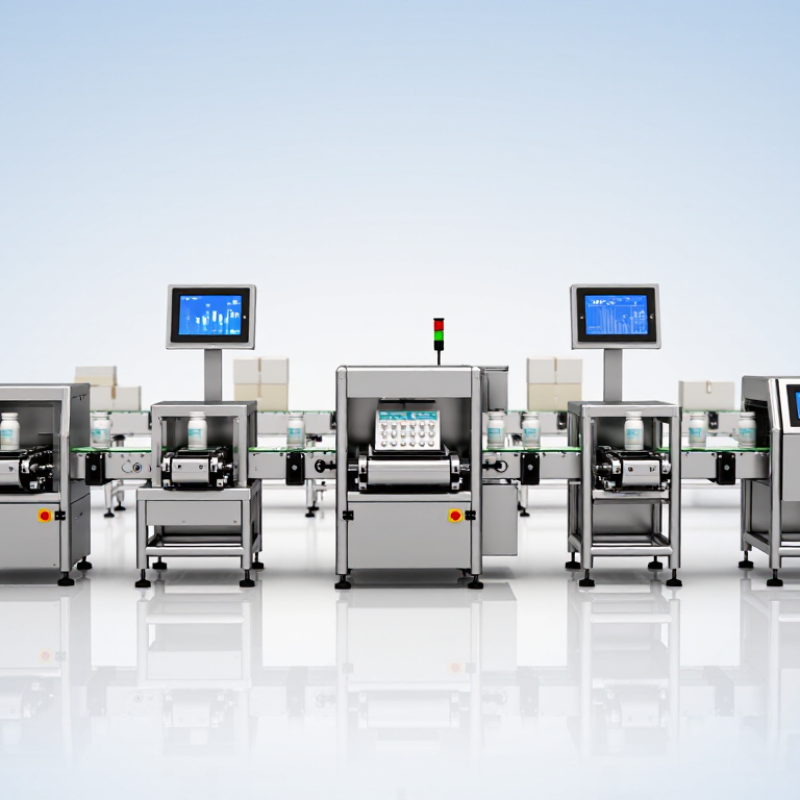
A pharmaceutical checkweigher weighs each package while it moves along a production line. A photoeye detects the passing bottle or carton, and a load cell records its weight. Software compares that reading with preset limits. Packages outside the range can trigger an automatic reject, such as a timed air jet or pusher. The goal is fast, consistent weight control—not a laboratory assay.
Weight checks help identify missing tablets, incomplete fills, or packaging variations. But total weight cannot confirm the amount of active ingredient in each dose. USP General Chapter <905> sets an acceptance value of 15.0 or less for the first 10 dosage units in its uniformity test, under specified conditions. That test is distinct from online checkweighing. FDA regulation 21 CFR 211.110 also identifies weight variation as an in-process control when appropriate. The distinction matters.
Tips: Match the checkweigher’s settings to the package size and line speed. Keep packages spaced apart, and check performance with certified test weights. Watch for vibration. A drifting belt or loose guide rail can distort readings; even a well-set machine needs routine verification.

Choosing a pharmaceutical checkweigher starts with the product, not the machine’s headline speed. Define the acceptable weight range, package dimensions, and line rate using real production data. Then test representative packs, including the lightest and heaviest formats. A small bottle may behave differently from a flexible sachet. Watch for vibration, product spacing, and unstable fills. These details can affect readings.
Accuracy matters. So does repeatability. Ask how the system handles tare variation, drifting readings, and rejected packs. Confirm that its sensors and weighing range suit your products. Review calibration procedures, electronic records, and how operators can trace an event. A clear audit trail is useful only if staff can retrieve the right record quickly. Test the reject mechanism at normal line speed, and verify that rejected packs cannot quietly return to good product flow. It sounds obvious. It is sometimes missed.
Also assess cleaning access, changeover time, and integration with upstream and downstream equipment. A machine that performs well in a showroom may struggle beside a vibrating conveyor or during frequent format changes. Request a trial with your own packaging and document the results. Compare measured performance with the supplier’s stated limits. Leave room for operator feedback, too. The first trial may reveal awkward controls or hard-to-clean corners. That is not a reason to dismiss a system, but it deserves a closer look.
In 2026, seven leading pharmaceutical checkweigher machines are better viewed as equipment types than a fixed ranking. A high-speed conveyor model suits fast-moving cartons and bottles. A precision model handles small tablets or low-fill-volume packages. Multi-lane systems weigh several streams at once, but need careful lane balancing. Compact bench-top units fit sampling rooms and short production runs.
Line-integrated checkweighers connect weighing with filling or packaging controls. Combination systems add another inspection step, such as metal detection, where the product and process allow it. Washdown-ready machines suit areas that require frequent cleaning. Their seals and surfaces matter; “washdown-ready” alone does not prove a unit fits a site’s cleaning procedure. Small details count.
A practical evaluation should include real packs, target speeds, and the lightest and heaviest expected weights. Ask how the machine handles vibration, belt changes, rejected packs, and calibration checks. Verify that records can support the site’s quality procedures. A factory demonstration can look smooth, yet behave differently on a crowded line. That is worth remembering. The best fit depends on pack size, line layout, cleaning needs, and the team’s ability to maintain stable weighing conditions.
| Checkweigher Type | Typical Package Format | Where Weight Is Checked | Common Line Integration | Typical Rejection Method | Best-Fit Application |
|---|---|---|---|---|---|
| Blister Carton Checkweigher | Cartons containing blister packs, leaflets, or other enclosed components | After cartoning and before final case packing | Cartoner, product-tracking system, reject confirmation sensor | Timed pusher or air blast, selected to suit carton size and line layout | Detecting missing or extra components when their weight difference is measurable |
| Pharmaceutical Bottle Checkweigher | Plastic or glass bottles containing tablets, capsules, or liquids | After filling and closure, typically on a conveyor | Filler, capper, labeler, and downstream reject station | Pusher, diverter, or drop-down belt | Checking filled bottle weight and identifying underfilled or overfilled units |
| Sachet and Pouch Checkweigher | Flexible sachets and small sealed pouches | After filling and sealing | Form-fill-seal or pouch line, with guides suited to flexible packs | Air jet or mechanical reject, depending on pack weight and handling needs | Inline weight checks for powders, granules, and other products packed in flexible formats |
| Vial Checkweigher | Small glass vials, including liquid-filled and lyophilized-product containers | After filling and stoppering, or at another validated point in the line | Vial filler, conveyor or starwheel handling, and reject confirmation | Gentle pusher or lane diverter designed to limit glass-to-glass contact | Checking individual vial weights where containers require controlled handling |
| Ampoule Checkweigher | Sealed glass ampoules | After filling and sealing | Ampoule filling line with stable spacing and dedicated product guides | Carefully timed reject mechanism suited to fragile glass containers | Weight verification of liquid-filled ampoules on lines designed for fragile products |
| Pre-Filled Syringe Checkweigher | Pre-filled syringes, usually carried in nests, trays, or controlled conveyor fixtures | At a validated point after filling and before secondary packaging | Syringe filling equipment, nest handling, and product-tracking controls | Controlled removal of the affected unit or carrier, according to the line design | Weight checks for pre-filled syringe production where product orientation and handling are controlled |
| Multi-Lane Checkweigher | Parallel rows of small cartons, bottles, sachets, or other repeatable packs | After filling or packaging, with each lane measured separately | Multi-lane packaging equipment, lane tracking, and individual reject confirmation | Lane-specific pusher, air jet, or diverter | Checking multiple parallel product streams while retaining lane-level reject identification |
Selection note: Suitability depends on the product, package dimensions, line speed, handling requirements, target weight tolerance, and validation needs. A checkweigher supports weight control but does not by itself verify product identity, fill composition, or package integrity.
Across seven pharmaceutical checkweighers, compare accuracy using the same pack, target weight, and belt speed. Otherwise, the results are not directly comparable. OIML R 51-1:2006 classifies automatic catchweighing instruments, including X(x) and Y(a) categories, with permissible errors tied to instrument class and verification scale interval. That gives buyers a metrological reference, not a guarantee that every pack will meet a chosen tolerance at maximum speed.
Throughput needs equal scrutiny. A machine rated for more packs per minute may show greater weight variation when small cartons arrive close together or wobble on the belt. Ask suppliers for test results at the intended line speed, including reject accuracy and the share of packs within tolerance. Short test runs can mislead. A longer run may reveal drift, vibration, or inconsistent product spacing.
For a fair comparison, record mean weight, standard deviation, false-reject rate, and verified packs per minute under production-like conditions. The U.S. FDA’s 21 CFR Part 211.68 requires appropriate checks and calibration of automatic equipment, reinforcing the need for documented performance. One caution: a single accuracy figure looks reassuring, but hides how the machine behaves during changeovers and routine cleaning. That detail matters.
Matching a checkweigher to pharmaceutical production starts with the product, not the machine’s maximum speed. A small glass vial, a flexible pouch, and a coated tablet bottle need different belt support and handling. Record the actual container dimensions, target weight, line speed, and expected changeover frequency before comparing models. Speed matters. A fast unit that destabilizes lightweight packs can create false rejects and costly interruptions.
The World Health Organization’s Global Vaccine Market Report 2022 estimates that 16 billion vaccine doses were supplied in 2021, compared with 5.8 billion in 2019. That sharp increase highlights the pressure on high-volume packaging lines. For a checkweigher, ask suppliers to demonstrate accuracy at your real operating speed, using filled containers from your line. Review reject confirmation, fault alarms, and how rejected packs are physically separated. Test the setup during format changes, too; this step is easy to underestimate.
Data handling deserves equal attention. FDA’s 2023 Drug Shortages Annual Report identifies manufacturing and quality problems among reported shortage causes, reinforcing the value of dependable process controls. Specify accessible weight records, user permissions, and integration with existing line systems. Confirm calibration and challenge-test procedures with your quality team. One reflection: a detailed specification sheet can still miss the awkward reality of a vibrating conveyor or dusty floor. A site trial often reveals more than another sales presentation.


For those larger-sized parts, or smaller quantity runs, we have 2 independent powder coat booths and ovens. The quality, durability and affordability of today’s powder coating finishes make this the process of choice for world-class companies.
Powder coating advantages over other forms of coating are many. Materials used in the Powder coating process can be metals and non-metals that come in a multitude of thicknesses, textures, colors, etc. Another of Powder coating’s biggest advantages over conventional coatings is its ability to create finishes in many different textures. Powder Coating Booths allow us the ability to apply these advantages to large products.
Tri-State Fabricators runs a full-service conveyor line for painting. Wet painting can provide protection or decoration to many different part styles. From start to finish, every project is easier to undergo random and point-based inspection by our skilled painting team.
Advantages to our Wet Paint Line are these lines start with product prep and ends with a thorough inspection of a high quality finished product. Our ability to complete large and small projects with a superior finish and doing so in a timely and economical fashion. This passes along the savings in production to our customers. When powder coating ins not an option, our Wet Paint Line gets the job done right the first time.
When the parts get big and heavy we roll-out our custom paint racks and oversize booth. By utilizing our partnerships with all the major paint brands, we can match virtually any color with wet paint.
The advantages of having access to a Wet Paint Booth are many. Large projects of many different shapes can be loaded into the booth. The Wet Paint Booth offers an environment that is much more controlled than a typical parts painting operation.
Not only are they used because of their controlled environment, but they’re are also advantageous when it comes to applying paint to parts that are needed in industries that require specialty coatings such as medical, aerospace, etc.
Our military forces have some very high standards when it comes to the finish of their vehicles and equipment. From the first pre-treatment step to final coat, it takes a great deal of knowledge and experience to protect the men and women of our armed forces. They deserve only the best, and Tri-State Fabricators provides it.
All of our processes are closely monitored by our staff and management teams. Both of which are highly trained in the processes of metal fabrication and finishing. Tri-State Fabricators’ goal is to always fully satisfy each and every customer, including the military. We will always put a 110% into what we do.
Abrasive media blasting is an excellent way to remove old paint, rust, and increase the paint/powder adhesion. Glass beads produce a much smoother and brighter finish than angular abrasives; leaving the part clean yet without any dimensional change. Chemically inert and environmentally friendly, we can recycle our beads approximately 30 times; making them a more preferred method of metal cleaning or surface finishing.
Advantages to Glass Bead Blasting are many. Glass bead blast media is used when a project is needing rough surfaces need to become smooth for applications of coatings such as paint. It is typically used to clean paint and rust from a product surface without deforming the surface it is being used on. Overall, compared to many other blasting media, Glass Bead Blasting is a very economical choice and those savings are always passed on to our customers.
Tri-State Fabricators utilize a zinc phosphate wash to clean and etch the material to ensure the best paint adhesion possible. The unique design of our 3-stage wash system does the work like a 5-stage. From Cleaning and rinsing to conversion coating and post-treatment, Our Part Washing process is a complete service and works throughout the fabrication service and the finishing service.
Along with the previously mentioned benefits, Curing is a vital chemical reaction that leaves the product finish hard and relatively safe from mild abrasion and aggressive corrosion. This process can be done in more than one way; ambient air-dry or in curing ovens at temps that exceed 240°.
From fixing paint mistakes (someone else’s of course) to simply cleaning our paint line hooks, our burn-off oven is put to good use. After a quick burn-off, a little clean up, and a fresh coat of paint, your parts will look better than new.
Why does our Burn-Off Oven work so well? Because super heating the air around parts turns the materials into ashes. From paint and powder coatings to rubber and machining oils, high temps do the job without degrading the integrity of the part.
Masking is a vital part of producing high quality products. We have die-cut masking patterns to protect machined surfaces as well as a wide range of plugs and caps to protect threaded holes and bolts. We provide permanent and temporary masking.
Masking allows the selected sections of a product to be protected from a fabrication or finishing service. This can be with both chemicals when etching and tapes, paints when only finishing just a section of the product. Masking is great in aiding the customization process of a project.
Screen printing is a photographic process that transfers artwork onto a porous nylon screen which allows colored ink to flow through the screen and be deposited on an aluminum or plastic component. We can generally have just about any design created onto a screen for your parts.
Some of the advantages of Screen Printing are, brand recognition for your business displaying on your products, assembly instructions, product warnings/hazards, etc. Tri-State Fabricators produces Screen Printing of the highest quality so you know it’s durable.
Metal Finishing is the art of treating the exterior portion of product, often metal but can also be made of other materials, so that the surface is clean and free of any debris. Then the process of applying coats or either paint of powder coat takes place. This coating process improves the quality of the product in both appearance and resistance to wear and corrosion.
Tri-State Fabricators, Inc., understands that a project typically isn’t complete until a high-quality finish has been added to your product. This is why our painting and powder coating teams continuously inspect the products throughout the Metal Finishing process.

