


Choosing among China’s multi-adapter wiper blade manufacturers takes more than comparing prices or product photos. Buyers need to assess fitment coverage, connector design, materials, production consistency, and communication. A Multi Adapterwiper blade may suit several arm types, but “universal” does not always mean a perfect fit. Small differences in adapters can affect installation, blade pressure, and wiping quality.
A useful supplier review starts with practical evidence. Ask for current vehicle-application data, adapter samples, material specifications, and documented quality checks. Check whether the manufacturer can explain how its blades perform through repeated wipe cycles, temperature changes, and exposure to rain. Clear packaging labels and traceable model numbers also make ordering and after-sales support easier. Details matter.
China has many manufacturers with different strengths, from broad product ranges to flexible OEM services. Yet a polished catalog alone proves little. Request samples, compare connector security, and confirm production capacity before making large commitments. If possible, inspect the factory or arrange an independent quality review. These steps do not remove every risk, but they help buyers make informed decisions. The best partner depends on target vehicles, market needs, order volume, and service expectations—not a single ranking. Some claims may sound convincing; verify them.
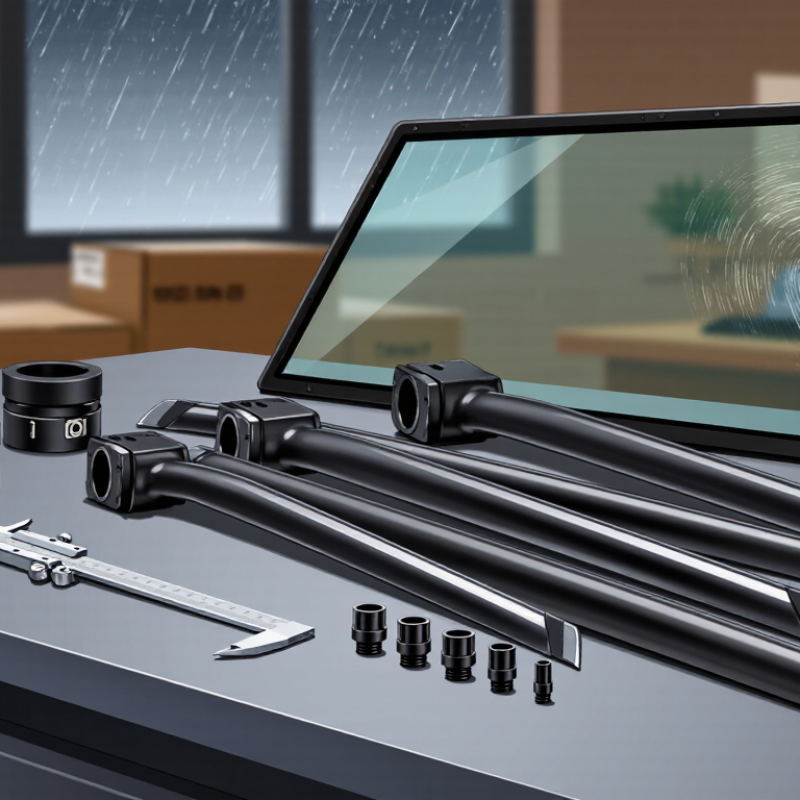
What Is a Multi-Adapter Wiper Blade?
A multi-adapter wiper blade comes with connector pieces designed to fit different wiper-arm styles. Common interfaces include hook, pin, and bayonet fittings. The correct adapter locks the blade onto the arm and keeps it aligned as the arm moves across the glass. It does not mean every blade fits every vehicle. Fit matters.
OICA’s 2023 production statistics report about 93.5 million motor vehicles built worldwide. That scale helps explain the variety of wiper-arm designs, though production totals do not measure adapter compatibility. In the United States, NHTSA’s FMVSS No. 104 evaluates wiper-system operation and windshield coverage. A multi-adapter connector alone cannot guarantee effective wiping; blade length, arm pressure, and installation also matter.
During fitting, check that the adapter clicks firmly into place and sits straight on the arm. Gently tug the blade before switching on the wipers. A loose connector can chatter, lift, or leave unwiped streaks near the driver’s sightline. Small part. Big consequence. Adapter charts can still be confusing, and vehicle trims sometimes differ. Confirm the arm shape on the actual vehicle rather than relying only on a model-year listing.

Multi-adapter wiper blades are supplied with several connector pieces to suit different wiper-arm designs. Common connections include hook, side-pin, and push-button styles. The right fit depends on your vehicle’s arm, not just the blade’s length. Two blades of equal length can use different connectors. Check the owner’s manual or inspect the existing connector before choosing a replacement.
During installation, match the adapter to the arm shape and secure it until it clicks or locks firmly. A loose connection may shift or detach as the blade moves. Gently tug the blade before testing it, then run the wipers with washer fluid. Watch for uneven contact, missed patches, or unusual noise. Even a correct connector cannot fix a bent arm or a poorly sized blade. Fit can be fiddly, and adapter diagrams are not always clear.
Tips: Compare the new adapter with the old connector before removing anything. Keep unused adapters for reference, but never force a piece into place. If the blade rocks or feels loose, stop and check compatibility again.
For multi adapter wiper blades, a manufacturer’s quality system matters as much as its adapter range. Ask whether production follows a documented system, such as ISO 9001, and whether automotive supply requirements are relevant to your project. Certificates are useful, but they do not prove that every blade fits or performs well.
Check how the factory verifies fitment across different arm types. A practical review should cover adapter locking force, blade pressure distribution, wiping coverage, and resistance to vibration. Request test records for hot and cold conditions, water exposure, and repeated wiping cycles. Then compare the records with samples from current production, not just a polished prototype. Small details matter.
Materials need traceability, too. Ask for specifications covering rubber hardness, coating, frame corrosion resistance, and batch inspection. A supplier should be able to explain how failed parts are isolated and corrective actions are checked. Not always. Paperwork can appear complete while a sample still chatters on a curved windshield. That gap deserves attention. Buyers should clarify test methods, acceptance limits, and adapter compatibility before placing an order. A clear answer is more useful than a broad claim of “high quality.”
| Evaluation Dimension | Relevant Standard or Practice | What to Verify | Evidence to Request | Why It Matters |
|---|---|---|---|---|
| Wiper-system regulatory performance | GB 15085-2013, covering motor-vehicle windscreen wiper and washer systems | Confirm whether the product or vehicle program requires testing against the current applicable edition and scope. The standard addresses the system, not just an aftermarket blade in isolation. | Applicable test reports, test conditions, product identification, and confirmation of the standard edition used | Helps establish that the blade is evaluated in the correct vehicle-system context rather than relying only on general product claims. |
| Automotive quality management | IATF 16949:2016; ISO 9001:2015 | Check certificate scope, site address, validity, and whether the certification is relevant to the manufacturing site and product. IATF 16949 is commonly required by automotive supply chains but is not a universal legal requirement for every blade maker. | Current certificates and, where applicable, confirmation through the certification body's verification process | Shows whether documented quality-management processes are in place; certification alone does not prove that a particular blade performs well. |
| Multi-adapter fitment and coverage | Vehicle-specific fitment validation and controlled adapter specifications | Check connector type, arm compatibility, blade length, installation clearance, and coverage for each listed vehicle application. Verify every adapter included in a multi-adapter kit. | Fitment matrix, adapter drawings, installation instructions, and sample checks against the specified arm types | Reduces the risk of incorrect fit, loose connections, installation errors, or blade interference with the vehicle. |
| Wiping performance | Defined internal or customer test method under specified conditions | Review wipe quality, streaking, chattering, missed areas, and contact across the intended windshield curvature. Confirm the test uses the relevant blade, arm, glass, and operating conditions. | Test procedure, sample results, acceptance criteria, and records identifying the tested product revision | Performance depends on the complete blade-and-vehicle setup, so results are meaningful only when test conditions are documented. |
| Durability and environmental validation | Product-specific validation plan; ISO 9227 may be used as a salt-spray test method for corrosion evaluation | Ask which components are tested, how samples are prepared, and what acceptance criteria apply. ISO 9227 specifies test methods; it does not set a universal pass/fail requirement for wiper blades. | Validation plan, corrosion or environmental test reports, sample details, and documented acceptance limits | Supports assessment of exposure-related risks to metal and coated components without treating a test method as a performance guarantee. |
| Material and component consistency | Approved material specifications and incoming inspection controls | Check how rubber, steel or other support components, coatings, and adapters are specified and controlled. Confirm how material or supplier changes are reviewed. | Material specifications, inspection records, supplier-change controls, and batch identification | Consistent incoming materials and change control help limit variation between production batches. |
| Production and inspection controls | Documented process control and risk-based inspection | Review controls for critical dimensions, assembly, adapter retention, visual defects, and final inspection. Ask how nonconforming products are contained and corrected. | Control plans, inspection records, calibration records, and corrective-action examples with sensitive details removed | Demonstrates that quality is managed during production, not solely by checking finished samples. |
| Traceability and change management | Lot or batch identification and documented engineering-change approval | Confirm that finished products can be linked to production lots and that changes to materials, tooling, design, or manufacturing location are controlled. | Sample packaging or batch codes, traceability procedure, and change-notification process | Enables faster investigation and containment if a fitment or quality issue is reported. |
| Supplier assessment | Risk-based audit and sample approval before production orders | Assess manufacturing capability, production capacity, subcontracted processes, quality records, and consistency between approved samples and mass production. | Site-audit findings, approved-sample records, production trial results, and corrective-action follow-up | Helps buyers compare suppliers using verifiable capability and product evidence rather than unsupported “best manufacturer” claims. |
Evaluating a Chinese multi-adapter wiper blade manufacturer starts with fitment evidence, not a broad catalog. Ask for an application matrix listing arm types, adapter codes, blade lengths, and vehicle references. Compare it with your target market’s requirements. Request samples for the relevant arm styles, then check whether each adapter locks securely and releases without excessive force. A loose click is not enough. Small details matter.
Review how the manufacturer controls quality between production runs. Ask for documented checks on connector retention, blade pressure, and wipe performance, plus records that link samples to production batches. If available, observe a sample inspection or request photos of the test setup. Also discuss replacement adapter supply, packaging, lead times, and how fitment complaints are investigated. Clear answers are useful; vague assurances are not. A polished presentation can still leave gaps, so treat missing records as questions rather than proof of poor quality. No checklist catches every mismatch. Confirm key specifications in writing, and compare the delivered samples with the approved drawings before placing a larger order.
Suggested buyer-assessment weighting (%). These are rubric weights, not measured manufacturer or market data.
Prioritize verified arm-type compatibility and secure fit, then assess wiping performance and durability using samples and documented test results. Confirm quality-control records and delivery capabilities before placing an order.
When comparing multi adapter wiper blade manufacturers, start with vehicle coverage. Ask for an application list that includes arm types, connector dimensions, and supported blade lengths. A broad catalog is useful, but accurate fitment matters more than a large number on paper. Request samples for common and less common adapters, then check whether each locks firmly without excessive force.
Look closely at materials and testing. The rubber should wipe evenly across a wet windshield, while the adapter should resist cracking after repeated attachment. Ask how the manufacturer checks pressure distribution, corrosion resistance, and performance in hot and cold conditions. Useful evidence includes written test procedures, inspection records, and clear criteria for rejecting defective parts. Details matter.
Production consistency deserves equal attention. Compare sample quality with parts from a regular production batch, and ask how dimensions are controlled. A small mismatch can cause chatter, streaks, or a loose connection. Ask about minimum order quantities, lead times, packaging, and how quality issues are handled. Clear answers are reassuring; vague promises are not.
Communication can reveal practical strengths. Does the team explain compatibility limits, or simply claim universal fit? No supplier is flawless. Even so, a manufacturer that documents problems and follows up with corrective checks may be more dependable than one offering polished claims without supporting data. Ask for details you can verify.


For those larger-sized parts, or smaller quantity runs, we have 2 independent powder coat booths and ovens. The quality, durability and affordability of today’s powder coating finishes make this the process of choice for world-class companies.
Powder coating advantages over other forms of coating are many. Materials used in the Powder coating process can be metals and non-metals that come in a multitude of thicknesses, textures, colors, etc. Another of Powder coating’s biggest advantages over conventional coatings is its ability to create finishes in many different textures. Powder Coating Booths allow us the ability to apply these advantages to large products.
Tri-State Fabricators runs a full-service conveyor line for painting. Wet painting can provide protection or decoration to many different part styles. From start to finish, every project is easier to undergo random and point-based inspection by our skilled painting team.
Advantages to our Wet Paint Line are these lines start with product prep and ends with a thorough inspection of a high quality finished product. Our ability to complete large and small projects with a superior finish and doing so in a timely and economical fashion. This passes along the savings in production to our customers. When powder coating ins not an option, our Wet Paint Line gets the job done right the first time.
When the parts get big and heavy we roll-out our custom paint racks and oversize booth. By utilizing our partnerships with all the major paint brands, we can match virtually any color with wet paint.
The advantages of having access to a Wet Paint Booth are many. Large projects of many different shapes can be loaded into the booth. The Wet Paint Booth offers an environment that is much more controlled than a typical parts painting operation.
Not only are they used because of their controlled environment, but they’re are also advantageous when it comes to applying paint to parts that are needed in industries that require specialty coatings such as medical, aerospace, etc.
Our military forces have some very high standards when it comes to the finish of their vehicles and equipment. From the first pre-treatment step to final coat, it takes a great deal of knowledge and experience to protect the men and women of our armed forces. They deserve only the best, and Tri-State Fabricators provides it.
All of our processes are closely monitored by our staff and management teams. Both of which are highly trained in the processes of metal fabrication and finishing. Tri-State Fabricators’ goal is to always fully satisfy each and every customer, including the military. We will always put a 110% into what we do.
Abrasive media blasting is an excellent way to remove old paint, rust, and increase the paint/powder adhesion. Glass beads produce a much smoother and brighter finish than angular abrasives; leaving the part clean yet without any dimensional change. Chemically inert and environmentally friendly, we can recycle our beads approximately 30 times; making them a more preferred method of metal cleaning or surface finishing.
Advantages to Glass Bead Blasting are many. Glass bead blast media is used when a project is needing rough surfaces need to become smooth for applications of coatings such as paint. It is typically used to clean paint and rust from a product surface without deforming the surface it is being used on. Overall, compared to many other blasting media, Glass Bead Blasting is a very economical choice and those savings are always passed on to our customers.
Tri-State Fabricators utilize a zinc phosphate wash to clean and etch the material to ensure the best paint adhesion possible. The unique design of our 3-stage wash system does the work like a 5-stage. From Cleaning and rinsing to conversion coating and post-treatment, Our Part Washing process is a complete service and works throughout the fabrication service and the finishing service.
Along with the previously mentioned benefits, Curing is a vital chemical reaction that leaves the product finish hard and relatively safe from mild abrasion and aggressive corrosion. This process can be done in more than one way; ambient air-dry or in curing ovens at temps that exceed 240°.
From fixing paint mistakes (someone else’s of course) to simply cleaning our paint line hooks, our burn-off oven is put to good use. After a quick burn-off, a little clean up, and a fresh coat of paint, your parts will look better than new.
Why does our Burn-Off Oven work so well? Because super heating the air around parts turns the materials into ashes. From paint and powder coatings to rubber and machining oils, high temps do the job without degrading the integrity of the part.
Masking is a vital part of producing high quality products. We have die-cut masking patterns to protect machined surfaces as well as a wide range of plugs and caps to protect threaded holes and bolts. We provide permanent and temporary masking.
Masking allows the selected sections of a product to be protected from a fabrication or finishing service. This can be with both chemicals when etching and tapes, paints when only finishing just a section of the product. Masking is great in aiding the customization process of a project.
Screen printing is a photographic process that transfers artwork onto a porous nylon screen which allows colored ink to flow through the screen and be deposited on an aluminum or plastic component. We can generally have just about any design created onto a screen for your parts.
Some of the advantages of Screen Printing are, brand recognition for your business displaying on your products, assembly instructions, product warnings/hazards, etc. Tri-State Fabricators produces Screen Printing of the highest quality so you know it’s durable.
Metal Finishing is the art of treating the exterior portion of product, often metal but can also be made of other materials, so that the surface is clean and free of any debris. Then the process of applying coats or either paint of powder coat takes place. This coating process improves the quality of the product in both appearance and resistance to wear and corrosion.
Tri-State Fabricators, Inc., understands that a project typically isn’t complete until a high-quality finish has been added to your product. This is why our painting and powder coating teams continuously inspect the products throughout the Metal Finishing process.

