


Choosing the best MONOFILAMENT FISHING NETS in 2026 means looking beyond price and advertised strength. FAO’s The State of World Fisheries and Aquaculture 2024 reported 92.3 million tonnes of global capture fisheries production in 2022. That figure shows the scale of fishing activity, but it does not identify a single best net design. Performance depends on the fishery, target species, mesh size, and working conditions.
Small details matter. A net’s twine diameter, mesh consistency, knot or knotless construction, and resistance to sunlight can affect handling and service life. Visibility matters, too: clearer material may suit some conditions, while darker netting can be easier to manage against certain backgrounds. No universal winner exists. A strong net may feel stiff, and a light one may need more careful handling. Real-world use can be messier than a product chart suggests.
This guide compares net options by durability, visibility, ease of repair, and value, while treating manufacturer claims with caution. It also explains which specifications deserve close attention before purchase. Match the net to its intended use, and check local requirements for mesh and gear. Those checks are practical, not glamorous. But they can prevent an expensive mismatch and help buyers make a more informed choice in 2026.
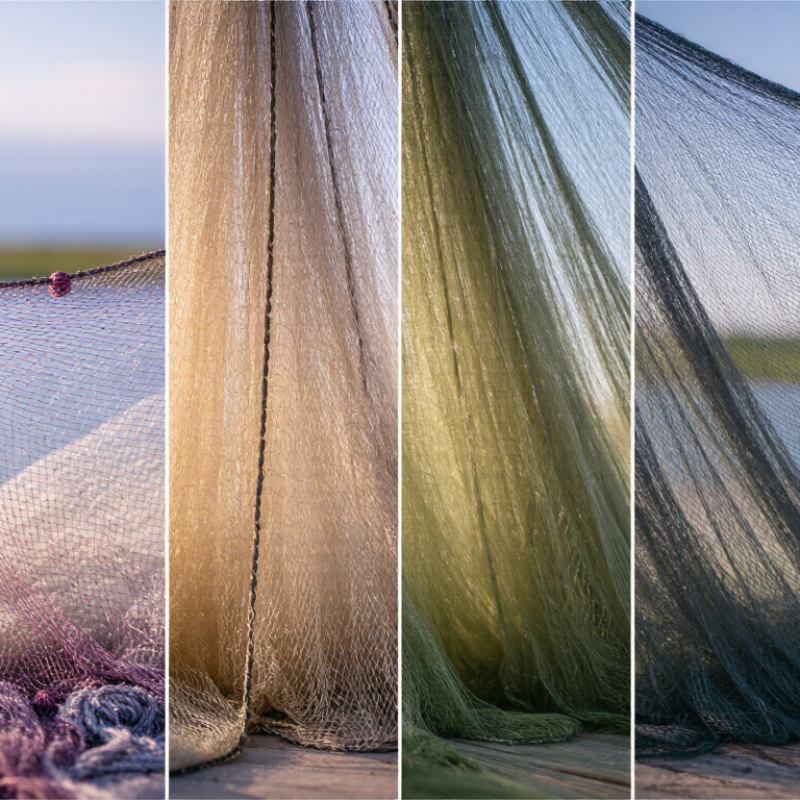
Monofilament fishing nets are built from single, smooth synthetic strands rather than bundles of twisted fibers. Their thin lines can reduce water resistance and may be less visible underwater, though visibility depends on light, water clarity, and algae growth. A net does not simply “catch” fish: mesh openings, hanging angle, and tension influence whether fish become gilled, wedged, or entangled. Small changes matter.
The FAO’s The State of World Fisheries and Aquaculture 2024 reports 92.3 million tonnes of aquatic animals from capture fisheries in 2022. That figure describes the sector, not monofilament-net performance. It does show why gear design and selectivity deserve careful attention. Mesh size should suit the intended species and fishing conditions; a net that is too tight can retain undersized fish, while oversized mesh may reduce catches. No single setup works everywhere.
In practice, inspect the net before use. Look for cloudy, abraded strands, loose knots, and stretched mesh near the lead line. Rinse off salt and debris, then dry it out of direct heat. Smooth filament can be difficult to see and handle when wet. That part is easy to underestimate. Monofilament may resist some forms of wear, but it can still weaken at knots and under repeated strain; replace damaged sections rather than assuming they will hold.
| Net Type | Typical Stretched Mesh Size | Typical Twine Diameter | Common Use | How It Works | Key Trade-Off |
|---|---|---|---|---|---|
| Fine-mesh net | About 1–2 in (25–51 mm) | About 0.15–0.30 mm | Small fish, where permitted | Fish may become caught around the head or gill area when the mesh opening is appropriately sized for the fish. | Can catch small fish and other animals; local rules may restrict mesh size or use. |
| Medium-mesh gillnet | About 2–4 in (51–102 mm) | About 0.20–0.40 mm | Selective fishing for mid-sized fish, subject to regulations | The mesh opening is designed to retain fish within a chosen size range, though fish shape and how the net is set also affect catch. | Mesh size alone does not guarantee selectivity; bycatch and entanglement remain possible. |
| Large-mesh gillnet | About 4–8 in (102–203 mm) | About 0.30–0.60 mm | Larger fish in authorized fisheries | Larger openings are intended to retain larger-bodied fish; fish can be gilled, wedged, or entangled. | Requires careful selection and monitoring; may be unsuitable or unlawful in many waters. |
| Fine-mesh cast net | Often about 3/8–1 in (10–25 mm) | Varies by net size and construction | Baitfish capture where allowed | The circular net spreads during a cast and sinks, then its weighted edge closes around fish as it is retrieved. | Mesh, weight, and net diameter affect sinking and handling; cast-net rules vary by location. |
| Lightweight dip or landing net | Commonly about 1/4–1 in (6–25 mm) | Varies by net size and construction | Landing or handling fish from shore or a boat | The net is moved under or around a fish rather than left set to catch fish passively. | Choose mesh and frame size for the intended fish; fine mesh may hold debris and requires rinsing. |
How monofilament works: Monofilament netting uses single, smooth strands rather than bundles of fibers. Its relatively low visibility underwater can help it catch fish, while mesh opening, twine diameter, net dimensions, and setting method all influence performance. The ranges above are general examples, not product specifications; check local fishing regulations before using any net.

Mesh size deserves close attention. It affects which fish are retained and how easily smaller fish can pass through. FAO technical guidance identifies mesh size, twine diameter, and hanging ratio as key factors shaping gillnet selectivity. Match these details to your target species and fishing conditions, rather than relying on a “one-size-fits-all” net. Twine should feel consistent across the panel, with no rough joins or uneven knots. Small flaws matter.
Visibility and durability are practical trade-offs. Monofilament can be less visible underwater, but that does not make every net equally suitable for every location or light condition. Check the listed material, knot strength, float spacing, and resistance to abrasion; inspect a sample panel if possible. FAO and UNEP’s 2009 assessment estimated that abandoned, lost, or discarded fishing gear made up about 10% of marine litter. That older estimate is not a product test, but it underlines why secure attachment and reliable retrieval matter. I would also consider repairability. It is easy to overlook until a snag opens a tear.
“Best” depends on the fish, water, and way you handle a net. For drifting or set-net fishing, monofilament gill nets are light and relatively unobtrusive underwater. Their clear strands can be hard to see, which may improve catch efficiency but also demands careful deployment and retrieval. Mesh opening matters. A suitable mesh helps target the intended fish size, while a poor match can lead to missed fish or unwanted catches. For casting in open water, a circular monofilament cast net can spread quickly when its weight line lands evenly. Practice helps. Wind, weeds, and uneven shoreline footing can still spoil a throw.
For lifting fish beside a boat or bank, a monofilament landing net offers a quick, compact option. Fine mesh can cling to hooks, scales, and debris, though, so knotless or rubberized mesh may be easier to handle. Check the frame size. Long handles suit higher banks; shorter frames are easier to control in a small boat. Seine-style nets can cover shallow water, but they need room and coordinated handling. That is not always practical. Compare strand thickness, knots, float spacing, and the sinker line before choosing. Rinse and dry nets after use; sun exposure and abrasion can weaken monofilament over time. Field conditions matter more than a tidy comparison chart, and my first choice has sometimes been the wrong one.
For monofilament gill nets, mesh size is a useful starting point when matching a net to the fishery. These indicative stretched-mesh ranges are examples, not universal recommendations or legal limits.
Larger mesh openings generally select for larger-bodied fish, but actual catch depends on fish shape, net construction, and local conditions. Check applicable regulations and fishery guidance before choosing or using a net.
Mesh size should match the body depth of your intended catch, not just its overall length. A fish needs to enter the opening and be held securely. If the mesh is too large, smaller target fish may pass through. If it is too small, unwanted fish and debris can become harder to release. Check how the seller measures mesh; stretched and bar measurements are not always interchangeable. Small details matter.
Net design matters just as much. A deeper net may suit fish moving through a defined depth, while a shallower design can be easier to handle in confined water. Consider the float line, weight line, and hanging ratio together. They shape how the net opens and sits in the water. Monofilament can be less visible than many thicker materials, but visibility changes with light, water clarity, and background. It is not invisible.
Think about your fishing conditions before choosing. A strong current may demand a stable, well-weighted setup, while snags call for a simpler net that is easier to retrieve. There is no universal sweet spot. I would rather accept a little less coverage than choose mesh that holds the wrong fish. Check local gear rules, inspect knots and seams, and adjust after observing what the net actually catches.
When choosing a monofilament fishing net, match the mesh opening and net size to the fish and water you expect to encounter. Smaller mesh can hold smaller fish, but it may also collect more leaves and debris. Check the twine for even thickness, secure knots, and weak spots near the seams. Small details matter. A net can look sturdy on a shelf yet feel awkward once wet, so consider its weight and handling, too.
Look closely at the float line, sinkers, and attachment points. They should be evenly spaced and firmly secured, without frayed cord or loose knots. Ask how the net is intended to be used, and check that its dimensions suit your boat or storage space. It is easy to focus on mesh size alone; that is not always the best buying decision.
After use, rinse the net with clean water, especially after exposure to salt or muddy water. Spread it out to dry fully in a shaded, ventilated area. Sunlight and heat can weaken synthetic fibers over time. Remove weeds gently instead of pulling hard on the mesh, and store the net loosely in a dry place. Inspect it before each trip. Small snags can grow. I would still recheck the seams, even when the net looks fine.


For those larger-sized parts, or smaller quantity runs, we have 2 independent powder coat booths and ovens. The quality, durability and affordability of today’s powder coating finishes make this the process of choice for world-class companies.
Powder coating advantages over other forms of coating are many. Materials used in the Powder coating process can be metals and non-metals that come in a multitude of thicknesses, textures, colors, etc. Another of Powder coating’s biggest advantages over conventional coatings is its ability to create finishes in many different textures. Powder Coating Booths allow us the ability to apply these advantages to large products.
Tri-State Fabricators runs a full-service conveyor line for painting. Wet painting can provide protection or decoration to many different part styles. From start to finish, every project is easier to undergo random and point-based inspection by our skilled painting team.
Advantages to our Wet Paint Line are these lines start with product prep and ends with a thorough inspection of a high quality finished product. Our ability to complete large and small projects with a superior finish and doing so in a timely and economical fashion. This passes along the savings in production to our customers. When powder coating ins not an option, our Wet Paint Line gets the job done right the first time.
When the parts get big and heavy we roll-out our custom paint racks and oversize booth. By utilizing our partnerships with all the major paint brands, we can match virtually any color with wet paint.
The advantages of having access to a Wet Paint Booth are many. Large projects of many different shapes can be loaded into the booth. The Wet Paint Booth offers an environment that is much more controlled than a typical parts painting operation.
Not only are they used because of their controlled environment, but they’re are also advantageous when it comes to applying paint to parts that are needed in industries that require specialty coatings such as medical, aerospace, etc.
Our military forces have some very high standards when it comes to the finish of their vehicles and equipment. From the first pre-treatment step to final coat, it takes a great deal of knowledge and experience to protect the men and women of our armed forces. They deserve only the best, and Tri-State Fabricators provides it.
All of our processes are closely monitored by our staff and management teams. Both of which are highly trained in the processes of metal fabrication and finishing. Tri-State Fabricators’ goal is to always fully satisfy each and every customer, including the military. We will always put a 110% into what we do.
Abrasive media blasting is an excellent way to remove old paint, rust, and increase the paint/powder adhesion. Glass beads produce a much smoother and brighter finish than angular abrasives; leaving the part clean yet without any dimensional change. Chemically inert and environmentally friendly, we can recycle our beads approximately 30 times; making them a more preferred method of metal cleaning or surface finishing.
Advantages to Glass Bead Blasting are many. Glass bead blast media is used when a project is needing rough surfaces need to become smooth for applications of coatings such as paint. It is typically used to clean paint and rust from a product surface without deforming the surface it is being used on. Overall, compared to many other blasting media, Glass Bead Blasting is a very economical choice and those savings are always passed on to our customers.
Tri-State Fabricators utilize a zinc phosphate wash to clean and etch the material to ensure the best paint adhesion possible. The unique design of our 3-stage wash system does the work like a 5-stage. From Cleaning and rinsing to conversion coating and post-treatment, Our Part Washing process is a complete service and works throughout the fabrication service and the finishing service.
Along with the previously mentioned benefits, Curing is a vital chemical reaction that leaves the product finish hard and relatively safe from mild abrasion and aggressive corrosion. This process can be done in more than one way; ambient air-dry or in curing ovens at temps that exceed 240°.
From fixing paint mistakes (someone else’s of course) to simply cleaning our paint line hooks, our burn-off oven is put to good use. After a quick burn-off, a little clean up, and a fresh coat of paint, your parts will look better than new.
Why does our Burn-Off Oven work so well? Because super heating the air around parts turns the materials into ashes. From paint and powder coatings to rubber and machining oils, high temps do the job without degrading the integrity of the part.
Masking is a vital part of producing high quality products. We have die-cut masking patterns to protect machined surfaces as well as a wide range of plugs and caps to protect threaded holes and bolts. We provide permanent and temporary masking.
Masking allows the selected sections of a product to be protected from a fabrication or finishing service. This can be with both chemicals when etching and tapes, paints when only finishing just a section of the product. Masking is great in aiding the customization process of a project.
Screen printing is a photographic process that transfers artwork onto a porous nylon screen which allows colored ink to flow through the screen and be deposited on an aluminum or plastic component. We can generally have just about any design created onto a screen for your parts.
Some of the advantages of Screen Printing are, brand recognition for your business displaying on your products, assembly instructions, product warnings/hazards, etc. Tri-State Fabricators produces Screen Printing of the highest quality so you know it’s durable.
Metal Finishing is the art of treating the exterior portion of product, often metal but can also be made of other materials, so that the surface is clean and free of any debris. Then the process of applying coats or either paint of powder coat takes place. This coating process improves the quality of the product in both appearance and resistance to wear and corrosion.
Tri-State Fabricators, Inc., understands that a project typically isn’t complete until a high-quality finish has been added to your product. This is why our painting and powder coating teams continuously inspect the products throughout the Metal Finishing process.

