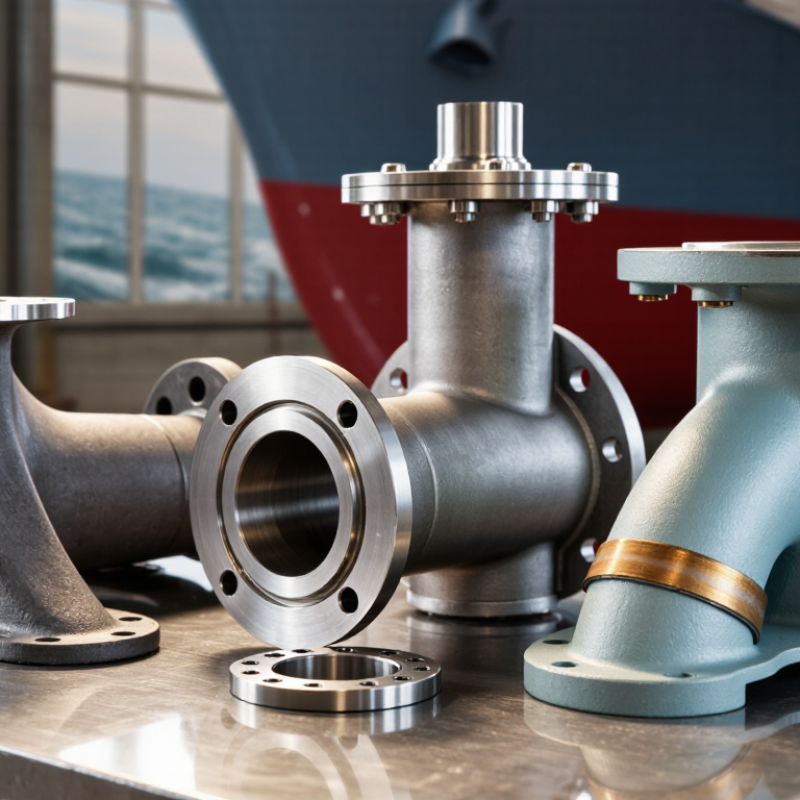
What Are the Best Marine Steel Castings in 2026? The answer depends on the vessel, the component, and the water it must withstand. A rudder stock faces different demands from a pump casing or deck fitting. Salt spray, cyclic loading, impact, and repair access all matter. There is no single grade that wins every job.
Casting authority John Campbell’s published work emphasizes how process control shapes casting quality. A practical paraphrase of that principle is: “Reliable castings begin with a controlled process.” This is not a verbatim quotation. It is a useful lens for comparing Marine Steel Castings in 2026. Buyers should examine alloy selection, casting design, heat treatment, and inspection records—not just a supplier’s headline strength figure. Ask how the foundry manages shrinkage, porosity, and dimensional variation. Look for traceable material certificates and inspection methods suited to the part’s risks. A clean surface helps, but it cannot prove soundness inside. That distinction is easy to overlook.
This guide compares common marine casting options against real operating needs, including corrosion resistance, toughness, machinability, and lifecycle cost. It also considers supplier experience and quality documentation. Some trade-offs remain uncomfortable: a higher-alloy casting may resist corrosion better, yet cost more and require tighter process control. The best choice is not always the most expensive one. Nor is the lowest bid automatically poor. Check the evidence. Then match it to the service conditions, with room for engineering review where assumptions are uncertain.
What Are the Best Marine Steel Castings in 2026?
Marine steel castings are solid metal components formed by pouring molten steel into a shaped mould. They serve in demanding shipboard roles, including rudder structures, propeller hubs, anchor components, and pump housings. Their shapes can be difficult to machine from solid stock. Casting makes complex forms practical.
The process begins with a design, a suitable steel grade, and a mould, often made from bonded sand. Foundry teams melt and refine the steel, then pour it into the prepared cavity. After cooling, workers remove the mould, clean the casting, and inspect it. Heat treatment can improve mechanical properties. UNCTAD’s Review of Maritime Transport 2024 reports that ships carry over 80 percent of world trade by volume, underscoring why dependable marine components matter. The World Steel Association reported 1.88 billion tonnes of global crude steel production in 2024; this is industry context, not a measure of marine casting output.
Looks are not enough. Internal shrinkage, inclusions, or cracks may escape a basic visual check. Reliable production therefore combines chemistry control, dimensional checks, and suitable non-destructive testing, such as ultrasonic or magnetic-particle inspection. Requirements vary with the component, steel grade, and vessel classification rules. A casting can look flawless and still need closer examination; that practical limitation deserves attention. For buyers, traceable heat records and test reports help connect each part to its material and inspection history.
How marine steel castings are made—and a comparison of specified minimum tensile strength for selected cast carbon-steel grades.
How to read this chart: These are specified minimum tensile strengths for ASTM A216/A216M cast carbon-steel grades, not a universal ranking of marine castings. The right grade depends on the component, service conditions, design requirements, and applicable marine rules. Casting production typically involves making a pattern and mold, melting and pouring steel, cooling and shakeout, heat treatment when specified, then inspection and machining.
Source: ASTM A216/A216M grade requirements. Values shown in MPa, rounded from the standard’s ksi values.
Marine steel castings must withstand more than static loads. On a vessel, a stern frame or pump housing may face vibration, impact, seawater, and changing temperatures. Strength matters, but toughness matters too. A casting that carries the load yet cracks under repeated stress is not a reliable choice. Fatigue resistance should match the part’s duty cycle, not just its drawing.
Saltwater is unforgiving. Corrosion performance depends on the steel grade, surface finish, coatings, drainage, and maintenance. No single alloy solves every exposure. A useful specification also sets limits for porosity, inclusions, and dimensional variation. These defects can concentrate stress or complicate machining. Details matter. Inspection should fit the component: visual and dimensional checks, suitable non-destructive testing, and mechanical tests such as tensile or impact testing. Records help connect results to the casting and its heat treatment.
There is no universal winner, which can be inconvenient. Engineers should compare operating loads, seawater exposure, repair access, and fabrication needs before selecting a grade. Weldability may matter for an assembly, while a rotating component may demand tighter control of balance and geometry. Corrosion resistance alone is not enough. A sound choice comes from matching verified material data and inspection evidence to real service conditions, then reviewing performance after operation.
Marine steel grades and their corrosion resistance depend on salt exposure, temperature, and component design. Cast CF8M stainless steel, broadly comparable to wrought 316, suits many marine components. Yet warm seawater and narrow crevices can trigger pitting. Duplex cast grades such as CD3MN generally provide higher strength and better resistance to chloride pitting. No grade is immune. A poorly drained joint can undermine an otherwise sensible material choice.
The cost of getting corrosion control wrong is substantial. NACE International’s IMPACT study estimated global corrosion costs at US$2.5 trillion, or 3.4% of global GDP, using 2013 data. That estimate covers many industries, not marine castings alone, but it highlights why material selection and maintenance matter. For exposed parts, compare alloy chemistry alongside service temperature, flow, and inspection access. Coatings or cathodic protection may help carbon-steel castings, but damage and upkeep deserve attention. I would not choose by grade name alone.
Tips: State seawater temperature and chloride exposure in the specification. Check crevices, drains, and coating condition during inspections.
Marine casting choice depends on load, seawater exposure, and the component’s shape. Carbon and low-alloy steel castings are common in stern frames, rudder horns, and shaft brackets. These parts carry heavy loads near the propeller and hull. Their thick sections need careful control during cooling, since shrinkage defects can weaken critical areas.
Stainless and duplex steel castings are used for seawater pump casings, valve bodies, and impellers. They offer stronger corrosion resistance than ordinary carbon steel, but alloy choice still matters. Chloride levels, temperature, and flow can affect performance. Small details count. A poorly finished crevice may collect salt and start corrosion.
Bronze castings also appear in marine systems, especially for propellers and pump components, though they are not steel. For steel parts, buyers should review material records, dimensional checks, and suitable nondestructive testing. Ask how the casting will be inspected in high-stress zones. No single alloy fits every vessel; service conditions are easy to underestimate, and that deserves a second look.
Marine steel casting selection in 2026 should start with the part’s real operating conditions. Record expected loads, seawater exposure, temperature changes, and access for inspection or repair. A pump casing and a rudder component do not face the same stresses. Ask for the specified steel grade, heat-treatment records, and chemical analysis, and check them against the drawing. A certificate alone cannot reveal every internal defect.
Review the casting process and inspection plan before comparing prices. Look for dimensional reports and suitable non-destructive testing, such as ultrasonic or magnetic-particle inspection where appropriate. Check critical areas closely: thick sections, transitions, and machined faces can hide problems or affect fit. That matters. Confirm that inspection criteria are agreed before production, not after a delivery is already delayed.
Consider the supplier’s ability to control repeatability, document changes, and protect finished surfaces during shipment. Ask how defects are assessed and repaired, and whether repaired areas receive reinspection. Match the acceptance criteria to the component’s risk; rejecting every minor surface mark may add cost without improving service life. There is no perfect checklist. Even careful reviews can miss a practical detail, such as whether the casting can be removed for maintenance in the vessel’s limited space.
| Casting Material or Standard | Typical Marine Use | Relevant Verified Basis | Key Advantages | Limitations and Checks | Selection Guidance |
|---|---|---|---|---|---|
| Carbon steel castings — ASTM A216/A216M Grade WCB | Pressure-containing cast components, such as valve bodies and pump casings, where the design conditions and fluid compatibility permit carbon steel. | ASTM A216/A216M covers carbon steel castings for fusion-welded pressure-containing parts. WCB has a specified minimum tensile strength of 70 ksi (485 MPa) and minimum yield strength of 36 ksi (250 MPa). | Widely used for pressure service; weldability and repair procedures can be addressed through qualified procedures. | Not inherently seawater-corrosion-resistant. Confirm corrosion protection, coating or lining requirements, corrosion allowance, operating temperature, pressure, and applicable approval requirements. | Consider for protected or non-seawater-wetted service when its certified mechanical properties meet the design requirements. |
| Low-temperature carbon steel castings — ASTM A352/A352M | Pressure-containing components exposed to low design temperatures, subject to the selected grade and service conditions. | ASTM A352/A352M covers steel castings for pressure-containing parts in low-temperature service. Grade-specific requirements and impact-test conditions must be checked in the applicable edition. | Provides a standardized route for specifying castings where low-temperature toughness is important. | Do not assume all grades have the same impact properties or temperature limits. Verify the grade, heat treatment, test temperature, and required impact-test results. | Choose only after establishing the minimum design metal temperature and confirming the specified grade’s certified test results. |
| Corrosion-resistant stainless steel castings — ASTM A743/A743M | Corrosion-resistant components, including selected pump and valve parts; suitability depends on alloy grade, seawater exposure, geometry, and operating conditions. | ASTM A743/A743M covers corrosion-resistant iron-chromium and iron-chromium-nickel alloy castings for general application. Specify the exact grade rather than the standard alone. | Some grades provide improved corrosion resistance compared with carbon steel and can be appropriate for specific marine environments. | “Stainless” does not mean immune to seawater attack. Assess pitting, crevice corrosion, deposits, stagnant zones, temperature, and galvanic coupling. | Use when the selected grade’s corrosion performance is supported for the actual fluid and operating conditions; confirm chemistry and heat-treatment records. |
| Duplex stainless steel castings — ASTM A995/A995M | Pressure-containing components where a duplex stainless grade is specified for strength and corrosion-service requirements. | ASTM A995/A995M covers duplex stainless steel castings for pressure-containing parts. Requirements are grade-specific, so mechanical and corrosion criteria must be checked against the selected grade. | Duplex grades combine a ferritic-austenitic structure and can offer higher strength than many common austenitic stainless grades. | Performance depends on grade, casting quality, heat treatment, and service conditions. Check phase balance, weld repairs, heat-treatment records, and suitability for the specific seawater exposure. | Shortlist for demanding service only when the project’s corrosion assessment and certified grade properties support the choice. |
| General steel-casting requirements — ISO 4990 | Technical delivery requirements for steel castings used in a range of applications, including marine equipment when incorporated into the purchase specification. | ISO 4990 addresses technical delivery conditions for steel castings. It does not, by itself, identify a universally best marine alloy or replace the component’s design specification. | Can help structure requirements for casting supply, inspection, testing, and documentation. | Confirm the applicable edition, material designation, supplementary requirements, acceptance criteria, and any vessel-class or statutory requirements. | Use as part of a complete procurement specification, alongside the required material grade and project-specific inspection plan. |
| Strength and pressure design | All load-bearing and pressure-containing castings. | Compare certified tensile and yield properties with the design code, design pressure, temperature, loads, and required safety factors. | Connects material selection to the actual component duty rather than to a generic “marine grade” label. | Do not substitute room-temperature minimum properties for the properties required at the design temperature. Account for casting geometry and the governing design code. | Require material test certificates traceable to the casting heat and verify that the design calculations use the specified grade and condition. |
| Seawater corrosion exposure | Wetted surfaces, splash zones, seawater piping, pumps, valves, and components exposed to marine deposits or washdown. | Seawater salinity and temperature vary by location; chloride concentration, flow, oxygen, deposits, and crevice geometry affect corrosion risk. | A service-specific assessment can prevent both under-specification and unnecessary material cost. | Evaluate pitting and crevice risks, flow velocity, stagnant periods, coating or lining condition, and contact with dissimilar metals. A corrosion allowance is project-specific, not universal. | Base the alloy and protection system on the actual seawater chemistry, temperature, flow, inspection access, and expected service life. |
| Internal quality and defect inspection | Castings where soundness, pressure integrity, fatigue resistance, or critical geometry affects safe operation. | Specify visual, dimensional, surface, and volumetric examination methods and acceptance levels in the purchase specification. Examination extent depends on component criticality and governing requirements. | Documented inspection helps detect surface and internal discontinuities before installation. | No single inspection method detects every defect. Define the method, coverage, personnel qualification, acceptance criteria, and repair approval process in advance. | Request traceable inspection reports and require approved procedures for any weld repair, followed by the specified re-examination. |
| Traceability and documentation | All safety-critical, pressure-containing, or class-controlled marine castings. | Documentation should link the component to its material grade, heat or batch, heat treatment, mechanical tests, chemical analysis, and inspection results. | Supports verification, maintenance planning, and compliance audits throughout the component’s service life. | Certificates should be checked for consistency with the purchase order and applicable project or vessel requirements. | Make complete, heat-traceable documentation and any required independent or class inspection explicit contract requirements. |
| How to interpret “best”: There is no single steel casting that is best for every marine application. Select by service environment, design code, pressure and temperature, corrosion assessment, required mechanical properties, inspection plan, and vessel or project approval requirements. Confirm the currently applicable standard edition and project specifications before purchase. | |||||


For those larger-sized parts, or smaller quantity runs, we have 2 independent powder coat booths and ovens. The quality, durability and affordability of today’s powder coating finishes make this the process of choice for world-class companies.
Powder coating advantages over other forms of coating are many. Materials used in the Powder coating process can be metals and non-metals that come in a multitude of thicknesses, textures, colors, etc. Another of Powder coating’s biggest advantages over conventional coatings is its ability to create finishes in many different textures. Powder Coating Booths allow us the ability to apply these advantages to large products.
Tri-State Fabricators runs a full-service conveyor line for painting. Wet painting can provide protection or decoration to many different part styles. From start to finish, every project is easier to undergo random and point-based inspection by our skilled painting team.
Advantages to our Wet Paint Line are these lines start with product prep and ends with a thorough inspection of a high quality finished product. Our ability to complete large and small projects with a superior finish and doing so in a timely and economical fashion. This passes along the savings in production to our customers. When powder coating ins not an option, our Wet Paint Line gets the job done right the first time.
When the parts get big and heavy we roll-out our custom paint racks and oversize booth. By utilizing our partnerships with all the major paint brands, we can match virtually any color with wet paint.
The advantages of having access to a Wet Paint Booth are many. Large projects of many different shapes can be loaded into the booth. The Wet Paint Booth offers an environment that is much more controlled than a typical parts painting operation.
Not only are they used because of their controlled environment, but they’re are also advantageous when it comes to applying paint to parts that are needed in industries that require specialty coatings such as medical, aerospace, etc.
Our military forces have some very high standards when it comes to the finish of their vehicles and equipment. From the first pre-treatment step to final coat, it takes a great deal of knowledge and experience to protect the men and women of our armed forces. They deserve only the best, and Tri-State Fabricators provides it.
All of our processes are closely monitored by our staff and management teams. Both of which are highly trained in the processes of metal fabrication and finishing. Tri-State Fabricators’ goal is to always fully satisfy each and every customer, including the military. We will always put a 110% into what we do.
Abrasive media blasting is an excellent way to remove old paint, rust, and increase the paint/powder adhesion. Glass beads produce a much smoother and brighter finish than angular abrasives; leaving the part clean yet without any dimensional change. Chemically inert and environmentally friendly, we can recycle our beads approximately 30 times; making them a more preferred method of metal cleaning or surface finishing.
Advantages to Glass Bead Blasting are many. Glass bead blast media is used when a project is needing rough surfaces need to become smooth for applications of coatings such as paint. It is typically used to clean paint and rust from a product surface without deforming the surface it is being used on. Overall, compared to many other blasting media, Glass Bead Blasting is a very economical choice and those savings are always passed on to our customers.
Tri-State Fabricators utilize a zinc phosphate wash to clean and etch the material to ensure the best paint adhesion possible. The unique design of our 3-stage wash system does the work like a 5-stage. From Cleaning and rinsing to conversion coating and post-treatment, Our Part Washing process is a complete service and works throughout the fabrication service and the finishing service.
Along with the previously mentioned benefits, Curing is a vital chemical reaction that leaves the product finish hard and relatively safe from mild abrasion and aggressive corrosion. This process can be done in more than one way; ambient air-dry or in curing ovens at temps that exceed 240°.
From fixing paint mistakes (someone else’s of course) to simply cleaning our paint line hooks, our burn-off oven is put to good use. After a quick burn-off, a little clean up, and a fresh coat of paint, your parts will look better than new.
Why does our Burn-Off Oven work so well? Because super heating the air around parts turns the materials into ashes. From paint and powder coatings to rubber and machining oils, high temps do the job without degrading the integrity of the part.
Masking is a vital part of producing high quality products. We have die-cut masking patterns to protect machined surfaces as well as a wide range of plugs and caps to protect threaded holes and bolts. We provide permanent and temporary masking.
Masking allows the selected sections of a product to be protected from a fabrication or finishing service. This can be with both chemicals when etching and tapes, paints when only finishing just a section of the product. Masking is great in aiding the customization process of a project.
Screen printing is a photographic process that transfers artwork onto a porous nylon screen which allows colored ink to flow through the screen and be deposited on an aluminum or plastic component. We can generally have just about any design created onto a screen for your parts.
Some of the advantages of Screen Printing are, brand recognition for your business displaying on your products, assembly instructions, product warnings/hazards, etc. Tri-State Fabricators produces Screen Printing of the highest quality so you know it’s durable.
Metal Finishing is the art of treating the exterior portion of product, often metal but can also be made of other materials, so that the surface is clean and free of any debris. Then the process of applying coats or either paint of powder coat takes place. This coating process improves the quality of the product in both appearance and resistance to wear and corrosion.
Tri-State Fabricators, Inc., understands that a project typically isn’t complete until a high-quality finish has been added to your product. This is why our painting and powder coating teams continuously inspect the products throughout the Metal Finishing process.