


7 Best Machine Guarding Doors for Industrial Safety

Machine Guarding Doors help separate people from moving machinery, flying chips, hot surfaces, and unexpected motion. The right door must protect workers without turning routine access into a struggle. A sliding panel beside a conveyor, for example, needs enough clearance to open without blocking an aisle. Hinged, interlocked, and lift-up designs each solve different access problems.

David M. Johnson, author of Machine Guarding: A Practical Guide, offers a useful principle, paraphrased here: “A guard should prevent hazardous access without making safe work harder.” That balance deserves attention. A door that is bypassed because it slows a task is not performing as intended. Neither is a well-built panel that leaves a reach-in gap near a moving belt. Details matter.

This guide reviews seven Machine Guarding Doors for industrial settings, including sliding, hinged, interlocked, and transparent-panel options. It considers access frequency, opening direction, visibility, cleaning needs, and how the door fits the machine layout. A clear polycarbonate panel can help operators check a process, but scratches and glare may limit visibility over time. A safety interlock can stop motion when a door opens, but only when selected, installed, and maintained for the actual application. No single design fits every line. The right choice starts with the hazard, the work, and the people who use the equipment each shift. Safety can still be awkward in practice; that is a reason to review the design, not to ignore it.
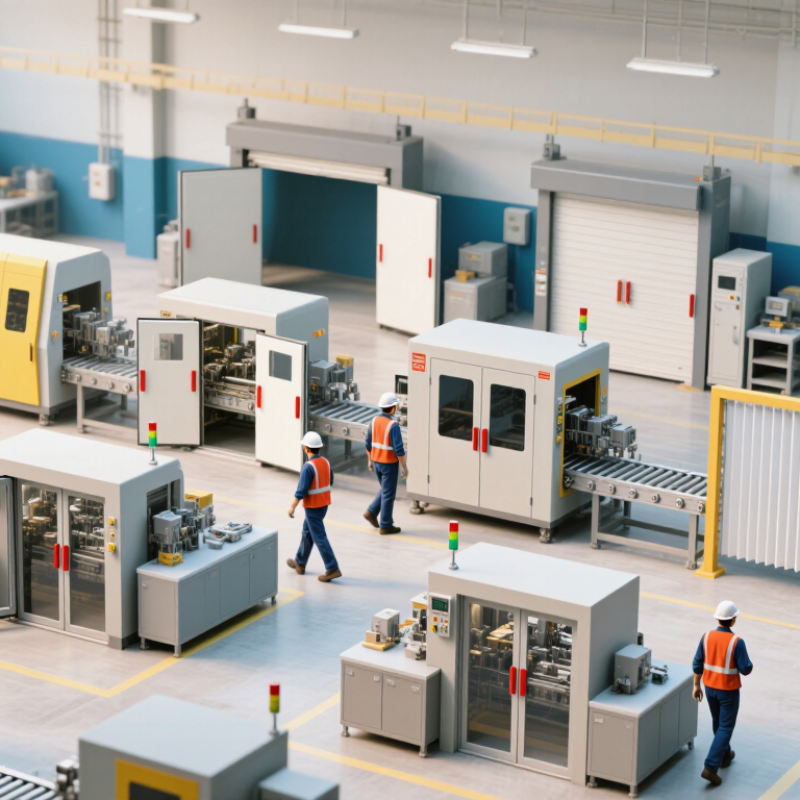
7 Best Machine Guarding Doors for Industrial Safety

What Machine Guarding Doors Are and How They Protect Workers

A machine guarding door is a movable barrier around hazardous equipment, such as a press, robot cell, or conveyor transfer point. It helps keep hands and bodies away from moving parts during normal operation. Many doors use an interlock that signals the machine to stop or prevents a cycle from starting when the door opens. The exact protection depends on the machine, the hazard, and how the door is integrated. A door alone is not a safety system.

Good guarding starts with observing real work: where operators load parts, clear jams, and reach for controls. The door should allow necessary tasks without creating easy ways to bypass protection. Its frame, hinges, latch, and safety devices need to suit the environment and operating conditions. Stopping distance matters, too; a machine that keeps moving after the door opens may still expose someone to danger. There is no perfect door for every cell. That detail is easy to overlook.

Tips: Check that the door closes and latches reliably, and inspect interlocks for damage or loose wiring. Test the safety function according to the site’s documented procedure. Never treat an interlocked door as a substitute for proper energy isolation during servicing. Keep the instructions visible. That helps, but habits still need attention.


Machine Guarding Door Types: Typical Safety Functions

Compare common guarding-door configurations by their typical functions. This is an illustrative feature map, not a performance rating; actual functions depend on the machine design and risk assessment.

A value of 1 indicates the function is typically included in the configuration shown; 0 means it is not typically included. Guard interlocks and guard locking must be selected and installed for the specific hazards and stopping time.

Key Safety Standards and Features of Industrial Guarding Doors

Industrial guarding doors must do more than close an opening. They should prevent access to hazardous motion while allowing safe loading, inspection, and cleaning. ISO 14120 addresses guard design and construction, while ISO 14119 covers interlocking devices associated with guards. ISO 13857 provides guidance on safety distances. For control systems, ISO 13849-1 may apply to safety-related functions. Requirements vary by machine and location, so confirm the applicable standards and editions with a qualified safety professional.

Details matter.

A well-chosen door should resist expected impacts, stay aligned, and open without awkward reaching. Check that hinges, handles, and latches remain secure after repeated use. If opening the door could expose a worker to moving parts, an interlock may be needed; stopping times and access conditions should inform its design. A clear panel can help operators spot a jam, but it must suit the environment and remain easy to inspect. Metal dust, coolant, and vibration can wear components faster than expected. Small gaps can also invite unsafe workarounds. Include guard checks in routine maintenance, and test interlocks after repairs or adjustments. Even a compliant design can become unreliable when a latch loosens or a switch is bypassed. Safety depends on the installed system, its upkeep, and how people actually use it.

Seven Types of Machine Guarding Doors for Industrial Use

Industrial machine guarding doors vary with the machine, available floor space, and frequency of access. Hinged doors suit compact cells, but their swing can block an aisle. Sliding doors move sideways and work well where clearance is tight. Vertical-lift doors rise above the opening, though overhead space must be clear. Roll-up doors save room and open quickly. They need regular checks.

Folding doors can cover wide openings while stacking to one side. Interlocked access doors use sensors to stop hazardous motion when opened; correct installation and testing matter. Removable access panels are useful for occasional servicing, not routine entry. Choose a style that lets operators see the work area without reaching through the guard. Clear panels can help, but scratches, coolant, and dust may reduce visibility. Check hinges, tracks, latches, and interlocks during planned inspections. A door that looks sturdy may still leave a gap near the frame. There is no perfect design; even a well-chosen door can be awkward if operators must force it open. Test access and visibility on the actual machine before settling on a layout.

7 Best Machine Guarding Doors for Industrial Safety - Seven Types of Machine Guarding Doors for Industrial Use

Door type Typical configuration Common industrial uses Safety considerations Advantages and limitations
1. Hinged swing door A rigid panel attached to a frame with side-mounted hinges; opens inward or outward. Machine enclosures, production cells, and operator access points with sufficient clearance. Check hinge condition, secure closure, and whether opening the door creates access to a hazard. Use an appropriately selected guard interlock when required by the risk assessment. Simple access and straightforward maintenance; the swing path needs floor space and can obstruct nearby work areas.
2. Horizontal sliding door A framed panel that travels sideways on a track or guide system. CNC machine enclosures, automated work cells, and areas where a swing door would interfere with equipment or walkways. Protect against access around the panel and at track openings. Keep guides clear of debris and assess pinch points during movement. Does not require a door swing area; needs lateral clearance and maintained tracks.
3. Vertical lift-up door A rigid panel that moves vertically, often with guided travel and a counterbalance or powered mechanism. Large machine openings, loading stations, and enclosures where horizontal or swing clearance is limited. Prevent unexpected descent, provide suitable mechanical support for servicing, and assess crushing or shearing hazards along the travel path. Can provide a wide opening with a compact footprint; adds moving components that require inspection and maintenance.
4. Roll-up door Flexible or linked slats that coil above the opening when raised. Production openings with frequent material movement, where a compact overhead storage area is available. Confirm that the closed assembly provides the required physical barrier. Assess the moving curtain and bottom edge for impact, entrapment, or crushing hazards. Opens quickly and uses little side clearance; may provide less rigidity than a solid panel and requires attention to the roll mechanism.
5. Bi-fold door Two or more hinged sections fold together as the door opens. Wide machine openings and production cells where a full-width swing door would take up too much space. Evaluate pinch points at panel joints and the opening path. Ensure the panels remain secured in the closed position. Can create a broad opening in a smaller swing area; has more hinges and joints to inspect than a single-panel door.
6. Removable access panel A fixed panel designed to be detached for infrequent access, often using fasteners or a tool. Maintenance access, inspection points, and sections not intended for routine operator entry. Removal should not be treated as a substitute for safe isolation. Where access to a hazard is possible, follow applicable lockout/tagout procedures and the site risk assessment. Simple and suitable for infrequent access; slower to open and less suitable for routine entry or exit.
7. Interlocked access door A hinged or sliding physical door fitted with a guard interlocking device that monitors its position. Robotic cells, automated machinery, and guarded processes requiring controlled access. The interlock and associated control system must be selected, installed, and validated for the assessed risk. Do not bypass or defeat the interlock; additional measures may be needed if hazardous motion does not stop promptly. Can help prevent access during hazardous operation; adds control-system requirements and does not replace a suitable physical guard.

Selection note: Choose and validate guards based on the machine-specific risk assessment, access frequency, stopping time, and applicable local regulations. Door type alone does not establish that a machine is safe.

How to Select a Door for Your Machine and Work Environment

Selecting a machine guarding door starts with the hazards and tasks around the machine. Check whether operators need frequent access for loading, cleaning, or tool changes. A sliding door can suit a narrow aisle, while a hinged door needs clear swing space. Space is tight. Match the opening to the largest part or tool that must pass through, not just the operator’s hands. For flying chips or coolant, choose a sturdy panel that keeps visibility without exposing workers to spray or debris. Mesh may provide airflow, but its openings must fit the hazard being controlled.

Tips: Measure the aisle and opening with the machine in its actual position. Check handle reach, sightlines, and whether the door can be opened without blocking an escape route. Confirm that any interlock suits the machine’s stopping behavior.

Consider the work environment, too. Dust, oil, vibration, and washdown can affect hinges, latches, and sensors over time. Select materials and hardware that tolerate those conditions, and plan how they will be inspected and cleaned. The door should close reliably after routine access; a design that is awkward to use may get left open. That matters. Before installation, review the guarding layout with maintenance staff and operators. They may notice a snag point or blind spot that drawings miss. Check the finished setup during real tasks, since a convenient design on paper can feel different beside a running machine.

Installation, Interlocking, and Maintenance for Lasting Safety

A machine guard is only effective when it fits the hazard and stays in place. OSHA’s FY 2023 Top 10 citation data recorded 1,644 machine-guarding violations, keeping the issue among its most frequently cited workplace hazards. That figure is a reminder: installation deserves more than a quick visual check. Measure openings against the point of operation, fasten the frame securely, and make sure the door cannot swing into a walkway. Small gaps matter.

Interlocked doors should stop hazardous motion when opened, and the machine should not restart unexpectedly when they close. Verify the interlock during commissioning and after repairs, using the machine’s documented safe test procedure. For work that requires entry, follow applicable energy-control procedures under OSHA’s 29 CFR 1910.147; an interlock alone is not a substitute for isolating hazardous energy. Test it.

Maintenance should be routine, not reactive. Check hinges, latches, wiring, sensors, and mounting points for looseness, wear, and damage. A door that rubs or needs a hard shove is already giving useful feedback. Record inspection dates and defects, then keep the machine out of service until safety functions are restored. The awkward part is consistency: a checklist can be completed without anyone really looking. Have trained workers confirm that the guard closes properly and the machine responds as intended, especially after cleaning, adjustment, or a tooling change.

Powder Coat Booths

For those larger-sized parts, or smaller quantity runs, we have 2 independent powder coat booths and ovens. The quality, durability and affordability of today’s powder coating finishes make this the process of choice for world-class companies.

Powder coating advantages over other forms of coating are many. Materials used in the Powder coating process can be metals and non-metals that come in a multitude of thicknesses, textures, colors, etc. Another of Powder coating’s biggest advantages over conventional coatings is its ability to create finishes in many different textures. Powder Coating Booths allow us the ability to apply these advantages to large products.

Wet Paint Line

Tri-State Fabricators runs a full-service conveyor line for painting. Wet painting can provide protection or decoration to many different part styles. From start to finish, every project is easier to undergo random and point-based inspection by our skilled painting team.

Advantages to our Wet Paint Line are these lines start with product prep and ends with a thorough inspection of a high quality finished product. Our ability to complete large and small projects with a superior finish and doing so in a timely and economical fashion. This passes along the savings in production to our customers. When powder coating ins not an option, our Wet Paint Line gets the job done right the first time.

Wet Paint Booths

When the parts get big and heavy we roll-out our custom paint racks and oversize booth. By utilizing our partnerships with all the major paint brands, we can match virtually any color with wet paint.

The advantages of having access to a Wet Paint Booth are many. Large projects of many different shapes can be loaded into the booth. The Wet Paint Booth offers an environment that is much more controlled than a typical parts painting operation.

Not only are they used because of their controlled environment, but they’re are also advantageous when it comes to applying paint to parts that are needed in industries that require specialty coatings such as medical, aerospace, etc.

Military CARC

Our military forces have some very high standards when it comes to the finish of their vehicles and equipment. From the first pre-treatment step to final coat, it takes a great deal of knowledge and experience to protect the men and women of our armed forces. They deserve only the best, and Tri-State Fabricators provides it.

All of our processes are closely monitored by our staff and management teams. Both of which are highly trained in the processes of metal fabrication and finishing. Tri-State Fabricators’ goal is to always fully satisfy each and every customer, including the military. We will always put a 110% into what we do.

Glass-Bead Blasting

Abrasive media blasting is an excellent way to remove old paint, rust, and increase the paint/powder adhesion. Glass beads produce a much smoother and brighter finish than angular abrasives; leaving the part clean yet without any dimensional change. Chemically inert and environmentally friendly, we can recycle our beads approximately 30 times; making them a more preferred method of metal cleaning or surface finishing.

Advantages to Glass Bead Blasting are many. Glass bead blast media is used when a project is needing rough surfaces need to become smooth for applications of coatings such as paint. It is typically used to clean paint and rust from a product surface without deforming the surface it is being used on. Overall, compared to many other blasting media, Glass Bead Blasting is a very economical choice and those savings are always passed on to our customers.

Part Washing

Tri-State Fabricators utilize a zinc phosphate wash to clean and etch the material to ensure the best paint adhesion possible. The unique design of our 3-stage wash system does the work like a 5-stage. From Cleaning and rinsing to conversion coating and post-treatment, Our Part Washing process is a complete service and works throughout the fabrication service and the finishing service.

Along with the previously mentioned benefits, Curing is a vital chemical reaction that leaves the product finish hard and relatively safe from mild abrasion and aggressive corrosion. This process can be done in more than one way; ambient air-dry or in curing ovens at temps that exceed 240°.

Burn-Off Oven

From fixing paint mistakes (someone else’s of course) to simply cleaning our paint line hooks, our burn-off oven is put to good use. After a quick burn-off, a little clean up, and a fresh coat of paint, your parts will look better than new.

Why does our Burn-Off Oven work so well? Because super heating the air around parts turns the materials into ashes. From paint and powder coatings to rubber and machining oils, high temps do the job without degrading the integrity of the part.

Masking

Masking is a vital part of producing high quality products. We have die-cut masking patterns to protect machined surfaces as well as a wide range of plugs and caps to protect threaded holes and bolts. We provide permanent and temporary masking.

Masking allows the selected sections of a product to be protected from a fabrication or finishing service. This can be with both chemicals when etching and tapes, paints when only finishing just a section of the product. Masking is great in aiding the customization process of a project.

Screen Printing

Screen printing is a photographic process that transfers artwork onto a porous nylon screen which allows colored ink to flow through the screen and be deposited on an aluminum or plastic component. We can generally have just about any design created onto a screen for your parts.

Some of the advantages of Screen Printing are, brand recognition for your business displaying on your products, assembly instructions, product warnings/hazards, etc. Tri-State Fabricators produces Screen Printing of the highest quality so you know it’s durable.

Metal Finishing

Metal Finishing is the art of treating the exterior portion of product, often metal but can also be made of other materials, so that the surface is clean and free of any debris. Then the process of applying coats or either paint of powder coat takes place. This coating process improves the quality of the product in both appearance and resistance to wear and corrosion.

Tri-State Fabricators, Inc., understands that a project typically isn’t complete until a high-quality finish has been added to your product. This is why our painting and powder coating teams continuously inspect the products throughout the Metal Finishing process.
