


Choosing an Industrial Filling Machine is not just a matter of matching a bottle to a nozzle. A buyer must consider the product’s viscosity, target fill volume, container shape, and planned production rate. A thin liquid may run smoothly through a gravity filler, while a thick sauce needs a different pumping system. Small details matter. A sticky residue around a nozzle can slow a line and complicate cleaning.
Quality-management expert W. Edwards Deming wrote, “Quality comes not from inspection, but from improvement of the production process.” His principle offers a useful lens for comparing filling equipment: look beyond advertised speed and examine how consistently a machine performs during real production. Ask suppliers about dosing accuracy, changeover time, cleaning access, spare parts, and technical support. Request a demonstration using containers and product characteristics similar to yours. A polished showroom test is helpful, but it cannot answer every question.
This guide reviews seven filling-machine types for global buyers, from compact manual systems to automated lines. It explains where each option fits, what trade-offs to expect, and which specifications deserve close attention. No machine is best for every plant. That can be frustrating. A lower purchase price may bring more manual work, while higher automation can demand extra training and maintenance. Treat these comparisons as a starting point, then verify claims against your own production needs and supplier documentation.
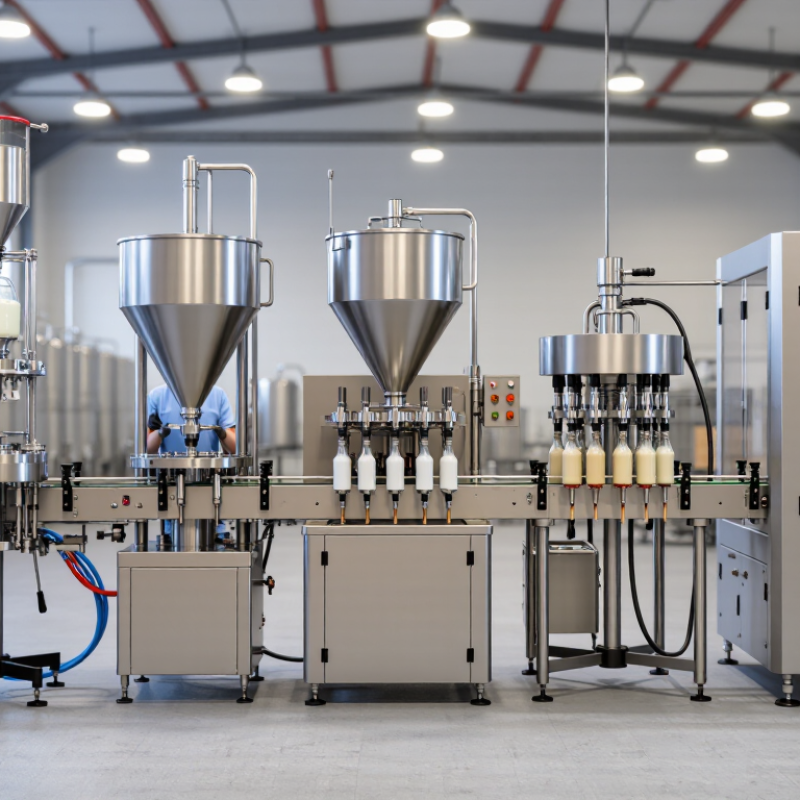
Industrial filling machines dispense measured amounts of liquids, pastes, powders, or granules into containers. Their purpose is consistent dosing, not simply higher speed. Depending on the product, a line may use gravity, piston, pump, or auger filling. A food producer might fill thick sauce into jars, while a cosmetics facility may dispense lotion into bottles. Beverage, dairy, pharmaceutical, household-product, and agricultural-input manufacturers also use filling equipment. Each application has different requirements for viscosity, hygiene, container shape, and cleaning.
The filling method affects accuracy, product waste, and changeover time. Thin liquids may splash or foam; dense creams may need wider nozzles and slower flow. Powders can bridge in a hopper, making feeder design important.
Buyers should check the target fill range, container dimensions, expected output, product-contact materials, and cleaning process. Request a trial with the actual product and containers. A specification sheet may not reveal small problems, such as nozzle drips or awkward adjustments.
Tips: Measure fill variation across repeated runs, not just one cycle. Check whether operators can reach nozzles and cleaning points safely. Small inconveniences add up during a long shift. Confirm how container changes are handled, too; manual adjustments can work well when they are clear and repeatable.

Filling technology should match the product’s behavior, not just its target volume. Thin liquids, such as water-like solutions, often suit gravity or flowmeter filling. Flowmeters measure liquid moving through a line, which can help maintain consistent doses across production runs. Thicker products, such as sauces or creams, usually need piston fillers that push a measured amount through a nozzle. Product temperature and texture matter too. A cream that flows easily when warm may become slow and uneven after cooling.
Powders and free-flowing granules often use auger or cup-based dosing systems. Their accuracy can shift with particle size, moisture, and settling inside the hopper. Foam changes everything. Bottom-up filling can reduce splashing when handling foamy liquids, though nozzle speed and container shape still need testing.
Container geometry matters. Narrow necks may require slim nozzles, while wide-mouth jars allow easier access for thicker products. Pouches need controlled positioning and a reliable seal after filling. Glass containers may require gentle handling, since small impacts can cause chips or breakage. Before selecting equipment, test it with the actual product and container. Test real product. Watch for drips, trapped air, and changing fill levels during a full run. A machine that works well for one batch may behave differently with another. That detail is easy to underestimate.
Industrial filling machines are designed around product behavior, not just container size.
Gravity fillers suit free-flowing liquids such as water or thin oils.
Piston fillers handle thicker products, including sauces and creams, with measured strokes.
Pump fillers move products through tubing, but the pump type matters when ingredients are delicate.
Overflow fillers help bottles look evenly filled, especially when shelf appearance matters.
Net-weight fillers measure product by mass, useful when fill quantity must be checked directly.
Auger fillers meter powders into jars or bags; powder flow can change with humidity.
Vacuum fillers draw liquid into compatible containers using pressure differences, so container strength and product properties need review.
Small details count. These seven types are not interchangeable. A sample run with the actual product can reveal drips, foam, settling, or slow refill cycles that a specification sheet misses.
A clean factory floor and a neatly printed brochure are reassuring, but they do not prove a machine will suit every shift. Buyers should compare changeover time, cleaning access, container range, and local service support, then ask for measured test results.
I would still leave room for doubt: one successful trial may not represent a full production day.
A useful comparison starts with the product and container, not the machine’s headline speed. Rated output may assume steady flow, uniform bottles, and no changeovers. Ask for the expected rate using your actual liquid, fill volume, and container shape. Watch a trial run. Does the line keep pace when operators replace a roll of caps or clear a bottle jam? A fast machine can still create a slow production day.
Accuracy matters in every shift. Request fill-weight or volume results across several runs, including startup and restart. A few milliliters of variation can add up across thousands of containers. Small details count. Compare manual, semi-automatic, and automatic setups by checking how many operators they need and how easily settings change. More automation is not always better; complex controls can require training and specialist support.
Compare total cost over the expected service life, not just the purchase price. Include installation, utilities, routine parts, cleaning time, training, and planned downtime. Ask how quickly common wear parts can be replaced, and whether local technicians are available. These estimates are imperfect; real maintenance often differs from a spreadsheet. Still, a clear cost model helps buyers weigh speed against accuracy and practical upkeep.
| Machine Type | Best Suited For | Typical Speed | Typical Fill Accuracy | Automation Options | Relative Initial Cost | Key Buying Consideration |
|---|---|---|---|---|---|---|
| Gravity Filler | Free-flowing, low-viscosity liquids such as water and some non-carbonated beverages | About 10–60 containers per minute | Typically around ±0.5–1.5% by volume, depending on the product and setup | Available with automatic container indexing, level controls, and multi-head configurations | Low to medium | Simple and economical, but generally unsuitable for thick, foaming, or highly valuable products. |
| Overflow Filler | Thin liquids where a consistent visible fill level matters, including personal-care and household products | About 10–60 containers per minute | Consistent fill height; the actual volume can vary with container shape and internal dimensions | Automatic models can include conveyor handling, nozzle diving, and recipe controls | Low to medium | Creates an even-looking fill line, but does not guarantee identical net volume in differently shaped containers. |
| Piston Filler | Medium- to high-viscosity products such as sauces, creams, pastes, and some products with particulates | About 10–60 containers per minute | Typically around ±0.5–1.0% by volume under suitable operating conditions | Can be configured with multiple pistons, automatic controls, and clean-in-place systems | Medium | Positive-displacement filling handles thicker products well; piston, valve, and nozzle design must suit the product. |
| Peristaltic Pump Filler | Small-dose, shear-sensitive, sterile, or high-purity liquids in pharmaceutical, laboratory, and specialty production | About 5–30 containers per minute | Often around ±0.5–1.0% by volume for suitable small-dose applications | Electronic dose control and recipe storage are common; tubing can be replaced without product-contact pump parts | Medium to high | Useful where product isolation and quick tubing changes matter; tubing life and dose size affect operating cost. |
| Gear Pump Filler | Viscous liquids, oils, and products requiring controlled metering | About 10–60 containers per minute | Typically around ±0.5–1.0% by volume, depending on viscosity, pump setup, and calibration | Servo-driven dosing, programmable recipes, and multi-nozzle layouts are available | Medium to high | Can deliver repeatable doses, but product compatibility, cleanability, and wear-part requirements need review. |
| Net-Weight Filler | Products sold by mass, high-value liquids, and applications requiring weight-based fill verification | About 5–30 containers per minute | Commonly designed for approximately ±0.1–0.5% of target weight; confirm the achievable tolerance for the fill size | Electronic weighing, automatic tare, feedback control, and data logging are typical options | High | Measures product mass directly, but weighing equipment, settling time, and container handling influence throughput. |
| Rotary Multi-Head Filler | High-volume production of compatible products in standardized containers | About 60–300 containers per minute, depending on the number of heads and product | Depends on the installed filling technology; performance should be specified for the actual product and package | Typically integrated with automatic infeed, filling, discharge, and synchronized line controls | High to very high | Offers high throughput, but requires more floor space, investment, and format-change planning than simpler systems. |
Comparison note: Speeds and accuracy figures are indicative industry ranges, not guaranteed specifications. Actual performance varies with fill volume, product viscosity and foaming behavior, container geometry, number of filling heads, changeover requirements, and operating conditions. Request a product-specific test and a total-cost estimate covering installation, labor, maintenance, utilities, and consumables.
A filling machine can perform well in one plant and still miss a buyer’s local requirements. Compliance is not a single certificate. Request current declarations, electrical drawings, material-contact specifications, and risk assessments. Confirm applicable standards with a qualified local reviewer, since requirements can change. Compare voltage, frequency, guarding, enclosure rating, and emergency stops with the actual site conditions. Keep copies. A tidy document pack helps, but it does not prove the installed machine matches the paperwork. That gap is easy to overlook.
Compatibility starts with the product and package. Bring sample bottles, caps, and product data to a machine trial; note viscosity, foaming, target speed, and changeover time. Ask how filling accuracy is checked and how product-contact parts are cleaned. Then check utilities, floor space, conveyor height, and control-system connections. Support needs equal attention. Confirm response hours, spare-part availability, language options, and who can visit the site if remote troubleshooting fails. Weak connectivity can make remote help frustrating. Even a careful checklist misses details sometimes, so record trial results and open questions before approving the purchase.


For those larger-sized parts, or smaller quantity runs, we have 2 independent powder coat booths and ovens. The quality, durability and affordability of today’s powder coating finishes make this the process of choice for world-class companies.
Powder coating advantages over other forms of coating are many. Materials used in the Powder coating process can be metals and non-metals that come in a multitude of thicknesses, textures, colors, etc. Another of Powder coating’s biggest advantages over conventional coatings is its ability to create finishes in many different textures. Powder Coating Booths allow us the ability to apply these advantages to large products.
Tri-State Fabricators runs a full-service conveyor line for painting. Wet painting can provide protection or decoration to many different part styles. From start to finish, every project is easier to undergo random and point-based inspection by our skilled painting team.
Advantages to our Wet Paint Line are these lines start with product prep and ends with a thorough inspection of a high quality finished product. Our ability to complete large and small projects with a superior finish and doing so in a timely and economical fashion. This passes along the savings in production to our customers. When powder coating ins not an option, our Wet Paint Line gets the job done right the first time.
When the parts get big and heavy we roll-out our custom paint racks and oversize booth. By utilizing our partnerships with all the major paint brands, we can match virtually any color with wet paint.
The advantages of having access to a Wet Paint Booth are many. Large projects of many different shapes can be loaded into the booth. The Wet Paint Booth offers an environment that is much more controlled than a typical parts painting operation.
Not only are they used because of their controlled environment, but they’re are also advantageous when it comes to applying paint to parts that are needed in industries that require specialty coatings such as medical, aerospace, etc.
Our military forces have some very high standards when it comes to the finish of their vehicles and equipment. From the first pre-treatment step to final coat, it takes a great deal of knowledge and experience to protect the men and women of our armed forces. They deserve only the best, and Tri-State Fabricators provides it.
All of our processes are closely monitored by our staff and management teams. Both of which are highly trained in the processes of metal fabrication and finishing. Tri-State Fabricators’ goal is to always fully satisfy each and every customer, including the military. We will always put a 110% into what we do.
Abrasive media blasting is an excellent way to remove old paint, rust, and increase the paint/powder adhesion. Glass beads produce a much smoother and brighter finish than angular abrasives; leaving the part clean yet without any dimensional change. Chemically inert and environmentally friendly, we can recycle our beads approximately 30 times; making them a more preferred method of metal cleaning or surface finishing.
Advantages to Glass Bead Blasting are many. Glass bead blast media is used when a project is needing rough surfaces need to become smooth for applications of coatings such as paint. It is typically used to clean paint and rust from a product surface without deforming the surface it is being used on. Overall, compared to many other blasting media, Glass Bead Blasting is a very economical choice and those savings are always passed on to our customers.
Tri-State Fabricators utilize a zinc phosphate wash to clean and etch the material to ensure the best paint adhesion possible. The unique design of our 3-stage wash system does the work like a 5-stage. From Cleaning and rinsing to conversion coating and post-treatment, Our Part Washing process is a complete service and works throughout the fabrication service and the finishing service.
Along with the previously mentioned benefits, Curing is a vital chemical reaction that leaves the product finish hard and relatively safe from mild abrasion and aggressive corrosion. This process can be done in more than one way; ambient air-dry or in curing ovens at temps that exceed 240°.
From fixing paint mistakes (someone else’s of course) to simply cleaning our paint line hooks, our burn-off oven is put to good use. After a quick burn-off, a little clean up, and a fresh coat of paint, your parts will look better than new.
Why does our Burn-Off Oven work so well? Because super heating the air around parts turns the materials into ashes. From paint and powder coatings to rubber and machining oils, high temps do the job without degrading the integrity of the part.
Masking is a vital part of producing high quality products. We have die-cut masking patterns to protect machined surfaces as well as a wide range of plugs and caps to protect threaded holes and bolts. We provide permanent and temporary masking.
Masking allows the selected sections of a product to be protected from a fabrication or finishing service. This can be with both chemicals when etching and tapes, paints when only finishing just a section of the product. Masking is great in aiding the customization process of a project.
Screen printing is a photographic process that transfers artwork onto a porous nylon screen which allows colored ink to flow through the screen and be deposited on an aluminum or plastic component. We can generally have just about any design created onto a screen for your parts.
Some of the advantages of Screen Printing are, brand recognition for your business displaying on your products, assembly instructions, product warnings/hazards, etc. Tri-State Fabricators produces Screen Printing of the highest quality so you know it’s durable.
Metal Finishing is the art of treating the exterior portion of product, often metal but can also be made of other materials, so that the surface is clean and free of any debris. Then the process of applying coats or either paint of powder coat takes place. This coating process improves the quality of the product in both appearance and resistance to wear and corrosion.
Tri-State Fabricators, Inc., understands that a project typically isn’t complete until a high-quality finish has been added to your product. This is why our painting and powder coating teams continuously inspect the products throughout the Metal Finishing process.

