


A quiet campsite can make small comforts feel important. The kettle begins to whisper, cold air settles around the tent, and freshly ground coffee brings a little warmth to the morning. A Hand Crank Coffee Grinder For Camping offers a simple way to prepare beans without batteries or a power outlet. But the best choice depends on more than portability. Burr consistency, handle comfort, capacity, and how easily the grinder fits into a pack all matter.
Coffee educator James Hoffmann has discussed how grind size affects extraction. A useful paraphrase of that principle is: “Choose a grind that suits the coffee you want to make.” This is a summary, not a verbatim quotation. For campers, it points to a practical question: can the grinder produce a steady grind without turning breakfast into a workout? Some compact models are impressively light. Others feel slow when grinding enough beans for two cups. The trade-off is real.
This guide compares seven hand-crank grinders for camping, with attention to portability, build quality, ease of adjustment, and everyday usability. We consider details you notice outdoors: a handle that stays put, grounds that do not spill across a picnic table, and parts that are manageable to clean. No single grinder suits every trip. A short overnight hike calls for different priorities than a long stay beside the car. And even a good grinder can feel tedious before coffee. We’ll point out both the strengths and the compromises, so you can choose with clearer expectations.
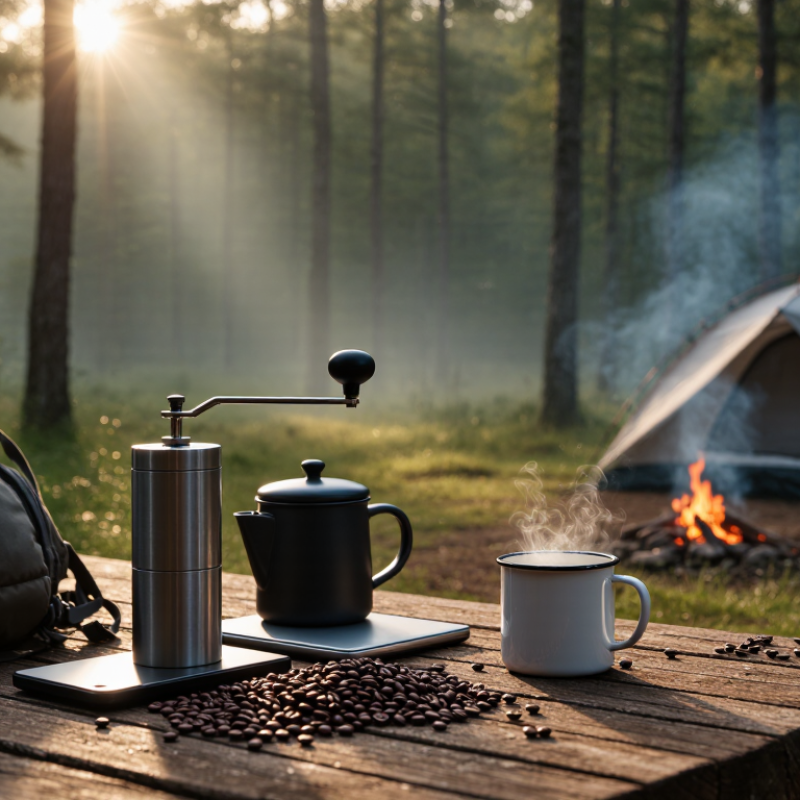
A camping-ready hand crank grinder should earn its space in your pack. Look for a compact body with a secure lid, so beans stay put when the trail gets rough. Weight matters, but so does shape: a narrow grinder can fit beside a mug or stove without awkward packing. Check the handle, too. A removable crank is easier to stow, while a firm grip helps when your hands are cold. Small details count.
Consistent burrs and useful grind settings matter more than a long list of features. Coarse grounds suit a French press, while finer settings work for pour-over. Adjustment should be easy to feel and repeat, even outdoors. A clear, stable setting ring helps. Very tiny steps may be less useful if they are hard to adjust with cold fingers. Consider capacity as well: grinding enough for two cups saves time, but a larger chamber adds bulk.
For field use, choose sturdy materials and parts that are easy to brush clean. Damp grounds can cling inside after a rainy morning. A simple design is often easier to maintain than one with hidden crevices. Set the grinder on a flat rock or camp table while turning; lightweight models can wobble. There is a trade-off: a compact grinder may take more turns per cup, and that can feel tedious before breakfast.

A camping grinder should balance grind consistency, pack size, weight, and ease of cleaning. The Outdoor Industry Association’s 2024 Outdoor Participation Trends Report counted 175.8 million U.S. outdoor recreation participants in 2023, a reminder that gear often travels beyond the car park. For coffee, burr alignment and a useful adjustment range matter more than a long list of settings.
The Specialty Coffee Association’s brewing guidance places a common extraction target around 18–22 percent. That’s a brewing benchmark, not a grinder certification, but uneven grounds can make a consistent cup harder to achieve.
Check the grinder’s packed dimensions and weight against your actual kit. A folding handle saves space, though a tiny handle can feel awkward when grinding a coarse dose. Try the motion before buying, if possible. The axle should turn smoothly, and the catch cup should stay secure when tipped over.
Cleaning matters too: trapped grounds can make tomorrow’s cup taste stale. Look for parts that separate without tools, but avoid assuming every removable piece is useful in the field. Stainless components may tolerate rough handling, while lighter materials reduce pack weight; neither choice is perfect. A few extra grams may be worth it if the grinder feels steady in cold hands.
Seven hand crank coffee grinders for camping should be compared on more than size. The National Coffee Association’s 2024 National Coffee Data Trends report found that 67% of U.S. adults had coffee in the past day. Outdoor trips make a compact, reliable brew setup useful. The Outdoor Industry Association also reported 175.8 million U.S. participants in outdoor recreation in 2023. A grinder that packs neatly and works without power suits many campsites.
Compare the seven options by burr consistency, grind adjustment, capacity, weight, and ease of cleaning. Steel burrs can handle frequent use, while ceramic burrs may suit campers prioritizing corrosion resistance. Check whether the crank folds or detaches; loose parts are easy to misplace in a dim tent. A small hopper saves space but may require several batches for a group. That trade-off is easy to underestimate. Keep it simple.
Tips: Test the grinder at home before packing it. Set a medium grind for a pour-over, then adjust to taste. Brush out grounds after use, and store the crank securely. Small details matter.
A camping grinder should fit your brew method, trip length, and tolerance for extra weight. For pour-over, choose a model with repeatable adjustments; uneven grounds can leave a cup tasting both sharp and bitter. The Specialty Coffee Association’s Golden Cup guidance places brewed-coffee extraction yield around 18–22%, a useful benchmark for dialing in grind size and brewing. That number is not a promise of perfect flavor. Water temperature, dose, and pouring also matter.
Consider how the grinder behaves on a cold morning, not just how it looks at home. A long handle can make grinding easier, but it may snag in a crowded pack. A compact body saves space; a tiny catch cup can spill grounds onto damp tent fabric. Check whether the adjustment setting stays put while packed, and whether the parts are simple to brush clean. No tool is effortless. If you usually make coffee for two, a small grinder may turn breakfast into a slow chore. Weigh it with your other kit, then test one dose before leaving. A slightly imperfect cup outdoors is still useful feedback.
A hand-crank grinder works best outdoors when you keep it steady and protect it from grit. Set it on a flat rock or camp table, then hold the body firmly while turning the handle. Add only the beans you plan to brew; loose beans can spill onto damp ground surprisingly fast. Grind over a mug or a wide-mouth container, especially when wind is moving through camp. Keep it dry. A little moisture can make grounds cling inside the chamber and complicate cleanup.
After brewing, tap out the remaining grounds and use a small, soft brush to clear the burr area. Avoid rinsing the grinder unless its maker specifically allows it; water trapped inside can encourage rust or leave parts damp. That matters. Store the grinder in a sealed pouch, separate from dusty cookware and food crumbs. If the handle or adjustment ring feels stiff, stop and check for a lodged bean rather than forcing it. I once hurried through cleanup and missed grounds around the burrs, so the next grind felt uneven. It was a small mistake, but outdoors, spare cleaning tools are easy to forget. Check the adjustment and moving parts at home before a trip, and pack the brush beside your coffee kit.


For those larger-sized parts, or smaller quantity runs, we have 2 independent powder coat booths and ovens. The quality, durability and affordability of today’s powder coating finishes make this the process of choice for world-class companies.
Powder coating advantages over other forms of coating are many. Materials used in the Powder coating process can be metals and non-metals that come in a multitude of thicknesses, textures, colors, etc. Another of Powder coating’s biggest advantages over conventional coatings is its ability to create finishes in many different textures. Powder Coating Booths allow us the ability to apply these advantages to large products.
Tri-State Fabricators runs a full-service conveyor line for painting. Wet painting can provide protection or decoration to many different part styles. From start to finish, every project is easier to undergo random and point-based inspection by our skilled painting team.
Advantages to our Wet Paint Line are these lines start with product prep and ends with a thorough inspection of a high quality finished product. Our ability to complete large and small projects with a superior finish and doing so in a timely and economical fashion. This passes along the savings in production to our customers. When powder coating ins not an option, our Wet Paint Line gets the job done right the first time.
When the parts get big and heavy we roll-out our custom paint racks and oversize booth. By utilizing our partnerships with all the major paint brands, we can match virtually any color with wet paint.
The advantages of having access to a Wet Paint Booth are many. Large projects of many different shapes can be loaded into the booth. The Wet Paint Booth offers an environment that is much more controlled than a typical parts painting operation.
Not only are they used because of their controlled environment, but they’re are also advantageous when it comes to applying paint to parts that are needed in industries that require specialty coatings such as medical, aerospace, etc.
Our military forces have some very high standards when it comes to the finish of their vehicles and equipment. From the first pre-treatment step to final coat, it takes a great deal of knowledge and experience to protect the men and women of our armed forces. They deserve only the best, and Tri-State Fabricators provides it.
All of our processes are closely monitored by our staff and management teams. Both of which are highly trained in the processes of metal fabrication and finishing. Tri-State Fabricators’ goal is to always fully satisfy each and every customer, including the military. We will always put a 110% into what we do.
Abrasive media blasting is an excellent way to remove old paint, rust, and increase the paint/powder adhesion. Glass beads produce a much smoother and brighter finish than angular abrasives; leaving the part clean yet without any dimensional change. Chemically inert and environmentally friendly, we can recycle our beads approximately 30 times; making them a more preferred method of metal cleaning or surface finishing.
Advantages to Glass Bead Blasting are many. Glass bead blast media is used when a project is needing rough surfaces need to become smooth for applications of coatings such as paint. It is typically used to clean paint and rust from a product surface without deforming the surface it is being used on. Overall, compared to many other blasting media, Glass Bead Blasting is a very economical choice and those savings are always passed on to our customers.
Tri-State Fabricators utilize a zinc phosphate wash to clean and etch the material to ensure the best paint adhesion possible. The unique design of our 3-stage wash system does the work like a 5-stage. From Cleaning and rinsing to conversion coating and post-treatment, Our Part Washing process is a complete service and works throughout the fabrication service and the finishing service.
Along with the previously mentioned benefits, Curing is a vital chemical reaction that leaves the product finish hard and relatively safe from mild abrasion and aggressive corrosion. This process can be done in more than one way; ambient air-dry or in curing ovens at temps that exceed 240°.
From fixing paint mistakes (someone else’s of course) to simply cleaning our paint line hooks, our burn-off oven is put to good use. After a quick burn-off, a little clean up, and a fresh coat of paint, your parts will look better than new.
Why does our Burn-Off Oven work so well? Because super heating the air around parts turns the materials into ashes. From paint and powder coatings to rubber and machining oils, high temps do the job without degrading the integrity of the part.
Masking is a vital part of producing high quality products. We have die-cut masking patterns to protect machined surfaces as well as a wide range of plugs and caps to protect threaded holes and bolts. We provide permanent and temporary masking.
Masking allows the selected sections of a product to be protected from a fabrication or finishing service. This can be with both chemicals when etching and tapes, paints when only finishing just a section of the product. Masking is great in aiding the customization process of a project.
Screen printing is a photographic process that transfers artwork onto a porous nylon screen which allows colored ink to flow through the screen and be deposited on an aluminum or plastic component. We can generally have just about any design created onto a screen for your parts.
Some of the advantages of Screen Printing are, brand recognition for your business displaying on your products, assembly instructions, product warnings/hazards, etc. Tri-State Fabricators produces Screen Printing of the highest quality so you know it’s durable.
Metal Finishing is the art of treating the exterior portion of product, often metal but can also be made of other materials, so that the surface is clean and free of any debris. Then the process of applying coats or either paint of powder coat takes place. This coating process improves the quality of the product in both appearance and resistance to wear and corrosion.
Tri-State Fabricators, Inc., understands that a project typically isn’t complete until a high-quality finish has been added to your product. This is why our painting and powder coating teams continuously inspect the products throughout the Metal Finishing process.

