


Curly hair rarely dries evenly. One section may form soft spirals, while another stays damp near the roots. A diffuser can spread airflow across curls instead of concentrating it in one harsh stream. The right attachment may help preserve definition and reduce the rough, frizzy finish that fast drying sometimes leaves behind. Small details matter.
The market reflects a growing interest in styling tools: Grand View Research estimated the global hair dryer market at USD 9.2 billion in 2023 and projected further growth through 2030. That figure describes the wider dryer market, not proof that any diffuser performs well. For hair health, the American Academy of Dermatology advises limiting heat styling and using the lowest effective heat setting. These points make airflow, heat control, bowl depth, and fit worth examining—not just brand claims.
This guide compares the best hair diffusers for curly hair by practical features, including compatibility, ease of handling, and how gently each model distributes air. A deep bowl can hold longer curls; a lighter attachment may feel easier during a slow drying session. No tool is magic. Results still depend on curl pattern, technique, and heat exposure, and product descriptions rarely capture every real-world drawback. Consider this a careful shortlist, not a promise of identical results for every head of curls.
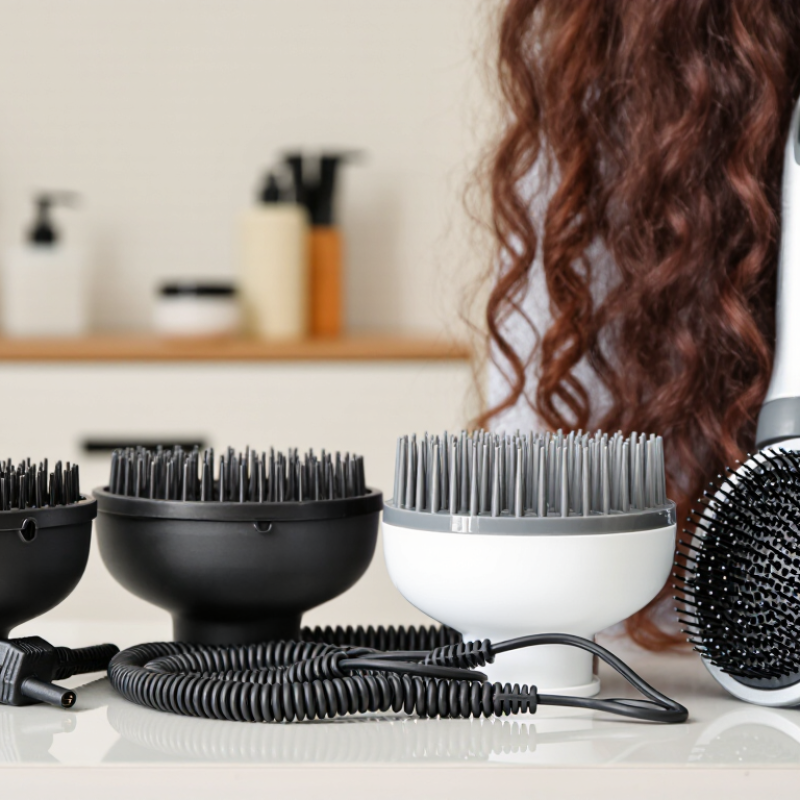
A hair diffuser spreads a dryer’s airflow across a wider area instead of concentrating it on one spot. Its bowl supports curls while the prongs lift roots, helping hair dry with less direct disturbance. Use it on damp, conditioned hair, placing sections gently in the bowl rather than pulling them taut. This can help curls keep their clumps and spring. It cannot create a curl pattern that is not already there.
Heat and distance still matter. A 2011 laboratory study in Annals of Dermatology measured hair-surface temperatures of about 47°C with a dryer held 15 centimeters away, compared with about 95°C at 5 centimeters. The study did not test every diffuser, so those figures are not a guarantee of safe temperatures. A diffuser can still expose hair to damaging heat. Choose a lower setting, keep the dryer moving, and pause if your scalp feels uncomfortably hot.
For more definition, tilt your head and let the diffuser meet the curls from below. Hold each section still for a short interval; constant repositioning can scatter wet strands and create frizz. Roots may need extra time. Patience helps. Some curls will dry unevenly, especially in dense sections, and that is not necessarily a technique failure. Avoid touching the hair repeatedly while it dries, though the urge is real. When the roots feel dry, stop rather than chasing a perfectly uniform finish.
| Rank | Diffuser Style | Best Suited For | How It Helps Shape and Dry Curls | What to Check |
|---|---|---|---|---|
| 1 | Deep-Bowl Diffuser | Medium-to-long curls and larger sections | The bowl can hold a section of curls while warm air is spread across it, making it easier to dry without directing a concentrated stream at individual strands. | Choose a bowl that can comfortably hold your curl sections and fits your dryer securely. |
| 2 | Wide-Bowl Diffuser | Thick hair or broad curl sections | A wider surface distributes air over more hair at once, which can make section-by-section drying more convenient. | A wide bowl may be bulky; check its weight and dryer compatibility. |
| 3 | Long-Prong Diffuser | Long, dense, or tightly curled hair | Longer prongs can help lift and separate hair near the roots, allowing airflow to reach areas that may otherwise stay damp. | Use a gentle setting and avoid pushing prongs forcefully through curls. |
| 4 | Short-Prong Diffuser | Short-to-medium hair and looser curl patterns | Shorter prongs provide support while curls are cupped in the diffuser, with less reach into the hair than longer-prong designs. | Check that the bowl is large enough for your usual section size. |
| 5 | Multi-Prong, Vented Diffuser | People who want airflow distributed across several contact points | Openings around the bowl and prongs spread airflow through the attachment, rather than relying on one narrow air stream. | Airflow and heat depend on the dryer settings as well as the attachment design. |
| 6 | Adjustable-Fit Diffuser | Households with different dryer shapes or sizes | An adjustable collar or flexible connector can make attachment fit more adaptable across compatible dryer outlets. | “Universal” does not guarantee a secure fit; confirm the outlet measurements and attachment instructions. |
| 7 | Collapsible Silicone Diffuser | Travel and limited storage space | Its foldable body packs more compactly than many rigid attachments and can still spread air when fully opened. | Let it cool before folding, and check that it is suitable for your dryer’s heat and airflow. |
| 8 | Compact Travel Diffuser | Travelers and occasional use | A smaller attachment takes up less space and can be useful for drying smaller sections or shorter hair. | Its smaller bowl may take more passes to dry long or dense hair. |
| 9 | Soft Fabric or Sock Diffuser | Gentle, low-airflow drying preferences | The fabric spreads air through a soft covering, which can soften the direct force of airflow compared with an uncovered dryer outlet. | Follow care and heat guidance; fabric attachments are not suitable for every dryer or setting. |
| 10 | Shallow-Bowl Diffuser | Short hair, loose waves, or gentle root drying | The shallow shape offers a broad surface for lightly cupping hair and can be easier to handle than a deeper bowl. | It may hold less hair at once and may be less convenient for long curls. |
| Selection note: These rankings compare general diffuser designs, not specific products. A diffuser disperses a dryer’s airflow to help dry curls while reducing direct, concentrated air on the hair; results also depend on dryer heat and speed, hair density and length, and drying technique. Use a low or moderate airflow setting if you want to limit curl disturbance, and check attachment fit before use. | ||||

When comparing hair diffusers, look beyond the shape of the bowl. A wide, deep bowl can cradle more curls, while a smaller one may suit short hair or careful root drying. Long prongs help lift roots and guide airflow through dense hair. They can also snag fragile curls if used roughly. Small details matter. Check that the diffuser fits your dryer securely, since a loose attachment can slip during styling. A lightweight design is easier to hold while drying sections near the back of your head.
Airflow and heat settings affect both drying time and curl definition. Low, adjustable airflow usually lets curls dry with less disturbance, which may help limit frizz. A cool setting can finish a style, though it will not replace gentle handling. Consider the diffuser’s vent pattern, too: evenly spaced openings can distribute air across the bowl rather than blasting one spot. Some dryers feel quiet in a shop but seem loud at home; that detail is easy to overlook. I still find that a diffuser’s results vary with curl pattern, haircut, and technique. Compare comfort and control, not just advertised drying speed.
Hair diffusers spread a dryer’s airflow, helping curls dry with less direct disturbance. The right choice depends on curl length, density, and dryer shape. Useful options include a compact bowl, deep bowl, wide bowl, finger-prong head, and short-prong design. Other choices are long-prong, adjustable-airflow, collapsible, universal-fit, and sock-style diffusers. Each has trade-offs. A deep bowl can hold longer curls, while prongs help lift roots. Compact bowls travel easily but may take longer on dense hair.
Check the attachment’s opening against your dryer nozzle before buying; “universal” does not always mean secure. A loose fit can leak air or slip during use. Fit matters. So does heat.
Start with low airflow and warm, not scorching, heat. Cup sections of damp hair gently in the bowl, then hold still for a short stretch. Move around rather than rubbing curls together. For finer hair, less heat may help limit frizz; thick hair may need more drying time. A diffuser cannot guarantee defined curls, and technique takes practice. Even careful drying can leave a few uneven sections.
Top 10 Best Hair Diffusers for Curly Hair
How to Match a Diffuser to Your Hair Type and Dryer
Choosing a diffuser starts with your hair’s length, density, and curl pattern—not just its appearance. A wide, deep bowl can hold longer or denser curls, while a smaller bowl may feel easier to position on short hair. Long prongs can help lift roots, but they may tangle fragile curls if you move the dryer too quickly. A common mistake is choosing by curl pattern alone. Hair thickness and length matter, too.
Tips: Check the attachment diameter and your dryer’s manual before buying. The diffuser should sit securely, without wobbling or blocking airflow. Use low or medium heat and low airflow when possible. Keep the bowl close, but don’t press it hard against your scalp.
There is no perfect match every time. A diffuser that fits the dryer may still feel too heavy, or its prongs may not suit your routine. If your curls are fine, try a shallower bowl and gentle airflow to reduce disruption. For dense curls, work in sections and let each section rest in the bowl briefly. Stop if the attachment becomes loose or unusually hot, and allow curls to cool before separating them.
How to match a diffuser design to your curl type and hair dryer
Ratings are practical editorial match scores from 1 (limited fit) to 5 (strong fit), not laboratory measurements or product-test results. Choose a diffuser that fits your dryer securely; low airflow and gentle heat can help limit disruption to curl formation. Hair length, density, and personal styling preferences also affect the best match.
Start with clean, damp curls, not dripping-wet hair. Blot gently with a microfiber towel or soft cotton T-shirt; rough rubbing can disturb curl clumps. Apply a light leave-in or heat protectant, then set the dryer to low airflow and low-to-medium heat. Place curls in the diffuser bowl and lift it toward your scalp without scrunching aggressively. Hold each section still for 20–30 seconds, then move on. Patience matters. Strong airflow may separate strands and create frizz, even when the temperature feels comfortable. For extra root lift, tilt your head and diffuse the roots before the ends.
A controlled 2011 study in Annals of Dermatology measured hair-dryer temperatures of about 47°C at 15 cm, 61°C at 10 cm, and 95°C at 5 cm. The researchers found that closer, hotter drying caused more cuticle damage; the study did not test diffusers specifically.
Keep the dryer moving between sections, and stop when curls are nearly dry rather than trying to eliminate every trace of moisture. Let them finish air-drying. Avoid touching or separating curls until then, though this can be hard when the roots still feel cool. If a section dries fuzzy, use less airflow next time; more product is not always the fix.


For those larger-sized parts, or smaller quantity runs, we have 2 independent powder coat booths and ovens. The quality, durability and affordability of today’s powder coating finishes make this the process of choice for world-class companies.
Powder coating advantages over other forms of coating are many. Materials used in the Powder coating process can be metals and non-metals that come in a multitude of thicknesses, textures, colors, etc. Another of Powder coating’s biggest advantages over conventional coatings is its ability to create finishes in many different textures. Powder Coating Booths allow us the ability to apply these advantages to large products.
Tri-State Fabricators runs a full-service conveyor line for painting. Wet painting can provide protection or decoration to many different part styles. From start to finish, every project is easier to undergo random and point-based inspection by our skilled painting team.
Advantages to our Wet Paint Line are these lines start with product prep and ends with a thorough inspection of a high quality finished product. Our ability to complete large and small projects with a superior finish and doing so in a timely and economical fashion. This passes along the savings in production to our customers. When powder coating ins not an option, our Wet Paint Line gets the job done right the first time.
When the parts get big and heavy we roll-out our custom paint racks and oversize booth. By utilizing our partnerships with all the major paint brands, we can match virtually any color with wet paint.
The advantages of having access to a Wet Paint Booth are many. Large projects of many different shapes can be loaded into the booth. The Wet Paint Booth offers an environment that is much more controlled than a typical parts painting operation.
Not only are they used because of their controlled environment, but they’re are also advantageous when it comes to applying paint to parts that are needed in industries that require specialty coatings such as medical, aerospace, etc.
Our military forces have some very high standards when it comes to the finish of their vehicles and equipment. From the first pre-treatment step to final coat, it takes a great deal of knowledge and experience to protect the men and women of our armed forces. They deserve only the best, and Tri-State Fabricators provides it.
All of our processes are closely monitored by our staff and management teams. Both of which are highly trained in the processes of metal fabrication and finishing. Tri-State Fabricators’ goal is to always fully satisfy each and every customer, including the military. We will always put a 110% into what we do.
Abrasive media blasting is an excellent way to remove old paint, rust, and increase the paint/powder adhesion. Glass beads produce a much smoother and brighter finish than angular abrasives; leaving the part clean yet without any dimensional change. Chemically inert and environmentally friendly, we can recycle our beads approximately 30 times; making them a more preferred method of metal cleaning or surface finishing.
Advantages to Glass Bead Blasting are many. Glass bead blast media is used when a project is needing rough surfaces need to become smooth for applications of coatings such as paint. It is typically used to clean paint and rust from a product surface without deforming the surface it is being used on. Overall, compared to many other blasting media, Glass Bead Blasting is a very economical choice and those savings are always passed on to our customers.
Tri-State Fabricators utilize a zinc phosphate wash to clean and etch the material to ensure the best paint adhesion possible. The unique design of our 3-stage wash system does the work like a 5-stage. From Cleaning and rinsing to conversion coating and post-treatment, Our Part Washing process is a complete service and works throughout the fabrication service and the finishing service.
Along with the previously mentioned benefits, Curing is a vital chemical reaction that leaves the product finish hard and relatively safe from mild abrasion and aggressive corrosion. This process can be done in more than one way; ambient air-dry or in curing ovens at temps that exceed 240°.
From fixing paint mistakes (someone else’s of course) to simply cleaning our paint line hooks, our burn-off oven is put to good use. After a quick burn-off, a little clean up, and a fresh coat of paint, your parts will look better than new.
Why does our Burn-Off Oven work so well? Because super heating the air around parts turns the materials into ashes. From paint and powder coatings to rubber and machining oils, high temps do the job without degrading the integrity of the part.
Masking is a vital part of producing high quality products. We have die-cut masking patterns to protect machined surfaces as well as a wide range of plugs and caps to protect threaded holes and bolts. We provide permanent and temporary masking.
Masking allows the selected sections of a product to be protected from a fabrication or finishing service. This can be with both chemicals when etching and tapes, paints when only finishing just a section of the product. Masking is great in aiding the customization process of a project.
Screen printing is a photographic process that transfers artwork onto a porous nylon screen which allows colored ink to flow through the screen and be deposited on an aluminum or plastic component. We can generally have just about any design created onto a screen for your parts.
Some of the advantages of Screen Printing are, brand recognition for your business displaying on your products, assembly instructions, product warnings/hazards, etc. Tri-State Fabricators produces Screen Printing of the highest quality so you know it’s durable.
Metal Finishing is the art of treating the exterior portion of product, often metal but can also be made of other materials, so that the surface is clean and free of any debris. Then the process of applying coats or either paint of powder coat takes place. This coating process improves the quality of the product in both appearance and resistance to wear and corrosion.
Tri-State Fabricators, Inc., understands that a project typically isn’t complete until a high-quality finish has been added to your product. This is why our painting and powder coating teams continuously inspect the products throughout the Metal Finishing process.

