


7 Best Greenhouse Covering Films for Global Buyers

A greenhouse cover does more than keep rain off a crop. It shapes how much light reaches leaves, how heat builds during the day, and how quickly a grower must replace worn material. Greenhouse Covering Film comes in several forms, from simple polyethylene sheets to specialized films with UV, anti-drip, or thermal properties. The right choice depends on climate, crop, structure, and budget. Small details matter.

This guide compares seven greenhouse films for buyers working in different growing conditions. It looks at light transmission, thickness, durability, heat retention, and practical handling—not just the claims on a product label. A film that performs well in a cool, windy region may not suit a hot site with intense sunlight. Installation quality also matters; loose edges and poor tension can shorten a cover’s useful life. No film is perfect.

Product specifications can vary by manufacturer, and published performance figures may not reflect every farm’s conditions. Treat them as a starting point, then confirm details such as UV treatment, warranty terms, and recommended service life with the supplier. Where possible, compare samples or speak with growers using similar structures. I would not rank one material as universally best. The better question is which film offers a dependable balance for your crop, local weather, and replacement cycle.
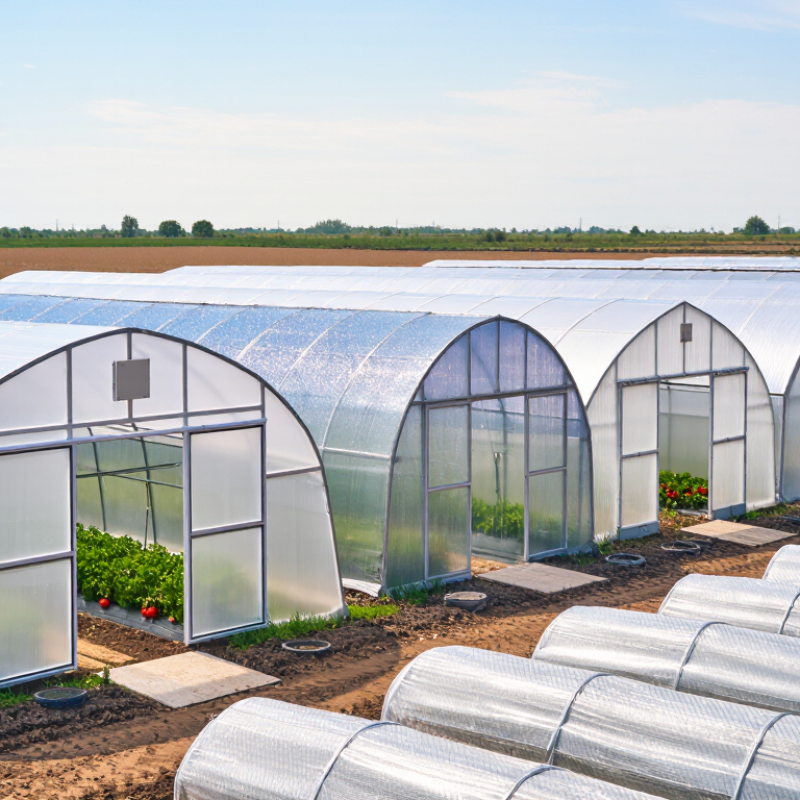
7 Best Greenhouse Covering Films for Global Buyers

Understanding Greenhouse Covering Films and Their Purpose

7 Best Greenhouse Covering Films for Global Buyers
Understanding Greenhouse Covering Films and Their Purpose

A greenhouse covering film is more than a rain shield. It controls sunlight, heat loss, and exposure to wind and rain. Clear films admit strong light, while diffusing films soften harsh sun and reduce sharp leaf shadows. The best option depends on the crop, climate, season, and frame design—not price alone. FAO’s 2013 Good Agricultural Practices guide for greenhouse vegetable crops identifies cover selection as part of managing light and growing conditions.

UMass Extension’s greenhouse energy guidance reports that double-layer polyethylene can reduce heat loss by about 30% compared with a single layer. That matters on cold nights. Yet extra layers can reduce light slightly, and dusty or aging film can weaken performance. A high-spec film can still disappoint if it is poorly installed. Film is not maintenance-free.

Tips: Check light-transmission and anti-drip specifications against crop needs. Inspect the film after storms, tighten loose edges, and replace cloudy sections before plants stretch toward weak light.


Greenhouse Covering Film Thickness Options

Nominal thickness examples used for greenhouse films. A mil is one-thousandth of an inch; 1 mil equals 25.4 micrometres (µm). Actual available thicknesses vary by supplier and product.

Key Properties That Shape Greenhouse Film Performance

A greenhouse film’s first job is to admit useful light without letting heat escape too quickly. Sethi’s 2009 review in Renewable and Sustainable Energy Reviews reports solar transmittance of roughly 80–90% for common greenhouse plastics, depending on material. Small differences matter: a dusty or stretched film can reduce light reaching leaves. Check whether a supplier’s figures describe total solar light or photosynthetically active radiation (PAR). They are not interchangeable.

Heat retention depends partly on long-wave infrared transmission. Films with infrared-blocking additives can reduce night-time heat loss, while anti-drip treatments help prevent droplets from shading crops. Diffusion also matters. It can soften harsh sun and spread light deeper into a dense canopy, though too much haze may lower direct transmission. ASTM D1003 provides a standard method for measuring haze in plastics; request test results, not just a product-sheet claim. Useful details include film thickness, UV-stabilizer content, and expected service conditions.

A specification can look neat on paper. Real weather is less tidy. FAO’s 2013 greenhouse-crop guidance stresses that covering transmission works alongside structural shading and crop layout. Compare film samples under similar light and temperature conditions, and check how their properties change after exposure. A high transmission number alone will not predict crop performance.

7 Best Greenhouse Covering Films for Global Buyers - Key Properties That Shape Greenhouse Film Performance

Film type Key performance properties Potential advantages Trade-offs and checks for buyers Often considered for
1. Clear LDPE (low-density polyethylene) A widely used, transparent greenhouse film. New, clean film typically transmits a high proportion of incoming light; actual transmission depends on thickness, additives, surface condition, and test method. Flexible, relatively lightweight, and commonly available in a broad range of widths and thicknesses. Basic grades may lack enhanced infrared retention, anti-drip properties, or long-term UV protection. Confirm these features separately rather than assuming they are included. General-purpose tunnels and greenhouses where a clear cover and straightforward specification are priorities.
2. EVA (ethylene-vinyl acetate) film EVA is used as a film material or blended into polyethylene formulations. Its properties vary with the EVA content and the complete formulation; many grades are flexible and designed for good light transmission. Can offer improved flexibility and impact performance compared with some basic polyethylene formulations. Selected grades are designed to provide thermal or anti-drip benefits. EVA content alone does not guarantee a particular light, thermal, or service-life result. Ask for test data for the finished film and check compatibility with the structure and climate. Buyers comparing flexible films or seeking a formulation tailored to local growing conditions.
3. IR-retentive (thermal) polyethylene film Formulated with additives that reduce transmission of some long-wave infrared radiation from the greenhouse interior. The level of thermal performance depends on the formulation and measurement conditions. Can reduce radiative heat loss at night compared with a similar film without an IR feature, potentially helping moderate nighttime heat loss. Does not eliminate the need for climate control, and results vary with weather, greenhouse design, and crop management. Request spectral or thermal test results and confirm visible-light transmission. Cooler regions or production periods when limiting nighttime heat loss is a priority.
4. Anti-drip (anti-condensation) film A treated or formulated surface encourages condensed water to spread into a film and drain, rather than forming droplets on the inner surface. Performance depends on the product and installation. Can reduce dripping onto plants and help limit light scattering caused by water droplets on the cover. It does not remove water vapor or prevent condensation itself. Treatment durability and required installation orientation vary; check the supplier’s instructions and expected performance period. Humid growing environments where condensation and water dripping onto crops are concerns.
5. Diffused-light polyethylene film Uses optical additives or surface features to scatter part of the incoming light. Haze and total light transmission vary by grade and should be considered separately. Can distribute light more evenly within a greenhouse and reduce sharply defined shadows compared with a clear film of similar construction. Diffusion does not necessarily increase the total amount of light entering the greenhouse. Compare measured haze and light-transmission data for the specific film. Structures where more even light distribution through the canopy is desirable.
6. UV-transmitting polyethylene film Designed to allow more ultraviolet radiation through than UV-blocking greenhouse films. The transmitted UV range depends on the film formulation and test specification. May suit production systems that specifically require greater UV exposure inside the structure. Higher UV transmission can accelerate degradation of inadequately stabilized film. Check UV-stabilization details and consider crop, beneficial-insect, and equipment requirements. Growers whose crop or production protocol calls for increased UV transmission.
7. UV-blocking polyethylene film Contains features that reduce transmission of specified ultraviolet wavelengths. The degree of blocking is wavelength-dependent and should be confirmed from spectral data. Can be selected where limiting UV entry is part of a crop, pest-management, or greenhouse-use strategy. UV blocking does not, by itself, establish resistance to outdoor UV degradation. Verify both the transmission specification and the film’s UV-stabilization claims. Growers requiring reduced transmission of particular UV wavelengths for their production system.
Buyer note: These features are not always mutually exclusive: a film may combine, for example, UV stabilization, IR retention, diffusion, and anti-drip performance. Compare the finished film’s stated thickness, light-transmission and spectral data, mechanical properties, installation requirements, and warranty conditions. Service life depends on climate, film thickness, additives, installation, and local handling; confirm expected life for the intended location.

Seven Greenhouse Film Types for Different Growing Needs

Greenhouse film selection should match the crop, climate, and structure. FAO’s 2013 Good Agricultural Practices for Greenhouse Vegetable Crops reports that intensive greenhouse tomato systems can approach 500 tonnes per hectare. That figure depends on climate and management, not film alone. A cover can help control light, heat, and moisture, but it cannot fix poor ventilation or irrigation.

Seven film types serve different needs. Standard LDPE is a practical, affordable choice for general protection. EVA offers flexibility and can improve light transmission. Thermal, infrared-retentive film helps reduce nighttime heat loss in cool regions. UV-stabilized film resists sunlight-driven degradation. Anti-drip film limits condensation droplets that can mark leaves or fruit. Diffused-light film scatters harsh sunlight, reducing bright patches beneath the roof. Photo-selective film filters particular wavelengths to suit crop or pest-management goals. These features may overlap in one product.

Check local sunlight, wind, and seasonal temperatures before choosing. In a hot house, extra heat retention may be a liability. In a cool area, it may help. Film lifespan also varies with thickness, installation, and exposure; supplier estimates are not guarantees. A small test bay can reveal problems before a full replacement. I would not choose by price alone.

Choosing a Film for Climate, Crops, and Greenhouse Design

A greenhouse film should be chosen for the weather it will face, not just its price per roll. In cold regions, a film with good heat retention can reduce overnight temperature loss, but it cannot replace suitable heating or ventilation. Hot, high-sun sites may benefit from diffuse light, which spreads illumination across leaves and can soften harsh shadows. Check the film’s light transmission and expected service life against local conditions.

Crop needs matter just as much. Tomatoes and cucumbers generally need strong, even light, while leafy crops may respond differently to intense midday sun. Anti-condensation properties can help prevent droplets from falling onto foliage, though they do not remove the need to manage humidity. Small details matter. Ask for test data on light transmission, UV stability, and thickness rather than relying on a vague “long-life” claim.

The greenhouse design also affects the right choice. A steep roof, large spans, and frequent wind exposure place different demands on film tension and attachment than a small tunnel. Confirm that the selected film suits the structure’s fastening system, and inspect edges for rubbing or loose sections after installation. A thicker film is not automatically the better option; it may cost more without solving a ventilation or shading problem. I would be cautious about choosing from a specification sheet alone. Local growers’ observations can help, but their results may not transfer neatly to another crop or climate.

Installing and Maintaining Greenhouse Covering Films

Installing greenhouse covering film begins with a clean, sound frame. Remove old clips, rust flakes, and sharp wire ends that could puncture the sheet. Check the frame dimensions and film orientation before cutting. Small details matter. Install on a calm day; wind can turn a manageable sheet into a sail. Follow the film supplier’s guidance for temperature and fastening, since materials vary. Pull the film evenly, but do not stretch it too tightly. Excess tension can cause tearing as temperatures change.

Secure the edges with suitable locking channels or fasteners, keeping pressure consistent along the frame. Wrinkles may collect water, while loose sections can flap and abrade against supports. A perfectly smooth finish is not always realistic, especially on older structures. Still, correct obvious slack before finishing the edges. Leave room for normal expansion and contraction.

Inspect the covering regularly, particularly after strong winds or heavy rain. Look for loose fasteners, cloudy patches, small tears, and places where film rubs against the frame. Repair minor damage promptly with compatible repair tape, applied to a clean, dry surface. Wash dust and algae with water and a mild, film-safe cleaner; avoid abrasive brushes and forceful sprays. I used to assume a quick visual check was enough. It isn’t. Some damage starts along hidden edges, so inspect those closely when conditions allow. Replace film when widespread brittleness or light loss affects crop performance.

Powder Coat Booths

For those larger-sized parts, or smaller quantity runs, we have 2 independent powder coat booths and ovens. The quality, durability and affordability of today’s powder coating finishes make this the process of choice for world-class companies.

Powder coating advantages over other forms of coating are many. Materials used in the Powder coating process can be metals and non-metals that come in a multitude of thicknesses, textures, colors, etc. Another of Powder coating’s biggest advantages over conventional coatings is its ability to create finishes in many different textures. Powder Coating Booths allow us the ability to apply these advantages to large products.

Wet Paint Line

Tri-State Fabricators runs a full-service conveyor line for painting. Wet painting can provide protection or decoration to many different part styles. From start to finish, every project is easier to undergo random and point-based inspection by our skilled painting team.

Advantages to our Wet Paint Line are these lines start with product prep and ends with a thorough inspection of a high quality finished product. Our ability to complete large and small projects with a superior finish and doing so in a timely and economical fashion. This passes along the savings in production to our customers. When powder coating ins not an option, our Wet Paint Line gets the job done right the first time.

Wet Paint Booths

When the parts get big and heavy we roll-out our custom paint racks and oversize booth. By utilizing our partnerships with all the major paint brands, we can match virtually any color with wet paint.

The advantages of having access to a Wet Paint Booth are many. Large projects of many different shapes can be loaded into the booth. The Wet Paint Booth offers an environment that is much more controlled than a typical parts painting operation.

Not only are they used because of their controlled environment, but they’re are also advantageous when it comes to applying paint to parts that are needed in industries that require specialty coatings such as medical, aerospace, etc.

Military CARC

Our military forces have some very high standards when it comes to the finish of their vehicles and equipment. From the first pre-treatment step to final coat, it takes a great deal of knowledge and experience to protect the men and women of our armed forces. They deserve only the best, and Tri-State Fabricators provides it.

All of our processes are closely monitored by our staff and management teams. Both of which are highly trained in the processes of metal fabrication and finishing. Tri-State Fabricators’ goal is to always fully satisfy each and every customer, including the military. We will always put a 110% into what we do.

Glass-Bead Blasting

Abrasive media blasting is an excellent way to remove old paint, rust, and increase the paint/powder adhesion. Glass beads produce a much smoother and brighter finish than angular abrasives; leaving the part clean yet without any dimensional change. Chemically inert and environmentally friendly, we can recycle our beads approximately 30 times; making them a more preferred method of metal cleaning or surface finishing.

Advantages to Glass Bead Blasting are many. Glass bead blast media is used when a project is needing rough surfaces need to become smooth for applications of coatings such as paint. It is typically used to clean paint and rust from a product surface without deforming the surface it is being used on. Overall, compared to many other blasting media, Glass Bead Blasting is a very economical choice and those savings are always passed on to our customers.

Part Washing

Tri-State Fabricators utilize a zinc phosphate wash to clean and etch the material to ensure the best paint adhesion possible. The unique design of our 3-stage wash system does the work like a 5-stage. From Cleaning and rinsing to conversion coating and post-treatment, Our Part Washing process is a complete service and works throughout the fabrication service and the finishing service.

Along with the previously mentioned benefits, Curing is a vital chemical reaction that leaves the product finish hard and relatively safe from mild abrasion and aggressive corrosion. This process can be done in more than one way; ambient air-dry or in curing ovens at temps that exceed 240°.

Burn-Off Oven

From fixing paint mistakes (someone else’s of course) to simply cleaning our paint line hooks, our burn-off oven is put to good use. After a quick burn-off, a little clean up, and a fresh coat of paint, your parts will look better than new.

Why does our Burn-Off Oven work so well? Because super heating the air around parts turns the materials into ashes. From paint and powder coatings to rubber and machining oils, high temps do the job without degrading the integrity of the part.

Masking

Masking is a vital part of producing high quality products. We have die-cut masking patterns to protect machined surfaces as well as a wide range of plugs and caps to protect threaded holes and bolts. We provide permanent and temporary masking.

Masking allows the selected sections of a product to be protected from a fabrication or finishing service. This can be with both chemicals when etching and tapes, paints when only finishing just a section of the product. Masking is great in aiding the customization process of a project.

Screen Printing

Screen printing is a photographic process that transfers artwork onto a porous nylon screen which allows colored ink to flow through the screen and be deposited on an aluminum or plastic component. We can generally have just about any design created onto a screen for your parts.

Some of the advantages of Screen Printing are, brand recognition for your business displaying on your products, assembly instructions, product warnings/hazards, etc. Tri-State Fabricators produces Screen Printing of the highest quality so you know it’s durable.

Metal Finishing

Metal Finishing is the art of treating the exterior portion of product, often metal but can also be made of other materials, so that the surface is clean and free of any debris. Then the process of applying coats or either paint of powder coat takes place. This coating process improves the quality of the product in both appearance and resistance to wear and corrosion.

Tri-State Fabricators, Inc., understands that a project typically isn’t complete until a high-quality finish has been added to your product. This is why our painting and powder coating teams continuously inspect the products throughout the Metal Finishing process.
