


Choosing a Garden Shed for international projects involves more than comparing prices. Buyers must weigh climate, materials, assembly, warranties, and access to replacement parts. A resin shed that suits a damp coastal garden may feel flimsy in a windy, exposed yard. Details matter.
Market research helps frame the decision. Mordor Intelligence’s Garden Sheds Market analysis tracks regional demand, product types, and sales channels, while Grand View Research’s outdoor storage research highlights changing homeowner needs. These reports provide useful market context, but they do not replace product-level checks. Buyers should verify dimensions, wind-load guidance, material specifications, and delivery terms directly with each manufacturer.
Material performance deserves close attention. The USDA Forest Products Laboratory’s Wood Handbook explains how wood responds to moisture, a key consideration for timber sheds. Wood scientist Robert J. Ross contributed to this body of research. A practical takeaway from that work is clear: “Plan for moisture, not just appearance.” This is an editorial paraphrase, not a verbatim quotation. It points to a common oversight: a handsome shed can still deteriorate if its base, ventilation, or finish is poorly matched to local conditions.
The manufacturers in this guide are assessed for product range, construction choices, customization, support, and suitability for global buyers. No single brand fits every garden. A little skepticism helps. Check the fine print before ordering.
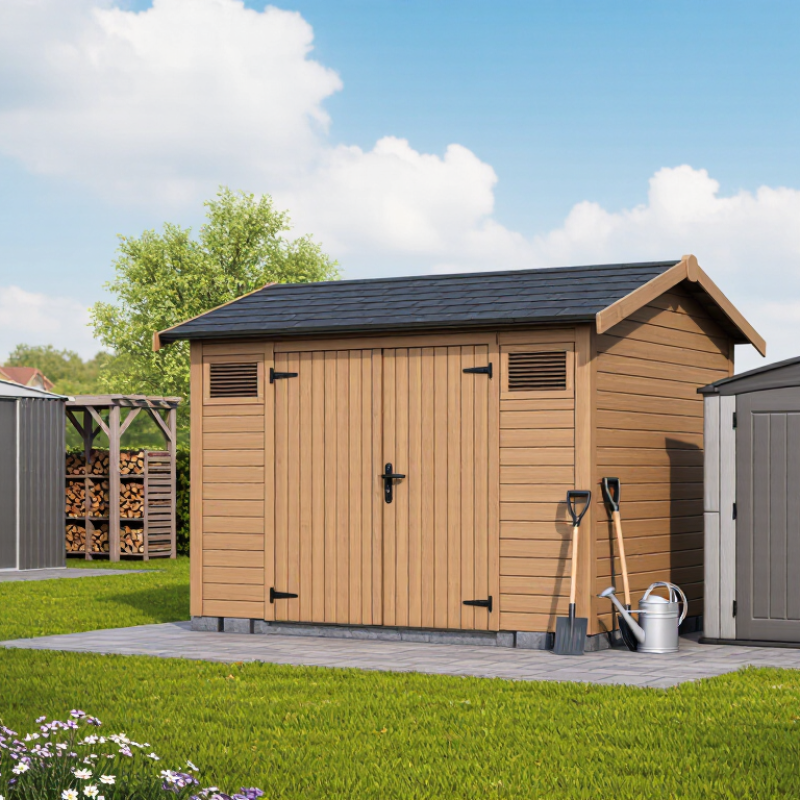
A garden shed is a small outdoor structure for storing tools, protecting equipment, or supporting a hobby. Its best design depends on how it will be used. A mower needs a wide, clear doorway; potting work needs daylight, ventilation, and a sturdy bench. An 8 × 10 ft footprint provides 80 square feet before wall thickness and framing reduce the usable floor area. That distinction matters. Shelves, door swings, and bulky items can quickly make the interior feel tight.
Material affects maintenance, weight, and comfort. Wood is easy to customize and can suit a garden setting, but it needs regular checks for moisture and surface wear. Metal is often lightweight and low-maintenance, though it may heat up in direct sun or become noisy in heavy rain. Resin resists rot and is simple to clean, but verify that the floor and panels feel sturdy enough for your planned load. No material is perfect.
Tips: Measure the largest item first, then mark an 8 × 10 ft outline on the ground. Check access for delivery, drainage after rain, and space beneath the roof. Allow room to open the door fully. A shed can look roomy on paper and still disappoint in daily use.

For global buyers, ISO 9227 offers a practical way to compare corrosion resistance in steel garden sheds. It describes controlled salt-spray tests, including neutral salt spray (NSS), using prepared samples inside a chamber. The test can reveal coating defects, rust creep, or blistering under specified conditions. Small details matter: panel preparation, coating thickness, exposed edges, and test duration should be consistent across suppliers. A higher number of test hours is not, by itself, proof of a longer outdoor service life.
Tips: Ask for the ISO 9227 method used, the test duration, and a report showing the tested coating system. Check whether the sample included cut edges or scratches. Compare like with like.
Salt spray is useful evidence, but it does not recreate every garden’s conditions. Rain, standing water, coastal air, and damaged fasteners can affect a shed differently. I would treat test results as one checkpoint, not a final ranking. A glossy panel may look reassuring; still, the weakest seam or screw head can be the first place corrosion appears. Some reports also leave sample details unclear, which makes comparison less reliable.
When comparing garden shed manufacturers, treat ISO 9001:2015 as evidence of managed processes, not proof that every shed is flawless. Ask for a current certificate and confirm its scope covers the factory and relevant production activities. Check the issuing body and validity dates, then request inspection records for timber moisture, panel dimensions, coating thickness, and fasteners. Details matter. A neat certificate can still leave questions about change control or subcontracted work. Ask how defects are recorded, corrected, and prevented from recurring.
Warranty terms deserve the same close reading as materials. Compare coverage for the frame, roof, doors, and finishes, since each may have different limits. Look for installation conditions, maintenance duties, transport-damage deadlines, and exclusions for weather exposure. Get the remedy in writing: repair, replacement parts, or refund, and clarify who pays shipping. Read closely. A long warranty may sound strong, yet narrow exclusions can make it less useful. Check whether claims go through the manufacturer or a local distributor, and whether service remains available after delivery. Keep specifications, dated photographs, and correspondence together. Buyers sometimes focus on the headline term and skip the small print. That mistake is easy to make.
This comparison is a supplier-evaluation checklist, not a verified ranking of named manufacturers. ISO certification and warranty coverage are manufacturer- and product-specific; confirm them with current certificates and written warranty documents before purchase.
| No. | Assessment Dimension | Evidence to Request | ISO 9001:2015 Quality Check | Warranty Terms to Compare |
|---|---|---|---|---|
| 1 | Certification validity | A current certificate showing the certified legal entity, certification body, certificate number, issue date, and expiry or validity status. | Verify the certificate directly with the issuing certification body or its certificate directory. Certification applies to the stated scope and locations. | Check which legal entity is responsible for honoring the warranty and how claims are submitted. |
| 2 | Certification scope | The certificate’s scope statement and the addresses of the sites involved in design, manufacture, or related services. | Confirm that the scope and covered site are relevant to the shed being quoted. ISO 9001 certifies a quality management system, not a particular shed or its performance. | Confirm that the warranty explicitly covers the quoted model and configuration. |
| 3 | Product specifications | Model-specific drawings, dimensions, material specifications, assembly instructions, and a dated quotation. | Check whether document control and change management are covered by the supplier’s quality system; request confirmation of the final production specification. | Compare the warranty version and coverage against the exact materials, options, and configuration quoted. |
| 4 | Material identification | Material grades or types, thicknesses, finish descriptions, and supplier or batch traceability where applicable. | Ask how incoming materials are checked and how nonconforming materials are controlled. These are supplier-process checks, not guarantees created by the certificate alone. | Identify any exclusions for corrosion, rot, fading, or damage caused by unsuitable installation or maintenance. |
| 5 | Production consistency | Inspection records, production checks, and the supplier’s process for correcting defects or nonconforming output. | Ask for evidence that inspection and corrective-action processes apply to the manufacturing site producing the order. | Check whether a remedy is available for manufacturing defects and whether the supplier may repair, replace, or refund affected parts. |
| 6 | Structural and load information | Documented load limits or test information relevant to the intended use and local conditions, where applicable. | Confirm that the supplied technical documents match the purchased model. ISO 9001:2015 does not itself establish shed-specific structural ratings. | Review exclusions related to overloading, severe weather, foundation conditions, and use outside the stated instructions. |
| 7 | Finish and weather protection | Written details of coatings, treatment, maintenance requirements, and any applicable product test reports. | Check how the supplier controls finish application and records inspection results; request product-specific evidence for any performance claims. | Compare coverage for finish deterioration with exclusions for normal wear, environmental exposure, and missed maintenance. |
| 8 | Warranty duration and start date | A complete written warranty stating the coverage period for each component and when coverage begins. | ISO 9001:2015 does not set a minimum product-warranty duration. Assess the supplier’s written terms separately from its certification. | Compare component-specific periods, start dates, registration requirements, and any deadlines for reporting damage. |
| 9 | Warranty exclusions and remedy | The full warranty document, including exclusions, required maintenance, claim evidence, and remedy options. | Check that the seller’s stated terms are provided in a controlled, current document and match the sales contract. | Compare exclusions, labor and replacement-part coverage, shipping costs, transferability, and whether the remedy is repair, replacement, or refund. |
| 10 | International delivery and support | Written confirmation of export packaging, delivery terms, spare-parts availability, support contacts, and claims handling for the destination country. | Verify which sites and processes are covered by the certificate; do not assume certification guarantees overseas after-sales service. | Confirm who pays for inspection, return freight, replacement parts, and local labor when a claim is made internationally. |
Garden shed manufacturers serve different needs, from compact resin lockers to timber workshops and large modular storage buildings. Their product ranges often vary by roof style, wall thickness, floor support, ventilation, and available dimensions. These details matter. A narrow garden may need sliding doors, while a workshop benefits from daylight panels and stronger floor framing. Global buyers should also check where products are made, how they ship, and whether replacement parts are available in their region. Coastal humidity, heavy rain, and seasonal snow can affect material choice. Catalog photos can mislead; even careful checks may miss small installation details.
Tips: Request a written specification, packed dimensions, and clear assembly instructions. Confirm the delivery method and who handles unloading. Ask about spare panels and hardware before ordering.
Compare manufacturers by product fit and market experience, not by price alone. A low-cost shed may need extra flooring or anchoring, changing its real cost. For overseas orders, verify stated measurements, packaging protection, and lead times with the seller. Local import duties and site preparation also affect the final budget. Some specifications remain unclear until you ask directly. That is worth noting, not ignoring. A useful shortlist matches the shed’s materials and construction to the buyer’s climate, intended use, and available installation support.
A shed that looks simple in a catalog can become complicated at the border. Before placing an order, ask the manufacturer for export documents, including a commercial invoice, packing list, country-of-origin details, and clear product specifications. Request the packed dimensions and weight, too. A pallet that exceeds a warehouse door can disrupt delivery plans. Check whether timber packaging needs treatment documents, and confirm who handles customs clearance and freight charges. Small details matter.
Do not assume every prefabricated shed uses HS code 9406. That heading may be relevant to certain prefabricated buildings, but classification depends on the product’s materials, construction, and how it is presented for import. A steel-framed garden room and a flat-packed wooden shed may not receive identical treatment. Ask a licensed customs broker or the destination country’s customs authority to confirm the classification before shipment. A supplier’s estimate is useful, not final. This distinction is easy to miss.
Local building rules deserve the same attention. Check zoning, permit thresholds, boundary setbacks, foundation requirements, and limits on height or floor area. Wind, snow, and fire-safety rules can affect the design, even when the shed is small. Ask for drawings showing anchors, roof loads, and door clearances. Keep the answers in writing. Requirements vary by location, and an attractive installation plan may still overlook one local detail. I would verify twice.
A practical checklist for comparing manufacturers and preparing for import and installation.
Bars count the checklist items shown for each area; they are not manufacturer ratings or country-specific legal requirements. HS 9406 may be relevant to prefabricated buildings, but classification depends on the product and customs rules. Confirm the tariff classification, import documentation, and local planning and building-code requirements for the destination.


For those larger-sized parts, or smaller quantity runs, we have 2 independent powder coat booths and ovens. The quality, durability and affordability of today’s powder coating finishes make this the process of choice for world-class companies.
Powder coating advantages over other forms of coating are many. Materials used in the Powder coating process can be metals and non-metals that come in a multitude of thicknesses, textures, colors, etc. Another of Powder coating’s biggest advantages over conventional coatings is its ability to create finishes in many different textures. Powder Coating Booths allow us the ability to apply these advantages to large products.
Tri-State Fabricators runs a full-service conveyor line for painting. Wet painting can provide protection or decoration to many different part styles. From start to finish, every project is easier to undergo random and point-based inspection by our skilled painting team.
Advantages to our Wet Paint Line are these lines start with product prep and ends with a thorough inspection of a high quality finished product. Our ability to complete large and small projects with a superior finish and doing so in a timely and economical fashion. This passes along the savings in production to our customers. When powder coating ins not an option, our Wet Paint Line gets the job done right the first time.
When the parts get big and heavy we roll-out our custom paint racks and oversize booth. By utilizing our partnerships with all the major paint brands, we can match virtually any color with wet paint.
The advantages of having access to a Wet Paint Booth are many. Large projects of many different shapes can be loaded into the booth. The Wet Paint Booth offers an environment that is much more controlled than a typical parts painting operation.
Not only are they used because of their controlled environment, but they’re are also advantageous when it comes to applying paint to parts that are needed in industries that require specialty coatings such as medical, aerospace, etc.
Our military forces have some very high standards when it comes to the finish of their vehicles and equipment. From the first pre-treatment step to final coat, it takes a great deal of knowledge and experience to protect the men and women of our armed forces. They deserve only the best, and Tri-State Fabricators provides it.
All of our processes are closely monitored by our staff and management teams. Both of which are highly trained in the processes of metal fabrication and finishing. Tri-State Fabricators’ goal is to always fully satisfy each and every customer, including the military. We will always put a 110% into what we do.
Abrasive media blasting is an excellent way to remove old paint, rust, and increase the paint/powder adhesion. Glass beads produce a much smoother and brighter finish than angular abrasives; leaving the part clean yet without any dimensional change. Chemically inert and environmentally friendly, we can recycle our beads approximately 30 times; making them a more preferred method of metal cleaning or surface finishing.
Advantages to Glass Bead Blasting are many. Glass bead blast media is used when a project is needing rough surfaces need to become smooth for applications of coatings such as paint. It is typically used to clean paint and rust from a product surface without deforming the surface it is being used on. Overall, compared to many other blasting media, Glass Bead Blasting is a very economical choice and those savings are always passed on to our customers.
Tri-State Fabricators utilize a zinc phosphate wash to clean and etch the material to ensure the best paint adhesion possible. The unique design of our 3-stage wash system does the work like a 5-stage. From Cleaning and rinsing to conversion coating and post-treatment, Our Part Washing process is a complete service and works throughout the fabrication service and the finishing service.
Along with the previously mentioned benefits, Curing is a vital chemical reaction that leaves the product finish hard and relatively safe from mild abrasion and aggressive corrosion. This process can be done in more than one way; ambient air-dry or in curing ovens at temps that exceed 240°.
From fixing paint mistakes (someone else’s of course) to simply cleaning our paint line hooks, our burn-off oven is put to good use. After a quick burn-off, a little clean up, and a fresh coat of paint, your parts will look better than new.
Why does our Burn-Off Oven work so well? Because super heating the air around parts turns the materials into ashes. From paint and powder coatings to rubber and machining oils, high temps do the job without degrading the integrity of the part.
Masking is a vital part of producing high quality products. We have die-cut masking patterns to protect machined surfaces as well as a wide range of plugs and caps to protect threaded holes and bolts. We provide permanent and temporary masking.
Masking allows the selected sections of a product to be protected from a fabrication or finishing service. This can be with both chemicals when etching and tapes, paints when only finishing just a section of the product. Masking is great in aiding the customization process of a project.
Screen printing is a photographic process that transfers artwork onto a porous nylon screen which allows colored ink to flow through the screen and be deposited on an aluminum or plastic component. We can generally have just about any design created onto a screen for your parts.
Some of the advantages of Screen Printing are, brand recognition for your business displaying on your products, assembly instructions, product warnings/hazards, etc. Tri-State Fabricators produces Screen Printing of the highest quality so you know it’s durable.
Metal Finishing is the art of treating the exterior portion of product, often metal but can also be made of other materials, so that the surface is clean and free of any debris. Then the process of applying coats or either paint of powder coat takes place. This coating process improves the quality of the product in both appearance and resistance to wear and corrosion.
Tri-State Fabricators, Inc., understands that a project typically isn’t complete until a high-quality finish has been added to your product. This is why our painting and powder coating teams continuously inspect the products throughout the Metal Finishing process.

