


Choosing a Filter Basket supplier in China takes more than comparing prices and polished product photos. The right partner must understand the application, document materials, and produce repeatable dimensions. A basket can look flawless on a sample table. Under pressure, it may tell a different story.
For this introduction, filtration sourcing specialist Lin Wei is presented as a fictional expert voice, not a verifiable industry authority. The practical reminder is: “A basket that matches the drawing but fails in service is not a successful purchase.” Buyers should check mesh size, wire grade, weld quality, tolerances, and finish against clear specifications. Ask how the supplier controls production between sample approval and repeat orders. Request material records and inspection results where relevant. Then compare lead times, packaging, and communication—not price alone.
Details matter. A small weld bead can snag debris; an uneven rim can prevent a secure fit. Request close-up photographs, dimensional reports, and a pre-production sample. If possible, arrange an independent inspection. Still, no checklist removes every risk. I would not treat a confident sales reply as proof of factory capability; that assumption is easy to make and hard to defend. This guide will help buyers assess supplier experience, production controls, quality evidence, and practical responsiveness before committing. The goal is not to find the cheapest basket. It is to find a supplier whose process can be checked, discussed, and improved when something falls short. A little caution helps.
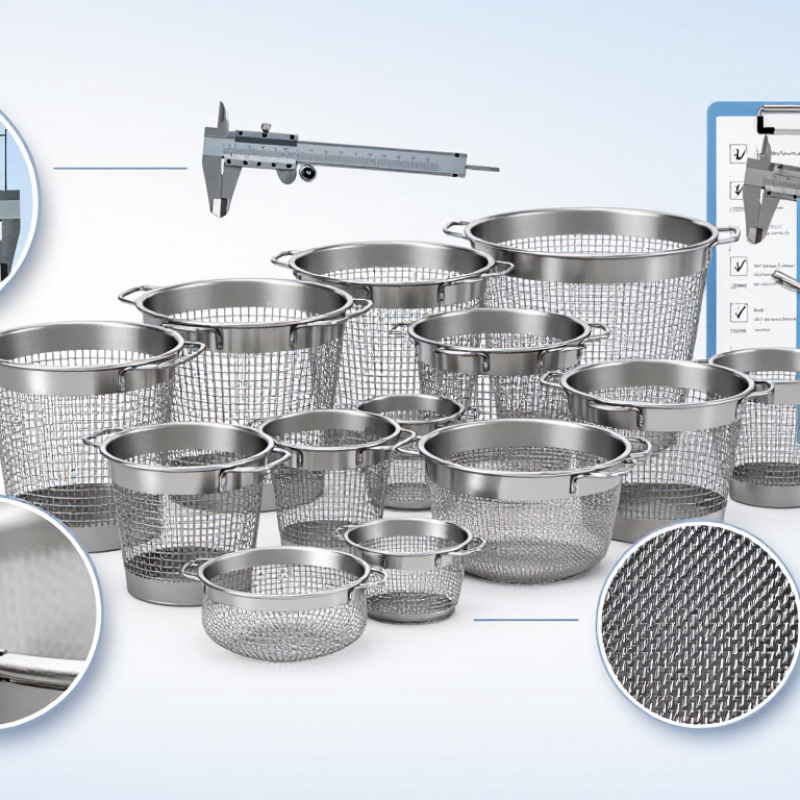
When comparing filter basket suppliers in China, begin with the dimensions of your actual housing, not a catalog image. Specify the basket’s outer diameter, height, rim shape, handle clearance, and connection points. Small errors matter. A basket that is only a few millimeters too wide may jam when hot or loaded with debris. Ask the supplier to confirm tolerances on a dimensioned drawing before production.
Micron rating should match the particles you need to capture and the flow your process can tolerate. A finer mesh may reduce flow or clog sooner, especially with viscous liquids. Define whether the rating is nominal or absolute, and request mesh data or a sample for inspection. I used to focus too much on the stated micron number; the open area and wire thickness matter too. Test it wet.
Provide the target flow rate and the fluid’s operating conditions, including temperature and viscosity. Then state the design pressure and any pressure spikes the basket may encounter. Ask how the supplier verifies deformation resistance and weld quality, and request test records tied to the proposed material and construction. A pressure value without test conditions tells you little. If the first specification feels incomplete, revise it with your process engineer before requesting a final quotation.

When evaluating a filter basket supplier in China, compare the quoted opening with a recognized measurement standard—not just a “mesh count.” ASTM E11’s standard sieve series lists nominal openings from 20 μm to 125 mm, with specified tolerances for test sieves. Ask for the exact aperture, wire diameter, material, and inspection method. A 200 μm opening made with thicker wire can behave differently from one made with finer wire, even when both are described as the same mesh size.
Check the supplier’s inspection records against the relevant ASTM E11 opening and tolerance tables. Request a sample report showing measured openings, not only a general certificate. For example, ask how the supplier checks several points across the basket, including near seams where openings may distort. Note that ASTM E11 is a test-sieve specification; it is a useful reference, but it does not automatically certify every filter basket. A small mismatch can matter.
Tips: Send a drawing with the target opening and tolerance, then confirm whether the basket uses woven mesh or perforated sheet. Ask for photographs under magnification and a measurement report tied to the sample lot. If the supplier cannot explain the measuring method, pause. It may be worth checking the details again.
Selected nominal openings shown on a logarithmic scale.
These are selected nominal opening sizes from the ASTM E11 sieve series, converted to micrometers for comparison. When evaluating a filter basket supplier, confirm the requested opening size, applicable tolerances, and inspection documentation against the current standard.
When comparing filter basket suppliers in China, start with the steel grade, not the quoted price. Type 304 stainless steel suits many general-purpose applications, including clean water and indoor filtration. Type 316L contains about 2–3% molybdenum, which improves resistance to chloride-related pitting. That difference matters near saltwater, coastal air, or chloride-bearing process fluids. It is not a guarantee against corrosion.
Ask suppliers to identify the grade on material certificates and explain how they verify it. A handheld alloy analyzer can help check incoming material, while certificates support traceability. For welded baskets, 316L’s low carbon content can reduce the risk of weld-related corrosion. Still, poor welds, rough edges, or trapped residue can undermine either grade. Details matter.
Request a sample with the proposed mesh, wire diameter, seam, and finish. Inspect the openings under steady light; uneven spacing can affect filtration. Ask how the basket is cleaned after fabrication, especially if the process leaves heat tint or polishing residue. Small checks. Also consider fluid temperature, cleaning chemicals, and exposure time before choosing a grade. I would not assume 316L is always the better purchase: for mild conditions, 304 may be adequate, while harsh service needs a more specific corrosion review.
When evaluating a filter basket supplier in China, treat ISO 9001:2015 as a starting point, not proof of product quality. Ask to see the current certificate, its scope, issuing body, and latest surveillance record. Check that the listed site actually makes or inspects the baskets. A certificate can be valid while a process remains inconsistent. That matters.
Walk the production records from incoming wire or sheet to packed basket. Material certificates should identify the grade, heat or lot number, and material source. Operators should link those details to job cards and finished batches. Try a sample trace exercise: select a basket and ask staff to retrieve its material record, drawing revision, inspection results, and shipment date. Notice how long it takes. If records depend on one person’s memory, traceability is fragile.
Review inspection methods, not just a polished quality manual. Ask how aperture size, weld strength, dimensions, burrs, and corrosion resistance are checked. Confirm that measuring instruments are calibrated. Request recent test reports for comparable production, with acceptance limits and records of corrective actions. A video call can show gauges and inspection stations, but it cannot replace an on-site audit when volumes or risks are high. Compare several production samples, too; one perfect sample proves little. No audit catches everything. Leave room for follow-up.
Supplier audit checklist for filter baskets. Review objective evidence against the product specification, drawing, and agreed purchase requirements.
| Audit Dimension | What to Verify | Objective Evidence to Request | Evaluation Record |
|---|---|---|---|
| ISO 9001:2015 certification | Confirm the certificate is current and its stated scope covers relevant manufacturing or processing activities. | Certificate, issuing certification body, validity dates, stated sites and scope. Verify certificate details with the issuer or an appropriate accreditation directory where available. | Certificate valid: ☐ Yes ☐ No Scope relevant: ☐ Yes ☐ No Notes: __________ |
| Quality management processes | Check that documented processes control orders, drawings, production changes, inspection, and product release. | Process map or procedures; a sample order-to-inspection record; revision-controlled drawing and specification; evidence that changes are reviewed and communicated. | Records reviewed: __________ Gaps: __________ |
| Control of external providers | Review how the supplier selects and monitors outside providers for wire mesh, sheet, welding, surface treatment, or other outsourced work. | Approved-provider criteria, purchase requirements, incoming inspection records, and examples of actions taken when supplied material or services failed requirements. | Controls adequate: ☐ Yes ☐ No Notes: __________ |
| Material identification and traceability | Confirm that material identity can be linked from receipt through production to the finished basket, at the level agreed for the order. | Receiving records and lot or heat identification; traceability example linking a finished item or batch to its material records; documented handling of mixed or unidentified material. | Traceability demonstrated: ☐ Yes ☐ No Sample reference: __________ |
| Material certificates | Check that the supplied grade and product form match the purchase specification and that certificates relate to the delivered material. | Material test certificate or other agreed material documentation, such as an EN 10204 3.1 inspection certificate where specified; matching grade, heat or lot reference, and supplier records. | Grade matches specification: ☐ Yes ☐ No Documents complete: ☐ Yes ☐ No |
| Incoming and in-process inspection | Verify inspection points are defined for relevant characteristics, such as wire diameter, mesh opening, basket dimensions, welds, and finish. | Inspection plan, acceptance criteria tied to the approved drawing or specification, completed inspection records, and examples of measured results. | Inspection records reviewed: __________ Notes: __________ |
| Measuring equipment | Check that instruments used for acceptance decisions are suitable, identified, and maintained or calibrated as appropriate. | Equipment list; calibration or verification records; instrument identification on sample inspection records; actions taken for equipment found out of tolerance. | Equipment controls adequate: ☐ Yes ☐ No Notes: __________ |
| Product and performance testing | Agree tests and acceptance limits before production. For filtration performance, define the test method and conditions rather than relying on an unexplained micron-rating claim. | Test procedure and report identifying the sample, method, conditions, results, and acceptance criteria. Depending on the specification, tests may address dimensions, flow, retention, or other defined performance characteristics. | Method agreed: ☐ Yes ☐ No Report available: ☐ Yes ☐ No |
| Corrosion or surface testing | Where required by the application, verify that the test method, exposure conditions, and acceptance criteria are specified and relevant to the agreed material and finish. | Applicable test standard or agreed procedure, test conditions, sample identification, results, and disposition. Do not treat an unspecified corrosion test as proof of suitability for every service environment. | Required for this order: ☐ Yes ☐ No Evidence reviewed: __________ |
| Nonconforming product and corrective action | Check how defects are identified, segregated, reviewed, and corrected, and how recurring problems are investigated. | Nonconformance records, disposition and rework approvals where applicable, corrective-action examples, and verification that corrective actions were effective. | Process demonstrated: ☐ Yes ☐ No Notes: __________ |
| Final release and shipment records | Confirm finished goods are released against agreed requirements and can be matched to the order and shipment. | Final inspection or release record; product identification; packing list; batch or lot reference where required; and records of any approved deviation. | Release evidence complete: ☐ Yes ☐ No Notes: __________ |
| Audit conclusion | Summarize evidence, unresolved risks, and any corrective actions before approval or order placement. | Record the audit date, documents sampled, open findings, responsible person, and due date for each action. | Decision: ☐ Approve ☐ Conditional ☐ Hold Follow-up date: __________ |
Scoring option: If a numerical score is useful, apply the same documented scale to every audit item—for example, 0 = no adequate evidence, 1 = partial evidence or action required, and 2 = adequate evidence observed. Set approval thresholds internally; ISO 9001:2015 certification alone does not guarantee that a particular product meets its specification.
Compare Samples, MOQ, Lead Time, and Total Cost Before Supplier Selection
A useful comparison starts with one clear specification sheet. List basket diameter, height, mesh size, material, finish, and handle dimensions. Send the same requirements to each supplier. This makes quotations easier to compare. Ask for physical samples, not just photos. Check whether the rim sits flat, the mesh feels even, and the handle stays secure when the basket is full. Small details matter.
MOQ can change the real cost. A low unit price may require an order larger than your storage space or sales forecast supports. Ask whether the supplier can offer a trial quantity, and confirm if setup fees apply. Lead time needs similar care. Request separate estimates for sample preparation, production, inspection, and shipping. Build in extra time for revisions. Delays happen.
Compare the total landed cost, including packaging, tooling, freight, and any inspection charges. Ask for an itemized quotation and confirm the currency and quote validity period. One limitation is easy to miss: a sample may be hand-finished, while bulk units follow a faster process. Ask how production pieces will be checked and what happens if dimensions fall outside the agreed tolerance. Recheck the sample against your actual filter holder before approving the order.


For those larger-sized parts, or smaller quantity runs, we have 2 independent powder coat booths and ovens. The quality, durability and affordability of today’s powder coating finishes make this the process of choice for world-class companies.
Powder coating advantages over other forms of coating are many. Materials used in the Powder coating process can be metals and non-metals that come in a multitude of thicknesses, textures, colors, etc. Another of Powder coating’s biggest advantages over conventional coatings is its ability to create finishes in many different textures. Powder Coating Booths allow us the ability to apply these advantages to large products.
Tri-State Fabricators runs a full-service conveyor line for painting. Wet painting can provide protection or decoration to many different part styles. From start to finish, every project is easier to undergo random and point-based inspection by our skilled painting team.
Advantages to our Wet Paint Line are these lines start with product prep and ends with a thorough inspection of a high quality finished product. Our ability to complete large and small projects with a superior finish and doing so in a timely and economical fashion. This passes along the savings in production to our customers. When powder coating ins not an option, our Wet Paint Line gets the job done right the first time.
When the parts get big and heavy we roll-out our custom paint racks and oversize booth. By utilizing our partnerships with all the major paint brands, we can match virtually any color with wet paint.
The advantages of having access to a Wet Paint Booth are many. Large projects of many different shapes can be loaded into the booth. The Wet Paint Booth offers an environment that is much more controlled than a typical parts painting operation.
Not only are they used because of their controlled environment, but they’re are also advantageous when it comes to applying paint to parts that are needed in industries that require specialty coatings such as medical, aerospace, etc.
Our military forces have some very high standards when it comes to the finish of their vehicles and equipment. From the first pre-treatment step to final coat, it takes a great deal of knowledge and experience to protect the men and women of our armed forces. They deserve only the best, and Tri-State Fabricators provides it.
All of our processes are closely monitored by our staff and management teams. Both of which are highly trained in the processes of metal fabrication and finishing. Tri-State Fabricators’ goal is to always fully satisfy each and every customer, including the military. We will always put a 110% into what we do.
Abrasive media blasting is an excellent way to remove old paint, rust, and increase the paint/powder adhesion. Glass beads produce a much smoother and brighter finish than angular abrasives; leaving the part clean yet without any dimensional change. Chemically inert and environmentally friendly, we can recycle our beads approximately 30 times; making them a more preferred method of metal cleaning or surface finishing.
Advantages to Glass Bead Blasting are many. Glass bead blast media is used when a project is needing rough surfaces need to become smooth for applications of coatings such as paint. It is typically used to clean paint and rust from a product surface without deforming the surface it is being used on. Overall, compared to many other blasting media, Glass Bead Blasting is a very economical choice and those savings are always passed on to our customers.
Tri-State Fabricators utilize a zinc phosphate wash to clean and etch the material to ensure the best paint adhesion possible. The unique design of our 3-stage wash system does the work like a 5-stage. From Cleaning and rinsing to conversion coating and post-treatment, Our Part Washing process is a complete service and works throughout the fabrication service and the finishing service.
Along with the previously mentioned benefits, Curing is a vital chemical reaction that leaves the product finish hard and relatively safe from mild abrasion and aggressive corrosion. This process can be done in more than one way; ambient air-dry or in curing ovens at temps that exceed 240°.
From fixing paint mistakes (someone else’s of course) to simply cleaning our paint line hooks, our burn-off oven is put to good use. After a quick burn-off, a little clean up, and a fresh coat of paint, your parts will look better than new.
Why does our Burn-Off Oven work so well? Because super heating the air around parts turns the materials into ashes. From paint and powder coatings to rubber and machining oils, high temps do the job without degrading the integrity of the part.
Masking is a vital part of producing high quality products. We have die-cut masking patterns to protect machined surfaces as well as a wide range of plugs and caps to protect threaded holes and bolts. We provide permanent and temporary masking.
Masking allows the selected sections of a product to be protected from a fabrication or finishing service. This can be with both chemicals when etching and tapes, paints when only finishing just a section of the product. Masking is great in aiding the customization process of a project.
Screen printing is a photographic process that transfers artwork onto a porous nylon screen which allows colored ink to flow through the screen and be deposited on an aluminum or plastic component. We can generally have just about any design created onto a screen for your parts.
Some of the advantages of Screen Printing are, brand recognition for your business displaying on your products, assembly instructions, product warnings/hazards, etc. Tri-State Fabricators produces Screen Printing of the highest quality so you know it’s durable.
Metal Finishing is the art of treating the exterior portion of product, often metal but can also be made of other materials, so that the surface is clean and free of any debris. Then the process of applying coats or either paint of powder coat takes place. This coating process improves the quality of the product in both appearance and resistance to wear and corrosion.
Tri-State Fabricators, Inc., understands that a project typically isn’t complete until a high-quality finish has been added to your product. This is why our painting and powder coating teams continuously inspect the products throughout the Metal Finishing process.

