


What Is the Best Explosion Proof LED Floodlight in 2026?

Choosing the best explosion-proof LED floodlight in 2026 means looking beyond wattage and lumen claims. In a refinery walkway or grain-processing area, the wrong fixture can leave dark patches, create glare, or fail under heat, dust, and vibration. The right choice starts with the site’s classified hazard, required light levels, ambient temperature, and mounting height.

The U.S. Department of Energy’s 2020 U.S. Lighting Market Characterization tracks installed lighting and energy use, offering useful context for evaluating LED upgrades. For product performance, compare test data such as IES LM-79 photometry with the fixture’s hazardous-location certifications and temperature ratings. IEC 60079 series requirements also provide a technical framework for equipment used in explosive atmospheres. Certification details matter.

Lighting researcher Dr. Mariana Figueiro has described light as “the most powerful synchronizer of the human circadian system.” Her comment concerns human light exposure, not hazardous-area equipment, but it reinforces a practical point: lighting quality affects people as well as energy use. Still, there is no single floodlight that suits every site. A high-lumen model may perform poorly if its beam pattern causes harsh shadows or its thermal limits do not fit the environment. This guide compares the features that deserve close scrutiny: verified protection markings, measured output, beam distribution, thermal performance, materials, and serviceability. Treat supplier claims as starting points, not proof. Check the certificate and test report.
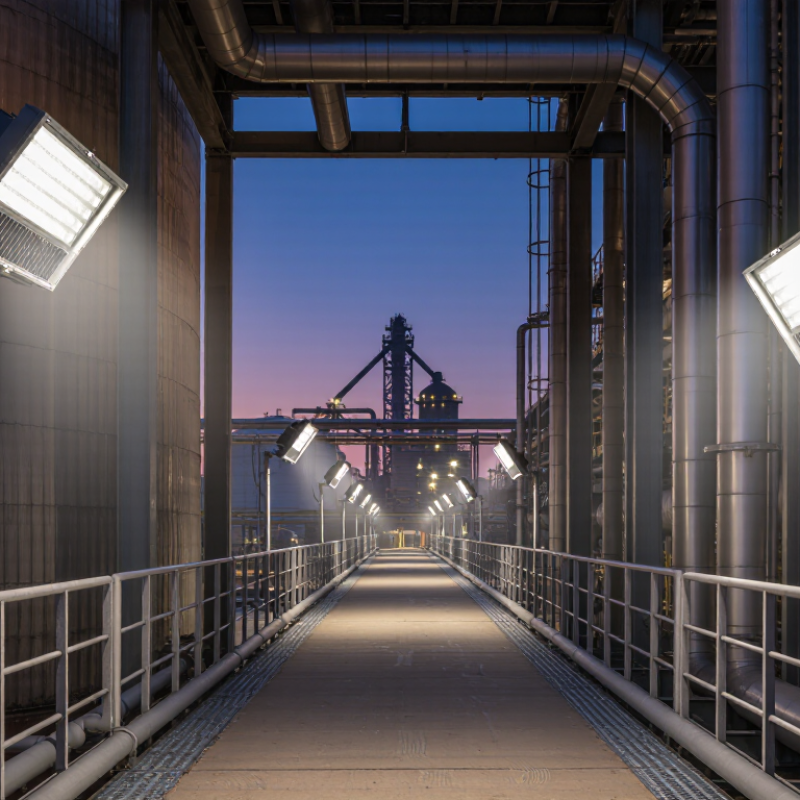
What Is the Best Explosion Proof LED Floodlight in 2026?

What Defines an Explosion-Proof LED Floodlight

What defines an explosion-proof LED floodlight is not a rugged-looking housing. It is a tested assembly designed to contain an internal ignition and prevent flames from igniting the surrounding atmosphere. Under IEC 60079-0 and IEC 60079-1, equipment must meet requirements for construction, testing, and flameproof enclosures. The exact protection method matters: a fixture approved for one gas group or temperature class may not suit another. Dust hazards require their own assessment.

A proper selection starts with the site classification, then checks the fixture’s certification, gas or dust group, temperature rating, and ambient-temperature range. Cable entries and glands must match the enclosure approval; a mismatched fitting can undermine the protection. Efficiency is useful, but it does not prove safety. The U.S. Department of Energy’s 2022 Energy Savings Forecast of Solid-State Lighting projected annual U.S. LED savings of about 569 TWh by 2035. That is an energy forecast, not an explosion-safety rating. The label is important, but it is not the whole story.

Tips: Before installation, compare the nameplate with the site documents and inspect seals, entries, and mounting points. Small details matter. If the classification is unclear, pause and ask a qualified hazardous-area professional.


How Hazardous-Area Classifications and Certifications Work

An explosion-proof LED floodlight is suitable only when its certification matches the actual hazardous area. A site’s classification considers what combustible gas, vapor, dust, or fibers may be present, and how often. A paint-mixing room and a grain-handling area can require different equipment. The distinction matters.

In the Class and Division system, Class identifies the material type, while Division describes how often it may occur. Zone systems use different categories and terminology. Gas or dust groups further distinguish substances by ignition behavior. Temperature ratings also matter: the fixture’s hottest surface must remain below the ignition temperature of the surrounding material. These systems are not interchangeable. I still find this easy to overlook when comparing fixtures by wattage or brightness alone.

Check the certification marking and documentation for the exact model, not just the product family. Confirm the approved area, material group, temperature rating, and operating limits, including ambient temperature. A certified light can still be unsuitable if installed outside its stated conditions. Look closely at cable entries, mounting hardware, and seals; small installation details matter in the field. If a site drawing or marking is unclear, ask a qualified safety professional or the relevant certification body to verify it before selection.

Which Lighting and Safety Specifications Matter

Choosing an explosion-proof LED floodlight starts with the site’s documented hazard classification, not the fixture’s lumen rating. Confirm that its certification matches the specific gas or dust hazard, area classification, temperature class, and ambient temperature range. Check the product marking against the site assessment; similar-looking ratings are not interchangeable.

An IP rating describes resistance to dust and water, but it does not prove protection against ignition. That matters.

For lighting performance, compare delivered lumens, beam angle, and mounting height with the actual work area. A tight beam may leave dark corners, while excessive glare can make inspection harder. Check the label. Also review enclosure materials, corrosion resistance, operating temperature, and driver specifications.

Heat can affect component life, especially in enclosed or hot locations. Ask how the fixture is serviced and whether its weight suits the support structure. A higher lumen figure can look convincing on paper; it may not suit the space.

I would reassess the choice after checking a lighting layout and the site’s exact classification with a qualified electrical professional.

How to Compare Explosion-Proof Floodlights in 2026

What Is the Best Explosion Proof LED Floodlight in 2026?

How to Compare Explosion-Proof Floodlights in 2026

A useful comparison starts with the site, not the brightest number on a product sheet. Check the hazardous-area marking against the site assessment, including gas or dust classification and temperature requirements. Then compare measured light output, beam angle, and uniformity. A narrow beam may suit a loading bay, while a broad pattern can reduce dark patches around equipment. Ask for test reports and installation instructions, not just marketing claims. Small detail. It matters.

Look at the full operating conditions. Compare ambient-temperature limits, enclosure rating, corrosion resistance, and impact protection for the actual location. A coastal plant or washdown area may need different protection than a dry indoor process room. Check whether the driver and seals are replaceable, and whether the fixture can be serviced without removing nearby equipment. Efficiency matters, but so do lumen maintenance and expected operating life. Published figures may depend on test conditions, so request the conditions behind them.

Finally, compare installation and lifecycle costs, not only purchase price. Review mounting options, wiring access, weight, and maintenance clearances before choosing. Confirm that the exact fixture configuration is suitable for the designated area with a qualified electrical professional. One weak point in many comparisons: buyers sometimes assume two products with similar wattage deliver similar light. They may not. Match photometric data to the work surface, and leave room to reassess after an on-site lighting check.

What Is the Best Explosion-Proof LED Floodlight in 2026?

How to compare IP dust and water protection ratings when evaluating floodlights

The chart shows the separate dust and water digits defined by IEC 60529; these digits are protection-code levels, not a performance score. IP68 immersion conditions are specified by the manufacturer. An IP rating alone does not certify a light for hazardous locations—also verify the required explosion-protection certification, gas or dust group, and temperature class for the installation.

How to Choose the Best Floodlight for Your Application

What Is the Best Explosion Proof LED Floodlight in 2026?

How to Choose the Best Floodlight for Your Application

The best floodlight starts with the actual hazard, not the lumen rating. Confirm the area’s classification, gas or dust group, temperature limits, and required protection marking with a qualified site professional. A fixture suitable for one zone may be unsuitable for another. That detail matters.

Next, match light output and beam angle to the task. A narrow beam can reach a loading bay, while a wider distribution can reduce dark patches around pumps and walkways. Check mounting height, glare, ambient temperature, corrosion, and lens-cleaning access.

DOE’s 2023 Energy Savings Forecast of Solid-State Lighting projects up to 5.1 quads of annual U.S. energy savings by 2035 from wider solid-state lighting adoption. This is a forecast, not a promise for any single site.

Look for independent certification appropriate to the installation, plus clear photometric files and maintenance guidance. Compare delivered lumens, not just input watts. Check the heat. Dusty lenses and pipe shadows can undermine a neat lighting plan; a night-time site walk often reveals what drawings miss. Revisit the specification after installation, because the first layout may not be perfect.

Powder Coat Booths

For those larger-sized parts, or smaller quantity runs, we have 2 independent powder coat booths and ovens. The quality, durability and affordability of today’s powder coating finishes make this the process of choice for world-class companies.

Powder coating advantages over other forms of coating are many. Materials used in the Powder coating process can be metals and non-metals that come in a multitude of thicknesses, textures, colors, etc. Another of Powder coating’s biggest advantages over conventional coatings is its ability to create finishes in many different textures. Powder Coating Booths allow us the ability to apply these advantages to large products.

Wet Paint Line

Tri-State Fabricators runs a full-service conveyor line for painting. Wet painting can provide protection or decoration to many different part styles. From start to finish, every project is easier to undergo random and point-based inspection by our skilled painting team.

Advantages to our Wet Paint Line are these lines start with product prep and ends with a thorough inspection of a high quality finished product. Our ability to complete large and small projects with a superior finish and doing so in a timely and economical fashion. This passes along the savings in production to our customers. When powder coating ins not an option, our Wet Paint Line gets the job done right the first time.

Wet Paint Booths

When the parts get big and heavy we roll-out our custom paint racks and oversize booth. By utilizing our partnerships with all the major paint brands, we can match virtually any color with wet paint.

The advantages of having access to a Wet Paint Booth are many. Large projects of many different shapes can be loaded into the booth. The Wet Paint Booth offers an environment that is much more controlled than a typical parts painting operation.

Not only are they used because of their controlled environment, but they’re are also advantageous when it comes to applying paint to parts that are needed in industries that require specialty coatings such as medical, aerospace, etc.

Military CARC

Our military forces have some very high standards when it comes to the finish of their vehicles and equipment. From the first pre-treatment step to final coat, it takes a great deal of knowledge and experience to protect the men and women of our armed forces. They deserve only the best, and Tri-State Fabricators provides it.

All of our processes are closely monitored by our staff and management teams. Both of which are highly trained in the processes of metal fabrication and finishing. Tri-State Fabricators’ goal is to always fully satisfy each and every customer, including the military. We will always put a 110% into what we do.

Glass-Bead Blasting

Abrasive media blasting is an excellent way to remove old paint, rust, and increase the paint/powder adhesion. Glass beads produce a much smoother and brighter finish than angular abrasives; leaving the part clean yet without any dimensional change. Chemically inert and environmentally friendly, we can recycle our beads approximately 30 times; making them a more preferred method of metal cleaning or surface finishing.

Advantages to Glass Bead Blasting are many. Glass bead blast media is used when a project is needing rough surfaces need to become smooth for applications of coatings such as paint. It is typically used to clean paint and rust from a product surface without deforming the surface it is being used on. Overall, compared to many other blasting media, Glass Bead Blasting is a very economical choice and those savings are always passed on to our customers.

Part Washing

Tri-State Fabricators utilize a zinc phosphate wash to clean and etch the material to ensure the best paint adhesion possible. The unique design of our 3-stage wash system does the work like a 5-stage. From Cleaning and rinsing to conversion coating and post-treatment, Our Part Washing process is a complete service and works throughout the fabrication service and the finishing service.

Along with the previously mentioned benefits, Curing is a vital chemical reaction that leaves the product finish hard and relatively safe from mild abrasion and aggressive corrosion. This process can be done in more than one way; ambient air-dry or in curing ovens at temps that exceed 240°.

Burn-Off Oven

From fixing paint mistakes (someone else’s of course) to simply cleaning our paint line hooks, our burn-off oven is put to good use. After a quick burn-off, a little clean up, and a fresh coat of paint, your parts will look better than new.

Why does our Burn-Off Oven work so well? Because super heating the air around parts turns the materials into ashes. From paint and powder coatings to rubber and machining oils, high temps do the job without degrading the integrity of the part.

Masking

Masking is a vital part of producing high quality products. We have die-cut masking patterns to protect machined surfaces as well as a wide range of plugs and caps to protect threaded holes and bolts. We provide permanent and temporary masking.

Masking allows the selected sections of a product to be protected from a fabrication or finishing service. This can be with both chemicals when etching and tapes, paints when only finishing just a section of the product. Masking is great in aiding the customization process of a project.

Screen Printing

Screen printing is a photographic process that transfers artwork onto a porous nylon screen which allows colored ink to flow through the screen and be deposited on an aluminum or plastic component. We can generally have just about any design created onto a screen for your parts.

Some of the advantages of Screen Printing are, brand recognition for your business displaying on your products, assembly instructions, product warnings/hazards, etc. Tri-State Fabricators produces Screen Printing of the highest quality so you know it’s durable.

Metal Finishing

Metal Finishing is the art of treating the exterior portion of product, often metal but can also be made of other materials, so that the surface is clean and free of any debris. Then the process of applying coats or either paint of powder coat takes place. This coating process improves the quality of the product in both appearance and resistance to wear and corrosion.

Tri-State Fabricators, Inc., understands that a project typically isn’t complete until a high-quality finish has been added to your product. This is why our painting and powder coating teams continuously inspect the products throughout the Metal Finishing process.
