


Choosing the best Electric Stacker Lift manufacturer in China takes more than comparing prices or catalog photos. A unit may look suitable online, yet struggle with a narrow aisle, uneven floor, or frequent pallet changes. Buyers should verify rated capacity, lift height, mast dimensions, battery options, and braking performance against actual warehouse conditions. Small details matter.
Industry investment trends make this evaluation more relevant. MHI’s 2024 Annual Industry Report found that 55% of surveyed supply-chain professionals planned to increase investment in supply-chain innovation. The report does not measure stacker purchases specifically, but it signals growing attention to operational technology. For a buyer, that means checking whether a manufacturer can explain equipment specifications clearly and support them with test records, documented quality processes, and responsive after-sales service.
This guide compares Chinese manufacturers through practical criteria: product range, customization, component traceability, production capability, warranty terms, and export support. Ask for a detailed quotation and confirm what it includes, such as the battery, charger, and spare parts. Request references or inspection evidence where possible. A low initial price can conceal service gaps or a poor fit for your site. No shortlist is perfect. Even published specifications need confirmation against real operating conditions. The strongest choice is the supplier that can match the machine to your workload and substantiate its claims—not simply promise the highest capacity.
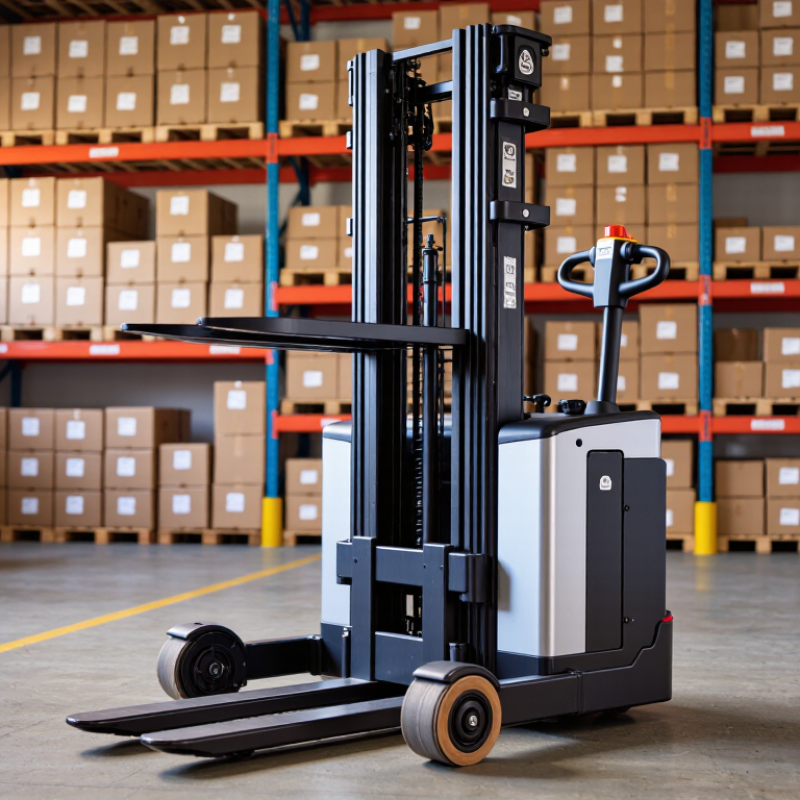
An electric stacker lift is a powered material-handling machine that raises and moves palletized loads over short distances. Its forks slide beneath a pallet, while an electric motor lifts the load along a vertical mast. Many models are walk-behind units; some include a platform for the operator. Simple in appearance. Useful in the right space.
In a warehouse, an operator might use one to lift a pallet from floor level and place it on a low or mid-height rack. The battery powers both travel and lifting, reducing the physical effort required for repeated handling. Actual performance depends on rated capacity, lift height, pallet dimensions, aisle width, and floor condition. Check the load rating carefully. A tall load can behave differently from a compact one, even at the same weight.
An electric stacker lift is not automatically a substitute for every forklift. It is generally suited to lighter, shorter-distance stacking tasks, but operating needs vary by site. Measure rack openings and turning areas before choosing equipment. Also consider charging access and how often the machine will be used. These details are easy to overlook; I would verify them on the actual work floor, not just from a product sheet.

Electric stackers support material handling by lifting palletized goods and moving them across short warehouse routes. An operator can raise a load to a storage level, travel through an aisle, and lower it without using a full-sized forklift. This is useful in stockrooms, small distribution areas, and loading zones where space is limited. Their compact frames can turn in tighter spaces, while electric drive reduces the physical effort of moving heavy pallets.
Performance depends on matching the machine to the work. Check rated capacity, lift height, pallet dimensions, aisle width, floor condition, and expected battery runtime before choosing equipment. For example, a stacker that handles a 1,000-kilogram load at floor level may have a lower safe capacity when lifting high; operators should follow the capacity plate and operating guidance. Small details matter. Uneven floors, tight corners, or frequent charging gaps can slow a shift more than expected. A common planning mistake is to focus only on maximum lift height. The route, load frequency, and operator visibility matter too. Stackers can improve routine pallet movement, but they are not a shortcut around safe work practices.
| Material-Handling Dimension | How an Electric Stacker Helps | Typical Application | Key Specification to Check | Selection Consideration |
|---|---|---|---|---|
| Pallet lifting and stacking | An electric motor raises the forks, reducing the need for manual pumping when placing or retrieving palletized loads. | Stacking pallets in warehouse racking or at designated storage positions. | Rated load capacity and lift height; both vary by model and may be affected by load center and lift height. | Match the truck’s capacity to the heaviest intended load and the required rack or storage height. |
| Horizontal load movement | Depending on the design, the stacker may provide powered travel or be a walk-behind unit that is manually moved. | Moving pallets between receiving, storage, production, and dispatch areas. | Travel mode, travel speed, turning radius, and operator-control layout. | Choose powered travel for longer or more frequent moves; confirm that the turning radius suits the available aisle space. |
| Loading and unloading | Forks lift pallets to help transfer loads between floor level and compatible platforms or work areas. | Short-distance movement of palletized goods around loading areas and docks. | Fork dimensions, maximum lift height, ground clearance, and compatibility with the pallet type. | Check floor condition, thresholds, ramps, and platform height before selecting a unit. |
| Stock replenishment | Controlled lifting and lowering supports replenishment of lower or mid-level storage locations. | Moving pallet loads from reserve storage to picking or production zones. | Residual capacity at the required lift height, mast configuration, and visibility around the load. | Use the load chart for the specific configuration; nominal capacity alone may not describe capacity at height. |
| Operation in confined areas | A compact walk-behind format can maneuver in spaces that may not suit larger lift trucks. | Small warehouses, back rooms, workshops, and selected narrow-aisle tasks. | Overall width, chassis length, turning radius, and aisle width required for the intended maneuver. | Compare the manufacturer’s aisle requirement with the actual layout, pallet size, and turning method. |
| Repeated lifting tasks | Powered lifting can reduce repetitive manual effort during regular pallet handling. | Frequent pallet placement or retrieval during a work shift. | Battery type and capacity, charging method, duty cycle, and expected operating time. | Plan charging and battery maintenance around the work schedule; actual runtime depends on load, use, and conditions. |
| Workplace safety and control | Operator controls, braking systems, and load-handling features help support controlled movement when used correctly. | Routine warehouse transport and stacking by trained operators. | Emergency stop, braking, safety switch, operator protection, and applicable local requirements. | Provide operator training, inspect equipment regularly, and follow the operating and maintenance instructions. |
| Specifications and capabilities differ by model and configuration. Confirm the load chart, operating conditions, and applicable safety requirements with the equipment supplier before purchase or use. | ||||
When comparing Chinese electric stacker lift manufacturers, begin with the actual job: load weight, pallet size, aisle width, and lifting height. Ask for the rated capacity at full lift, not only the headline capacity. A stacker rated for 1,000 kilograms may handle less safely at maximum height. Check turning radius and fork dimensions against your narrowest aisle. Small mismatches matter.
Inspect the mast, welds, forks, and load wheels in person or through clear inspection records. Ask how each unit is load-tested and whether test results are traceable to its serial number. Check emergency-stop access, braking, and controls with an operator wearing work gloves. Simple details count. Battery type, charging time, and replacement availability also affect daily use. A polished control panel cannot compensate for unclear maintenance instructions.
Compare service support as carefully as the machine. Request parts lists, operating manuals, warranty terms, and realistic response times for common repairs. Ask which wear parts are stocked and how quickly they can ship. If possible, arrange a factory audit or independent pre-shipment inspection. Photos help, but they cannot reveal every weld or wiring issue. Price comparisons are imperfect when specifications differ, and suppliers may describe capacity in different ways. Get each configuration and test condition in writing before comparing quotations.
China’s electric stacker lifts come from several kinds of manufacturers, not one uniform supplier group. Some factories specialize in warehouse handling equipment, producing walkie stackers, semi-electric models, and pedestrian-operated units. Others build broader forklift ranges and include stackers in a larger materials-handling portfolio. Contract manufacturers may also produce equipment to a buyer’s specifications, with configurations and components varying by order. Manufacturing capability differs widely. A polished product page alone tells little.
To assess a supplier, ask for rated capacity, lift height, turning radius, battery type, charger details, and duty-cycle guidance. Request a current specification sheet and clear photos of the mast, forks, controls, and data plate. If possible, review a sample unit or arrange a factory inspection. Check how spare parts are identified and whether service instructions are available in English. Ask how each unit is load-tested before dispatch, and request inspection records. That matters. Compare identical configurations across quotations; a lower price may reflect a smaller battery, different mast, or fewer accessories. I would not assume “manufacturer” means every key part is made in-house. Ask which components are sourced, and have the answers confirmed in writing.
Electric stacker manufacturers offer models across a range of rated load capacities. This chart shows common capacity classes, not a ranking or company-specific comparison.
Rated capacity is model-specific and can vary with lift height, load centre and configuration. Check the individual model’s nameplate and specifications before comparing products.
Evaluating a Chinese electric stacker supplier starts with the actual job: load weight, lift height, aisle width, and daily operating hours. Ask for the rated capacity at the required lift height, not just the headline capacity. Request a load chart, battery specifications, and a recorded demonstration with a comparable pallet. Check welds, fork alignment, mast movement, and braking on the factory floor. Small details matter. A polished brochure cannot prove stable lifting.
Inspect the supplier’s quality records, component traceability, spare-parts availability, and warranty response process. Ask how long common parts take to ship, and request sample inspection reports from recent production. MHI’s 2024 Annual Industry Report found that 55% of surveyed supply-chain professionals planned to increase technology investment. That figure is not specific to stackers, but it underlines the value of assessing equipment alongside service and support. Confirm that operating and maintenance manuals are clear, and that the supplier can explain battery care and routine checks. I would still ask for references from comparable users; paperwork alone can miss the rough edges of real warehouse use.


For those larger-sized parts, or smaller quantity runs, we have 2 independent powder coat booths and ovens. The quality, durability and affordability of today’s powder coating finishes make this the process of choice for world-class companies.
Powder coating advantages over other forms of coating are many. Materials used in the Powder coating process can be metals and non-metals that come in a multitude of thicknesses, textures, colors, etc. Another of Powder coating’s biggest advantages over conventional coatings is its ability to create finishes in many different textures. Powder Coating Booths allow us the ability to apply these advantages to large products.
Tri-State Fabricators runs a full-service conveyor line for painting. Wet painting can provide protection or decoration to many different part styles. From start to finish, every project is easier to undergo random and point-based inspection by our skilled painting team.
Advantages to our Wet Paint Line are these lines start with product prep and ends with a thorough inspection of a high quality finished product. Our ability to complete large and small projects with a superior finish and doing so in a timely and economical fashion. This passes along the savings in production to our customers. When powder coating ins not an option, our Wet Paint Line gets the job done right the first time.
When the parts get big and heavy we roll-out our custom paint racks and oversize booth. By utilizing our partnerships with all the major paint brands, we can match virtually any color with wet paint.
The advantages of having access to a Wet Paint Booth are many. Large projects of many different shapes can be loaded into the booth. The Wet Paint Booth offers an environment that is much more controlled than a typical parts painting operation.
Not only are they used because of their controlled environment, but they’re are also advantageous when it comes to applying paint to parts that are needed in industries that require specialty coatings such as medical, aerospace, etc.
Our military forces have some very high standards when it comes to the finish of their vehicles and equipment. From the first pre-treatment step to final coat, it takes a great deal of knowledge and experience to protect the men and women of our armed forces. They deserve only the best, and Tri-State Fabricators provides it.
All of our processes are closely monitored by our staff and management teams. Both of which are highly trained in the processes of metal fabrication and finishing. Tri-State Fabricators’ goal is to always fully satisfy each and every customer, including the military. We will always put a 110% into what we do.
Abrasive media blasting is an excellent way to remove old paint, rust, and increase the paint/powder adhesion. Glass beads produce a much smoother and brighter finish than angular abrasives; leaving the part clean yet without any dimensional change. Chemically inert and environmentally friendly, we can recycle our beads approximately 30 times; making them a more preferred method of metal cleaning or surface finishing.
Advantages to Glass Bead Blasting are many. Glass bead blast media is used when a project is needing rough surfaces need to become smooth for applications of coatings such as paint. It is typically used to clean paint and rust from a product surface without deforming the surface it is being used on. Overall, compared to many other blasting media, Glass Bead Blasting is a very economical choice and those savings are always passed on to our customers.
Tri-State Fabricators utilize a zinc phosphate wash to clean and etch the material to ensure the best paint adhesion possible. The unique design of our 3-stage wash system does the work like a 5-stage. From Cleaning and rinsing to conversion coating and post-treatment, Our Part Washing process is a complete service and works throughout the fabrication service and the finishing service.
Along with the previously mentioned benefits, Curing is a vital chemical reaction that leaves the product finish hard and relatively safe from mild abrasion and aggressive corrosion. This process can be done in more than one way; ambient air-dry or in curing ovens at temps that exceed 240°.
From fixing paint mistakes (someone else’s of course) to simply cleaning our paint line hooks, our burn-off oven is put to good use. After a quick burn-off, a little clean up, and a fresh coat of paint, your parts will look better than new.
Why does our Burn-Off Oven work so well? Because super heating the air around parts turns the materials into ashes. From paint and powder coatings to rubber and machining oils, high temps do the job without degrading the integrity of the part.
Masking is a vital part of producing high quality products. We have die-cut masking patterns to protect machined surfaces as well as a wide range of plugs and caps to protect threaded holes and bolts. We provide permanent and temporary masking.
Masking allows the selected sections of a product to be protected from a fabrication or finishing service. This can be with both chemicals when etching and tapes, paints when only finishing just a section of the product. Masking is great in aiding the customization process of a project.
Screen printing is a photographic process that transfers artwork onto a porous nylon screen which allows colored ink to flow through the screen and be deposited on an aluminum or plastic component. We can generally have just about any design created onto a screen for your parts.
Some of the advantages of Screen Printing are, brand recognition for your business displaying on your products, assembly instructions, product warnings/hazards, etc. Tri-State Fabricators produces Screen Printing of the highest quality so you know it’s durable.
Metal Finishing is the art of treating the exterior portion of product, often metal but can also be made of other materials, so that the surface is clean and free of any debris. Then the process of applying coats or either paint of powder coat takes place. This coating process improves the quality of the product in both appearance and resistance to wear and corrosion.
Tri-State Fabricators, Inc., understands that a project typically isn’t complete until a high-quality finish has been added to your product. This is why our painting and powder coating teams continuously inspect the products throughout the Metal Finishing process.

