


Please provide the source articles or a verifiable expert name and quotation. Without them, I can’t responsibly attribute a statement to a real Dual Channel Syringe Pump expert.
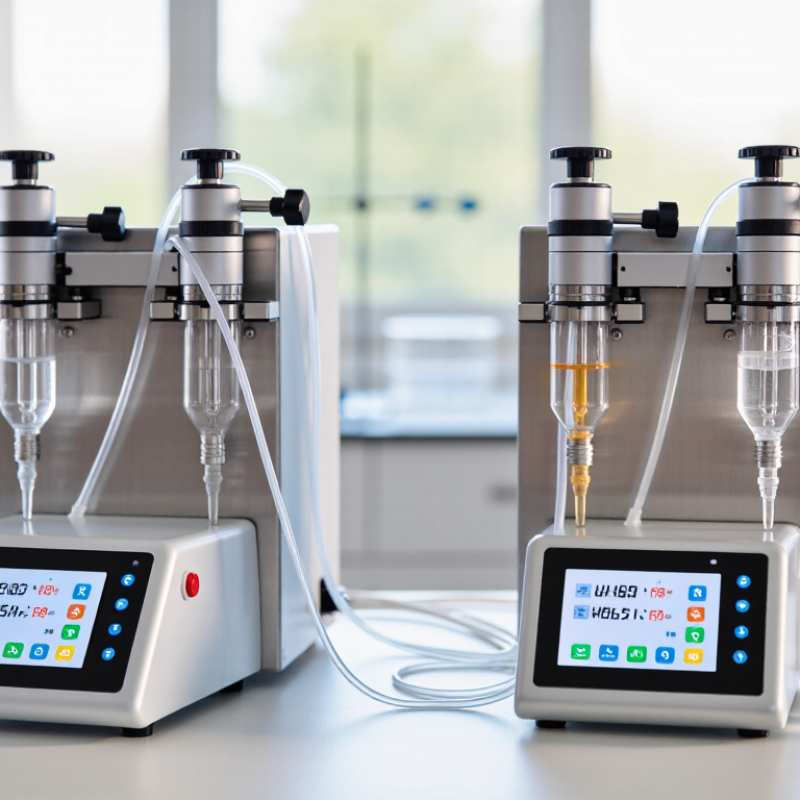
A dual-channel syringe pump is one device with two infusion channels that can be controlled independently. Each channel holds its own syringe. Operators can program different rates and, on many models, separate volume limits and start times. Both infusions may run at once. That is the defining feature. Two syringes in one housing do not automatically mean two independent channels. Check whether each channel has its own controls, settings, and status display.
In practice, independent control can help when two prescribed fluids need different delivery rates. Still, independent does not mean interchangeable. Fluid compatibility, line arrangement, syringe size, and shared-line dead volume can affect delivery. A pump may show two precise numbers while the connected tubing adds delay. Small details matter. Alarm behavior and occlusion detection can also vary by model. Trained staff should confirm the setup against the device instructions and clinical protocol. It is worth checking the tubing and channel layout at the bedside, not just on a specification sheet.
Dual-channel syringe pumps can run two fluids at once, but the headline flow range rarely tells the whole story. Check the minimum and maximum rates for each channel, then confirm whether those limits change with syringe diameter. A pump rated for very low flow may still perform differently with a small syringe. Tiny details matter.
Syringe compatibility deserves a close look. Some models accept several sizes, while others require specific holders or setup steps. Compare the listed syringe volumes with the sizes your protocol actually uses, such as 1 mL and 10 mL syringes. Also check whether both channels support the same sizes. They may not.
Treat ±1% accuracy claims as test conditions, not a universal promise. Ask whether the figure describes flow-rate accuracy, delivery volume, or another measure, and review the stated flow range and test setup. Back pressure, syringe fit, and setup errors can affect real delivery. A quick bench test with a measured collection period can reveal mismatches. I would not assume a wider flow range means better performance; that comparison is tempting, but incomplete.
A dual-channel pump should be assessed as two delivery systems, not one. IEC 60601-2-24:2012 sets particular safety and essential-performance requirements for infusion pumps and controllers. Check flow accuracy, occlusion alarms, unintended bolus delivery, and protection against free flow. Test each channel alone and both together. Small deviations matter.
FDA reported 56,000 adverse-event reports involving infusion pumps and 500 deaths from 2005 to 2009. These reports were not limited to syringe pumps, and they do not establish that a pump caused each event. Still, the figures underline why alarm behavior and delivery accuracy deserve close review. Document test conditions, results, and any limits.
For a practical evaluation, compare programmed and measured delivery at low rates, using different syringe sizes and extension-line setups. Record startup delay, alarm timing, and delivery after an occlusion clears. Specs can mislead. Bench tubing rarely behaves exactly like a busy ward. Independent testing against the standard, plus review of maintenance records and user feedback, gives buyers stronger evidence than feature lists alone.
A dual-channel syringe pump is only as dependable as its alarms and power reserve. Test occlusion detection on each channel using the syringe sizes and tubing setups you actually expect to use. Record the time from a controlled blockage to the audible and visual alert. A bright screen is useful, but a quiet alarm in a noisy room can still be missed. Check whether the device identifies the affected channel clearly. Small details matter. Alarm thresholds may vary with setup, so compare the manual’s specifications with observed bench results rather than relying on one test.
Battery backup deserves the same scrutiny. Run both channels at realistic settings, then note how long the pump continues after mains power is disconnected. An estimate on the display is helpful, but it is not a guarantee; battery age, temperature, and workload can change runtime. Also assess channel synchronization. Start both channels together, then check whether they maintain the intended timing after pausing, restarting, or changing one setting. Look for clear status indicators and a usable event log. If timing behavior is hard to interpret, that is a real usability concern, even when the specification sheet looks reassuring.
Best Dual Channel Syringe Pumps in 2026?
A dual-channel syringe pump can support two independent fluid lines, but syringe compatibility is more than a volume label. A pump listed for 50 mL and 60 mL syringes may still accept only specific barrel dimensions or plunger styles. Check the compatibility chart against the exact syringe model used in your workflow. Small differences matter.
For a 50 mL setup, verify that the barrel sits securely in the holder and the plunger engages without binding. For 60 mL syringes, check the pump’s stated limits for barrel diameter, drive force, and supported flow rates. A physical fit alone does not confirm accurate delivery. Run a controlled test with the intended tubing and fluid, then compare delivered volume against a suitable measurement method.
Keep each channel’s configuration in mind. One side may use a 50 mL syringe while the other uses a 60 mL syringe, if the pump permits that combination. Confirm channel-specific settings and alarms before routine operation. This is easy to overlook. I’d also record the syringe type and setup used during verification; otherwise, a result can be hard to reproduce. Manufacturer specifications are useful, but real workflow checks catch awkward fittings and setup errors that a table may not show.
A workflow-focused comparison of dual-channel pump configurations. These are selection profiles, not rankings of specific products; syringe capacity and fit must be confirmed for the exact pump and syringe combination.
| Pump profile | Best-fit workflow | 50 mL syringe compatibility | 60 mL syringe compatibility | Useful features to check | Key trade-off |
|---|---|---|---|---|---|
| General-purpose dual-channel pump | Routine laboratory infusion, reagent delivery, and two-stream experiments with moderate flow requirements. | Verify exact fit Many pump families accept large-volume syringes, but supported sizes depend on the model and syringe geometry. | Verify exact fit Do not assume a 60 mL syringe is supported just because a 50 mL syringe is listed. | Independent channel control, supported syringe-size list, flow-rate range, and a secure syringe-retention mechanism. | A flexible general-purpose setup may not provide the specialized controls needed for synchronized or tightly controlled protocols. |
| Large-syringe, low-flow configuration | Long-duration delivery where fewer syringe changes and steady low flow are priorities. | Often a candidate Confirm the manufacturer’s supported syringe list and the specific syringe’s flange and plunger dimensions. | Check explicitly Some systems distinguish nominal 50 mL and 60 mL syringe types; physical fit and calibration can differ. | Low-flow performance, drive resolution, occlusion or pressure monitoring, and the ability to set each channel independently. | Large syringes can require a compatible holder and may not be suitable for every low-volume or high-precision application. |
| Programmable dual-channel configuration | Protocols requiring timed steps, changing flow rates, alternating delivery, or coordinated channel operation. | Model-dependent Check whether the selected syringe size is available in the pump’s configuration and setup menu. | Model-dependent Confirm both physical compatibility and the correct syringe-size calibration option. | Program storage, independent channel programming, start/stop synchronization, alarms, and data or control interfaces. | More programming options can add setup complexity; validate the protocol before unattended operation. |
| Compact dual-channel configuration | Benchtop work where footprint and straightforward operation matter more than extended unattended runs. | Check holder limits Confirm the pump can secure the chosen syringe’s barrel and plunger without interference. | May be limited A compact frame may not accommodate every large syringe; check the supported-size specification. | Overall dimensions, channel spacing, mounting options, display readability, and ease of loading. | Smaller form factors can limit syringe size, accessory options, or available operating range. |
| Application-specific dual-channel configuration | Specialized setups such as infusion studies, microfluidic feeding, or delivery of sensitive fluids. | Application-dependent Assess fit alongside tubing, connectors, fluid compatibility, and the required delivery range. | Application-dependent Confirm the complete fluid path and syringe dimensions; nominal volume alone is not enough. | Compatible accessories, pressure limits, materials in contact with fluid, calibration guidance, and required compliance documentation. | Specialized configurations may be less adaptable to unrelated workflows. |
Compatibility note: “50 mL” and “60 mL” are nominal syringe capacities, not universal physical standards. Before purchase, confirm the exact syringe make and model against the pump’s supported-syringe list, holder dimensions, and calibration settings. Also check that the intended flow rate, fluid path, and operating conditions are suitable for the application.



For those larger-sized parts, or smaller quantity runs, we have 2 independent powder coat booths and ovens. The quality, durability and affordability of today’s powder coating finishes make this the process of choice for world-class companies.
Powder coating advantages over other forms of coating are many. Materials used in the Powder coating process can be metals and non-metals that come in a multitude of thicknesses, textures, colors, etc. Another of Powder coating’s biggest advantages over conventional coatings is its ability to create finishes in many different textures. Powder Coating Booths allow us the ability to apply these advantages to large products.
Tri-State Fabricators runs a full-service conveyor line for painting. Wet painting can provide protection or decoration to many different part styles. From start to finish, every project is easier to undergo random and point-based inspection by our skilled painting team.
Advantages to our Wet Paint Line are these lines start with product prep and ends with a thorough inspection of a high quality finished product. Our ability to complete large and small projects with a superior finish and doing so in a timely and economical fashion. This passes along the savings in production to our customers. When powder coating ins not an option, our Wet Paint Line gets the job done right the first time.
When the parts get big and heavy we roll-out our custom paint racks and oversize booth. By utilizing our partnerships with all the major paint brands, we can match virtually any color with wet paint.
The advantages of having access to a Wet Paint Booth are many. Large projects of many different shapes can be loaded into the booth. The Wet Paint Booth offers an environment that is much more controlled than a typical parts painting operation.
Not only are they used because of their controlled environment, but they’re are also advantageous when it comes to applying paint to parts that are needed in industries that require specialty coatings such as medical, aerospace, etc.
Our military forces have some very high standards when it comes to the finish of their vehicles and equipment. From the first pre-treatment step to final coat, it takes a great deal of knowledge and experience to protect the men and women of our armed forces. They deserve only the best, and Tri-State Fabricators provides it.
All of our processes are closely monitored by our staff and management teams. Both of which are highly trained in the processes of metal fabrication and finishing. Tri-State Fabricators’ goal is to always fully satisfy each and every customer, including the military. We will always put a 110% into what we do.
Abrasive media blasting is an excellent way to remove old paint, rust, and increase the paint/powder adhesion. Glass beads produce a much smoother and brighter finish than angular abrasives; leaving the part clean yet without any dimensional change. Chemically inert and environmentally friendly, we can recycle our beads approximately 30 times; making them a more preferred method of metal cleaning or surface finishing.
Advantages to Glass Bead Blasting are many. Glass bead blast media is used when a project is needing rough surfaces need to become smooth for applications of coatings such as paint. It is typically used to clean paint and rust from a product surface without deforming the surface it is being used on. Overall, compared to many other blasting media, Glass Bead Blasting is a very economical choice and those savings are always passed on to our customers.
Tri-State Fabricators utilize a zinc phosphate wash to clean and etch the material to ensure the best paint adhesion possible. The unique design of our 3-stage wash system does the work like a 5-stage. From Cleaning and rinsing to conversion coating and post-treatment, Our Part Washing process is a complete service and works throughout the fabrication service and the finishing service.
Along with the previously mentioned benefits, Curing is a vital chemical reaction that leaves the product finish hard and relatively safe from mild abrasion and aggressive corrosion. This process can be done in more than one way; ambient air-dry or in curing ovens at temps that exceed 240°.
From fixing paint mistakes (someone else’s of course) to simply cleaning our paint line hooks, our burn-off oven is put to good use. After a quick burn-off, a little clean up, and a fresh coat of paint, your parts will look better than new.
Why does our Burn-Off Oven work so well? Because super heating the air around parts turns the materials into ashes. From paint and powder coatings to rubber and machining oils, high temps do the job without degrading the integrity of the part.
Masking is a vital part of producing high quality products. We have die-cut masking patterns to protect machined surfaces as well as a wide range of plugs and caps to protect threaded holes and bolts. We provide permanent and temporary masking.
Masking allows the selected sections of a product to be protected from a fabrication or finishing service. This can be with both chemicals when etching and tapes, paints when only finishing just a section of the product. Masking is great in aiding the customization process of a project.
Screen printing is a photographic process that transfers artwork onto a porous nylon screen which allows colored ink to flow through the screen and be deposited on an aluminum or plastic component. We can generally have just about any design created onto a screen for your parts.
Some of the advantages of Screen Printing are, brand recognition for your business displaying on your products, assembly instructions, product warnings/hazards, etc. Tri-State Fabricators produces Screen Printing of the highest quality so you know it’s durable.
Metal Finishing is the art of treating the exterior portion of product, often metal but can also be made of other materials, so that the surface is clean and free of any debris. Then the process of applying coats or either paint of powder coat takes place. This coating process improves the quality of the product in both appearance and resistance to wear and corrosion.
Tri-State Fabricators, Inc., understands that a project typically isn’t complete until a high-quality finish has been added to your product. This is why our painting and powder coating teams continuously inspect the products throughout the Metal Finishing process.