


Choosing the best custom ABS electronics enclosure in 2026 starts with the device, not the catalog. A handheld controller needs different protection from a wall-mounted sensor. Board dimensions, connector positions, cable exits, and mounting points should guide the shape. Small details matter. A port placed three millimeters off can make assembly awkward or block access.
Dieter Rams, a respected product-design authority, offered a useful principle: “Good design is as little design as possible.” For an enclosure, that means adding only the ribs, bosses, vents, and seals the product actually needs. Yet minimalism has limits. Thin walls may flex, and tightly packed components can trap heat. ABS is valued for impact resistance, low weight, and molding flexibility, but performance depends on the grade, geometry, and operating environment. Ask suppliers about resin data, wall-thickness recommendations, and any flame-rating documentation relevant to your application.
The best choice is rarely the prettiest sample alone. Check how the lid closes, whether screw bosses survive repeated assembly, and whether cable glands fit without strain. Test a prototype with the real circuit board and connectors. Then test it in expected temperatures and handling conditions. A polished rendering cannot reveal every fit problem. That is easy to forget. This guide compares practical design, material, manufacturing, and verification factors to help you judge custom ABS electronics enclosure options with clearer expectations—and fewer expensive surprises.
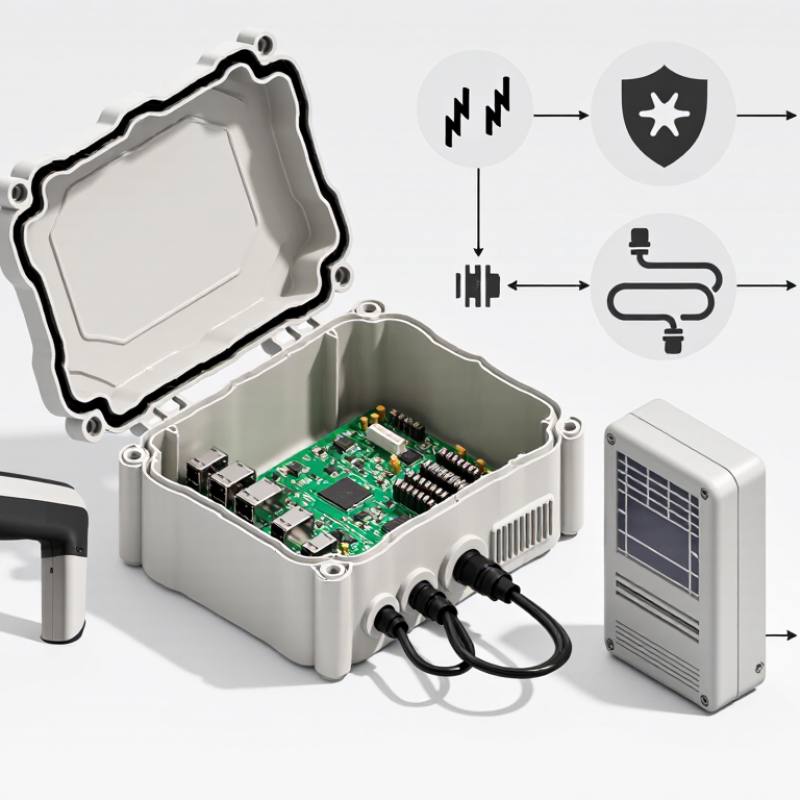
A custom ABS electronics enclosure is a purpose-designed shell that protects a specific circuit, not merely a plastic box in a chosen color. Its dimensions must fit the board, battery, wiring, and connectors without pinching cables or blocking access. Designers also specify wall thickness, bosses, ribs, snap-fits, and screw locations. These details affect assembly and durability. Small tolerances matter.
Material choice is part of the definition. ABS offers a practical balance of impact resistance, rigidity, and moldability, but its performance depends on the resin grade and enclosure geometry. UL 94 provides measurable flammability classifications: for a V-0 rating, each vertical specimen must stop burning within 10 seconds after each flame application, with no flaming particles igniting the cotton indicator. This is a material test, not a guarantee that every finished enclosure meets the same rating.
A useful custom design also addresses heat, dust, moisture, and electromagnetic interference. IEC 60529 defines IP ratings through standardized ingress-protection tests; a gasket alone does not establish an IP rating. Vent placement, seam design, and connector openings all matter. ABS is electrically insulating, so shielding may require conductive coatings or inserts. That adds cost and can complicate grounding. A prototype should be checked with the actual electronics under operating conditions. Sometimes the first design is still a little too tight. That is useful evidence, not failure.

A custom ABS electronics enclosure should begin with the device’s real operating conditions, not its appearance. In 2026, designers need to consider heat, impact, moisture, and how often users will open the case. A compact sensor mounted near a warm motor may need ventilation or more internal clearance. Those changes can affect dust protection, so test the complete assembly rather than relying on a drawing.
Wall thickness, corner radii, and mounting bosses influence strength and manufacturability. Very thin walls may flex around screw posts; overly thick sections can cool unevenly during molding and cause sink marks. Keep bosses supported with ribs, and leave space for cables, connectors, and tool access. Small details matter. A lid that fits perfectly in CAD may bind after molding because of shrinkage and tolerance variation.
Material choice should match the environment. Standard ABS offers a useful balance of toughness and cost for many indoor products, but heat, sunlight, and chemical exposure can change what is suitable. Ask for documented material properties and verify any flame-resistance requirement against the finished design. If the enclosure sits outdoors, ordinary ABS may age or discolor; UV-stabilized grades or another material may be worth evaluating. There is no universal “best” grade. Build prototypes, measure temperatures under load, and check fit after repeated opening. One test may still miss a real-world problem.
Customization affects more than appearance; it influences how an ABS enclosure handles heat, impact, dust, and assembly. Wall thickness is a key choice. Thicker walls can improve stiffness, but they add weight and may retain heat around power components. Thin sections can flex near screw bosses, especially after repeated servicing. For a warm circuit board, model airflow and measure internal temperatures under its actual operating load. Vents may help, but they can also admit dust or moisture. Small details matter. There is no universal best vent pattern.
Cutouts, mounting points, and sealing features should match the installation. A connector opening placed a few millimeters off can strain a cable or block a plug. Ribs and bosses reinforce fixing points, yet poorly placed features may complicate molding or concentrate stress. Specify the resin grade, temperature range, cleaning exposure, and expected impact; “ABS” alone does not describe every formulation. For outdoor or chemically exposed use, validate the material instead of assuming a standard grade will suffice. Test a prototype. Check fit, heat rise, and screw retention after repeated assembly. One trade-off deserves an honest review: adding every requested feature can make a once-simple design less durable.
| Customization Option | Practical Example | Effect on Performance | Trade-Off or Limitation | What to Verify |
|---|---|---|---|---|
| Wall thickness | Nominal walls of 2.0–3.0 mm for a small handheld or wall-mounted enclosure | Thicker walls can improve rigidity and resistance to handling loads. Adequate thickness around bosses and fasteners helps reduce cracking. | More material can increase weight, cost, molding time, and the risk of sink marks or uneven cooling. | Check the actual part geometry, molding guidance, fastening loads, and prototype stiffness. |
| Ribbing and corner radii | Internal ribs, reinforced mounting bosses, and rounded internal corners | Well-designed ribs can add stiffness without making every wall uniformly thicker. Rounded corners help reduce local stress concentrations. | Overly thick ribs or abrupt transitions may cause sink marks, warpage, or stress concentrations. | Review rib-to-wall proportions, draft, boss design, and molded-part samples. |
| Gasket and lid interface | Designed groove with a compatible elastomer gasket and controlled screw spacing | Can help limit dust and water ingress when the enclosure, gasket, fasteners, and assembly process are designed together. | A gasket alone does not establish an ingress-protection rating. Poor compression, joints, or cable entries can create leak paths. | Test the fully assembled product to the intended ingress-protection standard and test conditions. |
| Flame-retardant ABS grade | Specify a resin grade with a required flammability classification at the relevant test thickness | May improve resistance to ignition or flame spread under the conditions of the applicable material test. | Flame-retardant grades can differ in impact strength, flow, color, and processing behavior. A material rating does not automatically certify the finished device. | Confirm the exact resin grade, tested thickness, current material documentation, and product-level requirements. |
| UV-stabilized material or coating | UV-stabilized ABS grade or a compatible protective coating for light exposure | Can help reduce weathering effects such as discoloration or surface degradation, depending on the formulation and exposure. | Unmodified ABS may weather under prolonged outdoor exposure. UV resistance does not by itself make an enclosure weatherproof. | Request exposure data for the selected material or coating and evaluate the intended environment and service life. |
| Ventilation openings | Slotted vents or a membrane vent selected for the thermal and environmental requirements | Open vents can improve airflow and help dissipate heat; a suitable membrane vent may equalize pressure while limiting liquid entry. | Openings can reduce protection from dust and water. A vent membrane has defined operating limits and must be installed correctly. | Measure internal temperatures under worst-case load and test the complete enclosure with the selected vent. |
| EMI shielding treatment | Conductive internal coating or a conductive liner applied to selected enclosure surfaces | May improve electromagnetic shielding when the coating, seams, lid contact, and grounding are engineered as a continuous system. | Performance depends on frequency, coating coverage, contact resistance, and assembly. Standard ABS is electrically insulating. | Test the assembled product across its relevant frequency range; check seam continuity and grounding design. |
| Connector cutouts and cable entries | Custom openings aligned to connectors, switches, cable glands, and strain reliefs | Accurate cutouts can improve fit, serviceability, and cable routing while reducing unnecessary openings. | Cutouts can weaken nearby walls and create ingress or stress points if clearances and sealing features are inadequate. | Check connector tolerances, edge clearances, cable loads, sealing details, and assembly access. |
| Mounting features | Integral bosses, inserts, standoffs, or external mounting tabs | Can improve board positioning and installation repeatability when sized for the fasteners and expected loads. | Repeated tightening, excessive torque, or unsuitable screw selection can damage plastic bosses or inserts. | Validate fastener type, boss geometry, installation torque, and repeated-assembly requirements. |
| Surface finish and color | Textured, smooth, or molded-in color finish | Can affect appearance, scratch visibility, grip, and how fingerprints or minor surface defects are perceived. | Finish, color, and resin choice may affect visual consistency between production batches; coatings may add process steps. | Approve production-representative samples and specify color and finish acceptance criteria. |
What Is the Best Custom ABS Electronics Enclosure in 2026?
Which Applications and Standards Should Buyers Consider?
Custom ABS enclosures suit indoor sensor nodes, handheld controllers, and compact control panels. They are lightweight, easy to machine, and available in many shapes. Grand View Research estimated the global electrical enclosure market at USD 6.1 billion in 2023. That market includes materials beyond ABS, so the figure signals broad enclosure demand—not ABS-specific growth. Fit matters. Check heat, impact, cleaning chemicals, and cable-entry needs before choosing a design. A small vent can help with heat, but it may reduce dust protection.
Match standards to the actual application. IEC 60529 defines IP ratings for protection against dust and water; it does not measure chemical resistance or UV durability. UL 94 classifies plastic flammability, but results depend on the exact material grade and specimen thickness. Ask for test evidence that matches the enclosure’s resin, wall thickness, and finished design. One easy mistake is assuming a material certificate automatically covers a modified enclosure. It may not.
Tips: For outdoor use, verify UV and temperature performance separately. For wall-mounted equipment, confirm mounting strength and cable clearance. Request sample parts, then test them with real connectors and operating heat. Small details matter. Don’t over-specify an IP rating if the device never faces moisture; that can add cost without solving the real problem.
Choosing a custom ABS electronics enclosure starts with the device, not the catalog dimensions. Measure the largest components, cable bends, connector bodies, and screw heads, then allow room for assembly. A few millimeters matter. A board that fits on paper may still foul a lid rib or trap a plug behind a wall. Sketch the internal layout before requesting a design revision.
Match the enclosure to its working conditions. ABS is impact-resistant and easy to machine, but heat, sunlight, chemicals, and repeated flexing can affect performance. Estimate heat from the electronics and test the assembled unit during realistic operating cycles. Vent slots may improve cooling, yet they also admit dust and moisture. A tight seam is not proof of a reliable seal. Define the required protection level and validate it through suitable testing.
Check how the enclosure will be made and maintained. Confirm wall thickness, mounting points, screw bosses, inserts, and access to serviceable parts. Review drawings for tolerances and connector cutouts, then inspect a physical prototype with actual cables installed. Small details matter. A screwdriver may not reach a terminal, or a connector may press against the wall. A low quote is less useful if it requires hand trimming or leaves a weak lid. Revisit the assumptions after testing; early dimensions are often wrong.
How to evaluate and select the best-fit enclosure
Suggested starting weights for a selection scorecard—not survey results or a universal standard. Adjust them to your operating environment, applicable ingress-protection needs, mounting constraints, thermal limits, production volume, and budget. Confirm the final design through testing.


For those larger-sized parts, or smaller quantity runs, we have 2 independent powder coat booths and ovens. The quality, durability and affordability of today’s powder coating finishes make this the process of choice for world-class companies.
Powder coating advantages over other forms of coating are many. Materials used in the Powder coating process can be metals and non-metals that come in a multitude of thicknesses, textures, colors, etc. Another of Powder coating’s biggest advantages over conventional coatings is its ability to create finishes in many different textures. Powder Coating Booths allow us the ability to apply these advantages to large products.
Tri-State Fabricators runs a full-service conveyor line for painting. Wet painting can provide protection or decoration to many different part styles. From start to finish, every project is easier to undergo random and point-based inspection by our skilled painting team.
Advantages to our Wet Paint Line are these lines start with product prep and ends with a thorough inspection of a high quality finished product. Our ability to complete large and small projects with a superior finish and doing so in a timely and economical fashion. This passes along the savings in production to our customers. When powder coating ins not an option, our Wet Paint Line gets the job done right the first time.
When the parts get big and heavy we roll-out our custom paint racks and oversize booth. By utilizing our partnerships with all the major paint brands, we can match virtually any color with wet paint.
The advantages of having access to a Wet Paint Booth are many. Large projects of many different shapes can be loaded into the booth. The Wet Paint Booth offers an environment that is much more controlled than a typical parts painting operation.
Not only are they used because of their controlled environment, but they’re are also advantageous when it comes to applying paint to parts that are needed in industries that require specialty coatings such as medical, aerospace, etc.
Our military forces have some very high standards when it comes to the finish of their vehicles and equipment. From the first pre-treatment step to final coat, it takes a great deal of knowledge and experience to protect the men and women of our armed forces. They deserve only the best, and Tri-State Fabricators provides it.
All of our processes are closely monitored by our staff and management teams. Both of which are highly trained in the processes of metal fabrication and finishing. Tri-State Fabricators’ goal is to always fully satisfy each and every customer, including the military. We will always put a 110% into what we do.
Abrasive media blasting is an excellent way to remove old paint, rust, and increase the paint/powder adhesion. Glass beads produce a much smoother and brighter finish than angular abrasives; leaving the part clean yet without any dimensional change. Chemically inert and environmentally friendly, we can recycle our beads approximately 30 times; making them a more preferred method of metal cleaning or surface finishing.
Advantages to Glass Bead Blasting are many. Glass bead blast media is used when a project is needing rough surfaces need to become smooth for applications of coatings such as paint. It is typically used to clean paint and rust from a product surface without deforming the surface it is being used on. Overall, compared to many other blasting media, Glass Bead Blasting is a very economical choice and those savings are always passed on to our customers.
Tri-State Fabricators utilize a zinc phosphate wash to clean and etch the material to ensure the best paint adhesion possible. The unique design of our 3-stage wash system does the work like a 5-stage. From Cleaning and rinsing to conversion coating and post-treatment, Our Part Washing process is a complete service and works throughout the fabrication service and the finishing service.
Along with the previously mentioned benefits, Curing is a vital chemical reaction that leaves the product finish hard and relatively safe from mild abrasion and aggressive corrosion. This process can be done in more than one way; ambient air-dry or in curing ovens at temps that exceed 240°.
From fixing paint mistakes (someone else’s of course) to simply cleaning our paint line hooks, our burn-off oven is put to good use. After a quick burn-off, a little clean up, and a fresh coat of paint, your parts will look better than new.
Why does our Burn-Off Oven work so well? Because super heating the air around parts turns the materials into ashes. From paint and powder coatings to rubber and machining oils, high temps do the job without degrading the integrity of the part.
Masking is a vital part of producing high quality products. We have die-cut masking patterns to protect machined surfaces as well as a wide range of plugs and caps to protect threaded holes and bolts. We provide permanent and temporary masking.
Masking allows the selected sections of a product to be protected from a fabrication or finishing service. This can be with both chemicals when etching and tapes, paints when only finishing just a section of the product. Masking is great in aiding the customization process of a project.
Screen printing is a photographic process that transfers artwork onto a porous nylon screen which allows colored ink to flow through the screen and be deposited on an aluminum or plastic component. We can generally have just about any design created onto a screen for your parts.
Some of the advantages of Screen Printing are, brand recognition for your business displaying on your products, assembly instructions, product warnings/hazards, etc. Tri-State Fabricators produces Screen Printing of the highest quality so you know it’s durable.
Metal Finishing is the art of treating the exterior portion of product, often metal but can also be made of other materials, so that the surface is clean and free of any debris. Then the process of applying coats or either paint of powder coat takes place. This coating process improves the quality of the product in both appearance and resistance to wear and corrosion.
Tri-State Fabricators, Inc., understands that a project typically isn’t complete until a high-quality finish has been added to your product. This is why our painting and powder coating teams continuously inspect the products throughout the Metal Finishing process.

