


Choosing the best Cordless Led Desk Light from China requires more than comparing brightness and price. A dependable model should combine stable illumination, safe charging, useful battery life, and honest product information. It must also feel practical on a real desk, not only in a product photograph.
Lighting researcher Dr. Mariana Figueiro has stated, “Light is the most powerful synchronizer of the human circadian system.” Her observation concerns lighting broadly, but it matters here. A desk light affects reading comfort, evening work, and visual fatigue. Therefore, color temperature, glare control, and dimming deserve careful attention. A cold, harsh beam may look bright, yet still feel tiring after an hour.
Chinese manufacturers offer many cordless designs, from compact study lamps to premium aluminum models. Some include touch controls, magnetic bases, USB-C charging, and adjustable arms. Others advertise long battery life without explaining brightness conditions. That gap deserves attention. A lamp rated for twenty hours may reach that figure only at its lowest setting.
A useful evaluation should examine the battery, LEDs, diffuser, charging protection, hinge strength, and warranty support. It should also test the lamp beside a notebook, keyboard, and cup of coffee. Small details reveal more than specifications. The light should stay steady when the battery weakens. The base should not slide during ordinary use.
No single product fits every workspace. A student, remote worker, and designer may need different brightness levels. Personal preference still matters. Yet careful testing can separate genuinely reliable Cordless Led Desk Light options from attractive but disappointing products. This guide examines those differences with practical judgment, not perfect certainty.
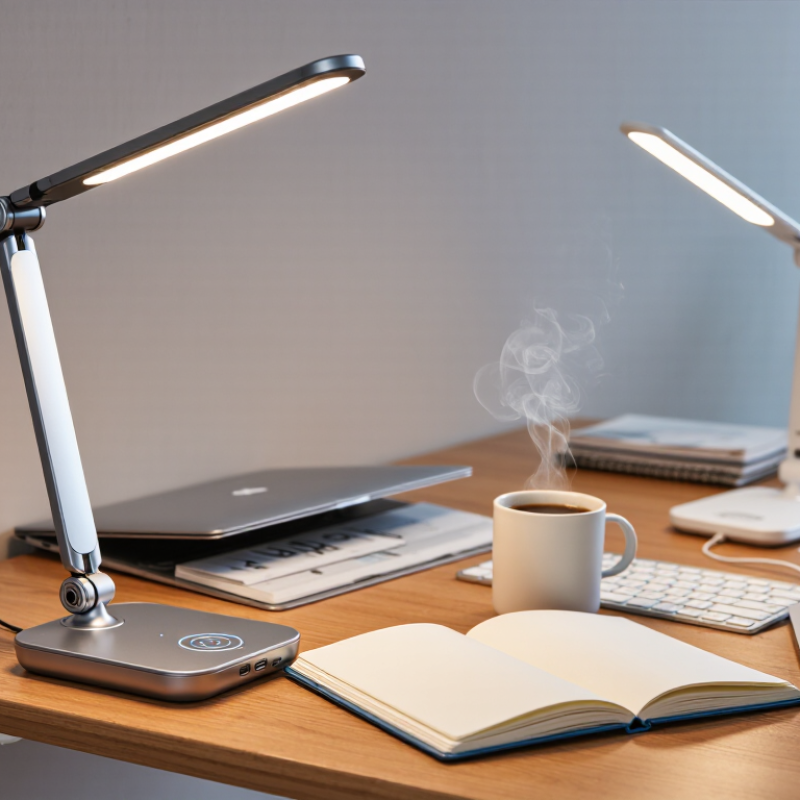
The best cordless LED desk light from China is defined by practical performance, not appearance alone. In daily use, it should provide steady light across a notebook without harsh glare. A color rendering index above 90 helps printed colors look more natural. Adjustable color temperature also supports reading, drafting, and evening work.
Battery quality matters just as much. A reliable model should last through several work sessions at medium brightness. USB-C charging is convenient, but charging speed and battery capacity need independent checking. Some product descriptions sound impressive. Real performance may differ. I would test the lamp at full brightness, then measure its running time and surface temperature.
A weighted base prevents movement when adjusting the arm. Smooth hinges should hold their position without sudden drops. Flicker-free operation is important for users who work near the lamp for hours. I also examine the diffuser, because visible LED points can create uncomfortable shadows. Manufacturing consistency is another key measure. Clear inspection records, traceable materials, and documented safety compliance show professional control. Still, small weaknesses can appear: touch controls may respond slowly, and painted surfaces may scratch during shipping. A trustworthy supplier should acknowledge these limits and provide realistic specifications, samples, and after-sales support.

When I test a cordless LED desk light from China, I look beyond brightness. A useful model should provide stable light for several hours, not just impressive showroom output. Battery capacity matters, but real runtime matters more. I prefer eight to twelve hours at medium brightness. That suits reading, sketching, and evening video calls. Charging through USB-C is practical. A visible battery indicator prevents unpleasant surprises. Small detail, big difference.
Light quality deserves closer inspection. For desk work, a high color rendering index, ideally above 90, keeps paper, skin, and colored materials looking natural. Adjustable color temperature helps. Warm light feels comfortable at night, while neutral white supports focused work. Dimming should remain smooth, without sudden jumps. Flicker is difficult to judge by eye, so I check technical specifications and use a camera-based test when possible. That method is not perfect. It can miss certain modulation patterns.
The physical design decides whether the lamp earns its space. A weighted base, firm hinges, and a downward-facing shade can reduce glare on the desk and screen. Touch controls look clean, though physical buttons may work better with wet or tired fingers. I also check heat near the LED housing, charging protection, and clear safety documents from the supplier. A sample may perform well, yet production consistency can vary. I still make mistakes. Before a large order, I request test reports, inspect several units, and confirm the battery replacement policy.
When comparing Chinese cordless LED desk light manufacturers, product photos are only a starting point. A reliable evaluation begins with factory capability, not polished catalog language. Request production records, quality procedures, and a recent sample from the same assembly line. Check whether the manufacturer controls LED modules, battery packs, charging boards, or only final assembly. That difference affects consistency and troubleshooting.
Test the light in realistic conditions. Measure illumination at a fixed distance, such as 40 centimeters, and record battery runtime at each brightness level. Check color temperature, color rendering, charging time, heat around the battery, and visible flicker through a phone camera. Ask for traceable safety reports that match the exact model, battery, charger, and intended market. Generic documents are not enough. They may describe an older design.
Manufacturer communication matters too. Compare minimum order quantities, sample fees, lead times, spare-part access, warranty handling, and responses to technical questions. A capable supplier should explain test methods clearly and accept reasonable inspection requirements. One overlooked detail is firmware or switch durability; repeated daily use can expose weak controls within months. An attractive sample can hide inconsistent assembly. I once underestimated packaging strength, and several units arrived with scratched bases. That mistake changed my review process. Factory visits, video inspections, and independent pre-shipment checks provide stronger evidence than promises. The best manufacturer is not always the cheapest. It is the one that documents performance, admits limitations, and corrects defects with measurable action.
| Anonymous Manufacturer Profile | Typical Product Focus | LED Power | Battery Capacity | Typical Runtime | Color Temperature | Color Rendering | Dimming and Controls | Charging Interface | Typical MOQ | Typical OEM Lead Time | Evaluation Score |
|---|---|---|---|---|---|---|---|---|---|---|---|
| Profile A: Entry-Level OEM Factory | Basic portable table lamps for promotional, hospitality, and retail programs | 2.5–3 W | 1,200–1,800 mAh lithium battery | 6–10 hours at medium brightness | 2,700–6,500 K; usually fixed or 3-step selectable | CRI 80 or higher | Touch switch; 3 brightness levels | USB Type-C or Micro-USB | 500–1,000 units | 25–40 days after sample approval | 7.0/10 |
| Profile B: Mid-Range Lighting Manufacturer | Rechargeable desk lamps for home, office, restaurant, and hotel use | 3–5 W | 1,800–2,600 mAh lithium battery | 8–18 hours, depending on brightness | 2,700–6,500 K; adjustable white or warm-to-cool modes | CRI 80–90 | Touch control; stepless or 3–5 step dimming | USB Type-C; some models support USB-C fast charging | 300–800 units | 20–35 days after sample approval | 8.4/10 |
| Profile C: Premium Design-Focused Factory | Decorative cordless lamps for residential interiors, restaurants, and boutique hospitality | 3–4 W | 2,000–3,000 mAh lithium battery | 10–24 hours, depending on brightness | 2,200–6,500 K; adjustable color temperature | CRI 90 or higher on selected models | Touch control; stepless dimming and memory function | USB Type-C; charging base available on selected designs | 200–500 units | 30–45 days after sample approval | 8.7/10 |
| Profile D: High-Volume Private-Label Factory | Standardized cordless lamps for supermarkets, e-commerce, and large distribution programs | 2.5–5 W | 1,500–2,600 mAh lithium battery | 7–18 hours, depending on battery and brightness | 2,700–6,500 K; fixed or multi-mode options | CRI 80 or higher | Push button or touch switch; 3–5 brightness levels | USB Type-C or Micro-USB | 1,000–3,000 units | 20–30 days for repeat production | 8.1/10 |
| Profile E: Engineering-Centered Smart Lighting Factory | Connected or feature-rich lamps for premium office and smart-home applications | 4–6 W | 2,000–3,200 mAh lithium battery | 8–20 hours, depending on connectivity and brightness | 2,700–6,500 K; adjustable white and tunable modes | CRI 90 or higher on selected models | Touch control, dimming memory, timer, and optional app integration | USB Type-C; charging dock optional | 500–1,000 units | 35–60 days, including firmware or tooling work | 8.5/10 |
The best cordless LED desk light from China is not defined by brightness alone. Buyers should request test reports, not only factory claims. IEC 60598-1 covers general luminaire safety, while IEC 60598-2-4 applies to portable luminaires. IEC 62471 also helps assess photobiological risks from intense light. Check insulation, charging temperature, cable strain, tip-over stability, and flicker performance. A lamp may look polished while its internal wiring remains poorly controlled.
Battery evidence matters. Ask for the cell specification, measured watt-hours, protection-circuit details, and cycle-test results. IEC 62133-2 addresses rechargeable battery safety, while UN 38.3 covers transport testing. The U.S. Department of Energy reports that LED lighting can use at least 75% less energy than incandescent lighting. However, low power does not prove long battery life. Suppliers should state runtime at each brightness level, not only the lowest setting. I prefer a physical sample test after several charging cycles.
Quality checks should include color temperature, color rendering, lumen output, and charging efficiency. The IEA’s 2024 energy-efficiency analysis identifies efficient lighting as an important electricity-saving opportunity. Still, claimed values can drift between samples.
Request a pre-production sample, an independent laboratory report, and an inspection plan for mass production. Check RoHS and destination-market requirements, too. My own mistake was trusting a high-capacity label without measuring runtime. Numbers need evidence.
Choosing the right cordless LED desk light starts with your routine, not its appearance. For reading, target about 500 lux on the desktop, consistent with EN 12464-1 office lighting guidance. Choose adjustable brightness and a color temperature between 3000K and 4000K. Warm light feels comfortable at night. Neutral light supports detailed daytime work. A high color rendering index, ideally CRI 90 or above, makes printed colors look more natural. The U.S. Department of Energy reports that LED lighting uses at least 75% less energy than incandescent lighting and can last up to 25 times longer.
Battery performance needs closer inspection. Ask the supplier for measured runtime at each brightness level, not only the maximum claim. A lamp lasting ten hours at its lowest setting may last three hours at useful brightness. Check battery capacity, charging time, replaceability, and protection against overcharging. IEC 62471 testing can help assess photobiological safety, especially when the lamp sits close to your eyes. For Chinese sourcing, request test reports, production samples, and inspection photos before placing a large order. Small details matter.
Tips: Put the lamp beside your actual notebook. Check glare, shadow direction, hinge stability, and touch-control response. I once focused too much on battery size and overlooked a narrow light spread. That was a poor choice. Ask for flicker-test results, preferably from independent equipment. Do not trust attractive specifications alone.


For those larger-sized parts, or smaller quantity runs, we have 2 independent powder coat booths and ovens. The quality, durability and affordability of today’s powder coating finishes make this the process of choice for world-class companies.
Powder coating advantages over other forms of coating are many. Materials used in the Powder coating process can be metals and non-metals that come in a multitude of thicknesses, textures, colors, etc. Another of Powder coating’s biggest advantages over conventional coatings is its ability to create finishes in many different textures. Powder Coating Booths allow us the ability to apply these advantages to large products.
Tri-State Fabricators runs a full-service conveyor line for painting. Wet painting can provide protection or decoration to many different part styles. From start to finish, every project is easier to undergo random and point-based inspection by our skilled painting team.
Advantages to our Wet Paint Line are these lines start with product prep and ends with a thorough inspection of a high quality finished product. Our ability to complete large and small projects with a superior finish and doing so in a timely and economical fashion. This passes along the savings in production to our customers. When powder coating ins not an option, our Wet Paint Line gets the job done right the first time.
When the parts get big and heavy we roll-out our custom paint racks and oversize booth. By utilizing our partnerships with all the major paint brands, we can match virtually any color with wet paint.
The advantages of having access to a Wet Paint Booth are many. Large projects of many different shapes can be loaded into the booth. The Wet Paint Booth offers an environment that is much more controlled than a typical parts painting operation.
Not only are they used because of their controlled environment, but they’re are also advantageous when it comes to applying paint to parts that are needed in industries that require specialty coatings such as medical, aerospace, etc.
Our military forces have some very high standards when it comes to the finish of their vehicles and equipment. From the first pre-treatment step to final coat, it takes a great deal of knowledge and experience to protect the men and women of our armed forces. They deserve only the best, and Tri-State Fabricators provides it.
All of our processes are closely monitored by our staff and management teams. Both of which are highly trained in the processes of metal fabrication and finishing. Tri-State Fabricators’ goal is to always fully satisfy each and every customer, including the military. We will always put a 110% into what we do.
Abrasive media blasting is an excellent way to remove old paint, rust, and increase the paint/powder adhesion. Glass beads produce a much smoother and brighter finish than angular abrasives; leaving the part clean yet without any dimensional change. Chemically inert and environmentally friendly, we can recycle our beads approximately 30 times; making them a more preferred method of metal cleaning or surface finishing.
Advantages to Glass Bead Blasting are many. Glass bead blast media is used when a project is needing rough surfaces need to become smooth for applications of coatings such as paint. It is typically used to clean paint and rust from a product surface without deforming the surface it is being used on. Overall, compared to many other blasting media, Glass Bead Blasting is a very economical choice and those savings are always passed on to our customers.
Tri-State Fabricators utilize a zinc phosphate wash to clean and etch the material to ensure the best paint adhesion possible. The unique design of our 3-stage wash system does the work like a 5-stage. From Cleaning and rinsing to conversion coating and post-treatment, Our Part Washing process is a complete service and works throughout the fabrication service and the finishing service.
Along with the previously mentioned benefits, Curing is a vital chemical reaction that leaves the product finish hard and relatively safe from mild abrasion and aggressive corrosion. This process can be done in more than one way; ambient air-dry or in curing ovens at temps that exceed 240°.
From fixing paint mistakes (someone else’s of course) to simply cleaning our paint line hooks, our burn-off oven is put to good use. After a quick burn-off, a little clean up, and a fresh coat of paint, your parts will look better than new.
Why does our Burn-Off Oven work so well? Because super heating the air around parts turns the materials into ashes. From paint and powder coatings to rubber and machining oils, high temps do the job without degrading the integrity of the part.
Masking is a vital part of producing high quality products. We have die-cut masking patterns to protect machined surfaces as well as a wide range of plugs and caps to protect threaded holes and bolts. We provide permanent and temporary masking.
Masking allows the selected sections of a product to be protected from a fabrication or finishing service. This can be with both chemicals when etching and tapes, paints when only finishing just a section of the product. Masking is great in aiding the customization process of a project.
Screen printing is a photographic process that transfers artwork onto a porous nylon screen which allows colored ink to flow through the screen and be deposited on an aluminum or plastic component. We can generally have just about any design created onto a screen for your parts.
Some of the advantages of Screen Printing are, brand recognition for your business displaying on your products, assembly instructions, product warnings/hazards, etc. Tri-State Fabricators produces Screen Printing of the highest quality so you know it’s durable.
Metal Finishing is the art of treating the exterior portion of product, often metal but can also be made of other materials, so that the surface is clean and free of any debris. Then the process of applying coats or either paint of powder coat takes place. This coating process improves the quality of the product in both appearance and resistance to wear and corrosion.
Tri-State Fabricators, Inc., understands that a project typically isn’t complete until a high-quality finish has been added to your product. This is why our painting and powder coating teams continuously inspect the products throughout the Metal Finishing process.

