


Choosing Commercial Flood Lights is not simply a matter of picking the brightest fixture. A parking area needs broad, even coverage, while a loading dock may need a tighter beam aimed at doors and vehicle paths. Picture a rainy evening: light reflects off wet pavement, shadows gather beside a wall, and glare can make visibility worse. Small details matter.
A useful comparison starts with the site. Check lumen output, beam angle, mounting height, color temperature, and the fixture’s stated weather resistance. Numbers need context. A high lumen rating alone does not guarantee useful light if the beam misses the target or creates harsh glare. Look for clear manufacturer specifications, warranty terms, and practical information about installation and maintenance. For outdoor locations, consider exposure to water, dust, vibration, and temperature changes.
This guide explores which Commercial Flood Lights may suit different commercial settings, from building entrances to sports grounds and warehouse yards. It also considers energy use, controls, durability, and total ownership costs—not just the purchase price. There is no single best option for every site. Even a careful shortlist can miss something; a real nighttime check often reveals dark corners that a product chart cannot. The goal is to compare fixtures against actual needs and make a confident, informed choice.
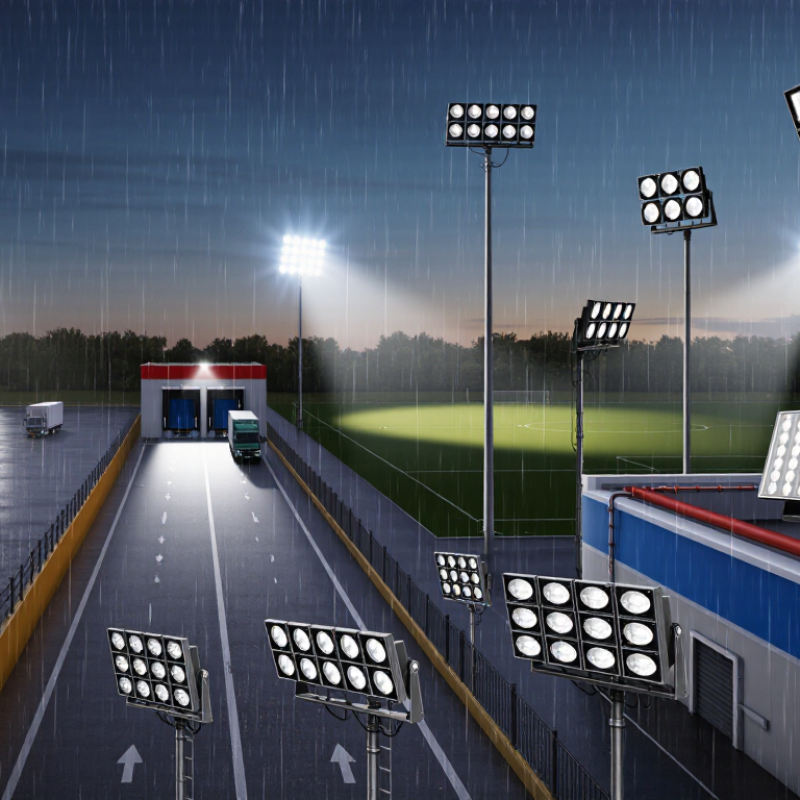
What Are the Best Commercial Flood Lights?
What Defines a Commercial Flood Light?
A commercial flood light is built to illuminate broad outdoor areas, such as loading zones, building entrances, and parking lots. Its defining feature is not simply high wattage. Check the lumen output, beam angle, and light distribution together. A narrow beam can leave dark gaps, while a wider beam may spill light beyond the target. Good fixtures manage heat, resist weather, and maintain steady output during long operating hours. Look for a suitable ingress protection rating for the installation location, plus a housing designed to handle rain, dust, and temperature changes. Details matter.
Tips: Compare usable lumens, not watts alone. Review the fixture’s photometric layout and mounting height before choosing. A sample installation can reveal glare or dark patches that a product sheet may not show.
Controls and maintenance also help define a commercial-grade fixture. Dimming, motion sensing, or scheduled operation can reduce unnecessary use when compatible with site needs. Ask about expected service life and how output changes over time; initial brightness is only part of the picture. Match color temperature to the task and surroundings. Cooler light can make edges easier to distinguish, but it may feel harsh near homes. There is no perfect setting for every site, and even a well-specified light can disappoint if aimed poorly.
| Specification | Typical Commercial Range | What It Defines | Selection Guidance |
|---|---|---|---|
| Light source | LED is the most common choice in new installations. | Commercial flood lights are designed to provide broad, high-intensity illumination for outdoor or large-area applications. | Look for a fixture with documented photometric data and replaceable or serviceable components where maintenance access matters. |
| Luminous output | About 5,000–60,000 lumens, depending on fixture size and application. | Lumens measure the total visible light produced by the fixture. | Choose output based on mounting height, area size, required illuminance, and a lighting layout—not wattage alone. |
| Efficacy | Roughly 100–150 lumens per watt for many commercial LED fixtures. | Efficacy indicates how much light is produced for each watt of electricity used. | Compare tested fixture efficacy alongside light distribution, glare control, and expected operating conditions. |
| Beam distribution | Common distributions range from narrow beams around 10°–30° to wide beams around 60°–120°. | Beam angle and optical distribution determine where light is directed and how evenly an area is covered. | Use narrower optics for long-distance or targeted lighting and wider optics for broad coverage; verify aiming and spill-light limits. |
| Ingress protection | IP65 is common; IP66 is used where stronger water-jet resistance is needed. | The IP rating describes protection against dust and water under specified test conditions. | For exposed outdoor locations, confirm the rating is for the complete assembled fixture and suits the actual cleaning and weather conditions. |
| Impact resistance | IK08 or IK10 may be specified for fixtures exposed to impact risks. | The IK rating indicates resistance to mechanical impact; higher numbers indicate greater tested impact resistance. | Consider a higher rating for sports facilities, public spaces, loading areas, or locations where equipment may be struck. |
| Color temperature | Common options are 3000 K, 4000 K, and 5000 K. | Correlated color temperature describes whether the light appears warmer or cooler. | Choose a consistent color temperature across the site and consider local requirements for outdoor lighting and light pollution. |
| Color rendering | CRI 70 or higher is common for general outdoor applications; CRI 80 or higher may suit color-critical tasks. | CRI describes how accurately colors appear under a light source compared with a reference source. | Use a higher CRI where workers need to distinguish colors, inspect surfaces, or identify objects accurately. |
| Electrical supply | Commercial models may support 120–277 V or 277–480 V, depending on the fixture. | Input-voltage compatibility determines whether the fixture can connect to the site’s electrical system. | Check the full input-voltage range, local electrical code, driver compatibility, and available circuit before ordering. |
| Controls and dimming | Options may include 0–10 V dimming, photocells, occupancy controls, or networked controls. | Controls can reduce energy use and adjust lighting to schedules, daylight, or occupancy. | Confirm control protocols and sensor compatibility; not every fixture includes controls as standard. |
| Surge protection | Protection levels vary by design; some fixtures specify internal surge protection in kilovolts. | Surge protection helps reduce damage from transient voltage events, including some lightning-related surges. | Review the rated protection level and consider additional site-level protection where exposure or electrical risk is high. |
| Service life | Many LED fixtures publish an estimated L70 life in the range of 50,000–100,000 hours. | L70 is the estimated operating time until light output reaches 70% of its initial level under stated conditions. | Check the test basis, ambient temperature, driver life, and warranty terms; rated life is not a guarantee of failure-free operation. |
| Thermal and environmental limits | Operating-temperature limits are model-specific and often cover sub-zero to hot outdoor conditions. | Thermal design affects performance and service life, particularly in enclosed or high-temperature locations. | Verify the fixture’s stated ambient-temperature range for the actual installation site and mounting arrangement. |
| Mounting and aiming | Common arrangements include yoke, slipfitter, and wall or pole mounting options. | Mounting hardware determines how securely the fixture attaches and how accurately it can be aimed. | Check pole or wall compatibility, wind exposure, adjustment range, and the fixture’s weight before installation. |
| Best-fit applications | Parking lots, building facades, loading areas, sports grounds, yards, and security perimeters. | A commercial fixture is selected for the required coverage, durability, operating schedule, and site conditions. | The best option is the one that meets the project’s lighting design, safety, energy, environmental, and maintenance requirements. |

Commercial flood lights differ not only by output, but by how they produce and direct light. LED fixtures use less energy than older halogen or metal-halide lamps and reach useful brightness quickly. Halogen produces warm, strong light, but more heat and frequent replacements can raise operating costs. Metal-halide can cover broad yards, though warm-up and restart delays may frustrate staff. That matters. A loading bay needs clear visibility on people and vehicle sides, while a parking lot often needs even ground coverage.
Optics and controls change the result. A narrow beam can illuminate a sign or gate; a broad beam suits open ground but may spill into windows. Check lumen output alongside beam angle, mounting height, and glare control. Color temperature affects appearance: cooler white can make edges easier to distinguish, while warmer light may feel less harsh. Motion sensors and photocells can reduce unnecessary runtime, but poorly placed sensors may switch lights off during quiet work. IP ratings indicate resistance to dust and water, so choose for actual exposure. A common mistake is choosing the brightest fixture before checking aiming and spacing.
Tips: Sketch the site at night, mark dark corners, and test one fixture before ordering many. Measure real coverage. Specs can mislead.
LED flood lights generally deliver high light output per watt and are a common choice for energy-efficient commercial lighting. High-pressure sodium and metal halide lamps are older discharge technologies, while halogen lamps typically use more energy for the same light output. Values are representative midpoints of common published efficacy ranges; actual performance varies by lamp, fixture, and operating conditions.
When comparing commercial flood lights, start with delivered lumens per watt, not wattage alone. Higher efficacy can reduce energy use, but only if the beam puts light where workers need it. Check the photometric distribution for the mounting height and target area. A wide beam may brighten a loading bay, yet spill light onto neighboring windows. Small detail. Color temperature and color rendering also matter near signs, equipment, and walkways.
The U.S. Department of Energy’s LED Lighting Factsheet reports that LEDs use at least 75% less energy and last up to 25 times longer than incandescent lighting. Those figures offer context, not a direct promise for every commercial fixture. Compare rated life, lumen maintenance, and warranty terms on the actual product specification. DOE’s CALiPER testing program also evaluates LED product performance, reminding buyers to look beyond marketing claims and examine test results.
Outdoor conditions deserve close attention. Check the ingress-protection rating for dust and water exposure, plus surge protection and operating-temperature limits. A fixture above a coastal dock faces different demands than one under a sheltered canopy. Heat can shorten component life, so inspect the housing and thermal design. Controls such as photocells or dimming may save energy, but compatibility can be overlooked. I have seen polished specifications leave installation questions unanswered; verify wiring, mounting, and aiming before purchase.
Matching a flood light to a commercial site starts with the work happening there. A loading yard needs broad, even coverage so staff can see vehicle paths and dock edges. A building entrance usually needs less output, with careful aiming to keep light off nearby windows. Start at ground level. Walk the site after dark and note shadows, glare, and dark corners before choosing fixture locations.
Then match the light’s distribution, mounting height, and durability to those conditions. A narrow beam can reach a tall sign, while a wider pattern suits open pavement. Check the fixture’s weather rating, housing material, and access for routine cleaning. Dust, rain, and vibration can shorten service life when equipment is poorly matched. Use controls such as timers or motion sensors where they suit actual operating hours. Test after dark. A plan can look convincing on paper and still leave a harsh hotspot beside a dim walkway. Adjust aiming and output on site, and document the final settings for maintenance staff.
What Are the Best Commercial Flood Lights?
How Installation and Maintenance Affect Long-Term Performance
A commercial flood light’s long-term performance depends on more than its rated output. Correct aiming reduces dark patches and wasted spill light; secure mounting helps prevent movement in wind. Match the fixture’s weather protection and beam pattern to the site, then check that wiring, controls, and surge protection suit the installation. Small oversights matter. A tilted fitting can send light across a car park rather than onto the walking surface.
Maintenance protects that investment. Dust on lenses, moisture in damaged seals, and heat trapped around the fixture can reduce useful output or shorten component life. Set a regular inspection schedule, clean lenses with suitable materials, and look for corrosion, loose fittings, or uneven brightness. The U.S. Department of Energy’s 2019 LED forecast projected annual U.S. electricity savings of 569 TWh by 2035 as LED adoption grew. That is a forecast, not a guarantee for every site. Poor installation can undermine the expected gains.
Tips: Record the fixture’s initial aim and output, then compare them during inspections. Check after storms and seasonal changes. DOE guidance on LM-80 testing and TM-21 projections can help buyers assess LED lumen-maintenance claims, though real-world results still depend on heat, drivers, and upkeep.


For those larger-sized parts, or smaller quantity runs, we have 2 independent powder coat booths and ovens. The quality, durability and affordability of today’s powder coating finishes make this the process of choice for world-class companies.
Powder coating advantages over other forms of coating are many. Materials used in the Powder coating process can be metals and non-metals that come in a multitude of thicknesses, textures, colors, etc. Another of Powder coating’s biggest advantages over conventional coatings is its ability to create finishes in many different textures. Powder Coating Booths allow us the ability to apply these advantages to large products.
Tri-State Fabricators runs a full-service conveyor line for painting. Wet painting can provide protection or decoration to many different part styles. From start to finish, every project is easier to undergo random and point-based inspection by our skilled painting team.
Advantages to our Wet Paint Line are these lines start with product prep and ends with a thorough inspection of a high quality finished product. Our ability to complete large and small projects with a superior finish and doing so in a timely and economical fashion. This passes along the savings in production to our customers. When powder coating ins not an option, our Wet Paint Line gets the job done right the first time.
When the parts get big and heavy we roll-out our custom paint racks and oversize booth. By utilizing our partnerships with all the major paint brands, we can match virtually any color with wet paint.
The advantages of having access to a Wet Paint Booth are many. Large projects of many different shapes can be loaded into the booth. The Wet Paint Booth offers an environment that is much more controlled than a typical parts painting operation.
Not only are they used because of their controlled environment, but they’re are also advantageous when it comes to applying paint to parts that are needed in industries that require specialty coatings such as medical, aerospace, etc.
Our military forces have some very high standards when it comes to the finish of their vehicles and equipment. From the first pre-treatment step to final coat, it takes a great deal of knowledge and experience to protect the men and women of our armed forces. They deserve only the best, and Tri-State Fabricators provides it.
All of our processes are closely monitored by our staff and management teams. Both of which are highly trained in the processes of metal fabrication and finishing. Tri-State Fabricators’ goal is to always fully satisfy each and every customer, including the military. We will always put a 110% into what we do.
Abrasive media blasting is an excellent way to remove old paint, rust, and increase the paint/powder adhesion. Glass beads produce a much smoother and brighter finish than angular abrasives; leaving the part clean yet without any dimensional change. Chemically inert and environmentally friendly, we can recycle our beads approximately 30 times; making them a more preferred method of metal cleaning or surface finishing.
Advantages to Glass Bead Blasting are many. Glass bead blast media is used when a project is needing rough surfaces need to become smooth for applications of coatings such as paint. It is typically used to clean paint and rust from a product surface without deforming the surface it is being used on. Overall, compared to many other blasting media, Glass Bead Blasting is a very economical choice and those savings are always passed on to our customers.
Tri-State Fabricators utilize a zinc phosphate wash to clean and etch the material to ensure the best paint adhesion possible. The unique design of our 3-stage wash system does the work like a 5-stage. From Cleaning and rinsing to conversion coating and post-treatment, Our Part Washing process is a complete service and works throughout the fabrication service and the finishing service.
Along with the previously mentioned benefits, Curing is a vital chemical reaction that leaves the product finish hard and relatively safe from mild abrasion and aggressive corrosion. This process can be done in more than one way; ambient air-dry or in curing ovens at temps that exceed 240°.
From fixing paint mistakes (someone else’s of course) to simply cleaning our paint line hooks, our burn-off oven is put to good use. After a quick burn-off, a little clean up, and a fresh coat of paint, your parts will look better than new.
Why does our Burn-Off Oven work so well? Because super heating the air around parts turns the materials into ashes. From paint and powder coatings to rubber and machining oils, high temps do the job without degrading the integrity of the part.
Masking is a vital part of producing high quality products. We have die-cut masking patterns to protect machined surfaces as well as a wide range of plugs and caps to protect threaded holes and bolts. We provide permanent and temporary masking.
Masking allows the selected sections of a product to be protected from a fabrication or finishing service. This can be with both chemicals when etching and tapes, paints when only finishing just a section of the product. Masking is great in aiding the customization process of a project.
Screen printing is a photographic process that transfers artwork onto a porous nylon screen which allows colored ink to flow through the screen and be deposited on an aluminum or plastic component. We can generally have just about any design created onto a screen for your parts.
Some of the advantages of Screen Printing are, brand recognition for your business displaying on your products, assembly instructions, product warnings/hazards, etc. Tri-State Fabricators produces Screen Printing of the highest quality so you know it’s durable.
Metal Finishing is the art of treating the exterior portion of product, often metal but can also be made of other materials, so that the surface is clean and free of any debris. Then the process of applying coats or either paint of powder coat takes place. This coating process improves the quality of the product in both appearance and resistance to wear and corrosion.
Tri-State Fabricators, Inc., understands that a project typically isn’t complete until a high-quality finish has been added to your product. This is why our painting and powder coating teams continuously inspect the products throughout the Metal Finishing process.

