China Best 3/8 Tube Hairpin Bender Supplier?
Choosing a China-based supplier for a “3/8" Tube Hairpin Bender” requires more than comparing prices. The machine must form consistent hairpin bends without flattening or marking the tube. For HVAC and refrigeration production, small differences in bend radius, alignment, and repeatability can affect assembly and downstream fit.
A useful supplier discussion starts with the actual job. Share tube material, wall thickness, bend dimensions, production volume, and required changeover frequency. Ask how the machine controls feeding, clamping, and bending, and request specifications that match your configuration. Details matter: a sample bend, measured for diameter change and angle consistency, says more than a broad performance claim. So does a clear explanation of tooling, spare parts, operator training, and service response.
Look closely at evidence. Factory videos, inspection records, reference installations, and a live acceptance test can help verify what a quotation promises. Confirm which components are included, how tolerances are measured, and what support is available after shipment. Not every supplier will provide the same level of documentation. That gap deserves attention.
A low quote can be tempting. Yet tooling quality, setup time, and access to replacement parts may shape the real cost of ownership. No single “best” supplier fits every production line. The right choice is the one that can show relevant experience, answer technical questions plainly, and demonstrate repeatable results on your tube specifications. A little caution helps. So does asking one more question before placing an order.
What Is a 3/8-Inch Tube Hairpin Bender?
A 3/8-inch tube hairpin bender is a machine or forming tool that turns straight tubing into a compact U-shaped bend. The 3/8-inch measurement usually refers to the tube’s outside diameter, not its inside opening. Always confirm this against the machine specification. Small details matter.
The tool guides the tube around a forming die while controlling the bend radius. In coil production, paired U-bends connect straight tube sections into hairpin-shaped circuits. A suitable setup helps limit flattening, wrinkles, and unwanted changes in tube diameter. Results depend on more than the nominal size: material, wall thickness, bend radius, and tooling condition all affect the finished shape.
Before production, operators should check the tube dimensions and make a test bend. Look closely at the curve under good lighting. Is the cross-section still reasonably round? A small mismatch may cause trouble during later assembly, even when the bend looks acceptable from above. This check is easy to overlook. Even a well-adjusted machine may need fine tuning when tube batches or material conditions change. That is not always obvious at first.
China Best 3/8-Inch Tube Hairpin Bender Supplier? What Is a 3/8-Inch Tube Hairpin Bender?
A 3/8-inch tube hairpin bender forms tubing into a U-shaped return bend, commonly used in heat exchangers and HVAC or refrigeration coils. “3/8 inch” refers to the tube’s outside diameter; 3/8 inch equals 9.525 mm.
The chart shows inch-to-millimeter conversions for common tube outside diameters. Before selecting a bender, check that it matches the tube material, wall thickness, and required bend radius.
How Does a Tube Hairpin Bender Form Copper Tubing?
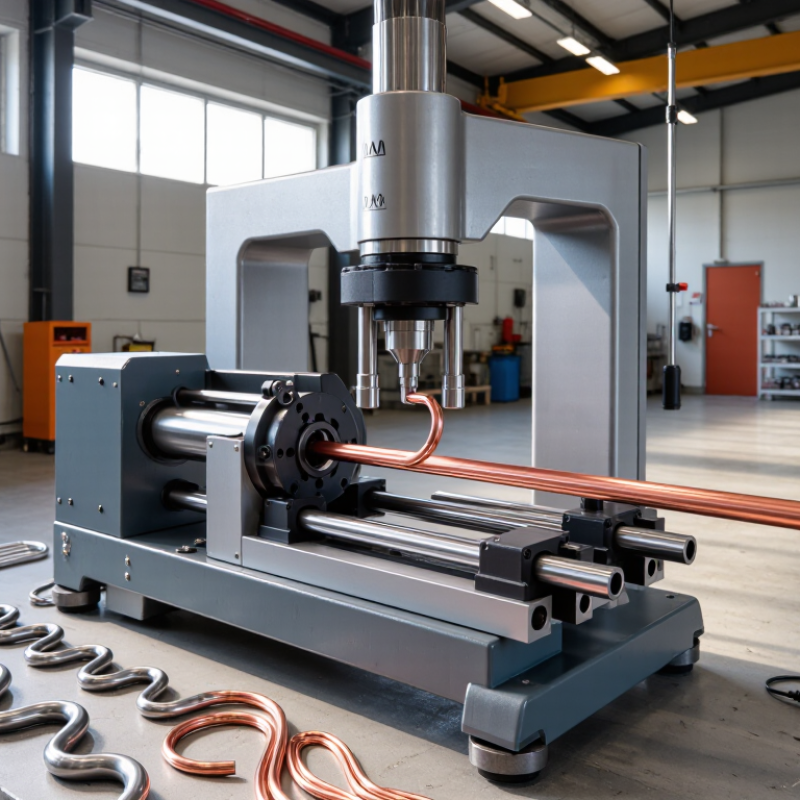
A tube hairpin bender turns straight copper tubing into repeated U-shaped returns used in heat exchangers. The operator loads a measured length, guides it against a forming die, and secures it to prevent twisting. Keep alignment true. In many machines, a clamp holds the straight section while a rotating arm draws the copper around a fixed-radius former. Some setups use a mandrel or internal support to reduce flattening, especially with thin-wall tubing. The bend develops gradually, not in one sharp push. That matters.
For 3/8-inch tubing, the die and tooling must match the tube’s outside diameter, wall thickness, and specified bend radius. After forming one leg, the machine indexes or repositions the tube and makes the return bend, creating a consistent hairpin shape. Copper has some springback, so the final angle may differ slightly from the tool setting. An operator checks sample parts, adjusts for springback, then verifies leg spacing, overall length, and ovality with gauges. Look closely inside each bend. A small wrinkle can signal excess pressure or poor support. Material temper and lubrication can also affect the result, so confirm settings on the actual tubing batch.
China Best 3/8 Tube Hairpin Bender Supplier? - How Does a Tube Hairpin Bender Form Copper Tubing? | Process or data point | What the bender does | Practical tubing detail | Quality check |
| Tube size reference | Uses tooling matched to the tube’s outside diameter and the specified bend geometry. | 3/8 inch outside diameter equals 9.525 mm. Confirm whether the stated size refers to outside diameter before selecting tooling. | Check the tube specification and measure the outside diameter; do not rely on nominal size alone. |
| Material preparation | Feeds the copper tube into the machine and positions the required straight length for the two legs of the hairpin. | Copper tubing is supplied in different tempers and wall thicknesses. These affect forming behavior and must be compatible with the application and tooling. | Inspect for dents, kinks, surface damage, and contamination before loading. |
| Clamping and support | Secures the straight tube section while supporting the tube near the bend to limit unwanted movement. | Correct alignment helps keep the hairpin legs in the same plane and reduces twist. | Verify that the tube is seated consistently and that clamps do not crush or mark it. |
| Forming the return bend | Guides the tube around a form die to create the curved return that connects the two parallel legs. | A hairpin commonly has a U-shaped return; the bend radius is determined by the drawing and the selected die, not by the 3/8-inch tube size alone. | Check bend shape, radius, and visible signs of wrinkling or flattening against the part drawing. |
| Springback control | Uses the selected tooling and machine settings to account for the tube’s tendency to relax slightly after forming. | Springback varies with copper temper, wall thickness, bend radius, and forming conditions, so there is no single setting suitable for every tube. | Measure sample parts after release and adjust the setup only against the required drawing dimensions. |
| Leg alignment and spacing | Positions the two straight legs to the required center-to-center spacing and overall length. | Leg spacing and length are application-specific and should be taken from the part drawing. | Use a suitable gauge or measuring fixture to check spacing, parallelism, and overall dimensions. |
| Finished-part inspection | Releases the formed hairpin for dimensional and visual inspection before downstream assembly. | Tube ends may require additional cutting, facing, or cleaning depending on the manufacturing process. | Confirm the drawing requirements, end condition, and absence of cracks, sharp damage, or unacceptable deformation. |
Note: Final bend radius, leg spacing, tolerances, and machine settings depend on the tube specification, tooling, and part drawing. Confirm these requirements with a production trial before full-scale manufacture.
Which Specifications Matter When Choosing a Bender?
A 3/8-inch hairpin bender should be selected around the tube and finished geometry, not nominal diameter alone. The nominal outside diameter is 0.375 inch, or 9.525 mm, using the exact conversion in NIST Special Publication 811. Confirm wall thickness, alloy, temper, seam type, and production volume before specifying tooling. For stainless tubing, ASTM A269/A269M provides dimensional tolerance tables by size and product form. Check the applicable rows against measurements from your actual tube.
Ask for the centerline radius, leg spacing, hairpin length, and allowable springback. A tight radius can flatten the outer wall or wrinkle the inner wall. Request sample bends using your tube, then inspect ovality, parallel legs, pitch, and end alignment. Record the machine’s stated repeatability and changeover time; catalog capacity alone tells little. One detail is easy to underestimate: springback varies with material condition, so a setup that works for one lot may need adjustment on another.
Tips: Bring a cut tube sample and a dimensioned hairpin sketch. Measure outside diameter and wall thickness at several points. Small differences matter. If trial results are borderline, repeat the test with another tube length.
How to Evaluate Chinese Hairpin Bender Suppliers
China Best 3/8 Tube Hairpin Bender Supplier?
How to Evaluate Chinese Hairpin Bender Suppliers
Choosing a supplier takes more than comparing quoted prices. Ask how the 3/8-inch tube size is supported across different materials and wall thicknesses. A capable supplier should explain the machine’s bending range, tooling options, and changeover process in plain terms. Request a live test using your tube, not only a polished demonstration video. Watch for flattening, wrinkles, and inconsistent hairpin spacing. Small details count.
Check the machine’s repeatability over a full production run. Ask for sample parts and measurements, including bend dimensions and leg alignment. Confirm what is included: tooling, installation guidance, spare parts, and operator training. Clear technical drawings and a written acceptance checklist make discussions easier. So does a realistic delivery schedule. If answers stay vague, pause.
After-sales support deserves equal attention. Find out who handles setup questions, how quickly parts can be shipped, and whether troubleshooting instructions are available. A factory visit or third-party inspection may help, but neither guarantees a perfect machine. I would compare several suppliers using the same questions and test criteria. Even then, the first sample can be misleading; production conditions may reveal issues later. Ask how the supplier documents corrections and verifies the next batch before committing.
What to Verify Before Placing a Supplier Order
Before ordering a 3/8-inch tube hairpin bender, confirm the exact tube specification, not just its nominal size. The Copper Development Association’s Copper Tube Handbook gives standard tube dimensions; 3/8 inch converts to 9.525 mm nominal outside diameter. Ask the supplier to confirm tooling compatibility with your tube’s actual outside diameter, wall thickness, material, and temper. ASTM B280 is another useful reference for air-conditioning and refrigeration copper tube requirements. A machine rated for one tube condition may not produce clean bends with another.
Request a sample bend using your own tube. Inspect it for flattening, wrinkles, scratches, and springback, then measure the finished centerline radius. Ask for the machine’s rated bend range, repeatability tolerance, setup time, and spare-part lead time in writing. Review the operating manual and maintenance schedule, too. A polished sample can still conceal slow changeovers or difficult adjustments. That detail is easy to miss.
Tips: Send a tube sample and a drawing with the order inquiry. Request a short video of the machine bending the same specification, plus a written acceptance checklist. If the supplier cannot state how bend quality is measured, pause and clarify before paying a deposit.





