


5 Best Bulkhead USB Connectors for Global Buyers?

Global buyers need more than a low price when selecting a Bulkhead Usb Connector. They need stable power delivery, secure panel mounting, corrosion resistance, and predictable performance in real environments. Behind a control cabinet, a connector may face vibration, dust, moisture, and repeated cable movement. A loose fit can interrupt charging, data transfer, or machine monitoring.

Grand View Research valued the global USB devices market at approximately USD 29.8 billion in 2022. Its report also projects an 8.2% compound annual growth rate from 2023 to 2030. This expansion increases demand for durable USB interfaces in industrial equipment, vehicles, marine systems, and outdoor electronics. USB-IF specifications also recognize USB Type-C power delivery up to 240 watts under USB Power Delivery 3.1. However, connector performance depends on the complete design, not only the port standard.

Jeff Ravencraft, USB Implementers Forum President and COO, described USB Type-C as “the connector of the future.” That statement reflects market direction, but it does not remove practical selection risks. Buyers must still check IP ratings, shell materials, contact plating, locking methods, cable compatibility, and testing records. Some suppliers publish impressive specifications without showing meaningful evidence. That deserves caution.

This guide reviews five Bulkhead USB Connector options for global purchasing teams. The comparison considers installation depth, sealing, mechanical strength, signal reliability, and supply consistency. No ranking is perfect. A connector that suits a factory wall may fail inside a vibrating vehicle. The best choice depends on the enclosure, environment, and actual load.
5 Best Bulkhead USB Connectors for Global Buyers?

What Are Bulkhead USB Connectors and How Do They Work?

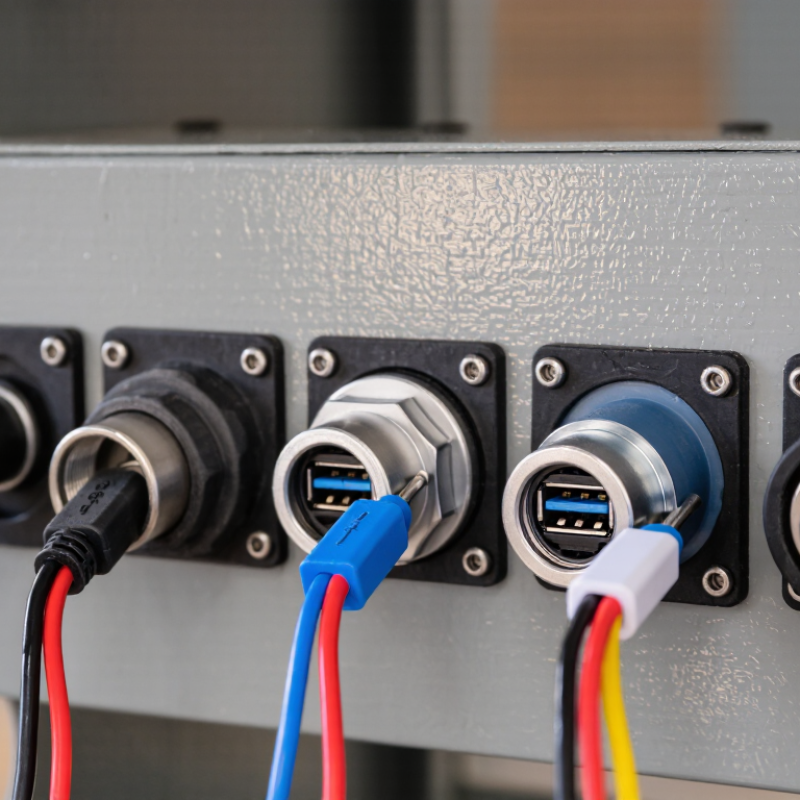
Bulkhead USB connectors are panel-mounted ports that let USB signals pass through an enclosure wall. They create an accessible connection outside a machine, cabinet, vehicle, or test instrument. The connector usually has a threaded body, mounting flange, rear cable, and a standard USB interface. It keeps internal wiring protected while making external access convenient.

Inside, metal contacts carry power and differential data signals between two USB cables or devices. The rear cable connects to a circuit board, harness, or internal socket. A gasket can reduce dust and moisture entry around the panel opening. Shielding helps limit electrical noise, especially near motors or switching power supplies. However, a gasket alone does not guarantee waterproof performance. Installation pressure and enclosure design matter.

From practical assembly work, I check panel thickness, cutout size, connector orientation, and cable bend space before ordering. A tight fit looks professional but can stress the cable. For outdoor equipment, choose a sealed structure with a verified protection rating. For high-speed USB use, short internal wiring and controlled impedance are important. Cheap connectors sometimes pass power but fail data testing. That is an easy mistake. The strongest options balance retention, shielding, sealing, current capacity, and service access rather than relying on appearance alone.


Key Specifications Global Buyers Should Compare

5 Best Bulkhead USB Connectors for Global Buyers

When comparing the five strongest bulkhead USB connector options, global buyers should check specifications before appearance. USB Type-C models usually offer reversible plugging and higher power potential. USB-A models remain practical for older instruments and factory equipment. Confirm the actual data rate, not only the USB generation printed on a datasheet. A connector marked for high-speed transfer may perform poorly with a weak cable.

Power delivery needs close attention. Check the rated voltage, current, and total wattage under continuous use. A port supplying 5 volts at 3 amps may suit a small controller, but not every industrial computer. Thermal testing matters here. Hot panels reveal weaknesses quickly. Surge protection and shielding also deserve comparison, especially near motors, relays, or radio equipment.

The panel cutout and mounting method must match the enclosure drawing within tight tolerances. Compare thread size, flange dimensions, gasket design, and maximum panel thickness. An IP-rated connector is useful only when the cable connection maintains the same protection level. Materials such as nickel-plated brass, stainless steel, and reinforced polymers affect corrosion resistance and service life. Operating temperature, salt-spray performance, vibration resistance, and regional safety documentation should be recorded before purchasing.

A small detail often gets missed: cable bend radius. I have seen reliable connectors fail after a stiff cable was forced sideways. That was not the connector’s fault, but the installation plan was incomplete. Buyers should request sample units and test mating cycles, data stability, waterproofing, and charging performance with their actual cables. Five products may look identical. Their internal contacts may not be.

Five Leading Bulkhead USB Connector Types for Different Uses

5 Best Bulkhead USB Connectors for Global Buyers?

Five Leading Bulkhead USB Connector Types for Different Uses

Bulkhead USB-A connectors suit control panels, test benches, and older industrial equipment. Their wide opening accepts common cables and supports simple replacement. USB-C bulkhead connectors serve newer instruments, laptops, and compact charging stations. They can carry data and power through one reversible port. However, buyers should verify power ratings, data speed, and cable compatibility. A USB-C shape does not guarantee advanced performance.

Micro-Usb Bulkhead Connectors remain useful in compact sensors, handheld devices, and embedded systems. They save panel space, but their small shells can wear faster under repeated plugging.

Mini-USB versions still fit legacy cameras, navigation units, and field instruments. They are less common now. USB-B bulkhead connectors provide a firm connection for printers, measurement equipment, and laboratory controllers. Their square profile helps prevent accidental cable mismatch.

For outdoor or mobile equipment, choose a sealed bulkhead version with a protective cap. Check the gasket material, mounting thread, panel thickness, and ingress rating before ordering. A connector may look rugged yet fail after dust enters its rear terminals. That detail is easy to miss. I have seen installation plans focus on the front socket while ignoring cable strain relief. It is not perfect. Temperature range, vibration resistance, shielding, and grounding also deserve practical testing. Global buyers should request drawings and sample units before placing larger orders.

Installation, Sealing, and Durability Considerations

Choosing among the five best bulkhead USB connectors requires more than checking the port type. Installation quality often determines real performance. Confirm the connector’s panel thickness range before drilling. A loose fit can compress the gasket unevenly. A tight fit may distort the housing.

Sealing depends on the enclosure, cable exit, and installation torque. Look for a clearly stated IP rating, but verify how that rating was tested. Outdoor equipment may face rain, dust, vibration, and sudden temperature changes. Use the supplied gasket on a clean, flat surface. Avoid silicone unless the manufacturer permits it. Excess sealant can trap moisture near the contacts. Durability also depends on strain relief and mating cycles. A connector that feels strong may still fail after repeated cable movement. Choose corrosion-resistant hardware for humid or coastal locations. USB performance can degrade when long cables, poor grounding, or weak shielding are involved. I would not rely on appearance alone. That has caused expensive rework.

Tips: Measure twice and drill once. Deburr the panel opening carefully. Tighten the retaining nut evenly, without crushing the gasket. Leave a small service loop behind the panel. Test data transfer and charging after installation. Repeat the test after vibration or temperature exposure when possible. One detail is easy to miss: dust caps need their own seal and retention strength. Connection failures often begin there.

How to Select a Reliable Bulkhead USB Supplier Worldwide

Selecting a reliable bulkhead USB supplier worldwide requires more than comparing catalog prices. Check the supplier’s experience with panel-mount connectors, cable assemblies, and harsh installation environments. Ask for dimensional drawings, current ratings, insertion-cycle data, and waterproof test results. A serious supplier should provide clear answers, not vague promises.

Inspect the connector details closely. Look for corrosion-resistant shells, secure mounting threads, sealed caps, and strain relief around the cable. Confirm whether the connector supports USB 2.0, USB 3.x, or USB-C power delivery. These differences affect data speed, heat, and equipment compatibility. Request samples before placing a volume order. Test them behind a metal panel, under vibration, and near moisture. Small gaps can become expensive failures.

Supplier reliability also depends on documentation and communication. Review material certificates, inspection records, production capacity, and quality-control procedures. Ask how rejected units are traced and replaced. A supplier serving global buyers should explain packaging, lead times, export documents, and after-sales support clearly. Time-zone delays can expose weak communication. Do not rely only on polished websites or impressive sample photos. Some suppliers provide excellent samples but inconsistent mass production. That risk is easy to miss. An independent inspection may increase costs, yet it can reveal loose threads, uneven plating, or incorrect cable lengths before shipment. Be willing to question your own assumptions, especially when the lowest quote appears unusually attractive.

5 Best Bulkhead USB Connectors for Global Buyers? - How to Select a Reliable Bulkhead USB Supplier Worldwide
Rank Bulkhead USB Connector Type USB Standard & Typical Data Rate Common Port Configuration Typical Panel Cutout / Mounting Method Ingress Protection Typical Electrical Rating Best-Fit Applications Key Selection Criteria for Global Buyers
1 USB 2.0 Type-A Female-to-Female Bulkhead Coupler USB 2.0 Up to 480 Mb/s Type-A female connector on both sides; passive straight-through coupling Usually a circular or rectangular panel opening; threaded nut, flange screws, or snap-in retention Commonly IP54 to IP67, depending on the sealing gasket and cap design Typically rated for 5 V USB power and up to 500 mA under the USB 2.0 specification Control cabinets, industrial PCs, laboratory equipment, vehicle dashboards, and machine panels Choose a shielded version, corrosion-resistant shell, secure panel retention, and a supplier able to provide consistent pin-to-pin wiring and dimensional drawings.
2 USB 3.x Type-A Bulkhead Extension Connector USB 3.2 Gen 1 Up to 5 Gb/s Type-A female panel connector with an internal cable or rear connector Panel flange with screws or threaded mounting hardware; cutout dimensions vary by housing design Commonly IP65 to IP67 when fitted with a sealing cover and correctly installed gasket Typically supports 5 V bus power; current capability depends on the cable, contacts, and host implementation Industrial automation, outdoor control boxes, inspection systems, networking cabinets, and test equipment Verify that all SuperSpeed contacts are wired, the cable impedance is suitable for high-speed USB, and the supplier supplies insertion-loss or signal-integrity test information when required.
3 USB Type-B Panel-Mount Bulkhead Connector USB 2.0 Up to 480 Mb/s Type-B female device-side connector; commonly paired with a Type-A host cable Square flange, two-screw or four-screw mounting, with a defined panel thickness range Typically IP54 to IP67 in sealed industrial versions Usually 5 V USB power with current determined by the host and connected equipment Printers, measurement instruments, industrial controllers, medical equipment, and legacy embedded devices Confirm connector orientation, screw spacing, panel thickness compatibility, strain relief, and availability of replacement mating cables in the target market.
4 USB Type-C Bulkhead Feedthrough Connector USB 2.0 Up to 480 Mb/s
USB 3.x options Up to 5 or 10 Gb/s, design-dependent
Reversible Type-C female-to-female or female-to-cable feedthrough Round threaded mount, rectangular flange, or panel-mount screw holes; exact cutout must match the connector drawing Commonly IP54 to IP67; sealed dust caps are often available Basic USB-C power commonly supports 5 V; higher-power USB Power Delivery requires compatible contacts, cable, controller, and certification Modern industrial devices, portable instruments, kiosks, vehicle systems, consumer equipment, and charging panels Do not assume every Type-C bulkhead connector supports USB Power Delivery, DisplayPort, or high-speed data. Request a complete pinout, supported protocols, current rating, and test conditions.
5 Ruggedized USB Bulkhead Connector with Protective Cap USB 2.0 or USB 3.x Performance depends on the internal connector and cable assembly Type-A, Type-B, or Type-C interface with tethered cap, locking cover, or environmental sealing system Flange or threaded panel mount; may include locking hardware and rear cable strain relief Often IP67 or higher when mated and properly sealed; the unmated rating depends on the cap design Electrical rating follows the selected USB interface; confirm voltage, current, contact resistance, and shield continuity Marine equipment, transportation, outdoor instrumentation, defense-related non-classified equipment, and harsh factory environments Evaluate UV resistance, salt-spray performance, operating temperature, vibration resistance, gasket material, cap retention, and documented environmental test results.

Powder Coat Booths

For those larger-sized parts, or smaller quantity runs, we have 2 independent powder coat booths and ovens. The quality, durability and affordability of today’s powder coating finishes make this the process of choice for world-class companies.

Powder coating advantages over other forms of coating are many. Materials used in the Powder coating process can be metals and non-metals that come in a multitude of thicknesses, textures, colors, etc. Another of Powder coating’s biggest advantages over conventional coatings is its ability to create finishes in many different textures. Powder Coating Booths allow us the ability to apply these advantages to large products.

Wet Paint Line

Tri-State Fabricators runs a full-service conveyor line for painting. Wet painting can provide protection or decoration to many different part styles. From start to finish, every project is easier to undergo random and point-based inspection by our skilled painting team.

Advantages to our Wet Paint Line are these lines start with product prep and ends with a thorough inspection of a high quality finished product. Our ability to complete large and small projects with a superior finish and doing so in a timely and economical fashion. This passes along the savings in production to our customers. When powder coating ins not an option, our Wet Paint Line gets the job done right the first time.

Wet Paint Booths

When the parts get big and heavy we roll-out our custom paint racks and oversize booth. By utilizing our partnerships with all the major paint brands, we can match virtually any color with wet paint.

The advantages of having access to a Wet Paint Booth are many. Large projects of many different shapes can be loaded into the booth. The Wet Paint Booth offers an environment that is much more controlled than a typical parts painting operation.

Not only are they used because of their controlled environment, but they’re are also advantageous when it comes to applying paint to parts that are needed in industries that require specialty coatings such as medical, aerospace, etc.

Military CARC

Our military forces have some very high standards when it comes to the finish of their vehicles and equipment. From the first pre-treatment step to final coat, it takes a great deal of knowledge and experience to protect the men and women of our armed forces. They deserve only the best, and Tri-State Fabricators provides it.

All of our processes are closely monitored by our staff and management teams. Both of which are highly trained in the processes of metal fabrication and finishing. Tri-State Fabricators’ goal is to always fully satisfy each and every customer, including the military. We will always put a 110% into what we do.

Glass-Bead Blasting

Abrasive media blasting is an excellent way to remove old paint, rust, and increase the paint/powder adhesion. Glass beads produce a much smoother and brighter finish than angular abrasives; leaving the part clean yet without any dimensional change. Chemically inert and environmentally friendly, we can recycle our beads approximately 30 times; making them a more preferred method of metal cleaning or surface finishing.

Advantages to Glass Bead Blasting are many. Glass bead blast media is used when a project is needing rough surfaces need to become smooth for applications of coatings such as paint. It is typically used to clean paint and rust from a product surface without deforming the surface it is being used on. Overall, compared to many other blasting media, Glass Bead Blasting is a very economical choice and those savings are always passed on to our customers.

Part Washing

Tri-State Fabricators utilize a zinc phosphate wash to clean and etch the material to ensure the best paint adhesion possible. The unique design of our 3-stage wash system does the work like a 5-stage. From Cleaning and rinsing to conversion coating and post-treatment, Our Part Washing process is a complete service and works throughout the fabrication service and the finishing service.

Along with the previously mentioned benefits, Curing is a vital chemical reaction that leaves the product finish hard and relatively safe from mild abrasion and aggressive corrosion. This process can be done in more than one way; ambient air-dry or in curing ovens at temps that exceed 240°.

Burn-Off Oven

From fixing paint mistakes (someone else’s of course) to simply cleaning our paint line hooks, our burn-off oven is put to good use. After a quick burn-off, a little clean up, and a fresh coat of paint, your parts will look better than new.

Why does our Burn-Off Oven work so well? Because super heating the air around parts turns the materials into ashes. From paint and powder coatings to rubber and machining oils, high temps do the job without degrading the integrity of the part.

Masking

Masking is a vital part of producing high quality products. We have die-cut masking patterns to protect machined surfaces as well as a wide range of plugs and caps to protect threaded holes and bolts. We provide permanent and temporary masking.

Masking allows the selected sections of a product to be protected from a fabrication or finishing service. This can be with both chemicals when etching and tapes, paints when only finishing just a section of the product. Masking is great in aiding the customization process of a project.

Screen Printing

Screen printing is a photographic process that transfers artwork onto a porous nylon screen which allows colored ink to flow through the screen and be deposited on an aluminum or plastic component. We can generally have just about any design created onto a screen for your parts.

Some of the advantages of Screen Printing are, brand recognition for your business displaying on your products, assembly instructions, product warnings/hazards, etc. Tri-State Fabricators produces Screen Printing of the highest quality so you know it’s durable.

Metal Finishing

Metal Finishing is the art of treating the exterior portion of product, often metal but can also be made of other materials, so that the surface is clean and free of any debris. Then the process of applying coats or either paint of powder coat takes place. This coating process improves the quality of the product in both appearance and resistance to wear and corrosion.

Tri-State Fabricators, Inc., understands that a project typically isn’t complete until a high-quality finish has been added to your product. This is why our painting and powder coating teams continuously inspect the products throughout the Metal Finishing process.
