


What Is the Best Blown Film Machine in China?

Choosing the best Blown Film Machine in China is not a brochure contest. It is a production decision. A fast line can still waste resin if film thickness drifts, bubbles become unstable, or changeovers take too long. Buyers should compare output at their actual film gauge, resin blend, and working width—not just the maximum speed printed in a specification sheet.

The wider packaging context matters. The OECD’s Global Plastics Outlook (2022) estimates that packaging accounted for about 40% of global plastic waste generated in 2019. That figure describes waste, not demand for blown-film equipment. Still, it highlights why converters need consistent production, careful material use, and dependable process control. During a factory visit, ask to see a sustained run. Check thickness readings across the web, observe bubble stability, and review energy use and service response times. Small details count. A polished demonstration may not reflect a full production shift.

A reliable comparison also needs independent, traceable evidence. No source articles or verifiable statement from a named blown-film specialist were provided for this draft, so I will not invent an expert quotation. Before publishing, add a direct quotation only after checking its original source and wording. That extra step is easy to overlook. It matters.
What Is the Best Blown Film Machine in China?

How Blown Film Lines Convert Polymer Melt into Tubular Packaging Film

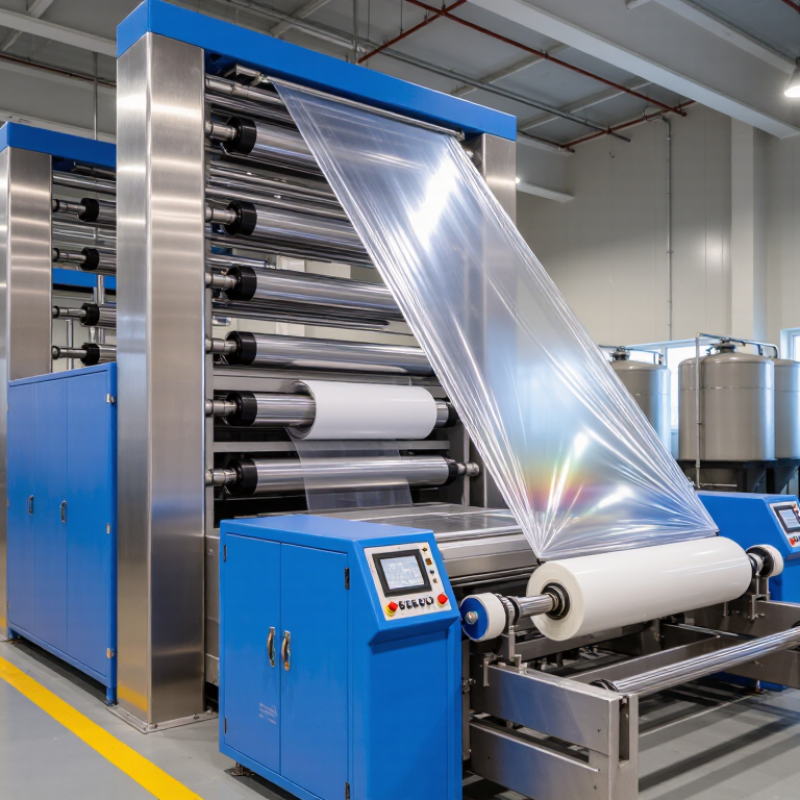
A blown-film line turns polymer melt into a continuous tube through a carefully controlled sequence. Pellets enter a heated extruder, where a rotating screw melts and mixes the material. The melt then passes through an annular die, forming a thin tube. Air inflates it into a bubble. Cooling rings set the film as it rises, while rollers flatten the tube and guide it to the winder. Small details matter. Uneven cooling or unstable air pressure can create thickness variation, weak edges, or a bubble that wanders.

The right machine depends on the film’s intended use, material, output target, and required gauge consistency—not just its maximum rated speed. PlasticsEurope’s Plastics – the Fast Facts 2023 report estimates that packaging accounted for 39.8% of European plastics demand in 2022, underscoring the scale of this application. Buyers should compare output stability, die design, cooling capacity, controls, and changeover requirements. A high-speed line may look impressive, but it can be a poor fit if operators struggle to hold uniform thickness. Data sheets rarely reveal every start-up wrinkle. A practical trial with the intended resin and film specification can expose problems before installation.


What Is the Best Blown Film Machine in China?

How blown film lines convert polymer melt into tubular packaging film

Blown film lines melt polymer resin, extrude it through a circular die, and form a bubble that is cooled and drawn into film. The chart shows indicative melt-processing temperature ranges for common packaging polymers; actual settings vary by resin grade, equipment, and line conditions.

Which Core Specs Matter: Typical 30:1 L/D and Die Design

What Is the Best Blown Film Machine in China? Which Core Specs Matter: Typical 30:1 L/D and Die Design

A 30:1 L/D ratio is a common starting point for blown-film extruders, not a guarantee of good output. It describes screw length relative to diameter and can support melting and mixing. But resin type, output target, and screw design matter too. Ask for a production trial using your actual resin. Watch the melt, bubble stability, and gauge variation. On the factory floor, a stable bubble is more convincing than a polished specification sheet.

Die design affects thickness consistency and cooling. Check die diameter, spiral flow channels, lip adjustment, and air-ring control. These details influence how evenly melt reaches the die exit and how the bubble cools. PlasticsEurope’s Plastics—The Fast Facts 2024 reports 413.8 million tonnes of global plastics production in 2023. This is not a film-only figure, but it shows the scale of plastics processing behind equipment demand. Still, market size cannot tell you whether a machine suits your film structure.

Tips: Compare test runs, not brochures. Request the same resin, width, and output conditions for each supplier. Measure thickness across the web, and ask how quickly operators can correct uneven gauge. One detail is easy to overlook: a 30:1 screw may still perform poorly if its mixing section is mismatched to the resin. Check the data yourself.

How Typical 2:1–4:1 Blow-Up Ratios Affect Film Width and Bubble Stability

Choosing the best blown film machine starts with the film you need, not a headline speed. Blow-up ratio (BUR) is the bubble diameter divided by the die diameter. It strongly influences layflat width. With a 100 mm die, a 2:1 BUR gives roughly 314 mm layflat width; a 4:1 ratio gives about 628 mm, before trimming and process variation.

More width comes with trade-offs. Higher BUR stretches the melt farther across the bubble, and some resins may show uneven gauge, haze, or weaker bubble control. Watch the bubble’s shape, frost-line height, and thickness readings as you adjust. If the bubble pulses or leans, check cooling airflow, melt consistency, and haul-off alignment—not just the ratio.

Go slowly. A calculation is only a starting point; resin grade, die design, and cooling conditions change the result. It is easy to over-trust the ratio. Compare trial rolls at several settings, record width and gauge variation, and ask the machine supplier for a stable operating range for your material. The best machine is one that holds your target width steadily, not merely one that reaches the highest BUR.

How to Compare Output, Gauge Control, and ASTM D882/D1709 Test Results

The best blown film machine in China is not simply the one with the highest quoted output. Compare output at the same resin, die size, layer structure, film width, and gauge. Ask for a sustained production run, not a brief peak. Record kilograms per hour alongside thickness variation across the web. A fast line that produces uneven film may create more scrap than saleable rolls.

Gauge control needs evidence. Request thickness profiles from several rolls and check readings across the machine direction and across the web. ASTM D882 provides tensile-testing methods for thin plastic sheeting; results depend on specimen dimensions, conditioning, and test speed. ASTM D1709 measures impact resistance using a falling dart. Its Method A uses a 38.1 mm dart head and a 0.66 m drop height. Compare results only when film thickness, test method, and conditioning match. Small differences in setup can change the story.

For context, PlasticsEurope’s Plastics—The Fast Facts 2024 reports global plastics production of 413.8 million tonnes in 2023, underscoring the scale of demand—but that figure cannot rank individual machines. Ask suppliers for raw gauge scans, ASTM test records, and repeat-run data from your own resin. Check the test lab and sample preparation, too. A tidy average can hide weak spots at the edges. I would still verify the data on-site; a polished report is not a production guarantee.

What Is the Best Blown Film Machine in China? - How to Compare Output, Gauge Control, and ASTM D882/D1709 Test Results

There is no universally best machine: compare machines using the same resin, film structure, width, thickness, and test conditions. The figures below are measurement guidance and a clearly identified calculation example—not verified performance claims for any supplier or machine.

Comparison dimension What to record How to compare fairly Evidence to request
Net output Stable production rate in kg/h, measured as usable film wound or collected over a defined period. Use the same resin grade, layer structure, film width, target thickness, and product-quality limits. State whether start-up scrap and edge trim are excluded. A timed production record showing the operating conditions, weighing method, duration, and scrap quantity.
Film thickness (gauge) Nominal thickness in μm; minimum, maximum, average, and measurement positions across the web and along the roll. Compare samples taken at the same locations and after the process has stabilized. Report the measurement instrument and sampling plan. A thickness profile or mapped measurement sheet from a full-width sample, plus instrument calibration information.
Gauge variation Range = maximum thickness − minimum thickness. Relative deviation from target = (measured thickness − target thickness) ÷ target thickness × 100%. Agree on the sampling locations and report both the absolute range and percentage deviation; an average alone can hide local thin or thick areas. Raw measurement data, not only a stated “gauge control accuracy” figure.
Illustrative gauge calculation For a 50 μm target, readings of 48 μm and 52 μm give a 4 μm range and deviations of −4% and +4%. This is a calculation example only; it is not a machine test result or an acceptance limit. Use actual readings from the agreed trial to calculate the result.
ASTM D882 tensile properties For thin plastic sheeting, report tensile strength, elongation, specimen direction, thickness, and test conditions as applicable. Test specimens cut in both machine direction (MD) and transverse direction (TD). Compare results only when specimen preparation and test conditions are equivalent. A laboratory report identifying the ASTM D882 edition, specimen details, number of specimens, conditioning, test speed, and individual results.
ASTM D1709 dart impact Report the dart impact result in grams and identify the test method used. ASTM D1709 evaluates the energy needed to cause failure under specified falling-dart conditions. Use the same film thickness, specimen conditioning, method, and test procedure. A result from one D1709 method should not be treated as directly interchangeable with the other. A laboratory report naming ASTM D1709 and the method, with thickness, conditioning, test details, and reported result.
Trial acceptance criteria Buyer-defined minimum output, thickness tolerance, and mechanical-property limits for the intended film application. Set limits before the trial. ASTM test methods describe how properties are measured; they do not establish a universal pass/fail specification for every product. A signed trial protocol and complete production and laboratory records.

Decision rule: Select the machine that meets your pre-agreed output, gauge, and film-property requirements in a repeatable trial under comparable conditions. Confirm the applicable current ASTM editions and test details with the testing laboratory.

How to Choose China’s Best Machine by Resin, Layer Count, Service, and Cost

What Is the Best Blown Film Machine in China?

The best machine is the one that consistently makes your target film, not the one with the longest specification sheet. Start with the resin. LDPE, LLDPE, and HDPE behave differently during extrusion, so ask whether the screw, die, and cooling system suit your actual material mix. Request a trial using your resin and target thickness. Check the bubble’s stability and measure thickness across the roll. Small details matter.

Layer count should follow the film’s purpose. A three-layer line may provide useful control over core and surface materials, while more layers can add flexibility for demanding structures. But more is not automatically better. Extra layers can increase setup complexity, waste, and maintenance needs. Share your target width, thickness range, output, and layer structure with the supplier before comparing models.

Service and total cost deserve equal attention. Ask what spare parts are stocked, how quickly technical support responds, and whether operators receive hands-on training. A low purchase price can lose its appeal if a small sensor failure causes several days of downtime. Compare energy use, installation, expected scrap, and maintenance—not just the quoted machine price. Some figures may look precise but depend on your resin and working conditions; confirm them during a factory trial or acceptance test.

Powder Coat Booths

For those larger-sized parts, or smaller quantity runs, we have 2 independent powder coat booths and ovens. The quality, durability and affordability of today’s powder coating finishes make this the process of choice for world-class companies.

Powder coating advantages over other forms of coating are many. Materials used in the Powder coating process can be metals and non-metals that come in a multitude of thicknesses, textures, colors, etc. Another of Powder coating’s biggest advantages over conventional coatings is its ability to create finishes in many different textures. Powder Coating Booths allow us the ability to apply these advantages to large products.

Wet Paint Line

Tri-State Fabricators runs a full-service conveyor line for painting. Wet painting can provide protection or decoration to many different part styles. From start to finish, every project is easier to undergo random and point-based inspection by our skilled painting team.

Advantages to our Wet Paint Line are these lines start with product prep and ends with a thorough inspection of a high quality finished product. Our ability to complete large and small projects with a superior finish and doing so in a timely and economical fashion. This passes along the savings in production to our customers. When powder coating ins not an option, our Wet Paint Line gets the job done right the first time.

Wet Paint Booths

When the parts get big and heavy we roll-out our custom paint racks and oversize booth. By utilizing our partnerships with all the major paint brands, we can match virtually any color with wet paint.

The advantages of having access to a Wet Paint Booth are many. Large projects of many different shapes can be loaded into the booth. The Wet Paint Booth offers an environment that is much more controlled than a typical parts painting operation.

Not only are they used because of their controlled environment, but they’re are also advantageous when it comes to applying paint to parts that are needed in industries that require specialty coatings such as medical, aerospace, etc.

Military CARC

Our military forces have some very high standards when it comes to the finish of their vehicles and equipment. From the first pre-treatment step to final coat, it takes a great deal of knowledge and experience to protect the men and women of our armed forces. They deserve only the best, and Tri-State Fabricators provides it.

All of our processes are closely monitored by our staff and management teams. Both of which are highly trained in the processes of metal fabrication and finishing. Tri-State Fabricators’ goal is to always fully satisfy each and every customer, including the military. We will always put a 110% into what we do.

Glass-Bead Blasting

Abrasive media blasting is an excellent way to remove old paint, rust, and increase the paint/powder adhesion. Glass beads produce a much smoother and brighter finish than angular abrasives; leaving the part clean yet without any dimensional change. Chemically inert and environmentally friendly, we can recycle our beads approximately 30 times; making them a more preferred method of metal cleaning or surface finishing.

Advantages to Glass Bead Blasting are many. Glass bead blast media is used when a project is needing rough surfaces need to become smooth for applications of coatings such as paint. It is typically used to clean paint and rust from a product surface without deforming the surface it is being used on. Overall, compared to many other blasting media, Glass Bead Blasting is a very economical choice and those savings are always passed on to our customers.

Part Washing

Tri-State Fabricators utilize a zinc phosphate wash to clean and etch the material to ensure the best paint adhesion possible. The unique design of our 3-stage wash system does the work like a 5-stage. From Cleaning and rinsing to conversion coating and post-treatment, Our Part Washing process is a complete service and works throughout the fabrication service and the finishing service.

Along with the previously mentioned benefits, Curing is a vital chemical reaction that leaves the product finish hard and relatively safe from mild abrasion and aggressive corrosion. This process can be done in more than one way; ambient air-dry or in curing ovens at temps that exceed 240°.

Burn-Off Oven

From fixing paint mistakes (someone else’s of course) to simply cleaning our paint line hooks, our burn-off oven is put to good use. After a quick burn-off, a little clean up, and a fresh coat of paint, your parts will look better than new.

Why does our Burn-Off Oven work so well? Because super heating the air around parts turns the materials into ashes. From paint and powder coatings to rubber and machining oils, high temps do the job without degrading the integrity of the part.

Masking

Masking is a vital part of producing high quality products. We have die-cut masking patterns to protect machined surfaces as well as a wide range of plugs and caps to protect threaded holes and bolts. We provide permanent and temporary masking.

Masking allows the selected sections of a product to be protected from a fabrication or finishing service. This can be with both chemicals when etching and tapes, paints when only finishing just a section of the product. Masking is great in aiding the customization process of a project.

Screen Printing

Screen printing is a photographic process that transfers artwork onto a porous nylon screen which allows colored ink to flow through the screen and be deposited on an aluminum or plastic component. We can generally have just about any design created onto a screen for your parts.

Some of the advantages of Screen Printing are, brand recognition for your business displaying on your products, assembly instructions, product warnings/hazards, etc. Tri-State Fabricators produces Screen Printing of the highest quality so you know it’s durable.

Metal Finishing

Metal Finishing is the art of treating the exterior portion of product, often metal but can also be made of other materials, so that the surface is clean and free of any debris. Then the process of applying coats or either paint of powder coat takes place. This coating process improves the quality of the product in both appearance and resistance to wear and corrosion.

Tri-State Fabricators, Inc., understands that a project typically isn’t complete until a high-quality finish has been added to your product. This is why our painting and powder coating teams continuously inspect the products throughout the Metal Finishing process.
