


7 Best ATEX Water Tanks for Global Buyers?

Choosing the right Atex Water Tank requires more than comparing capacity, price, and delivery time. Global buyers must examine certification, material quality, installation conditions, and supplier support.

A tank may store water safely but still include non-compliant pumps, sensors, valves, or control panels. That detail matters. Equipment installed in hazardous areas should match the required ATEX zone, gas or dust group, and temperature class. Buyers should request valid certificates, technical drawings, material specifications, and maintenance guidance before placing an order. Factory experience also matters. A manufacturer familiar with chemical plants, fuel facilities, and industrial sites can identify risks that a general water-tank supplier may miss. Still, no single model suits every project.

This guide reviews seven strong options for different global applications, including emergency water storage, process water, fire protection, and remote industrial sites. Each selection considers corrosion resistance, structural stability, inspection access, and compatibility with connected equipment. Practical details will be highlighted, such as tank-wall thickness, outlet placement, ladder design, and delivery limitations. A well-designed tank should remain stable under changing temperatures and uneven ground conditions. It should also allow technicians to inspect fittings without unnecessary exposure.

Some supplier claims may sound impressive but deserve closer review. “ATEX-ready” is not the same as complete system certification. Local regulations, site classification, and approval procedures can change the final choice. Treat this ranking as a practical starting point, not a universal answer. The best decision usually comes from verified documents, experienced engineering review, and honest site assessment.
7 Best ATEX Water Tanks for Global Buyers?

What Are ATEX Water Tanks and Where Are They Used?

7 Best ATEX Water Tanks for Global Buyers?

What Are ATEX Water Tanks and Where Are They Used?

ATEX water tanks are storage systems selected for areas with potentially explosive atmospheres. The stored water is not usually flammable. The surrounding equipment can still create ignition risks.

A suitable tank may use conductive materials, bonded fittings, and grounded metal components. Pumps, level sensors, mixers, and control panels also require careful review. A tank alone does not make an installation ATEX compliant. The complete system matters.

They are commonly used near chemical processing lines, fuel handling areas, wastewater treatment units, and industrial firewater systems. Grain and food-processing facilities may also need them where combustible dust is present. Outdoor tanks often support emergency cooling or firefighting networks.

Site classification comes first. Buyers should confirm the zone, temperature range, fluid quality, tank volume, and installation location. Vent design deserves attention, especially when pressure can change during filling or draining. Poor grounding is an avoidable weakness.

Experience shows that documentation can be as important as steel thickness. Ask for material certificates, inspection records, grounding details, and equipment certifications. Local engineers should verify the final design against regional requirements. ATEX rules guide many European projects, but global sites may follow additional standards.

Small details matter. A sensor cable can become the overlooked risk. Product descriptions also vary, and “ATEX-ready” may not mean fully certified. That wording deserves scrutiny before purchase.

7 Best ATEX Water Tanks for Global Buyers? - What Are ATEX Water Tanks and Where Are They Used?

No. Tank Configuration Typical Material Indicative Capacity Installation Format ATEX-Relevant Considerations Typical Applications Best Selection Criteria
1 Vertical Above-Ground Water Tank Carbon steel with protective coating, stainless steel, or reinforced plastic 1,000–100,000 L Outdoor or indoor, installed on a concrete foundation Use electrically suitable level sensors, pumps, mixers, and instrumentation for the designated hazardous zone. Bond and earth conductive components where required. Process-water storage, fire-water reserve, utility water, and wash-water systems Available footprint, required volume, corrosion resistance, access for inspection, and local climate
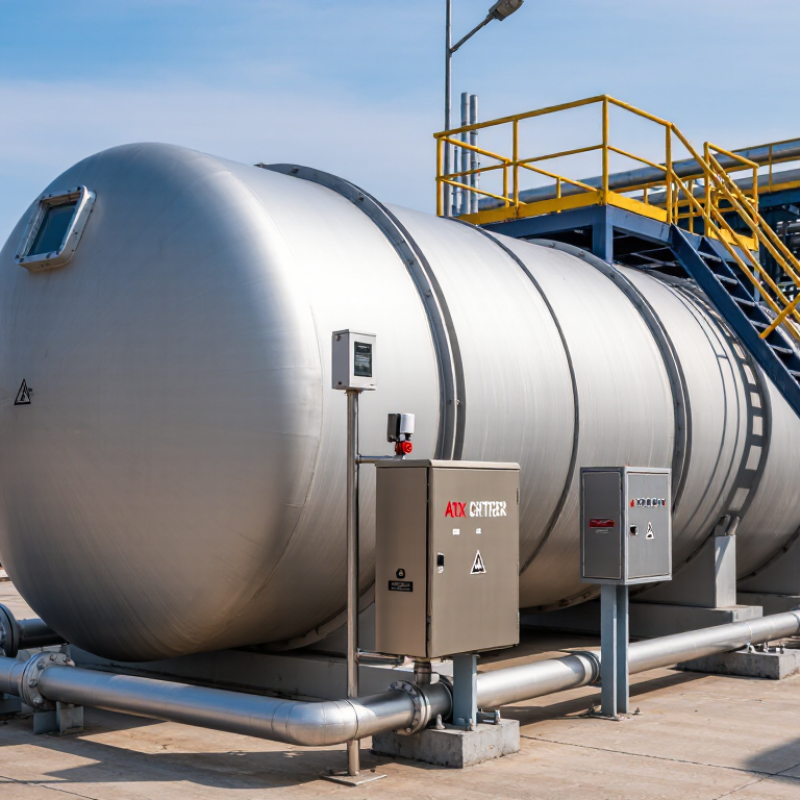
2 Horizontal Cylindrical Water Tank Coated carbon steel, stainless steel, or rotationally molded polyethylene 500–50,000 L Skid-mounted, saddles, or transportable frame Suitable for sites with limited overhead clearance. Any electrical accessories installed in a classified area require appropriate explosion-protection certification. Remote sites, packaged water-treatment units, construction facilities, and mobile utility systems Low headroom, transport requirements, structural support, and connection orientation
3 GRP/FRP Panel Water Tank Glass-reinforced plastic panels with sealed joints and internal liner 5,000–1,000,000 L Modular, assembled on site The tank body is generally non-electrical; verify static-control requirements, conductive bonding provisions, and the compliance of connected equipment. Large process-water storage, industrial facilities, mining sites, and water-treatment plants Large volume, restricted transport access, corrosion resistance, internal liner selection, and assembly space
4 Flexible Bladder Water Tank Reinforced PVC, TPU, or coated fabric membrane 1,000–500,000 L Ground-supported and collapsible Keep the membrane away from hot surfaces, sharp edges, and incompatible chemicals. Use non-sparking or suitably certified accessories when installed in a classified area. Temporary water supply, emergency storage, agricultural operations, and disaster-response systems Fast deployment, compact transport, temporary duration, ground condition, and liquid compatibility
5 Underground Water Storage Tank Reinforced concrete, coated steel, or double-wall reinforced plastic 10,000–500,000 L Buried below grade with manholes and access chambers Consider hazardous-area classification around manholes, vents, and pump chambers. Provide safe access, ventilation, gas monitoring, and certified electrical equipment where required. Sites with limited surface space, fire-water storage, industrial utilities, and rainwater harvesting Groundwater level, soil loading, buoyancy, inspection access, leak detection, and excavation cost
6 Double-Wall or Bunded Water Tank Carbon steel, stainless steel, or reinforced plastic with secondary containment 2,000–150,000 L Above-ground, commonly installed on a contained base Useful where spill control and separation from nearby process areas are important. Verify bonding, venting, instrumentation, and zone suitability for all accessories. Chemical-processing utilities, fuel-site service water, laboratories, and environmentally sensitive facilities Secondary containment volume, environmental rules, inspection needs, footprint, and material compatibility
7 Modular Skid-Mounted Water Tank System Stainless steel, coated carbon steel, GRP, or polyethylene with integrated piping 1,000–100,000 L Factory-assembled skid or containerized package Specify certified pumps, control panels, sensors, cable glands, and junction boxes for the applicable hazardous zone. The complete package should be assessed as an integrated installation. Oil and gas support facilities, offshore utilities, food and beverage plants, and remote industrial projects Short commissioning time, transport dimensions, pre-tested piping, automation requirements, and maintenance access
Important ATEX note: ATEX is the European regulatory framework for equipment and protective systems intended for use in potentially explosive atmospheres. Water itself is non-flammable, so a tank shell is not automatically an ATEX-certified product. The applicable hazardous-area classification, surrounding gases or dusts, temperature class, equipment category, static-electricity controls, vents, pumps, sensors, control panels, and installation practices must be assessed by a competent engineer before purchase and commissioning.

Key Safety Standards for Choosing an ATEX-Certified Water Tank

For global buyers, an ATEX water tank should be assessed as a complete system, not a container alone. ATEX Directive 2014/34/EU covers equipment intended for potentially explosive atmospheres. The tank’s location must be classified by gas or dust zone before selection. Zone 0, 1, and 2 require different protection levels. Dust zones differ. A tank may also fall outside ATEX scope, while its pump, sensor, or heater does not.

Check the equipment group, category, gas or dust group, and temperature class. These markings must match the site assessment and stored water process. The EN IEC 60079 series supports design, installation, and inspection practices in hazardous areas. A supplier should provide conformity documents, technical records, and clear installation instructions. Grounding and bonding are essential when plastic parts can accumulate static charge. Small details matter. Missing accessory certificates often delay commissioning.

Material selection affects reliability. Conductive or dissipative materials may be suitable, but a competent engineer should review chemical, thermal, and mechanical conditions. Do not treat IECEx documentation as an automatic substitute for ATEX compliance in every market. That assumption can be costly. Verify UV resistance, venting, overflow control, and maintenance access. Water sounds harmless. Yet an adjacent solvent area can change the design basis. Certification documents may describe the standard configuration, not later modifications. Record every change and recheck the zone assessment before operation.

Seven Leading ATEX Water Tank Options for Global Buyers

7 Best ATEX Water Tanks for Global Buyers?

Seven Leading ATEX Water Tank Options for Global Buyers

Global buyers need more than a large storage volume. They need a tank system matched to hazardous-area conditions, local climate, and maintenance skills. Seven practical options include stainless steel tanks, conductive polyethylene tanks, sectional steel tanks, double-wall tanks, insulated tanks, flexible bladder tanks, and modular tanks with certified accessories. Each option serves a different operating reality.

Stainless steel tanks suit harsh sites and frequent cleaning. Conductive polyethylene tanks reduce corrosion risks but require verified grounding. Sectional steel tanks simplify transport to remote facilities. Double-wall designs add protection where leakage control matters. Insulated tanks help maintain stable water temperatures in hot or cold regions. Flexible bladder tanks offer quick installation, though sharp surfaces can cause damage. Modular tanks allow future capacity changes, but joints need close inspection.

A reliable selection starts with the hazardous-zone classification. Confirm the tank’s materials, bonding points, vents, level sensors, pumps, and electrical controls. ATEX suitability may apply to connected equipment, not automatically to the tank shell. This detail is often missed. Ask for technical drawings, conformity documents, temperature limits, and inspection guidance. Consider salt air, ultraviolet exposure, freezing conditions, and emergency access. A cheaper tank can become expensive when replacement parts travel across borders. Field experience also shows that installation quality matters as much as product design. I would not approve a system from a datasheet alone. Witness the grounding test. Check the fittings twice.

How to Compare Tank Materials, Capacity, and Explosion Protection

7 Best ATEX Water Tanks for Global Buyers?

Tank material affects durability, weight, and inspection needs. Stainless steel tolerates heat, impact, and many industrial chemicals, but welded seams require careful examination. High-density polyethylene resists corrosion and reduces transport weight. However, sunlight and temperature cycling can weaken some plastics. Fiberglass offers useful strength, yet damaged laminates can be difficult to assess internally. Choose based on water chemistry, installation temperature, and access for inspection, not price alone.

Capacity should reflect demand, refill reliability, and emergency response time. Water weighs about 1,000 kilograms per cubic metre, according to NIST reference data. A five-metre water column creates roughly 49 kilopascals of pressure at its base. That load affects foundations, supports, and wall thickness. Oversizing can increase structural costs. Undersizing can leave essential systems without reserve water. A realistic demand study matters.

Explosion protection needs careful interpretation. ATEX categories describe equipment suitability for classified explosive atmospheres, as explained in the European Commission’s ATEX Guidelines. IEC 60079-10-1 supports area classification, while IEC 60079-14 addresses electrical installation practices. A water tank may not generate an explosive atmosphere, but pumps, sensors, vents, and nearby equipment can. Bonding, grounding, certified electrical parts, and controlled venting should match the zone assessment. Documentation is often overlooked. That is a practical weakness. Verify certificates, temperature ratings, inspection records, and local acceptance requirements before purchase.

Installation, Maintenance, and International Purchasing Considerations

Installation, Maintenance, and International Purchasing Considerations

Selecting one of the seven best ATEX water tanks requires more than comparing capacity and price. Confirm the hazardous-area classification first. ATEX requirements may apply to pumps, sensors, mixers, or electrical controls connected to the tank. Ask for conformity documents, technical files, material specifications, and installation instructions. Do not assume a certificate covers every accessory.

Place the tank on a level, load-rated foundation with clear access around valves and inspection points. Use compatible pipework and protect connections from impact. Bond and earth conductive components where the risk assessment requires it. Venting must suit the liquid, temperature, and surrounding zone. A local competent installer should verify the completed system before operation. Small errors matter here.

Maintenance should include visual inspections, leak checks, gasket replacement, and cleaning records. Inspect ladders, supports, level sensors, and emergency fittings after severe weather or unusual vibration. Keep spare seals available in the destination country. That can prevent long downtime. During international purchasing, compare total landed cost, not only the quoted tank price. Check packaging dimensions, shipping limits, customs documents, import duties, language requirements, and local approval procedures. Confirm whether replacement parts meet the same specification. A cheaper tank may become expensive after freight, adaptation, and delayed certification. Requirements also differ between countries, so written confirmation from qualified local professionals remains essential.

Powder Coat Booths

For those larger-sized parts, or smaller quantity runs, we have 2 independent powder coat booths and ovens. The quality, durability and affordability of today’s powder coating finishes make this the process of choice for world-class companies.

Powder coating advantages over other forms of coating are many. Materials used in the Powder coating process can be metals and non-metals that come in a multitude of thicknesses, textures, colors, etc. Another of Powder coating’s biggest advantages over conventional coatings is its ability to create finishes in many different textures. Powder Coating Booths allow us the ability to apply these advantages to large products.

Wet Paint Line

Tri-State Fabricators runs a full-service conveyor line for painting. Wet painting can provide protection or decoration to many different part styles. From start to finish, every project is easier to undergo random and point-based inspection by our skilled painting team.

Advantages to our Wet Paint Line are these lines start with product prep and ends with a thorough inspection of a high quality finished product. Our ability to complete large and small projects with a superior finish and doing so in a timely and economical fashion. This passes along the savings in production to our customers. When powder coating ins not an option, our Wet Paint Line gets the job done right the first time.

Wet Paint Booths

When the parts get big and heavy we roll-out our custom paint racks and oversize booth. By utilizing our partnerships with all the major paint brands, we can match virtually any color with wet paint.

The advantages of having access to a Wet Paint Booth are many. Large projects of many different shapes can be loaded into the booth. The Wet Paint Booth offers an environment that is much more controlled than a typical parts painting operation.

Not only are they used because of their controlled environment, but they’re are also advantageous when it comes to applying paint to parts that are needed in industries that require specialty coatings such as medical, aerospace, etc.

Military CARC

Our military forces have some very high standards when it comes to the finish of their vehicles and equipment. From the first pre-treatment step to final coat, it takes a great deal of knowledge and experience to protect the men and women of our armed forces. They deserve only the best, and Tri-State Fabricators provides it.

All of our processes are closely monitored by our staff and management teams. Both of which are highly trained in the processes of metal fabrication and finishing. Tri-State Fabricators’ goal is to always fully satisfy each and every customer, including the military. We will always put a 110% into what we do.

Glass-Bead Blasting

Abrasive media blasting is an excellent way to remove old paint, rust, and increase the paint/powder adhesion. Glass beads produce a much smoother and brighter finish than angular abrasives; leaving the part clean yet without any dimensional change. Chemically inert and environmentally friendly, we can recycle our beads approximately 30 times; making them a more preferred method of metal cleaning or surface finishing.

Advantages to Glass Bead Blasting are many. Glass bead blast media is used when a project is needing rough surfaces need to become smooth for applications of coatings such as paint. It is typically used to clean paint and rust from a product surface without deforming the surface it is being used on. Overall, compared to many other blasting media, Glass Bead Blasting is a very economical choice and those savings are always passed on to our customers.

Part Washing

Tri-State Fabricators utilize a zinc phosphate wash to clean and etch the material to ensure the best paint adhesion possible. The unique design of our 3-stage wash system does the work like a 5-stage. From Cleaning and rinsing to conversion coating and post-treatment, Our Part Washing process is a complete service and works throughout the fabrication service and the finishing service.

Along with the previously mentioned benefits, Curing is a vital chemical reaction that leaves the product finish hard and relatively safe from mild abrasion and aggressive corrosion. This process can be done in more than one way; ambient air-dry or in curing ovens at temps that exceed 240°.

Burn-Off Oven

From fixing paint mistakes (someone else’s of course) to simply cleaning our paint line hooks, our burn-off oven is put to good use. After a quick burn-off, a little clean up, and a fresh coat of paint, your parts will look better than new.

Why does our Burn-Off Oven work so well? Because super heating the air around parts turns the materials into ashes. From paint and powder coatings to rubber and machining oils, high temps do the job without degrading the integrity of the part.

Masking

Masking is a vital part of producing high quality products. We have die-cut masking patterns to protect machined surfaces as well as a wide range of plugs and caps to protect threaded holes and bolts. We provide permanent and temporary masking.

Masking allows the selected sections of a product to be protected from a fabrication or finishing service. This can be with both chemicals when etching and tapes, paints when only finishing just a section of the product. Masking is great in aiding the customization process of a project.

Screen Printing

Screen printing is a photographic process that transfers artwork onto a porous nylon screen which allows colored ink to flow through the screen and be deposited on an aluminum or plastic component. We can generally have just about any design created onto a screen for your parts.

Some of the advantages of Screen Printing are, brand recognition for your business displaying on your products, assembly instructions, product warnings/hazards, etc. Tri-State Fabricators produces Screen Printing of the highest quality so you know it’s durable.

Metal Finishing

Metal Finishing is the art of treating the exterior portion of product, often metal but can also be made of other materials, so that the surface is clean and free of any debris. Then the process of applying coats or either paint of powder coat takes place. This coating process improves the quality of the product in both appearance and resistance to wear and corrosion.

Tri-State Fabricators, Inc., understands that a project typically isn’t complete until a high-quality finish has been added to your product. This is why our painting and powder coating teams continuously inspect the products throughout the Metal Finishing process.


