


10 Best 3D CNC Automatic Tube Bending Machines for 2026

Choosing a tube bender is less about impressive specifications and more about producing accurate parts, shift after shift. A 3D CNC Automatic Tube Bending Machine can form complex tube paths while controlling bend angles, rotation, and feed length. Yet performance depends on the material, tube diameter, wall thickness, and tooling—not just the machine’s advertised capacity.

This guide compares ten machines for 2026, focusing on practical factors buyers can verify: supported tube sizes, bending accuracy, CNC controls, setup requirements, automation options, and service support. Look closely at tooling compatibility and changeover time. Small details matter. A machine that handles a demanding radius but takes too long to set up may not suit a high-mix production line. Likewise, headline speed means little if finished parts need frequent correction.

The right choice depends on the work. A compact shop making short runs may value flexible programming and straightforward setup, while a larger facility may prioritize automated loading and consistent cycle times. Specifications can also vary by configuration, so confirm details with the manufacturer before comparing prices. No ranking can replace a production trial. Treat this list as a starting point, then match each machine to your actual tube drawings, materials, and daily output. We also note where published information leaves questions worth asking. That part is easy to overlook.
10 Best 3D CNC Automatic Tube Bending Machines for 2026

What Is a 3D CNC Automatic Tube Bending Machine?

A 3D CNC automatic tube bending machine turns straight metal tubing into programmed shapes across several planes. Its controller coordinates three core motions: tube feed, tube rotation, and bend-arm rotation. Clamps hold the tube while tooling applies pressure; a mandrel may support its interior during tight-radius bends. The operator enters the part geometry, material, diameter, wall thickness, and bend sequence. The machine then repeats the cycle with limited manual handling. In practice, “3D” describes bends oriented in space, not necessarily a machine with only three axes. That distinction matters.

Setup still needs judgment. Springback, weld-seam position, and wall-thickness variation can shift a bend away from its target. Measure a first-off part at several points, including bend angle, centerline radius, and ovality. Then verify compensation settings on later batches. Even a clean simulation can miss real material variation. Grand View Research’s 2024 CNC machine market report valued the global market at $101.22 billion in 2023 and projected 6.3% annual growth through 2030. This is broad CNC-market context, not a tube-bender sales figure. When comparing machines, check repeatability, supported tube sizes, minimum bend radius, changeover time, and guarding—not speed alone. A fast cycle is not always a good part.


10 Best 3D CNC Automatic Tube Bending Machines for 2026 — What Is a 3D CNC Automatic Tube Bending Machine?

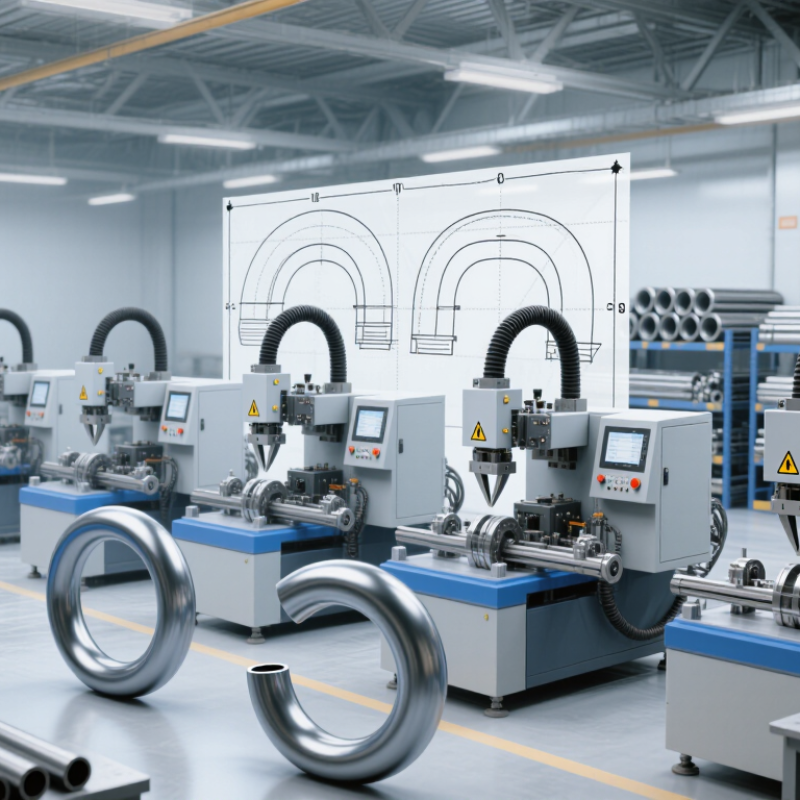
A 3D CNC automatic tube bending machine feeds and rotates a tube, then bends it to programmed angles in multiple planes to create a three-dimensional shape. The chart shows example bend angles as geometric references—not specifications or rankings for any particular machine. Actual bending limits depend on the machine, tooling, tube material, and tube dimensions.

How 3D CNC Tube Bending Technology Works

A 3D CNC tube-bending machine turns a digital tube path into controlled movements. The operator enters bend angles, radii, and distances between bends. The controller coordinates the feed axis, which advances the tube, with rotation and bending axes. Together, these movements create bends in different planes. Small changes matter. A few millimeters of feed error can shift a later bend and spoil alignment with a fixture.

The International Federation of Robotics reported 4.28 million industrial robots operating worldwide in 2023, up 10% from 2022, in its World Robotics 2024 report. That figure reflects wider factory automation, not tube benders specifically. In a bending cell, CNC control helps repeat a saved sequence, while tooling supports the tube and limits flattening or wrinkling. A mandrel may be used for tight bends or thin-walled tube. Setup still matters.

Metal springs back after bending. The controller or operator must account for this using material data, test bends, or measured results. Wall thickness, alloy, lubrication, and tool wear can all change the final shape. This is easy to underestimate. Even a well-programmed machine may need correction after the first part. Inspecting bend angles and checking the finished tube against its drawing helps verify the process.

Key Factors for Comparing Tube Bending Machines in 2026

When comparing 3D CNC automatic tube bending machines in 2026, start with the parts you actually make. Record tube diameter, wall thickness, material, bend radius, and finished-part tolerance. A machine’s maximum capacity means little if your daily stainless-steel tube springs back or wrinkles at a tight radius. Ask suppliers to run your drawings and material samples, then inspect the finished parts. Real parts reveal more than a polished specification sheet.

Look beyond bending speed. Check repeatability across a full shift, changeover time, tooling availability, scrap tracking, and how easily operators can adjust programs. Deloitte and MAPI’s 2019 Smart Factory Study found that 86% of surveyed manufacturers expected smart-factory initiatives to drive competitiveness within five years. For a tube bender, that makes data access and integration worth checking, not just headline automation claims. Still, a connected machine is not automatically a useful one.

Operator support matters, too. A 2024 study by Deloitte and The Manufacturing Institute projected that 3.8 million manufacturing jobs could be needed by 2033, with 1.9 million potentially unfilled. Compare training hours, diagnostic clarity, and routine maintenance access alongside price. Ask who can restore production after a sensor fault. Small details count. I would also challenge one assumption: the fastest cycle may not be the lowest-cost choice when setup, rework, and operator time are included.

10 Best 3D CNC Automatic Tube Bending Machines for 2026

For 2026, the ten best 3D CNC automatic tube bending machines are not one-size-fits-all. A practical shortlist should cover distinct shop needs: compact servo bending, high-volume production, multi-stack tooling, mandrel-supported bends, large-diameter tube, thin-wall material, tight radii, mixed profiles, robotic cells, and precision feedback systems. Each type solves a different problem. Match capacity to your actual tube diameter, wall thickness, material, and bend radius—not a dramatic catalog maximum.

On the shop floor, repeatability matters. Watch how quickly an operator can load a program, set the clamp, and verify the first part. A clean bend should show little flattening or wrinkling. Check whether the machine stores tooling offsets and reports errors clearly. Ask for a trial using your own tube; polished demonstrations can hide setup issues. Also inspect guarding, service access, and spare-part availability. A faster cycle is useful, but not if changeovers eat the shift. I’d be cautious about ranking machines by speed alone. It’s an easy number to compare, and an imperfect guide. For mixed production, software flexibility and dependable calibration may matter more than peak output.

Industries and Applications for 3D CNC Tube Bending Machines

Automotive production is a major application for 3D CNC tube bending. OICA reported approximately 93.5 million motor vehicles produced worldwide in 2023. Tubes serve in exhaust assemblies, seat frames, chassis reinforcements, and fluid lines. Repeatable bends help parts fit fixtures and adjacent components. Small angle errors can create costly assembly delays. It sounds simple; it isn’t.

Electric vehicles are expanding demand for formed tubes in cooling circuits, battery thermal management, and lightweight structures. The International Energy Agency’s Global EV Outlook 2024 estimates that nearly 14 million electric cars were sold in 2023, about 18% of global car sales. HVAC and building services are another practical market: bent tubes route refrigerant and water around tight corners in heat pumps and air-conditioning units. A neat drawing does not always reflect the awkward access conditions on a real shop floor.

Aerospace uses precision-bent tubes in cabin systems and fluid routing, where fit and inspection matter. Agricultural and construction equipment also rely on formed hydraulic lines that must clear moving parts and withstand vibration. Medical carts, laboratory equipment, and furniture use smaller tube assemblies for frames and supports. The right bend sequence depends on material, wall thickness, and clearance. In production, reliable setups can matter more than headline speed. Even experienced operators sometimes need another trial bend.

10 Best 3D CNC Automatic Tube Bending Machines for 2026 - Industries and Applications for 3D CNC Tube Bending Machines

The entries below are application-oriented machine categories, not specific products or ranked brand recommendations. Capacity ranges are representative planning guides; actual limits depend on tube material, wall thickness, bend radius, tooling, and machine configuration.

No. Machine Configuration Typical Tube OD Typical Wall Thickness Typical Bending Setup Common Materials Industries Typical Applications
1 Compact precision CNC bender 6–16 mm (0.24–0.63 in) 0.5–1.5 mm (0.020–0.059 in) Single-stack tooling; automatic feed, rotation, and bend control; suited to small-radius work when matched tooling is used Stainless steel, copper, aluminum, and low-carbon steel Medical equipment, instrumentation, electronics, and small appliances Instrument lines, compact fluid tubes, sensor tubing, and small formed tube assemblies
2 Small-diameter multi-plane CNC bender 8–25 mm (0.31–0.98 in) 0.6–2.0 mm (0.024–0.079 in) Automatic tube feeding and rotation for bends in multiple planes; optional multi-stack tooling Stainless steel, aluminum, copper, and carbon steel Automotive, appliance, HVAC, and furniture manufacturing Fuel and fluid lines, appliance tubing, small exhaust sections, and tubular frames
3 General-purpose mid-size CNC bender 10–38 mm (0.39–1.50 in) 0.8–3.0 mm (0.031–0.118 in) Automatic feed, rotation, and bend axes; commonly configured for single- or multi-stack production Carbon steel, stainless steel, aluminum, and copper alloys Automotive, HVAC, agricultural equipment, and general fabrication Fluid lines, handrails, chassis tubes, heat-exchanger connections, and formed brackets
4 High-volume automotive tube bender 6–50 mm (0.24–1.97 in) 0.7–3.5 mm (0.028–0.138 in) Production-oriented CNC control with automatic loading options, part programs, and multi-plane bending Carbon steel, stainless steel, aluminum, and coated steel tubing Automotive and commercial vehicle manufacturing Brake, fuel, cooling, air-conditioning, seat-frame, and exhaust-system tubes
5 Thin-wall mandrel-bending CNC system 10–60 mm (0.39–2.36 in) 0.6–2.5 mm (0.024–0.098 in) Mandrel and wiper-die capability for supporting thin-wall bends; practical radius depends on material and tooling Stainless steel, aluminum, and low-carbon steel Automotive, aerospace supply chains, furniture, and recreational vehicles Thin-wall exhaust pipes, visible trim tubes, lightweight frames, and smooth-flowing tube assemblies
6 Multi-stack, multi-radius CNC bender 12–76 mm (0.47–2.99 in) 1.0–4.0 mm (0.039–0.157 in) Multiple tool stacks allow different bend radii or tube sizes to be used within a programmed part family Carbon steel, stainless steel, and aluminum Automotive, bus and rail, HVAC, and industrial machinery Complex exhaust assemblies, vehicle structures, handrails, and multi-radius pipework
7 Large-diameter structural tube bender 38–100 mm (1.50–3.94 in) 2.0–6.0 mm (0.079–0.236 in) Heavy-duty rotary-draw setup with reinforced clamping and tooling; larger sections generally require larger bend radii Carbon steel, stainless steel, and structural aluminum alloys Construction equipment, transport, energy, and industrial fabrication Structural frames, large handrails, equipment guards, and heavy-duty fluid or exhaust tubing
8 High-strength steel tube CNC bender 20–80 mm (0.79–3.15 in) 1.5–5.0 mm (0.059–0.197 in) High-clamping-force configuration with material-specific tooling and springback compensation High-strength low-alloy steel, carbon steel, and selected stainless steels Automotive safety structures, agriculture, construction, and heavy vehicles Reinforcement members, roll structures, protective frames, and load-bearing tube assemblies
9 Large-section CNC bender for industrial pipework 60–150 mm (2.36–5.91 in) 3.0–10.0 mm (0.118–0.394 in) Heavy-duty machine frame and large tooling; setup and bend radius are selected for the material and section Carbon steel, stainless steel, and selected alloy steels Energy, shipbuilding, process equipment, and large-scale manufacturing Industrial pipe runs, large exhaust sections, structural members, and equipment connections
10 Flexible CNC cell with automatic handling 6–100 mm (0.24–3.94 in), depending on machine module Material- and diameter-dependent CNC bending combined with optional automatic loading, unloading, measuring, or part transfer equipment Carbon steel, stainless steel, aluminum, and copper alloys Contract manufacturing, automotive suppliers, HVAC, and general industry Mixed-part production, repeatable batch runs, and tube assemblies requiring consistent multi-plane geometry

Powder Coat Booths

For those larger-sized parts, or smaller quantity runs, we have 2 independent powder coat booths and ovens. The quality, durability and affordability of today’s powder coating finishes make this the process of choice for world-class companies.

Powder coating advantages over other forms of coating are many. Materials used in the Powder coating process can be metals and non-metals that come in a multitude of thicknesses, textures, colors, etc. Another of Powder coating’s biggest advantages over conventional coatings is its ability to create finishes in many different textures. Powder Coating Booths allow us the ability to apply these advantages to large products.

Wet Paint Line

Tri-State Fabricators runs a full-service conveyor line for painting. Wet painting can provide protection or decoration to many different part styles. From start to finish, every project is easier to undergo random and point-based inspection by our skilled painting team.

Advantages to our Wet Paint Line are these lines start with product prep and ends with a thorough inspection of a high quality finished product. Our ability to complete large and small projects with a superior finish and doing so in a timely and economical fashion. This passes along the savings in production to our customers. When powder coating ins not an option, our Wet Paint Line gets the job done right the first time.

Wet Paint Booths

When the parts get big and heavy we roll-out our custom paint racks and oversize booth. By utilizing our partnerships with all the major paint brands, we can match virtually any color with wet paint.

The advantages of having access to a Wet Paint Booth are many. Large projects of many different shapes can be loaded into the booth. The Wet Paint Booth offers an environment that is much more controlled than a typical parts painting operation.

Not only are they used because of their controlled environment, but they’re are also advantageous when it comes to applying paint to parts that are needed in industries that require specialty coatings such as medical, aerospace, etc.

Military CARC

Our military forces have some very high standards when it comes to the finish of their vehicles and equipment. From the first pre-treatment step to final coat, it takes a great deal of knowledge and experience to protect the men and women of our armed forces. They deserve only the best, and Tri-State Fabricators provides it.

All of our processes are closely monitored by our staff and management teams. Both of which are highly trained in the processes of metal fabrication and finishing. Tri-State Fabricators’ goal is to always fully satisfy each and every customer, including the military. We will always put a 110% into what we do.

Glass-Bead Blasting

Abrasive media blasting is an excellent way to remove old paint, rust, and increase the paint/powder adhesion. Glass beads produce a much smoother and brighter finish than angular abrasives; leaving the part clean yet without any dimensional change. Chemically inert and environmentally friendly, we can recycle our beads approximately 30 times; making them a more preferred method of metal cleaning or surface finishing.

Advantages to Glass Bead Blasting are many. Glass bead blast media is used when a project is needing rough surfaces need to become smooth for applications of coatings such as paint. It is typically used to clean paint and rust from a product surface without deforming the surface it is being used on. Overall, compared to many other blasting media, Glass Bead Blasting is a very economical choice and those savings are always passed on to our customers.

Part Washing

Tri-State Fabricators utilize a zinc phosphate wash to clean and etch the material to ensure the best paint adhesion possible. The unique design of our 3-stage wash system does the work like a 5-stage. From Cleaning and rinsing to conversion coating and post-treatment, Our Part Washing process is a complete service and works throughout the fabrication service and the finishing service.

Along with the previously mentioned benefits, Curing is a vital chemical reaction that leaves the product finish hard and relatively safe from mild abrasion and aggressive corrosion. This process can be done in more than one way; ambient air-dry or in curing ovens at temps that exceed 240°.

Burn-Off Oven

From fixing paint mistakes (someone else’s of course) to simply cleaning our paint line hooks, our burn-off oven is put to good use. After a quick burn-off, a little clean up, and a fresh coat of paint, your parts will look better than new.

Why does our Burn-Off Oven work so well? Because super heating the air around parts turns the materials into ashes. From paint and powder coatings to rubber and machining oils, high temps do the job without degrading the integrity of the part.

Masking

Masking is a vital part of producing high quality products. We have die-cut masking patterns to protect machined surfaces as well as a wide range of plugs and caps to protect threaded holes and bolts. We provide permanent and temporary masking.

Masking allows the selected sections of a product to be protected from a fabrication or finishing service. This can be with both chemicals when etching and tapes, paints when only finishing just a section of the product. Masking is great in aiding the customization process of a project.

Screen Printing

Screen printing is a photographic process that transfers artwork onto a porous nylon screen which allows colored ink to flow through the screen and be deposited on an aluminum or plastic component. We can generally have just about any design created onto a screen for your parts.

Some of the advantages of Screen Printing are, brand recognition for your business displaying on your products, assembly instructions, product warnings/hazards, etc. Tri-State Fabricators produces Screen Printing of the highest quality so you know it’s durable.

Metal Finishing

Metal Finishing is the art of treating the exterior portion of product, often metal but can also be made of other materials, so that the surface is clean and free of any debris. Then the process of applying coats or either paint of powder coat takes place. This coating process improves the quality of the product in both appearance and resistance to wear and corrosion.

Tri-State Fabricators, Inc., understands that a project typically isn’t complete until a high-quality finish has been added to your product. This is why our painting and powder coating teams continuously inspect the products throughout the Metal Finishing process.
