


A Ro Water Filter can make everyday drinking water more convenient, especially when tap water tastes salty, metallic, or strongly chlorinated. Reverse osmosis pushes water through a semi-permeable membrane, which can reduce many dissolved substances. The exact results depend on the system, its condition, and the water entering your home. Check the product’s independent certifications and performance data rather than relying on broad claims.
The difference is practical. A glass filled at the kitchen sink may taste cleaner, while a kettle may collect less mineral scale over time. But reverse osmosis is not a universal fix. It does not remove every possible contaminant, and some systems send water to a drain during filtration. That detail matters in homes where water use is a concern. Filter changes matter, too. A neglected cartridge can affect flow and taste, even when the unit still looks fine.
Think about your water report, household needs, and the available space beneath the sink before choosing a model. Some systems add minerals back for a fuller taste; others do not. Taste is personal. And yes, a simpler filter may be enough for some households. A Ro Water Filter is most worthwhile when its tested capabilities match a real water-quality concern—and when you are prepared to maintain it. One honest caveat: the label alone cannot tell you whether a system suits your tap.
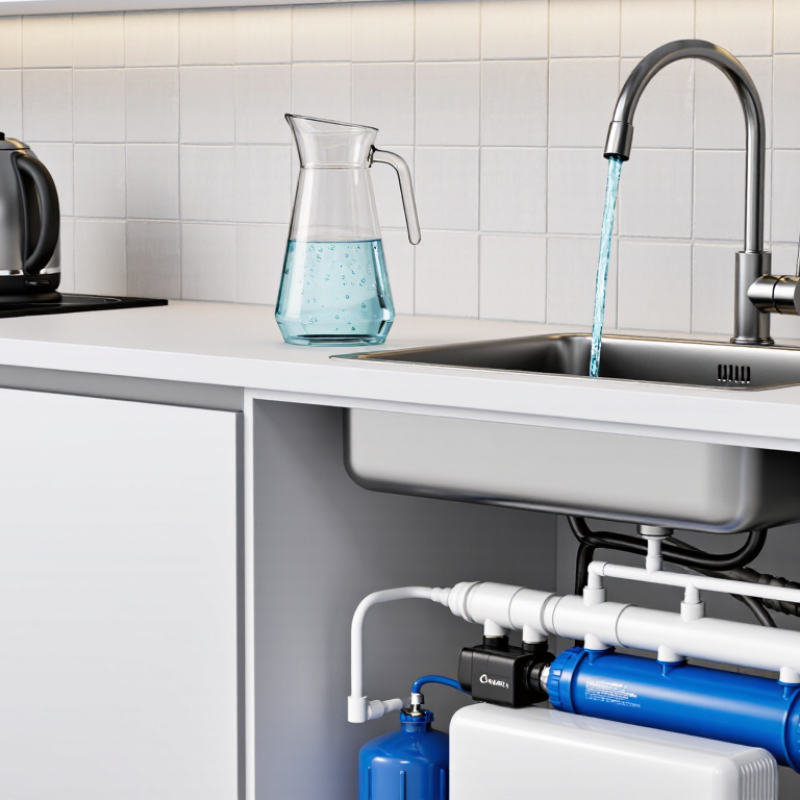
Reverse osmosis (RO) pushes pressurized water through a semipermeable membrane. Water molecules pass through, while many dissolved substances remain in a reject stream. Picture a thin barrier beneath the sink, with water slowly crossing it. It is not a sieve that catches everything.
CDC guidance says RO can reduce substances including lead, copper, sodium, and nitrate, although results vary by system and water chemistry (CDC, “About Home Water Treatment Systems”). NSF/ANSI 58 sets a minimum 75% total dissolved solids reduction requirement for certified systems. That figure is a test threshold, not proof that every unwanted substance disappears.
A typical unit sends some concentrated water to the drain while treated water fills a small tank. Membranes and prefilters need timely replacement; neglected filters can slow flow and affect performance. Check certified reduction claims against a recent water test, especially when local water has a known contaminant.
CDC notes that RO may reduce, rather than reliably remove, some substances. That distinction matters.
A clear glass is not proof of safe water: dissolved contaminants are invisible, and one filter cannot address every concern. RO also removes some minerals and uses more water than it delivers, so the practical choice depends on your household’s water and maintenance habits.

Reverse osmosis (RO) filters push water through a fine membrane that can reduce many dissolved contaminants. Depending on the system, these may include lead, arsenic, nitrate, fluoride, and some dissolved salts. A glass of treated water may taste less metallic or salty, though taste alone cannot confirm water safety.
RO is not a catch-all solution. Performance varies with the membrane, prefilters, water pressure, and maintenance. Some systems are certified to reduce specific contaminants; check the certification and claims for the exact model. That detail matters. RO can also reduce useful minerals, and many units send some water to drain. Their membranes do not reliably address every chemical or microbial risk, either. Replace filters on schedule, and test well water when its quality is uncertain. I’d avoid assuming that “RO” means every contaminant is gone. It means certain substances can be reduced under stated conditions. That distinction is easy to miss.
A reverse osmosis (RO) filter pushes water through a fine membrane that reduces many dissolved substances. Depending on the system and its tested performance, it may reduce lead, arsenic, and certain salts. Check the product’s independent test data rather than assuming every RO filter removes the same contaminants. Water quality varies by home. A recent water test can help identify what actually needs filtering.
The difference can be noticeable in a glass of water or a cup of tea, especially when tap water has a strong mineral taste. RO systems can also reduce scale buildup in kettles and coffee makers.
Small, practical benefits. But there are trade-offs. Many systems send some water down the drain, and filters and membranes need timely replacement. That maintenance is easy to forget. RO may also remove minerals, though most people get these from food.
Before choosing one, consider your water test, daily use, available space, and willingness to maintain the system. A filter is only useful when it suits the water and gets cared for.
Reverse osmosis can reduce many dissolved substances, but it is not a universal fix. Its performance depends on the membrane, system design, and incoming water. A water test helps identify what needs treatment; check that the system’s independently verified claims match those results. Some contaminants may require a different treatment method.
There is a trade-off. RO systems send some incoming water to drain, and the amount varies with water pressure, temperature, and system design. They also remove minerals such as calcium and magnesium. That may affect taste, though it is not automatically a health concern for people with varied diets. The water can taste flat. I would not assume every household notices the same difference.
Maintenance takes attention. Sediment and carbon prefilters need timely replacement, while membrane life depends on water quality and use. Follow the maker’s schedule, and sanitize the storage tank and lines as directed. A sudden drop in faucet flow can signal a clogged filter, low pressure, or another issue; it is a clue, not a diagnosis. Keep a simple replacement log. It is easy to forget. If the system treats water for a specific safety concern, periodic testing can help confirm it is still performing as intended.
| Dimension | What to Know | Practical Consideration |
|---|---|---|
| Reduction of dissolved substances | Reverse osmosis (RO) uses a semipermeable membrane to reduce many dissolved salts and other contaminants. The substances reduced depend on the system and its tested performance. | Check the specific model’s independent certification and performance data for the contaminants you want to address. |
| Not a universal treatment | No single treatment system removes every possible contaminant. RO performance can vary, and some systems include additional treatment stages for particular needs. | Use a recent water-quality report or appropriate testing to identify concerns before choosing a system. |
| Water rejected during filtration | RO systems send some incoming water to drain as concentrate. The amount varies with system design, water pressure, temperature, and operating conditions. | Review the product’s stated drain-water performance and follow installation guidance; avoid assuming all systems have the same water-use ratio. |
| Flow and storage | Many under-sink systems produce filtered water gradually and use a storage tank. Tank size and system capacity affect how quickly water is available. | Choose a capacity suited to household use, and allow space for the unit, tank, and faucet if required. |
| Filter and membrane replacement | Pre-filters, post-filters, and RO membranes require periodic replacement. The schedule depends on the system, water quality, and usage. | Follow the manufacturer’s replacement intervals and keep a record of changes. Delayed replacement can reduce performance or affect water quality. |
| Water pressure and installation | RO production depends in part on adequate feed-water pressure. Some installations may need a booster pump or other configuration adjustments. | Confirm pressure and plumbing requirements before installation; a qualified installer can help assess compatibility. |
| Mineral content and taste | RO reduces many dissolved minerals along with other substances, which can change the taste of water. Some systems add a remineralization stage. | Consider taste preferences when comparing systems. A remineralization stage is optional and does not replace routine maintenance. |
| Ongoing ownership costs | Replacement cartridges, occasional service, and installation can add to the initial purchase cost. | Compare the total cost over time, including replacement parts and any installation needs, rather than comparing purchase price alone. |
Note: Actual contaminant reduction, water use, capacity, and replacement intervals vary by system and site conditions. Follow the system’s instructions and verify claims against its current test or certification information.
An RO filter can reduce many dissolved substances, but its performance depends on the system and your water. Start with a recent water report or a suitable laboratory test. Identify what you want to reduce, then check whether the system’s documented performance covers those substances. Look for independent certification and clear test data, not just broad claims. Fit matters. Measure the space beneath your sink, including room for a storage tank and filter changes. Check your home’s water pressure and connection type, too; some systems need specific conditions to work well.
Tips: Compare replacement-filter costs and service intervals. Ask how much wastewater the unit produces under your water conditions. Keep the manual and mark replacement dates on a calendar. Small details matter.
Think about daily use. A household that fills bottles and cooks often may need more stored water than a smaller household. Compare the system’s production rate and tank capacity with your routine. A remineralizing stage is optional, not essential for every home; consider taste preferences and the water’s starting composition. I would not choose by the lowest price alone. A low-cost unit can become inconvenient if parts are hard to find or maintenance is unclear. Review the installation steps, warranty terms, and available support before deciding.


For those larger-sized parts, or smaller quantity runs, we have 2 independent powder coat booths and ovens. The quality, durability and affordability of today’s powder coating finishes make this the process of choice for world-class companies.
Powder coating advantages over other forms of coating are many. Materials used in the Powder coating process can be metals and non-metals that come in a multitude of thicknesses, textures, colors, etc. Another of Powder coating’s biggest advantages over conventional coatings is its ability to create finishes in many different textures. Powder Coating Booths allow us the ability to apply these advantages to large products.
Tri-State Fabricators runs a full-service conveyor line for painting. Wet painting can provide protection or decoration to many different part styles. From start to finish, every project is easier to undergo random and point-based inspection by our skilled painting team.
Advantages to our Wet Paint Line are these lines start with product prep and ends with a thorough inspection of a high quality finished product. Our ability to complete large and small projects with a superior finish and doing so in a timely and economical fashion. This passes along the savings in production to our customers. When powder coating ins not an option, our Wet Paint Line gets the job done right the first time.
When the parts get big and heavy we roll-out our custom paint racks and oversize booth. By utilizing our partnerships with all the major paint brands, we can match virtually any color with wet paint.
The advantages of having access to a Wet Paint Booth are many. Large projects of many different shapes can be loaded into the booth. The Wet Paint Booth offers an environment that is much more controlled than a typical parts painting operation.
Not only are they used because of their controlled environment, but they’re are also advantageous when it comes to applying paint to parts that are needed in industries that require specialty coatings such as medical, aerospace, etc.
Our military forces have some very high standards when it comes to the finish of their vehicles and equipment. From the first pre-treatment step to final coat, it takes a great deal of knowledge and experience to protect the men and women of our armed forces. They deserve only the best, and Tri-State Fabricators provides it.
All of our processes are closely monitored by our staff and management teams. Both of which are highly trained in the processes of metal fabrication and finishing. Tri-State Fabricators’ goal is to always fully satisfy each and every customer, including the military. We will always put a 110% into what we do.
Abrasive media blasting is an excellent way to remove old paint, rust, and increase the paint/powder adhesion. Glass beads produce a much smoother and brighter finish than angular abrasives; leaving the part clean yet without any dimensional change. Chemically inert and environmentally friendly, we can recycle our beads approximately 30 times; making them a more preferred method of metal cleaning or surface finishing.
Advantages to Glass Bead Blasting are many. Glass bead blast media is used when a project is needing rough surfaces need to become smooth for applications of coatings such as paint. It is typically used to clean paint and rust from a product surface without deforming the surface it is being used on. Overall, compared to many other blasting media, Glass Bead Blasting is a very economical choice and those savings are always passed on to our customers.
Tri-State Fabricators utilize a zinc phosphate wash to clean and etch the material to ensure the best paint adhesion possible. The unique design of our 3-stage wash system does the work like a 5-stage. From Cleaning and rinsing to conversion coating and post-treatment, Our Part Washing process is a complete service and works throughout the fabrication service and the finishing service.
Along with the previously mentioned benefits, Curing is a vital chemical reaction that leaves the product finish hard and relatively safe from mild abrasion and aggressive corrosion. This process can be done in more than one way; ambient air-dry or in curing ovens at temps that exceed 240°.
From fixing paint mistakes (someone else’s of course) to simply cleaning our paint line hooks, our burn-off oven is put to good use. After a quick burn-off, a little clean up, and a fresh coat of paint, your parts will look better than new.
Why does our Burn-Off Oven work so well? Because super heating the air around parts turns the materials into ashes. From paint and powder coatings to rubber and machining oils, high temps do the job without degrading the integrity of the part.
Masking is a vital part of producing high quality products. We have die-cut masking patterns to protect machined surfaces as well as a wide range of plugs and caps to protect threaded holes and bolts. We provide permanent and temporary masking.
Masking allows the selected sections of a product to be protected from a fabrication or finishing service. This can be with both chemicals when etching and tapes, paints when only finishing just a section of the product. Masking is great in aiding the customization process of a project.
Screen printing is a photographic process that transfers artwork onto a porous nylon screen which allows colored ink to flow through the screen and be deposited on an aluminum or plastic component. We can generally have just about any design created onto a screen for your parts.
Some of the advantages of Screen Printing are, brand recognition for your business displaying on your products, assembly instructions, product warnings/hazards, etc. Tri-State Fabricators produces Screen Printing of the highest quality so you know it’s durable.
Metal Finishing is the art of treating the exterior portion of product, often metal but can also be made of other materials, so that the surface is clean and free of any debris. Then the process of applying coats or either paint of powder coat takes place. This coating process improves the quality of the product in both appearance and resistance to wear and corrosion.
Tri-State Fabricators, Inc., understands that a project typically isn’t complete until a high-quality finish has been added to your product. This is why our painting and powder coating teams continuously inspect the products throughout the Metal Finishing process.

