


Bellows Valves are engineered for applications where ordinary stem seals may allow leakage, contamination, or maintenance problems. Their defining feature is a flexible metal bellows welded between the valve body and stem. As the stem moves, the bellows compresses or extends while keeping the process fluid isolated from the stem mechanism. This design creates a sealed pressure boundary around the moving stem.
The operating principle is practical. Turning the handwheel moves the stem and valve disc toward or away from the seat. The bellows follows that movement without exposing the process medium to packing materials. In laboratories, semiconductor systems, vacuum lines, and chemical plants, this separation can help protect product purity and reduce fugitive emissions. It is not magic. Bellows Valves still depend on correct material selection, welding quality, seat design, and installation.
Experienced engineers examine pressure, temperature, fluid compatibility, and expected cycling before choosing a valve. A stainless-steel bellows may suit one service, while Hastelloy or another alloy may be necessary elsewhere. The valve must also be tested for seat leakage and bellows integrity. Small installation errors can create large consequences.
Bellows fatigue deserves attention. Repeated flexing can eventually weaken the metal, especially when pressure, heat, or vibration exceeds the design range. No valve is universally ideal. Understanding how the bellows moves, seals, and ages helps users select reliable equipment rather than trusting appearance alone.
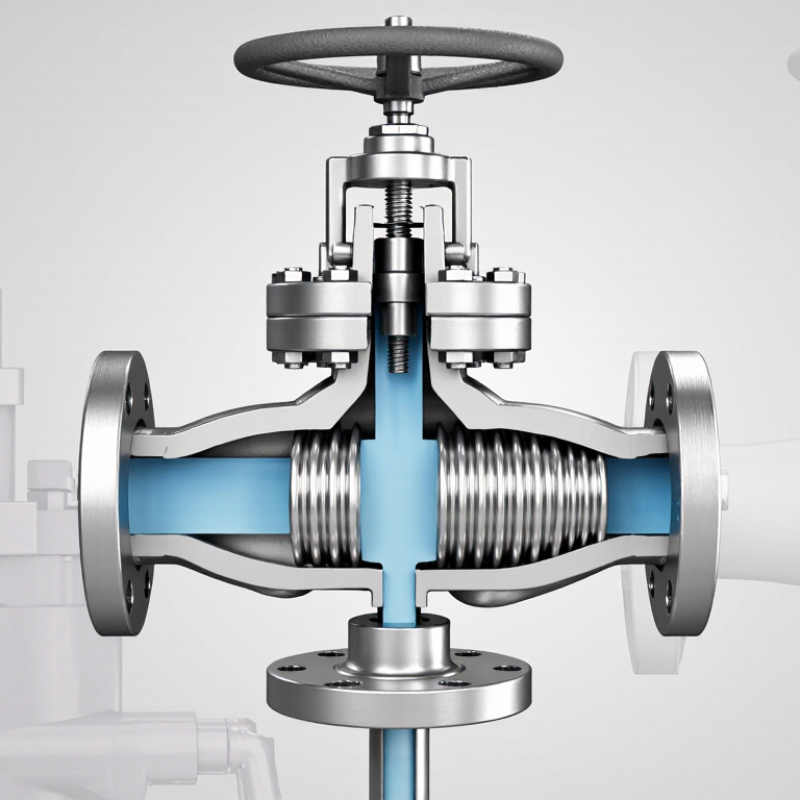
What Are Bellows Valves and How Do They Work?
Bellows valves are isolation valves designed to prevent process fluid from escaping around the stem. A flexible metal bellows forms a sealed barrier between the fluid and the atmosphere. This design is valuable when handling toxic, corrosive, radioactive, vacuum, or high-purity media. The bellows is central. It expands and contracts without rotating as the stem moves. That movement opens or closes the valve seat. The main components include the valve body, bonnet, stem, metal bellows, seat, plug, handwheel, and actuator. Many designs also include secondary packing or a monitoring port for added protection.
During operation, turning the handwheel moves the stem vertically. The stem carries the plug away from, or toward, the seat. Meanwhile, the bellows flexes axially and maintains the pressure boundary. Its welded joints and layered metal structure require careful engineering. Material selection depends on temperature, pressure, corrosion, and cycle frequency. A common mistake is assuming every bellows valve suits every service. It does not. Repeated thermal cycling can cause fatigue, even when external leakage remains absent. In field inspections, technicians should check stroke smoothness, seat shutoff, bonnet condition, and any monitoring connection. Leak testing may reveal problems before visible damage appears. No valve is maintenance-free. The bellows reduces one major leak path, but correct sizing, installation, and periodic testing still determine reliability.
| Data Dimension | Key Information | Definition, Purpose, or Operating Detail |
|---|---|---|
| Definition | Bellows valve | A valve that uses a flexible, corrugated metal bellows as a sealed barrier around the valve stem. The bellows isolates the process fluid from the external environment and helps prevent stem leakage. |
| Primary purpose | External leakage control | The bellows forms a hermetic or highly leak-resistant seal around the moving stem, reducing fugitive emissions and protecting the surrounding area from hazardous, toxic, radioactive, corrosive, or high-purity media. |
| Typical valve designs | Globe, gate, and control valves | Bellows sealing technology is commonly integrated into globe and gate valves and may also be used in specialized control or isolation valves where stem-emission control is important. |
| Main operating principle | Axial expansion and contraction | When the valve stem moves, the corrugated bellows compresses or extends axially. It follows the stem movement while maintaining a sealed separation between the process fluid and the valve bonnet area. |
| Flow-control element | Disc, plug, or wedge | The internal closure element moves toward or away from the valve seat to stop, start, or regulate flow. The bellows does not normally control flow directly; it seals the stem movement path. |
| Primary sealing surface | Valve seat and closure element | The seat and closure element provide the internal shutoff. Their design determines the valve's flow direction, pressure-drop characteristics, and shutoff performance. |
| Secondary sealing system | Gasket and packing arrangement | A bonnet gasket seals the pressure boundary between body sections. Some designs also include packing as a backup seal, although the bellows is the principal dynamic stem-sealing barrier. |
| Core component | Metal bellows | A thin-walled, convoluted metallic element designed to flex repeatedly within a specified stroke and pressure range. Its material, wall thickness, number of convolutions, and weld quality affect service life. |
| Core component | Valve body | The pressure-retaining housing that contains the flow passage, seat, closure element, and process connections. Body geometry influences pressure loss and maintenance access. |
| Core component | Bonnet | The upper housing attached to the valve body. It supports the stem and actuator interface and encloses the bellows assembly while maintaining the pressure boundary. |
| Core component | Valve stem | The mechanical member that transfers motion from a handwheel or actuator to the closure element. In a bellows valve, the stem is connected to the bellows so that movement does not create an open leakage path. |
| Core component | Actuator or handwheel | The operating mechanism that moves the stem. Manual handwheels are common for isolation service, while pneumatic, electric, or hydraulic actuators may be used for automated operation. |
| Common bellows materials | Austenitic stainless steels and nickel-based alloys | Material selection depends on temperature, pressure, corrosion resistance, fatigue requirements, and process compatibility. Stainless steel is widely used, while nickel-based alloys may be selected for more demanding chemical or thermal conditions. |
| Pressure boundary | Body, bonnet, bellows, and joints | All pressure-retaining parts must be designed for the intended pressure and temperature range. Welded bellows joints require careful manufacturing and inspection because defects can affect leakage performance and fatigue life. |
| Leakage behavior | Reduced stem fugitive emissions | Because the bellows separates the process fluid from the stem packing area, emissions through the stem interface are substantially reduced compared with conventional packed-stem arrangements when correctly designed and maintained. |
| Typical applications | Chemical processing, pharmaceuticals, vacuum systems, and power generation | These valves are used where preventing external leakage is important, including hazardous-fluid isolation, high-purity service, vacuum service, and systems handling hot or corrosive media. |
| Advantages | Leak prevention and contamination control | Key benefits include low external emissions, improved operator and environmental protection, reduced process contamination, and suitability for fluids that should not contact conventional stem packing. |
| Limitations | Fatigue, stroke, and cost considerations | The bellows has a finite flex life and must remain within its rated stroke, pressure, temperature, and cycle limits. Bellows valves can also be more expensive and may require more specialized inspection than conventional packed valves. |
| Failure modes | Fatigue cracking, corrosion, and mechanical damage | Repeated cycling, excessive pressure, thermal stress, vibration, corrosion, improper installation, or overstressing can damage the bellows and compromise its sealing function. |
| Inspection focus | Bellows integrity and valve-seat condition | Maintenance should consider operating cycles, signs of external leakage, stem movement, bonnet and flange joints, seat tightness, corrosion, and any pressure or leak testing required by the applicable procedure. |
| Selection criteria | Media, pressure, temperature, cycles, and connection type | A suitable valve is selected by matching the process fluid, pressure class, operating temperature, required flow capacity, shutoff needs, cycle frequency, materials, end connections, and actuator requirements. |

What Are Bellows Valves and How Do They Work?
How Bellows Valves Create a Sealed Flow Path
A bellows valve isolates the process fluid from its moving stem. Inside, a thin, welded metal bellows expands and contracts as the handwheel moves. The valve stem travels, but it does not slide through a conventional packing set. This creates a sealed flow path around the stem area. It is a small design change with serious value.
The U.S. Environmental Protection Agency’s Protocol for Equipment Leak Emission Estimates identifies valves as a major source of fugitive emissions. In many refinery inventories, valves represent about 60% of component leak emissions. Bellows construction directly addresses this risk. API 624 testing also evaluates fugitive emissions from rising-stem valves under repeated mechanical and thermal cycles. A properly selected bellows can reduce routine leakage, protect sensitive media, and limit contamination near the valve bonnet.
In field inspections, installers should check weld quality, pressure rating, temperature limits, and stroke alignment. A bellows is not indestructible. Excessive vibration or repeated over-stroking can damage it. That assumption is too simple. Good sealing also depends on clean pipework and correct installation.
Tips: Select the bellows material for the fluid and temperature. Confirm cycle-life data before frequent operation. Use helium testing when extremely low leakage matters. Recheck connections after thermal cycling. EPA’s equipment-leak guidance and API 624 test methods provide useful technical references, but site conditions still require engineering judgment.
Bellows valves use a flexible metal bellows to seal the stem area from the process fluid. This design limits fugitive emissions and protects sensitive media from outside contamination. Common configurations include globe, angle, and straight-through bodies. Globe valves suit precise throttling, while angle valves can simplify compact piping layouts. Welded bellows contain formed metal layers joined at their edges. Formed bellows are produced from seamless tubing and shaped through controlled pressure. Each type offers different flexibility, stroke length, and fatigue resistance.
Stainless steel is widely selected for its corrosion resistance and practical cost. Nickel-based alloys handle aggressive chemicals and elevated temperatures more reliably. Titanium can perform well in selected corrosive environments, but its cost may restrict use. The valve body may use stainless steel, carbon steel, or another compatible alloy. Material compatibility depends on pressure, temperature, fluid chemistry, and cycling frequency. No material is perfect. A strong alloy can still fail when chloride exposure, vibration, or poor welding is overlooked.
Tips: Check the bellows material against the actual process fluid, not a general chemical name. Inspect weld quality, pressure ratings, and cycle data before approval. Keep the stem aligned during installation. Misalignment creates uneven movement and may shorten bellows life. In field experience, maintenance teams sometimes focus on body corrosion while missing repeated thermal expansion. That assumption deserves review.
Bellows valves use a flexible metal bellows to seal around the moving stem. This design limits fugitive emissions and protects process fluids from outside contamination. They are common in corrosive, toxic, vacuum, and high-purity service. A reliable installation starts with the specification. Confirm pressure, temperature, materials, end connections, flow direction, and actuator requirements. The piping must be clean and properly supported. Never force a misaligned valve into place. That shortcut can distort the bellows.
Before operation, inspect the body, stem, and welded bellows area for damage. Open and close the valve slowly, using the specified handwheel or actuator settings. Avoid using excessive torque. Operators should monitor leakage, abnormal noise, vibration, and temperature changes. A valve that feels stiff needs investigation, not repeated force. Pressure testing should follow the project procedure and applicable standards. Record test results, torque settings, and the valve’s service conditions.
Maintenance intervals should reflect cycles, fluid chemistry, temperature, and service criticality. During planned shutdowns, clean exposed surfaces and check packing, connections, supports, and indicators. The bellows itself needs close attention. Look for cracking, corrosion, staining, or unusual movement. If leakage appears, isolate the system safely and have qualified personnel diagnose it. Do not assume a tight packing adjustment solves every problem. It may hide bellows fatigue. In practice, checklists help, but they are not perfect. Review failures honestly and update the maintenance plan.
Typical planning frequency for key inspection and maintenance activities
Bellows valves require correct alignment, clean piping, controlled tightening, and leak testing during installation. During operation, the valve should be opened and closed gradually without using the handwheel as a lever. Routine visual checks are commonly performed monthly, while a detailed inspection and preventive maintenance review are typically scheduled at least annually or during a planned shutdown.
Bellows valves use a flexible metal bellows to isolate the stem from the process fluid. When the handwheel turns, the stem moves the plug while the bellows compresses or expands. This design removes the usual stem-packing leak path. That matters in toxic, sterile, vacuum, and high-purity services.
The U.S. Environmental Protection Agency’s Protocol for Equipment Leak Emission Estimates identifies valves as contributing roughly 60% of fugitive emissions in petroleum and petrochemical equipment. Bellows sealing can reduce this exposure when installed and tested correctly. It also limits contamination, lowers routine packing maintenance, and supports cleaner operation. However, bellows can fatigue under excessive cycling, vibration, pressure spikes, or poor alignment. They also cost more than conventional packed valves. A failed bellows may provide little warning. That is an uncomfortable limitation.
Common applications include chemical processing, pharmaceutical systems, semiconductor gas lines, nuclear facilities, and vacuum equipment. In cryogenic service, thermal contraction deserves careful review. In high-temperature service, bellows material selection becomes critical. API 624 testing can help evaluate fugitive-emission performance, but test results do not replace site-specific engineering. Real installations are less tidy than catalogs suggest.
Tips: Check cycle frequency, temperature swings, corrosion data, and cleaning procedures before selecting a valve. Inspect the bellows area for unusual movement or noise. Keep records. Small clues matter. A qualified engineer should confirm pressure ratings and applicable standards.


For those larger-sized parts, or smaller quantity runs, we have 2 independent powder coat booths and ovens. The quality, durability and affordability of today’s powder coating finishes make this the process of choice for world-class companies.
Powder coating advantages over other forms of coating are many. Materials used in the Powder coating process can be metals and non-metals that come in a multitude of thicknesses, textures, colors, etc. Another of Powder coating’s biggest advantages over conventional coatings is its ability to create finishes in many different textures. Powder Coating Booths allow us the ability to apply these advantages to large products.
Tri-State Fabricators runs a full-service conveyor line for painting. Wet painting can provide protection or decoration to many different part styles. From start to finish, every project is easier to undergo random and point-based inspection by our skilled painting team.
Advantages to our Wet Paint Line are these lines start with product prep and ends with a thorough inspection of a high quality finished product. Our ability to complete large and small projects with a superior finish and doing so in a timely and economical fashion. This passes along the savings in production to our customers. When powder coating ins not an option, our Wet Paint Line gets the job done right the first time.
When the parts get big and heavy we roll-out our custom paint racks and oversize booth. By utilizing our partnerships with all the major paint brands, we can match virtually any color with wet paint.
The advantages of having access to a Wet Paint Booth are many. Large projects of many different shapes can be loaded into the booth. The Wet Paint Booth offers an environment that is much more controlled than a typical parts painting operation.
Not only are they used because of their controlled environment, but they’re are also advantageous when it comes to applying paint to parts that are needed in industries that require specialty coatings such as medical, aerospace, etc.
Our military forces have some very high standards when it comes to the finish of their vehicles and equipment. From the first pre-treatment step to final coat, it takes a great deal of knowledge and experience to protect the men and women of our armed forces. They deserve only the best, and Tri-State Fabricators provides it.
All of our processes are closely monitored by our staff and management teams. Both of which are highly trained in the processes of metal fabrication and finishing. Tri-State Fabricators’ goal is to always fully satisfy each and every customer, including the military. We will always put a 110% into what we do.
Abrasive media blasting is an excellent way to remove old paint, rust, and increase the paint/powder adhesion. Glass beads produce a much smoother and brighter finish than angular abrasives; leaving the part clean yet without any dimensional change. Chemically inert and environmentally friendly, we can recycle our beads approximately 30 times; making them a more preferred method of metal cleaning or surface finishing.
Advantages to Glass Bead Blasting are many. Glass bead blast media is used when a project is needing rough surfaces need to become smooth for applications of coatings such as paint. It is typically used to clean paint and rust from a product surface without deforming the surface it is being used on. Overall, compared to many other blasting media, Glass Bead Blasting is a very economical choice and those savings are always passed on to our customers.
Tri-State Fabricators utilize a zinc phosphate wash to clean and etch the material to ensure the best paint adhesion possible. The unique design of our 3-stage wash system does the work like a 5-stage. From Cleaning and rinsing to conversion coating and post-treatment, Our Part Washing process is a complete service and works throughout the fabrication service and the finishing service.
Along with the previously mentioned benefits, Curing is a vital chemical reaction that leaves the product finish hard and relatively safe from mild abrasion and aggressive corrosion. This process can be done in more than one way; ambient air-dry or in curing ovens at temps that exceed 240°.
From fixing paint mistakes (someone else’s of course) to simply cleaning our paint line hooks, our burn-off oven is put to good use. After a quick burn-off, a little clean up, and a fresh coat of paint, your parts will look better than new.
Why does our Burn-Off Oven work so well? Because super heating the air around parts turns the materials into ashes. From paint and powder coatings to rubber and machining oils, high temps do the job without degrading the integrity of the part.
Masking is a vital part of producing high quality products. We have die-cut masking patterns to protect machined surfaces as well as a wide range of plugs and caps to protect threaded holes and bolts. We provide permanent and temporary masking.
Masking allows the selected sections of a product to be protected from a fabrication or finishing service. This can be with both chemicals when etching and tapes, paints when only finishing just a section of the product. Masking is great in aiding the customization process of a project.
Screen printing is a photographic process that transfers artwork onto a porous nylon screen which allows colored ink to flow through the screen and be deposited on an aluminum or plastic component. We can generally have just about any design created onto a screen for your parts.
Some of the advantages of Screen Printing are, brand recognition for your business displaying on your products, assembly instructions, product warnings/hazards, etc. Tri-State Fabricators produces Screen Printing of the highest quality so you know it’s durable.
Metal Finishing is the art of treating the exterior portion of product, often metal but can also be made of other materials, so that the surface is clean and free of any debris. Then the process of applying coats or either paint of powder coat takes place. This coating process improves the quality of the product in both appearance and resistance to wear and corrosion.
Tri-State Fabricators, Inc., understands that a project typically isn’t complete until a high-quality finish has been added to your product. This is why our painting and powder coating teams continuously inspect the products throughout the Metal Finishing process.

