


An Alkaline Hydrogen Generator produces hydrogen by splitting water through electrolysis. It uses electrical current and an alkaline electrolyte, commonly a potassium hydroxide solution, to help carry ions between electrodes. The process may sound simple. Its safe, steady operation depends on several carefully controlled parts.
Inside the cell, water reaches the electrode surfaces while direct current drives the reaction. Hydrogen forms at the cathode, and oxygen forms at the anode. A diaphragm or separator keeps the gases apart as they leave the cell. It reduces mixing, but the whole system still needs sound seals, sensors, and operating controls. The details matter.
A complete generator may also include a power supply, water-treatment equipment, gas cooling, and drying stages. These components affect output, purity, and maintenance needs. For example, mineral deposits can build up when unsuitable feed water is used, while changing current can alter production rates. Actual performance depends on the design and operating conditions, so published specifications deserve close attention.
This guide explains what an alkaline hydrogen generator is and how its main components work together. It also considers practical limits, such as energy use and routine inspection. Hydrogen is colorless and highly flammable, so system design and handling procedures are essential—not optional details. And one point is easy to overlook: producing hydrogen is not the same as proving it is suitable for every application.
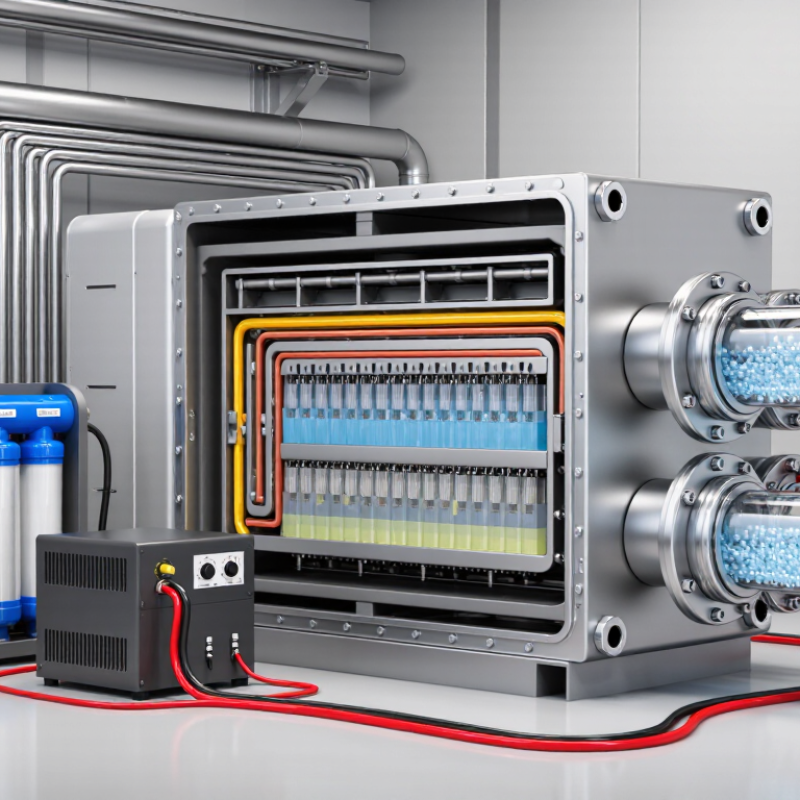
An alkaline hydrogen generator uses electricity to split water into hydrogen and oxygen. Its performance depends on three core parts: electrodes, a diaphragm, and a potassium hydroxide electrolyte. Together, they create a controlled path for electrons and hydroxide ions.
Electrodes carry the electrochemical reactions. At the cathode, water gains electrons and produces hydrogen gas. At the anode, hydroxide ions release oxygen and return toward the electrolyte.
Porous surfaces can improve gas release and reduce bubble buildup. Small details matter. Poor contact resistance wastes power and raises heat.
The diaphragm sits between both electrodes. It allows hydroxide ions to pass while limiting hydrogen and oxygen mixing. A damaged or poorly fitted diaphragm can reduce purity and increase operational risk.
The electrolyte commonly contains 20–30 wt% KOH, providing strong ionic conductivity. However, KOH is highly caustic, so sealed handling, protective equipment, and regular inspections are essential.
Water quality also matters because impurities may corrode electrodes or block the diaphragm. Operators should monitor temperature, electrolyte concentration, pressure, and gas output.
A stable reading does not always prove ideal performance. Ageing components can look normal while efficiency slowly declines. This is where practical maintenance often reveals more than specifications.

An alkaline hydrogen generator uses direct current to split water inside an alkaline electrolyte, usually containing potassium hydroxide. The reaction occurs across two electrodes separated by a diaphragm. At the cathode, water accepts electrons and forms hydrogen gas and hydroxide ions: 2H₂O + 2e⁻ → H₂ + 2OH⁻. Hydroxide ions then move through the electrolyte toward the anode. At the anode, they release electrons and produce oxygen: 4OH⁻ → O₂ + 2H₂O + 4e⁻. Hydrogen bubbles rise from one side, while oxygen leaves the other.
The process looks simple. It is not effortless. Electrode surfaces, electrolyte concentration, temperature, and diaphragm condition affect output and gas purity. Operators must also remove water impurities, because contamination can increase resistance and accelerate maintenance needs. The International Energy Agency’s Global Hydrogen Review 2024 reported more than 1.4 gigawatts of installed water-electrolysis capacity worldwide by the end of 2023, showing rapid industrial adoption. Yet scale does not remove basic physics. U.S. Department of Energy technical assessments commonly place present electrolytic energy use near 50 kilowatt-hours per kilogram of hydrogen, depending on system design and operating conditions. Some field results perform better, while others fall short. That variation deserves honest attention. A practical inspection should check voltage stability, temperature, gas crossover, electrolyte level, and visible bubble behavior. Small irregularities can signal declining efficiency before the numbers become obvious.
An alkaline hydrogen generator uses electricity to split water into hydrogen and oxygen. Inside the cell, an alkaline electrolyte, commonly potassium hydroxide, carries hydroxide ions between two electrodes. The power supply drives the reaction through a diaphragm that helps keep the gases separate. Hydrogen forms at the cathode, while oxygen forms at the anode.
Alkaline electrolysis commonly runs at 60–90°C. This range lowers electrolyte resistance and supports faster ion movement. It can also improve energy use when temperature, current, and electrolyte concentration remain stable. Operators usually monitor cell voltage, liquid level, gas purity, and cooling performance. A small temperature rise may seem helpful. Excess heat is not.
At 60°C, the process may respond more slowly and consume more electricity. Near 90°C, reaction speed can improve, but seals, diaphragms, and electrodes face greater thermal stress. Real systems rarely hold one perfect temperature. Load changes, water quality, and maintenance condition all matter. That is where simplified explanations become weak. A generator may perform well in a test room, yet behave differently during long operation. Careful calibration and routine inspection remain essential. Clean feedwater helps reduce deposits and protects stable gas production. Operators should also treat temperature sensors as critical instruments, not optional accessories.
Alkaline electrolysis commonly operates at 60–90°C. A direct current passes through an alkaline electrolyte, splitting water into hydrogen at the cathode and oxygen at the anode. The chart shows how the saturation vapor pressure of water increases across this typical operating range, based on IAPWS-IF97 steam-table data.
What Is an Alkaline Hydrogen Generator and How Does It Work?
An alkaline hydrogen generator splits water through electrolysis. Inside the cell, a direct current moves through an alkaline electrolyte, commonly a potassium hydroxide solution. Hydrogen forms at the cathode, while oxygen forms at the anode. The overall reaction is simple: 2H₂O → 2H₂ + O₂.
Material balance matters. Producing 1 kilogram of hydrogen requires about 9 kilograms of water. The reaction also generates approximately 8 kilograms of oxygen. This ratio comes from molecular masses: 36 kilograms of water produce 4 kilograms of hydrogen and 32 kilograms of oxygen. Scaled down, 9 kilograms becomes 1 kilogram and 8 kilograms. The numbers are clean.
Real equipment is less perfect. Water treatment, gas separation, cooling, and periodic purging create additional consumption. The alkaline electrolyte usually circulates rather than being consumed, but impurities and maintenance still require replacement. The International Energy Agency’s Global Hydrogen Review 2024 reports that water electrolysis commonly uses around 50–55 kWh of electricity per kilogram of hydrogen, depending on system design and operating conditions. That energy figure is often more important than the water ratio.
A useful field check is simple: weigh the feedwater and record hydrogen output over several hours. Losses then become visible. The theoretical balance remains essential, but it is not a complete operating promise. Temperature, pressure, water quality, and current efficiency can shift the measured result.
What Is an Alkaline Hydrogen Generator and How Does It Work?
Energy Demand: Typical Systems Use Roughly 50–60 kWh of Electricity per kg H₂
An alkaline hydrogen generator separates water into hydrogen and oxygen through electrolysis. Inside the stack, a liquid alkaline electrolyte carries ions between two electrodes. The cathode produces hydrogen, while the anode releases oxygen. A diaphragm keeps the gases apart and supports safer operation.
Electricity demand usually matters more than the water volume. Typical systems consume roughly 50–60 kWh of electricity per kilogram of hydrogen produced. One kilogram of hydrogen contains about 33.3 kWh of lower heating value energy. The difference reflects conversion losses, heat management, gas purification, compression, and pumps.
Real performance varies. A warm, stable stack may operate near its rated efficiency. Frequent starts, partial-load operation, or poor water quality can increase consumption. Auxiliary equipment also deserves attention. It may quietly use several additional kilowatt-hours per kilogram.
A practical example helps. Producing five kilograms daily could require approximately 250–300 kWh of electricity. That demand resembles the daily use of several household appliances running continuously. Actual results depend on system design and operating conditions.
The 50–60 kWh figure is useful, but it is not universal. Measurements should include the complete system boundary, not only the electrolysis stack. This distinction is often overlooked. A reliable assessment records electricity quality, operating pressure, temperature, hydrogen purity, and production rate. Without those details, efficiency comparisons can become misleading.
| Data Dimension | Typical Value or Description | Why It Matters |
|---|---|---|
| Electrolysis method | Alkaline water electrolysis | Uses an aqueous alkaline electrolyte to conduct ions between two electrodes. |
| Main input | Water, electricity, and an alkaline electrolyte such as potassium hydroxide or sodium hydroxide | Electricity drives the chemical reaction, while the electrolyte improves ionic conductivity. |
| Electrochemical reaction | 2H₂O → 2H₂ + O₂ | Water is split into hydrogen at the cathode and oxygen at the anode. |
| Hydrogen production site | Cathode, also called the negative electrode | Water molecules receive electrons and form hydrogen gas and hydroxide ions. |
| Oxygen production site | Anode, also called the positive electrode | Hydroxide ions release electrons and form oxygen and water. |
| Ion transport | Hydroxide ions move through the alkaline electrolyte from the cathode toward the anode. | Ion movement completes the internal electrical circuit. |
| Typical electricity consumption | Approximately 50–60 kWh per kg of H₂ | Actual consumption varies with stack efficiency, operating pressure, power electronics, cooling, water treatment, and gas purification. |
| Theoretical minimum energy | About 39.4 kWh per kg H₂ based on the higher heating value of hydrogen | Real systems require more energy because of electrical, thermal, gas-processing, and auxiliary losses. |
| Water consumption | The stoichiometric requirement is about 9 kg of water per kg of H₂; practical plant intake is higher. | Additional water may be needed for purification, cooling, flushing, and system losses. |
| Hydrogen output pressure | Often produced at several to a few tens of bar, depending on system design | Higher delivery pressure can reduce downstream compression requirements but may increase energy use. |
| Hydrogen purity | Commonly around 99.5%–99.999% after appropriate gas separation and purification | Required purity depends on the end use, such as fuel cells, industrial heating, or chemical production. |
| Operating temperature | Typically about 60–90°C for conventional alkaline electrolyzer systems | Temperature affects reaction kinetics, conductivity, efficiency, and materials durability. |
| Core components | Electrolyzer stack, electrodes, diaphragm, electrolyte circulation loop, rectifier, water-treatment unit, gas separator, cooling system, and controls | Each subsystem contributes to safe operation, gas quality, efficiency, and production reliability. |
| Diaphragm function | Separates hydrogen and oxygen compartments while allowing ion transport | Helps prevent gas mixing and supports safe, high-purity hydrogen production. |
| Dynamic response | Generally slower than proton-exchange-membrane systems when following rapidly changing power | Stable electricity supplies and operating buffers can improve performance with variable renewable power. |
| Typical advantages | Mature technology, potentially long operating life, and use of relatively abundant catalyst materials | These characteristics can support large-scale hydrogen production when operating conditions are suitable. |
| Key limitations | Electrolyte handling, possible gas crossover, lower flexibility than some newer designs, and the need for water and gas management | System design and regular monitoring are necessary to maintain efficiency and operational safety. |
| Emission profile | No direct carbon dioxide emissions during electrolysis; lifecycle emissions depend mainly on the electricity source. | Using renewable or low-carbon electricity can substantially reduce the climate impact of the produced hydrogen. |
Note: Values are representative engineering ranges. Actual performance depends on electrolyzer design, operating pressure, temperature, electricity quality, water purity, and balance-of-plant equipment.


For those larger-sized parts, or smaller quantity runs, we have 2 independent powder coat booths and ovens. The quality, durability and affordability of today’s powder coating finishes make this the process of choice for world-class companies.
Powder coating advantages over other forms of coating are many. Materials used in the Powder coating process can be metals and non-metals that come in a multitude of thicknesses, textures, colors, etc. Another of Powder coating’s biggest advantages over conventional coatings is its ability to create finishes in many different textures. Powder Coating Booths allow us the ability to apply these advantages to large products.
Tri-State Fabricators runs a full-service conveyor line for painting. Wet painting can provide protection or decoration to many different part styles. From start to finish, every project is easier to undergo random and point-based inspection by our skilled painting team.
Advantages to our Wet Paint Line are these lines start with product prep and ends with a thorough inspection of a high quality finished product. Our ability to complete large and small projects with a superior finish and doing so in a timely and economical fashion. This passes along the savings in production to our customers. When powder coating ins not an option, our Wet Paint Line gets the job done right the first time.
When the parts get big and heavy we roll-out our custom paint racks and oversize booth. By utilizing our partnerships with all the major paint brands, we can match virtually any color with wet paint.
The advantages of having access to a Wet Paint Booth are many. Large projects of many different shapes can be loaded into the booth. The Wet Paint Booth offers an environment that is much more controlled than a typical parts painting operation.
Not only are they used because of their controlled environment, but they’re are also advantageous when it comes to applying paint to parts that are needed in industries that require specialty coatings such as medical, aerospace, etc.
Our military forces have some very high standards when it comes to the finish of their vehicles and equipment. From the first pre-treatment step to final coat, it takes a great deal of knowledge and experience to protect the men and women of our armed forces. They deserve only the best, and Tri-State Fabricators provides it.
All of our processes are closely monitored by our staff and management teams. Both of which are highly trained in the processes of metal fabrication and finishing. Tri-State Fabricators’ goal is to always fully satisfy each and every customer, including the military. We will always put a 110% into what we do.
Abrasive media blasting is an excellent way to remove old paint, rust, and increase the paint/powder adhesion. Glass beads produce a much smoother and brighter finish than angular abrasives; leaving the part clean yet without any dimensional change. Chemically inert and environmentally friendly, we can recycle our beads approximately 30 times; making them a more preferred method of metal cleaning or surface finishing.
Advantages to Glass Bead Blasting are many. Glass bead blast media is used when a project is needing rough surfaces need to become smooth for applications of coatings such as paint. It is typically used to clean paint and rust from a product surface without deforming the surface it is being used on. Overall, compared to many other blasting media, Glass Bead Blasting is a very economical choice and those savings are always passed on to our customers.
Tri-State Fabricators utilize a zinc phosphate wash to clean and etch the material to ensure the best paint adhesion possible. The unique design of our 3-stage wash system does the work like a 5-stage. From Cleaning and rinsing to conversion coating and post-treatment, Our Part Washing process is a complete service and works throughout the fabrication service and the finishing service.
Along with the previously mentioned benefits, Curing is a vital chemical reaction that leaves the product finish hard and relatively safe from mild abrasion and aggressive corrosion. This process can be done in more than one way; ambient air-dry or in curing ovens at temps that exceed 240°.
From fixing paint mistakes (someone else’s of course) to simply cleaning our paint line hooks, our burn-off oven is put to good use. After a quick burn-off, a little clean up, and a fresh coat of paint, your parts will look better than new.
Why does our Burn-Off Oven work so well? Because super heating the air around parts turns the materials into ashes. From paint and powder coatings to rubber and machining oils, high temps do the job without degrading the integrity of the part.
Masking is a vital part of producing high quality products. We have die-cut masking patterns to protect machined surfaces as well as a wide range of plugs and caps to protect threaded holes and bolts. We provide permanent and temporary masking.
Masking allows the selected sections of a product to be protected from a fabrication or finishing service. This can be with both chemicals when etching and tapes, paints when only finishing just a section of the product. Masking is great in aiding the customization process of a project.
Screen printing is a photographic process that transfers artwork onto a porous nylon screen which allows colored ink to flow through the screen and be deposited on an aluminum or plastic component. We can generally have just about any design created onto a screen for your parts.
Some of the advantages of Screen Printing are, brand recognition for your business displaying on your products, assembly instructions, product warnings/hazards, etc. Tri-State Fabricators produces Screen Printing of the highest quality so you know it’s durable.
Metal Finishing is the art of treating the exterior portion of product, often metal but can also be made of other materials, so that the surface is clean and free of any debris. Then the process of applying coats or either paint of powder coat takes place. This coating process improves the quality of the product in both appearance and resistance to wear and corrosion.
Tri-State Fabricators, Inc., understands that a project typically isn’t complete until a high-quality finish has been added to your product. This is why our painting and powder coating teams continuously inspect the products throughout the Metal Finishing process.

