


Choosing a carport is no longer only about finding the lowest price. Prefabricated Metal Carports now serve homes, farms, workshops, and small commercial sites. Their factory-cut frames can reduce on-site waste and installation time. A practical choice still depends on wind exposure, snow loads, drainage, vehicle height, and local approval requirements.
Industry data supports this shift toward manufactured construction. Grand View Research reported that the global prefabricated construction market reached approximately $153.7 billion in 2023. Its 2024–2030 outlook also projects continued annual growth. The U.S. Census Bureau reported more than $2 trillion in annual construction spending during 2024, showing the scale of demand for durable building solutions. These figures do not guarantee that every carport performs well. They only show a growing market.
Details matter.
An experienced installer will inspect soil conditions, anchor placement, roof pitch, and exposed fasteners before recommending a model. Structural guidance from ASCE 7 and AISI S100 can help professionals evaluate design loads and cold-formed steel members. Manufacturer documentation should identify steel thickness, coating type, connection methods, and tested load ratings. Look for clear warranty terms, installation drawings, and corrosion protection suited to the local climate.
This guide presents seven practical tips for choosing Prefabricated Metal Carports. It also questions common assumptions. A thicker frame is not automatically the best frame. A lower quote may exclude anchoring, permits, delivery, or drainage work. Measure the actual vehicle, not the one you may buy later. Leave room for doors, mirrors, snow removal, and future storage. The right decision combines published evidence with a careful site inspection.
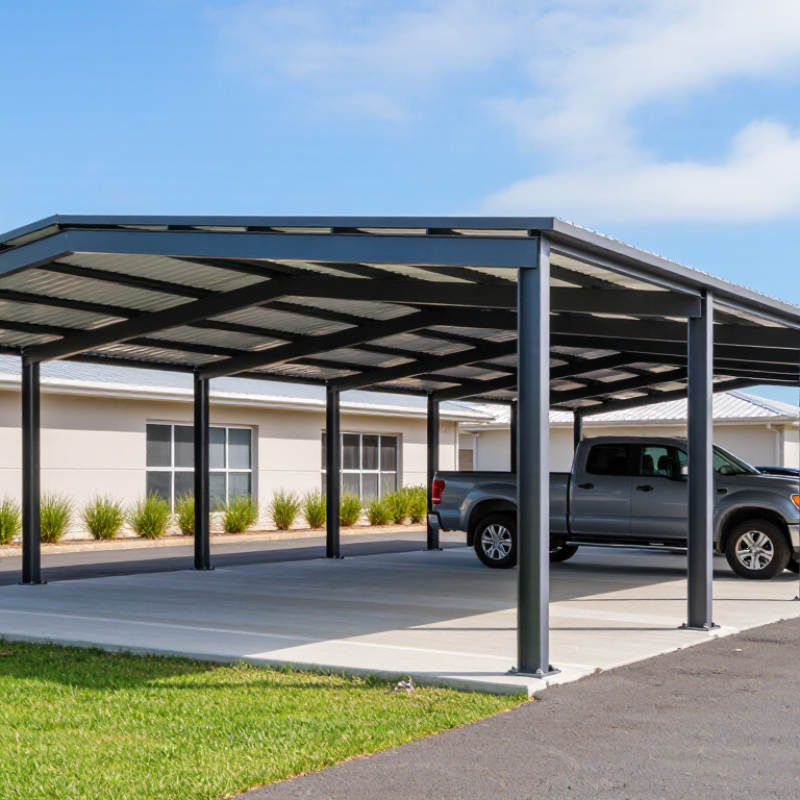
Define your carport’s purpose before comparing designs. A daily driver needs quick access and weather protection. A work vehicle may need extra side clearance. Storage requires a deeper structure, especially for bins, tools, or bicycles. A carport used for snow protection also needs a roof engineered for local snow loads. Shade alone may require less depth, but strong anchoring still matters.
Measure the actual vehicle, not its advertised size. Include mirrors, roof racks, tow bars, and open doors. Record the vehicle’s height at its tallest point. Then add comfortable clearance above the roof. A few extra inches can prevent expensive contact with roof panels. Width matters too. Two vehicles need space between doors, not just their combined body widths. It is easy to underestimate this.
Think about future use. You may replace a compact car with a taller van. Planning for that possibility can save reconstruction costs. Check ground slope, drainage, and the location of posts before ordering. Soft soil may require different anchoring methods than a concrete pad. Local building requirements can also affect height, placement, and wind resistance. A common mistake is choosing the largest structure available without checking the site. Bigger is not always better. It can reduce maneuvering room and create unnecessary maintenance. Fresh measurements, even when inconvenient, usually produce a more dependable choice.

Tip 1: Compare materials before comparing prices. Galvanized steel usually offers strong impact resistance and better support for heavy snow. Aluminum resists corrosion well, but it may dent more easily.
Tip 2: Inspect the coating quality. Look for even galvanizing, sealed edges, and a finish without exposed scratches. Check the coating.
Tip 3: Match the frame design to local weather. A boxed frame generally feels stronger than a narrow tubular frame.
Tip 4: Review connection points, braces, and roof pitch. More supports can improve stability, but they may reduce usable parking space. Measure twice.
Tip 5: Ask how the structure handles wind and snow loads. These ratings should be documented, not guessed from appearance. I once saw a low-cost frame bend because its anchors were too shallow.
Tip 6: Examine protective features closely. Choose secure anchoring, rust-resistant fasteners, drainage channels, and a roof that limits water pooling.
Tip 7: Consider ventilation and sunlight control. Vented panels can reduce trapped heat, while UV-resistant roofing helps protect paint and dashboards. However, no coating stays perfect forever. Inspect small chips each season and repair them early. A professional installer should explain maintenance intervals and provide clear load information.
Check local requirements before comparing prices or roof styles. Building codes may control height, width, setbacks, snow load, and wind resistance. Contact your local building department and request written guidance. Rules vary between neighboring towns.
Tip 1: Ask whether the carport needs a building permit. Some areas exempt small structures, while others require drawings and inspections. Tip 2: Confirm zoning setbacks from property lines, roads, wells, and drainage channels. A few inches can matter. Tip 3: Check whether a homeowners’ association or land covenant adds restrictions.
Site conditions deserve equal attention. Tip 4: Walk the proposed area after heavy rain and look for standing water. Tip 5: Locate underground utilities before digging anchor holes. Tip 6: Check soil strength, slope, and access for delivery equipment. A level gravel pad may look adequate, but weak soil can loosen anchors over time. Tip 7: Match the structure to local snow and wind data, not assumptions. Ask the installer or a qualified local professional how the frame should be anchored. Your first layout may be wrong. Recheck it. Small oversights, such as a low branch or narrow gate, can create expensive changes after delivery.
Wind resistance is one of the key code requirements for a prefabricated metal carport. The chart shows commonly referenced U.S. ultimate design wind-speed values by risk category. Actual requirements depend on the local jurisdiction, adopted code edition, site exposure, elevation, and proximity to coastal or high-wind areas.
Reference: ASCE 7 wind-speed risk-category framework. Local building officials and adopted code documents control the final design requirements.
Choosing a prefabricated metal carport requires more than comparing prices. Installation methods strongly affect stability. A carport placed on a level concrete pad usually resists movement better than one installed on loose soil. Ground anchors can work well, but only when they match the soil and expected wind conditions. Check local permit requirements before ordering. Small oversights become expensive later.
Durability depends on material thickness, protective coatings, roof design, and drainage. Galvanized steel helps resist rust, while a sound powder-coated finish adds another layer of protection. Ask how roof panels handle snow loads and heavy rain. Water should flow away from posts, not collect around their bases. I once saw a well-built structure weaken because blocked drainage kept the anchors damp. The frame was strong. The site was not.
Maintenance is simple, but it is not optional. Inspect bolts, anchors, seams, and roof panels at least twice a year. Look for flaking coating, orange rust, loose fasteners, or bent edges after severe weather. Remove leaves before they trap moisture. Keep soil and mulch away from metal posts. Replacing one damaged fastener early costs less than repairing a shifted frame. Some maintenance advice sounds obvious. It is still easy to forget. A written inspection checklist can prevent that.
A low quoted price can hide important expenses. Freight, site preparation, delivery equipment, and installation may be separate charges. Ask for an itemized estimate before comparing suppliers. Check whether the price includes anchors, roof trim, side panels, and tax. A concrete driveway may need different anchors than compacted soil. Small details can change the final cost.
Warranties deserve careful reading, not a quick glance. Confirm coverage for rust, paint failure, structural defects, and roof leaks. Ask who handles claims and how long replacement parts remain available. A ten-year frame warranty may exclude labor or damage from poor installation. That difference matters. Save the contract, drawings, payment records, and installation photographs in one folder.
Supplier reliability is harder to measure than price. Look for a physical business address, clear contact information, and recent customer feedback. Request references for similar carports in your climate. Ask how delivery delays, damaged panels, and missing hardware are handled. A dependable supplier answers specific questions without pressure. One lesson worth remembering: polished websites prove little. I used to treat fast replies as proof of quality, but that assumption can fail. A written warranty, realistic timeline, and transparent invoice provide stronger evidence. Allow time to inspect every package before the installer leaves. Mistakes are easier to correct early.


For those larger-sized parts, or smaller quantity runs, we have 2 independent powder coat booths and ovens. The quality, durability and affordability of today’s powder coating finishes make this the process of choice for world-class companies.
Powder coating advantages over other forms of coating are many. Materials used in the Powder coating process can be metals and non-metals that come in a multitude of thicknesses, textures, colors, etc. Another of Powder coating’s biggest advantages over conventional coatings is its ability to create finishes in many different textures. Powder Coating Booths allow us the ability to apply these advantages to large products.
Tri-State Fabricators runs a full-service conveyor line for painting. Wet painting can provide protection or decoration to many different part styles. From start to finish, every project is easier to undergo random and point-based inspection by our skilled painting team.
Advantages to our Wet Paint Line are these lines start with product prep and ends with a thorough inspection of a high quality finished product. Our ability to complete large and small projects with a superior finish and doing so in a timely and economical fashion. This passes along the savings in production to our customers. When powder coating ins not an option, our Wet Paint Line gets the job done right the first time.
When the parts get big and heavy we roll-out our custom paint racks and oversize booth. By utilizing our partnerships with all the major paint brands, we can match virtually any color with wet paint.
The advantages of having access to a Wet Paint Booth are many. Large projects of many different shapes can be loaded into the booth. The Wet Paint Booth offers an environment that is much more controlled than a typical parts painting operation.
Not only are they used because of their controlled environment, but they’re are also advantageous when it comes to applying paint to parts that are needed in industries that require specialty coatings such as medical, aerospace, etc.
Our military forces have some very high standards when it comes to the finish of their vehicles and equipment. From the first pre-treatment step to final coat, it takes a great deal of knowledge and experience to protect the men and women of our armed forces. They deserve only the best, and Tri-State Fabricators provides it.
All of our processes are closely monitored by our staff and management teams. Both of which are highly trained in the processes of metal fabrication and finishing. Tri-State Fabricators’ goal is to always fully satisfy each and every customer, including the military. We will always put a 110% into what we do.
Abrasive media blasting is an excellent way to remove old paint, rust, and increase the paint/powder adhesion. Glass beads produce a much smoother and brighter finish than angular abrasives; leaving the part clean yet without any dimensional change. Chemically inert and environmentally friendly, we can recycle our beads approximately 30 times; making them a more preferred method of metal cleaning or surface finishing.
Advantages to Glass Bead Blasting are many. Glass bead blast media is used when a project is needing rough surfaces need to become smooth for applications of coatings such as paint. It is typically used to clean paint and rust from a product surface without deforming the surface it is being used on. Overall, compared to many other blasting media, Glass Bead Blasting is a very economical choice and those savings are always passed on to our customers.
Tri-State Fabricators utilize a zinc phosphate wash to clean and etch the material to ensure the best paint adhesion possible. The unique design of our 3-stage wash system does the work like a 5-stage. From Cleaning and rinsing to conversion coating and post-treatment, Our Part Washing process is a complete service and works throughout the fabrication service and the finishing service.
Along with the previously mentioned benefits, Curing is a vital chemical reaction that leaves the product finish hard and relatively safe from mild abrasion and aggressive corrosion. This process can be done in more than one way; ambient air-dry or in curing ovens at temps that exceed 240°.
From fixing paint mistakes (someone else’s of course) to simply cleaning our paint line hooks, our burn-off oven is put to good use. After a quick burn-off, a little clean up, and a fresh coat of paint, your parts will look better than new.
Why does our Burn-Off Oven work so well? Because super heating the air around parts turns the materials into ashes. From paint and powder coatings to rubber and machining oils, high temps do the job without degrading the integrity of the part.
Masking is a vital part of producing high quality products. We have die-cut masking patterns to protect machined surfaces as well as a wide range of plugs and caps to protect threaded holes and bolts. We provide permanent and temporary masking.
Masking allows the selected sections of a product to be protected from a fabrication or finishing service. This can be with both chemicals when etching and tapes, paints when only finishing just a section of the product. Masking is great in aiding the customization process of a project.
Screen printing is a photographic process that transfers artwork onto a porous nylon screen which allows colored ink to flow through the screen and be deposited on an aluminum or plastic component. We can generally have just about any design created onto a screen for your parts.
Some of the advantages of Screen Printing are, brand recognition for your business displaying on your products, assembly instructions, product warnings/hazards, etc. Tri-State Fabricators produces Screen Printing of the highest quality so you know it’s durable.
Metal Finishing is the art of treating the exterior portion of product, often metal but can also be made of other materials, so that the surface is clean and free of any debris. Then the process of applying coats or either paint of powder coat takes place. This coating process improves the quality of the product in both appearance and resistance to wear and corrosion.
Tri-State Fabricators, Inc., understands that a project typically isn’t complete until a high-quality finish has been added to your product. This is why our painting and powder coating teams continuously inspect the products throughout the Metal Finishing process.

