


7 Tips for Choosing a Droplet Molding Apparatus

Choosing a Droplet Molding Apparatus is not simply a matter of selecting the highest flow rate or the lowest price. In a working laboratory, small details often decide whether droplets remain uniform. A loose connector can create pulses. A poorly matched channel can produce satellite droplets. Cleaning may also take longer than expected.

Professor David A. Weitz, a leading droplet-microfluidics researcher, has described droplets as “individual microreactors.” That perspective matters when comparing equipment. Each droplet must form consistently, travel smoothly, and remain stable during observation or collection. This guide introduces seven practical tips for choosing a Droplet Molding Apparatus that fits real experimental conditions.

The discussion will examine droplet-size control, flow stability, channel design, material compatibility, throughput, imaging access, and maintenance. Check the tubing first. It often reveals hidden weaknesses. A reliable apparatus should support repeatable pressure or syringe control, clear visual monitoring, and quick replacement of wetted parts. It should also match the chemicals, oils, surfactants, and temperatures used in your process.

There is no perfect system. A device that performs well for polymer beads may disappoint during biological encapsulation. An impressive specification sheet may not reflect daily handling. I have found that short trials with actual fluids expose more than polished demonstrations. Even this approach has limits; operator technique can influence results. Careful evaluation remains essential. The best choice balances precision, usability, cleaning time, technical support, and future process changes.
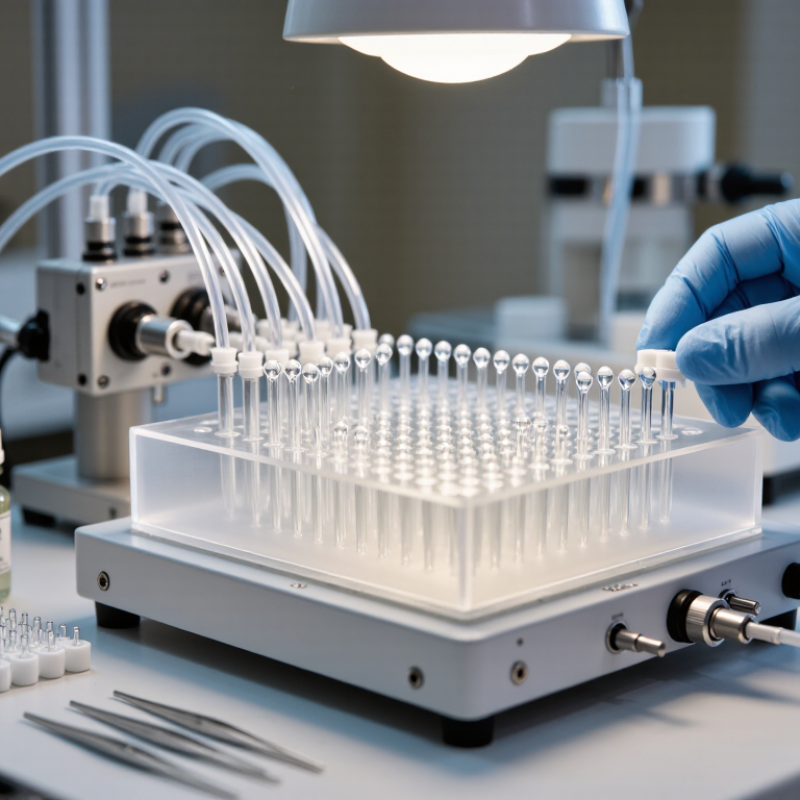
7 Tips for Choosing a Droplet Molding Apparatus

Define Droplet Size: Target 10–100 μm With CV Below 5%

Choosing a droplet molding apparatus starts with a measurable target: 10–100 μm droplets and a coefficient of variation below 5%. This range supports consistent dosing, reaction control, and imaging in many laboratory workflows. A 2023 review in Lab on a Chip identifies sub-5% size variation as a practical benchmark for highly uniform droplet generation. Measure performance, not promises.

In real testing, record at least 500 droplets under normal operating conditions. Capture images after stabilization, not during start-up. A 10 μm shift can change surface-area-to-volume ratios noticeably. Keep pressure, temperature, viscosity, and flow rates documented. ISO 9276-1 recommends reporting particle-size distributions rather than relying on a single average, which is especially important for droplets near the lower size limit. A 2024 industry analysis also forecasts roughly 13% annual growth for the broader microfluidics market, reflecting wider demand for repeatable small-volume processing.

Ask whether the apparatus maintains a CV below 5% across several runs. One successful image is not enough. Test different liquids and operators. Results may drift. That weakness matters. A device producing 50 μm droplets at 4% CV may perform poorly at 15 μm, where channel geometry, evaporation, and measurement noise become more influential. Specify the acceptable size window, sampling method, and recalibration interval before comparing equipment.


Match Flow Control: Compare 10²–10⁴ Droplets per Second

Choosing a droplet molding apparatus starts with flow control, not a glossy feature list. A system rated for 10² droplets per second may suit slow screening, but it can waste time during larger experiments. At 10⁴ droplets per second, small pressure changes become visible as size drift, satellite droplets, or occasional merging. Match the operating range to your real workload, not the maximum number printed in a specification sheet. Ask whether the quoted rate means stable production or a brief peak. That distinction matters.

During evaluation, run water-like and viscous test fluids at 100, 1,000, and 10,000 droplets per second. Record droplet diameter, coefficient of variation, pressure, temperature, and rejected droplets. Use a camera with enough frame rate to catch brief instabilities. Inspect the first and last minutes of every run. They often differ.

A reliable apparatus should restart consistently after pauses and maintain clean separation at the target speed. Check whether tubing volume creates a delay between pump changes and droplet response. That delay can mislead operators.

Keep spare nozzles and a written cleaning procedure nearby; tiny residue can distort results surprisingly fast.

My own preference is a system with transparent limits and accessible calibration. I have seen a smooth image hide an 8% size increase over one hour. It looked acceptable at first. Repeatability deserves more attention than a single impressive run.

Still, I would not reject a lower-throughput unit automatically. For delicate formulations, 10² droplets per second may protect uniformity better than forced speed. 马会

Select Materials for Chemical Compatibility and ISO 10993 Biocompatibility

Choosing a droplet molding apparatus starts with its material surfaces, not its advertised droplet size. Every channel, gasket, seal, and reservoir can contact the formulation. I check whether these materials resist solvents, oils, proteins, salts, and cleaning agents used in the process. Small droplets expose a high surface-area-to-volume ratio. That can increase adsorption and change concentration.

Chemical compatibility needs practical testing. I place the material in the actual formulation at operating temperature and observe swelling, cracking, discoloration, residue, or mass change. I also inspect droplet shape and flow after exposure. A material may look stable yet release extractables. That risk deserves attention. Supplier compatibility charts help, but they are not final proof.

Biocompatibility requires a separate evaluation under the ISO 10993 framework. The applicable tests depend on contact type, duration, and intended use. I request composition details, processing aids, sterilization history, and extractables data before selecting components. Traceable certificates strengthen the technical file.

Still, paperwork cannot replace testing with the finished apparatus. I once focused too heavily on polymer resistance and overlooked adhesive residues near a seal. That was a useful failure. A better review examines the complete fluid path, including tubing connections and molded interfaces. Keep materials consistent where possible, and document every change.

Evaluate Molding Precision Across 1–1000 μL/min Flow Rates

7 Tips for Choosing a Droplet Molding Apparatus

Evaluate Molding Precision Across 1–1000 μL/min Flow Rates

Choosing a droplet molding apparatus requires more than checking its maximum flow rate. Precision must remain stable from 1 to 1000 μL/min. At low flow, small pressure changes can alter droplet volume. At high flow, jetting, satellite droplets, or uneven spacing may appear. Test the exact fluid pair, channel geometry, and temperature used in production. A catalog specification is useful, but it does not prove repeatability. Measure at least thirty droplets per setting. Record diameter, volume, and generation frequency.

Tip 1: Build a flow-rate test ladder. Use 1, 5, 10, 100, 500, and 1000 μL/min. Add intermediate points near visible instability. Tip 2: Check pressure control, not only pump resolution. A pump may display fine increments while tubing compliance creates delayed delivery. Watch the junction through a camera. Log pressure beside each image. This record can reveal faults hidden by average measurements.

Tip 3: Verify changeover performance. After moving from 10 to 500 μL/min, let the system stabilize. Measure the first usable droplets separately. Tip 4: Examine cleaning access and calibration procedures. Residue in a narrow channel can shift results by several micrometers. In my tests, temperature control improved consistency, but I underestimated evaporation during long runs. That mistake changed concentration and made the apparatus seem unreliable. Sealed reservoirs corrected part of the error, not all of it. Leave room for uncertainty when comparing equipment.

7 Tips for Choosing a Droplet Molding Apparatus - Evaluate Molding Precision Across 1–1000 μL/min Flow Rates

Tip Evaluation Dimension 1 μL/min 10 μL/min 100 μL/min 1,000 μL/min Recommended Acceptance Criterion
1 Flow-rate accuracy ±5.0% ±3.0% ±2.0% ±2.0% Verify gravimetrically or by timed volume collection at each target flow rate.
Flow-rate repeatability, CV ≤4.0% ≤2.5% ≤1.5% ≤1.5% Use at least five repeated measurements after thermal and pressure stabilization.
2 Droplet-volume CV ≤8.0% ≤5.0% ≤3.0% ≤5.0% Target a CV below 5% for routine assays; use below 3% for quantitative encapsulation.
Droplet-size range 20–80 μm 30–150 μm 60–300 μm 150–900 μm Confirm the required size range using the actual dispersed and continuous phases.
3 Pressure stability ±8% ±5% ±3% ±3% Limit pressure drift during a 10-minute run to preserve droplet breakup conditions.
Pulsation or flow ripple ≤5% ≤3% ≤2% ≤2% Lower pulsation is especially important near the dripping-to-jetting transition.
4 Response and settling time 30–90 s 15–45 s 5–20 s 3–15 s Allow the system to reach a stable droplet size before collecting samples.
Start-up waste volume 10–50 μL 20–100 μL 50–250 μL 0.2–2.0 mL Select low dead-volume tubing and fittings when samples or reagents are limited.
5 Phase-ratio control 1:1–1:20 1:1–1:20 1:1–1:10 1:1–1:5 Choose independently controlled channels when droplet size depends strongly on phase ratio.
Viscosity compatibility 1–100 mPa·s 1–100 mPa·s 1–50 mPa·s 1–20 mPa·s Check pressure headroom, tubing resistance, and shear sensitivity for viscous formulations.
6 Monitoring capability Recommended: real-time pressure, flow, temperature, and image monitoring Use imaging at the molding junction to detect satellites, coalescence, wetting, and jetting.
Image-analysis sample size ≥300 droplets ≥300 droplets ≥200 droplets ≥100 droplets Use a statistically meaningful population and report mean diameter, CV, and defect rate.
7 Material and cleaning compatibility Confirm compatibility with aqueous, oil-based, solvent-containing, and bioactive formulations Check swelling, adsorption, extractables, chemical resistance, and sterilization requirements.
Changeover and cleaning time ≤20 min ≤20 min ≤30 min ≤30 min Prefer removable wetted parts and validated rinse procedures for frequent formulation changes.
Reference conditions: Values are representative engineering evaluation ranges for droplet molding systems using low-to-moderate viscosity liquid phases under stable laboratory conditions. Actual performance depends on channel geometry, interfacial tension, viscosity ratio, temperature, wettability, tubing compliance, and the selected flow-control method.

Verify Automation, Sterility, Maintenance, and Scale-Up Requirements

7 Tips for Choosing a Droplet Molding Apparatus

Verify Automation, Sterility, Maintenance, and Scale-Up Requirements

Automation should be judged by repeatability, not impressive screens. Deloitte’s 2023 Smart Manufacturing Survey found that 86% of manufacturing leaders expect smart factories to support competitiveness within five years. Choose equipment with recipe control, electronic records, alarm history, and clear operator access. Sensors should detect pressure drift, nozzle blockage, and temperature changes before batches are affected. Simple controls often perform better than complicated ones.

Sterility requires more than a clean-looking chamber. Confirm closed material paths, validated cleaning methods, compatible sterilization cycles, and documented environmental monitoring. The FDA’s Drug Shortages Task Force reported that manufacturing and product-quality problems contributed to 62% of shortages from 2013 to 2017. That figure makes maintenance a production concern, not merely a service issue. Ask for preventive-maintenance intervals, spare-part availability, calibration procedures, and response times. Small neglected seals can become expensive failures.

Scale-up should be tested with representative fluids and realistic droplet sizes. Review throughput, shear exposure, heat transfer, and batch-to-batch consistency. A useful apparatus should support controlled increases in flow without changing droplet formation unexpectedly. Request engineering data, validation records, and user references from comparable applications. Do not accept every performance claim without challenge. Some systems scale smoothly in trials but behave differently after installation. That gap deserves a documented risk assessment before purchase.

Powder Coat Booths

For those larger-sized parts, or smaller quantity runs, we have 2 independent powder coat booths and ovens. The quality, durability and affordability of today’s powder coating finishes make this the process of choice for world-class companies.

Powder coating advantages over other forms of coating are many. Materials used in the Powder coating process can be metals and non-metals that come in a multitude of thicknesses, textures, colors, etc. Another of Powder coating’s biggest advantages over conventional coatings is its ability to create finishes in many different textures. Powder Coating Booths allow us the ability to apply these advantages to large products.

Wet Paint Line

Tri-State Fabricators runs a full-service conveyor line for painting. Wet painting can provide protection or decoration to many different part styles. From start to finish, every project is easier to undergo random and point-based inspection by our skilled painting team.

Advantages to our Wet Paint Line are these lines start with product prep and ends with a thorough inspection of a high quality finished product. Our ability to complete large and small projects with a superior finish and doing so in a timely and economical fashion. This passes along the savings in production to our customers. When powder coating ins not an option, our Wet Paint Line gets the job done right the first time.

Wet Paint Booths

When the parts get big and heavy we roll-out our custom paint racks and oversize booth. By utilizing our partnerships with all the major paint brands, we can match virtually any color with wet paint.

The advantages of having access to a Wet Paint Booth are many. Large projects of many different shapes can be loaded into the booth. The Wet Paint Booth offers an environment that is much more controlled than a typical parts painting operation.

Not only are they used because of their controlled environment, but they’re are also advantageous when it comes to applying paint to parts that are needed in industries that require specialty coatings such as medical, aerospace, etc.

Military CARC

Our military forces have some very high standards when it comes to the finish of their vehicles and equipment. From the first pre-treatment step to final coat, it takes a great deal of knowledge and experience to protect the men and women of our armed forces. They deserve only the best, and Tri-State Fabricators provides it.

All of our processes are closely monitored by our staff and management teams. Both of which are highly trained in the processes of metal fabrication and finishing. Tri-State Fabricators’ goal is to always fully satisfy each and every customer, including the military. We will always put a 110% into what we do.

Glass-Bead Blasting

Abrasive media blasting is an excellent way to remove old paint, rust, and increase the paint/powder adhesion. Glass beads produce a much smoother and brighter finish than angular abrasives; leaving the part clean yet without any dimensional change. Chemically inert and environmentally friendly, we can recycle our beads approximately 30 times; making them a more preferred method of metal cleaning or surface finishing.

Advantages to Glass Bead Blasting are many. Glass bead blast media is used when a project is needing rough surfaces need to become smooth for applications of coatings such as paint. It is typically used to clean paint and rust from a product surface without deforming the surface it is being used on. Overall, compared to many other blasting media, Glass Bead Blasting is a very economical choice and those savings are always passed on to our customers.

Part Washing

Tri-State Fabricators utilize a zinc phosphate wash to clean and etch the material to ensure the best paint adhesion possible. The unique design of our 3-stage wash system does the work like a 5-stage. From Cleaning and rinsing to conversion coating and post-treatment, Our Part Washing process is a complete service and works throughout the fabrication service and the finishing service.

Along with the previously mentioned benefits, Curing is a vital chemical reaction that leaves the product finish hard and relatively safe from mild abrasion and aggressive corrosion. This process can be done in more than one way; ambient air-dry or in curing ovens at temps that exceed 240°.

Burn-Off Oven

From fixing paint mistakes (someone else’s of course) to simply cleaning our paint line hooks, our burn-off oven is put to good use. After a quick burn-off, a little clean up, and a fresh coat of paint, your parts will look better than new.

Why does our Burn-Off Oven work so well? Because super heating the air around parts turns the materials into ashes. From paint and powder coatings to rubber and machining oils, high temps do the job without degrading the integrity of the part.

Masking

Masking is a vital part of producing high quality products. We have die-cut masking patterns to protect machined surfaces as well as a wide range of plugs and caps to protect threaded holes and bolts. We provide permanent and temporary masking.

Masking allows the selected sections of a product to be protected from a fabrication or finishing service. This can be with both chemicals when etching and tapes, paints when only finishing just a section of the product. Masking is great in aiding the customization process of a project.

Screen Printing

Screen printing is a photographic process that transfers artwork onto a porous nylon screen which allows colored ink to flow through the screen and be deposited on an aluminum or plastic component. We can generally have just about any design created onto a screen for your parts.

Some of the advantages of Screen Printing are, brand recognition for your business displaying on your products, assembly instructions, product warnings/hazards, etc. Tri-State Fabricators produces Screen Printing of the highest quality so you know it’s durable.

Metal Finishing

Metal Finishing is the art of treating the exterior portion of product, often metal but can also be made of other materials, so that the surface is clean and free of any debris. Then the process of applying coats or either paint of powder coat takes place. This coating process improves the quality of the product in both appearance and resistance to wear and corrosion.

Tri-State Fabricators, Inc., understands that a project typically isn’t complete until a high-quality finish has been added to your product. This is why our painting and powder coating teams continuously inspect the products throughout the Metal Finishing process.
