


Choosing a Color-Coated Steel Sandwich Panel is not simply a matter of comparing prices. The panel affects thermal performance, fire safety, durability, and installation quality. UNEP’s 2023 Global Status Report for Buildings and Construction states that buildings produced approximately 37% of global energy- and process-related carbon emissions in 2022. This finding makes responsible material selection more important than ever. A panel with suitable insulation can reduce heat transfer through walls and roofs. However, performance depends on the core material, thickness, joint design, and site conditions.
This guide presents seven practical tips for buyers, based on recognized construction standards and field experience. EN 14509 provides requirements for factory-made, double-skin metal-faced insulating panels. ISO 12944 also helps buyers evaluate corrosion protection in different environmental conditions. Check the coating system, steel thickness, insulation density, fire classification, and documented test results. Do not rely on appearance alone. A smooth surface can hide weak bonding or poor edge detailing. Ask suppliers for technical datasheets, batch information, warranty terms, and installation instructions. Independent certification is valuable, but it is not magic. Verify whether the stated rating applies to the complete panel assembly, not only one component. Small details matter. This article will help you compare suppliers, identify misleading specifications, and select panels that suit your climate, building use, maintenance plan, and budget. A cheaper panel may become expensive after corrosion, leakage, or energy losses appear. Real projects rarely follow the brochure perfectly. Therefore, careful questions and site-specific judgment remain essential.
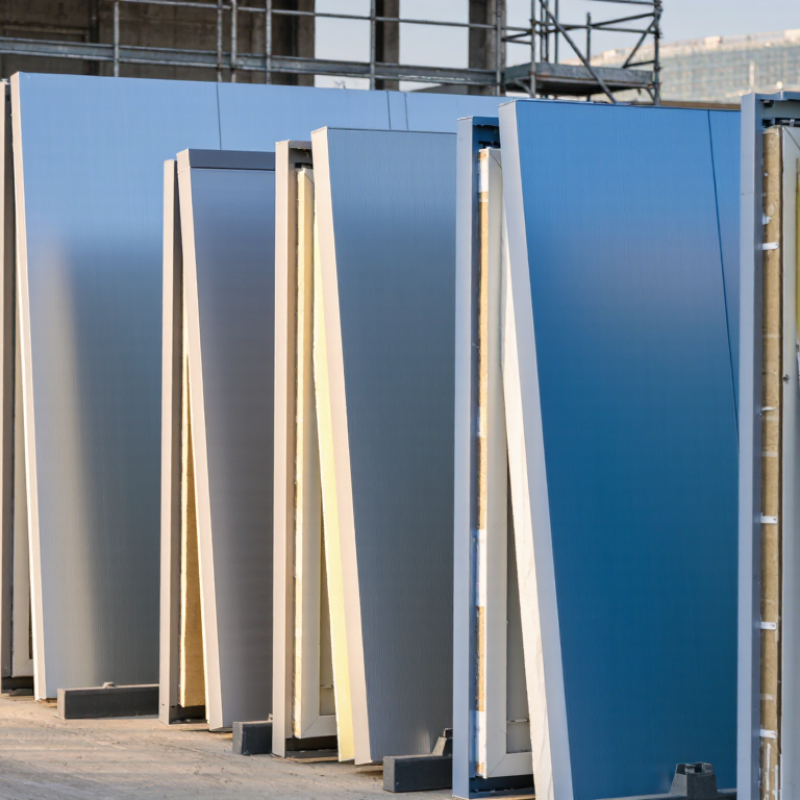
Buying color coated steel sandwich panels requires more than comparing prices. The International Energy Agency reports that buildings consume about 30% of global final energy. Therefore, thermal performance deserves careful attention, not vague claims.
Tip 1: Choose the core type for the building risk. Mineral wool offers strong fire resistance, while PIR often provides better insulation with less thickness. Tip 2: Check thickness against the climate and span, not appearance. A thicker panel can still perform poorly if joints leak. Tip 3: Request the tested U-value, calculated under EN ISO 6946 conditions. Lower is better, but the quoted figure may exclude fasteners and panel connections. That omission matters.
Tip 4: Ask for fire classification under EN 13501-1 and review the complete wall assembly. A core rating alone does not describe real building behavior. Tip 5: Evaluate service life through coating thickness, corrosion exposure, drainage, and maintenance access. ISO 15686 explains that service life depends on use and environment, not a single guaranteed number. Tip 6: Compare coating systems for humidity, ultraviolet exposure, and chemical contact. The right finish for a dry warehouse may fail near a coastal site. Tip 7: Inspect tolerances, joint design, certificates, and installation records. The European Commission’s Level(s) framework encourages life-cycle thinking, yet buyers often focus only on initial cost. I have seen this mistake repeated. A low price can hide energy losses, difficult repairs, or premature panel replacement.

When buying color coated steel sandwich panels, verify the face steel before comparing prices. A bright finish can hide thin metal. Specify 0.40–0.60 mm for each exposed face, and clarify whether thickness means base steel or total coated thickness. Request mill certificates, batch numbers, and production records. Use a calibrated micrometer at several panel points. One check is insufficient.
Coating designation matters in humid, industrial, or coastal environments. AZ150 means an aluminum-zinc alloy coating mass of 150 g/m², generally measured across both sides. Z275 indicates 275 g/m² of zinc coating, also usually measured across both sides. Confirm the applicable standard and test method. Suppliers may present figures differently. Do not treat AZ150 and Z275 as interchangeable. Their performance depends on edges, fasteners, forming, and exposure conditions.
Inspect cut edges, corners, and lock joints for bare steel, peeling paint, or uneven coating. Edges reveal problems. Request a coating report and a sample from the actual production line. The surface should feel consistent, not oily or powdery. Record delivery measurements before installation. Handling dents can later resemble manufacturing defects. This step is easy to skip. If documents conflict with the panel, pause acceptance and arrange independent testing. A cheaper panel becomes expensive when corrosion begins behind an unnoticed joint.
Tip 1: Start with the target U-value, not the panel price.
A U-value below 0.25 W/m²K usually requires suitable core thickness and verified thermal conductivity. Lower values reduce heat transfer, but only when joints remain properly sealed.
Tip 2: Request tested or calculated performance for the complete panel system.
Check the temperature, moisture, and ageing assumptions behind the result. A catalogue figure alone can mislead.
Tip 3: Inspect the edge details carefully.
Gaps around fasteners, corners, and open ends create thermal bridges. Small gaps matter.
Tip 4: Keep thermal and acoustic claims separate.
U-value does not measure sound reduction. Ask for sound insulation data, frequency ranges, and test conditions. Dense facings, resilient cores, and sealed laps may improve acoustic performance. However, one unsealed roof penetration can undermine the whole assembly.
Tip 5: Match the panel to the room.
Workshops need different control from offices. Consider rain noise, machinery, reverberation, and speech privacy. Test samples when occupancy matters. Do not guess.
Tip 6: Check coating durability for the actual exposure.
Coastal air, condensation, and cleaning chemicals can shorten service life. Ask for coating thickness, corrosion guidance, and maintenance instructions.
Tip 7: Review installation evidence before ordering.
Confirm tolerances, joint tapes, fixings, and installer competence. I have seen excellent panels underperform because corners were rushed. That is worth remembering. Compare the full installed cost, including leakage risks and acoustic detailing. Reflect on your assumptions.
Fire compliance should guide your sandwich panel choice, not follow it. A2-s1,d0 indicates limited combustibility and controlled smoke and flaming droplets. EI30, EI60, and similar ratings describe fire resistance for 30 or 60 minutes. These ratings are not interchangeable.
Check the complete tested assembly, including the panel core, joints, fixings, seals, and supporting structure. A compliant core can still fail when gaps surround doors, cables, or ventilation ducts. Ask for current, traceable test reports and classification documents. Confirm that the stated rating applies to the exact thickness and installation direction.
On site, I would inspect cut edges and penetrations before closing the walls. Small gaps near a roof junction deserve attention. Fire stopping must match the tested detail. Local building rules may require A2-s1,d0 panels in escape routes, while protected compartments may need EI30 or EI60 performance. A qualified fire engineer should verify the design.
Do not trust a label alone. Some product sheets simplify complex results, and I have seen installation assumptions overlooked. This is where careful review matters. Record batch information, drawings, and inspection photographs. That evidence supports reliable decisions when the project faces later approval or safety checks.
| Tip | What to Check | Relevant Requirement or Benchmark | Typical Technical Consideration | Documents to Request | Buying Decision |
|---|---|---|---|---|---|
| 1. Confirm the fire classification | Check the complete panel system, including the core, coatings, adhesives, joints and facings. | For reaction to fire under EN 13501-1, A2-s1,d0 means limited contribution to fire, low smoke production and no flaming droplets or particles. | A mineral-wool-core panel may be capable of achieving A2-s1,d0, but the exact classification depends on the tested construction and surface materials. | Current classification report, test report, declaration of performance and product technical data sheet. | Reject products supported only by general statements such as “fireproof” without a formal classification. |
| 2. Separate reaction-to-fire from fire resistance | Determine whether the project requires a surface reaction classification, a time-based fire-resistance rating, or both. | Fire resistance is commonly expressed under EN 13501-2 using R, E and I criteria. EI30 and EI60 indicate integrity and insulation for 30 or 60 minutes. | A panel with A2-s1,d0 is not automatically an EI30 or EI60 fire-resisting wall or ceiling assembly. | Fire-resistance test or assessment report covering the intended orientation, support structure, joints and penetrations. | Specify EI30 or EI60 only when required by the building design, fire strategy or local regulations. |
| 3. Select the core material for the risk level | Compare mineral wool, PIR, PUR and expanded polystyrene cores against the required fire performance. | Core materials have different fire behavior, and the final classification must come from the tested panel assembly rather than the core name alone. | Mineral wool is often selected where non-combustible or higher fire performance is a priority; polymeric cores may offer lower weight or improved thermal efficiency but require careful verification. | Core density, thermal conductivity, declared reaction-to-fire classification and approved use conditions. | Choose the core based on the required fire, thermal, structural and moisture performance together. |
| 4. Verify the panel thickness and span | Check thickness, support spacing, wind load, snow load, imposed load and fixing arrangement. | Structural capacity and fire performance are valid only within the limits of the tested or engineered configuration. | Increasing thickness can improve thermal resistance, but it does not by itself guarantee a higher fire-resistance rating. | Load-span tables, engineering calculations, panel thickness tolerance and fixing specifications. | Do not substitute thickness, support spacing or fasteners without confirming compliance with the tested system. |
| 5. Inspect joints, flashings and penetrations | Review panel joints, corner details, openings, service penetrations, doors, roof interfaces and sealants. | Fire ratings apply to the complete installed assembly; untested gaps or penetrations can compromise integrity and insulation. | Joint geometry, mineral-wool closers, fire-rated sealants and approved penetration systems can be critical to maintaining EI performance. | Installation manual, tested junction details, penetration certificates and compatible accessory specifications. | Purchase the panel together with a documented installation and accessory system. |
| 6. Check the steel facing and coating specification | Confirm steel grade, metallic coating, nominal coating mass, paint system, color stability and corrosion category. | Coating selection should suit the exposure environment and expected service life; fire classification should still be verified for the finished panel. | Higher-corrosivity environments may require more durable metallic and organic coating systems, especially at cut edges and joints. | Steel and coating declarations, coating thickness, corrosion-resistance data, color tolerance and warranty conditions. | Balance appearance, corrosion resistance, maintenance needs and compliance rather than choosing by color alone. |
| 7. Validate thermal and condensation performance | Compare declared thermal conductivity, U-value, airtightness, vapor control and condensation risk. | The required U-value depends on the building design and applicable energy regulations; thermal performance should be assessed for the complete wall or roof build-up. | Thermal bridges can occur at fasteners, joints, framing members and openings even when the panel’s center-of-panel U-value is low. | Declared U-value, thermal conductivity, air-permeability data, condensation analysis and installation details. | Select a panel that meets energy targets without creating moisture, corrosion or indoor-comfort problems. |
Important: A2-s1,d0 is a reaction-to-fire classification under EN 13501-1, while EI30 and EI60 are fire-resistance classifications under EN 13501-2. Always verify the applicable national building regulations and the test or assessment documents for the exact panel assembly, installation method and intended use.
A finished sandwich panel wall can look smooth while hiding serious installation defects. Audit every joint with a calibrated tape and feeler gauge. Check panel gaps against the project drawings, especially at corners, openings, and roof-to-wall transitions. Uneven joints can create thermal bridges, permit water entry, and distort the visible façade.
Fasteners deserve close attention. Confirm the specified type, spacing, embedment, and washer position. A washer should sit firmly without crushing the metal skin. Loose screws leave movement marks; over-tightened screws create dimples that collect water. Inspect several panels, not only the easiest areas. One missed fastener can weaken a joint under wind pressure. Small details matter.
Drainage needs a practical field test. Verify that flashings overlap correctly and that lower channels remain open. Remove metal swarf, foam scraps, and sealant blocks before closing the assembly. Use a controlled water test around penetrations and horizontal joints. Watch for water tracking behind the flashing. The test may reveal an installation that looked acceptable during dry weather. Inspections are not always perfect, so record photographs, measurements, and corrections immediately. Recheck repaired joints after the next rainfall.
Audit Installation Quality: Joint Tolerances, Fasteners, and Drainage Details
The audit checklist uses practical installation thresholds commonly specified for insulated metal panels: joint alignment within approximately ±2 mm, fastener spacing up to 300 mm where required by the design, and positive drainage with a roof slope of at least 5°. Higher compliance indicates better control of panel alignment, fastening quality, and water-shedding details.


For those larger-sized parts, or smaller quantity runs, we have 2 independent powder coat booths and ovens. The quality, durability and affordability of today’s powder coating finishes make this the process of choice for world-class companies.
Powder coating advantages over other forms of coating are many. Materials used in the Powder coating process can be metals and non-metals that come in a multitude of thicknesses, textures, colors, etc. Another of Powder coating’s biggest advantages over conventional coatings is its ability to create finishes in many different textures. Powder Coating Booths allow us the ability to apply these advantages to large products.
Tri-State Fabricators runs a full-service conveyor line for painting. Wet painting can provide protection or decoration to many different part styles. From start to finish, every project is easier to undergo random and point-based inspection by our skilled painting team.
Advantages to our Wet Paint Line are these lines start with product prep and ends with a thorough inspection of a high quality finished product. Our ability to complete large and small projects with a superior finish and doing so in a timely and economical fashion. This passes along the savings in production to our customers. When powder coating ins not an option, our Wet Paint Line gets the job done right the first time.
When the parts get big and heavy we roll-out our custom paint racks and oversize booth. By utilizing our partnerships with all the major paint brands, we can match virtually any color with wet paint.
The advantages of having access to a Wet Paint Booth are many. Large projects of many different shapes can be loaded into the booth. The Wet Paint Booth offers an environment that is much more controlled than a typical parts painting operation.
Not only are they used because of their controlled environment, but they’re are also advantageous when it comes to applying paint to parts that are needed in industries that require specialty coatings such as medical, aerospace, etc.
Our military forces have some very high standards when it comes to the finish of their vehicles and equipment. From the first pre-treatment step to final coat, it takes a great deal of knowledge and experience to protect the men and women of our armed forces. They deserve only the best, and Tri-State Fabricators provides it.
All of our processes are closely monitored by our staff and management teams. Both of which are highly trained in the processes of metal fabrication and finishing. Tri-State Fabricators’ goal is to always fully satisfy each and every customer, including the military. We will always put a 110% into what we do.
Abrasive media blasting is an excellent way to remove old paint, rust, and increase the paint/powder adhesion. Glass beads produce a much smoother and brighter finish than angular abrasives; leaving the part clean yet without any dimensional change. Chemically inert and environmentally friendly, we can recycle our beads approximately 30 times; making them a more preferred method of metal cleaning or surface finishing.
Advantages to Glass Bead Blasting are many. Glass bead blast media is used when a project is needing rough surfaces need to become smooth for applications of coatings such as paint. It is typically used to clean paint and rust from a product surface without deforming the surface it is being used on. Overall, compared to many other blasting media, Glass Bead Blasting is a very economical choice and those savings are always passed on to our customers.
Tri-State Fabricators utilize a zinc phosphate wash to clean and etch the material to ensure the best paint adhesion possible. The unique design of our 3-stage wash system does the work like a 5-stage. From Cleaning and rinsing to conversion coating and post-treatment, Our Part Washing process is a complete service and works throughout the fabrication service and the finishing service.
Along with the previously mentioned benefits, Curing is a vital chemical reaction that leaves the product finish hard and relatively safe from mild abrasion and aggressive corrosion. This process can be done in more than one way; ambient air-dry or in curing ovens at temps that exceed 240°.
From fixing paint mistakes (someone else’s of course) to simply cleaning our paint line hooks, our burn-off oven is put to good use. After a quick burn-off, a little clean up, and a fresh coat of paint, your parts will look better than new.
Why does our Burn-Off Oven work so well? Because super heating the air around parts turns the materials into ashes. From paint and powder coatings to rubber and machining oils, high temps do the job without degrading the integrity of the part.
Masking is a vital part of producing high quality products. We have die-cut masking patterns to protect machined surfaces as well as a wide range of plugs and caps to protect threaded holes and bolts. We provide permanent and temporary masking.
Masking allows the selected sections of a product to be protected from a fabrication or finishing service. This can be with both chemicals when etching and tapes, paints when only finishing just a section of the product. Masking is great in aiding the customization process of a project.
Screen printing is a photographic process that transfers artwork onto a porous nylon screen which allows colored ink to flow through the screen and be deposited on an aluminum or plastic component. We can generally have just about any design created onto a screen for your parts.
Some of the advantages of Screen Printing are, brand recognition for your business displaying on your products, assembly instructions, product warnings/hazards, etc. Tri-State Fabricators produces Screen Printing of the highest quality so you know it’s durable.
Metal Finishing is the art of treating the exterior portion of product, often metal but can also be made of other materials, so that the surface is clean and free of any debris. Then the process of applying coats or either paint of powder coat takes place. This coating process improves the quality of the product in both appearance and resistance to wear and corrosion.
Tri-State Fabricators, Inc., understands that a project typically isn’t complete until a high-quality finish has been added to your product. This is why our painting and powder coating teams continuously inspect the products throughout the Metal Finishing process.

