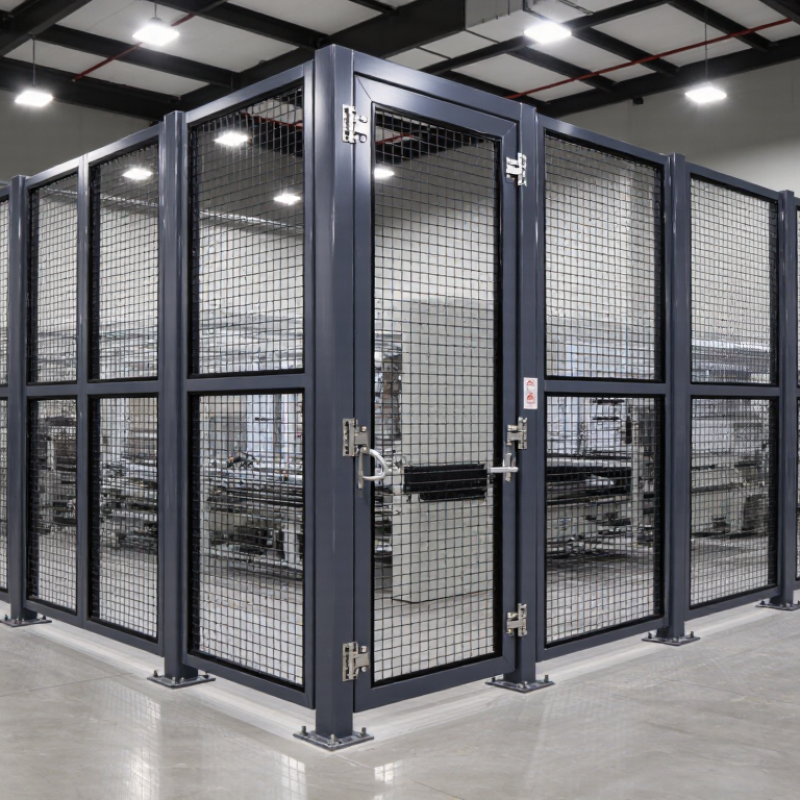
7 Machine Safety Fence Buying Tips for Global Buyers

Buying a Machine Safety Fence is not simply a matter of choosing steel panels. Global buyers must connect protection, production flow, installation conditions, and supplier reliability. These seven buying tips provide a practical starting point for that decision.

Begin with the hazard, not the catalog image. Identify moving parts, access points, maintenance zones, and possible material ejection. Measure the machine footprint, floor levels, service doors, and emergency routes carefully. A few centimeters can affect both safety and installation time. Think about visibility too. Operators may need clear sightlines through welded mesh during daily production.

Check the fence height, mesh opening, panel strength, posts, hinges, locks, and anchoring method. Ask suppliers for drawings, material specifications, inspection records, and installation guidance. Experienced manufacturers should explain how their design fits your machine, not just quote a price. Confirm that the proposal supports applicable workplace safety requirements in the installation region.

Consider cleaning, corrosion, replacement panels, and future machine changes. A powder-coated finish may suit a dry factory, while humid or corrosive areas need stronger protection. Compare total ownership cost, including freight, customs handling, installation, and spare parts. Cheap panels can become expensive after repeated adjustments. That lesson is easy to overlook.

Do not accept vague promises. Request dimensional tolerances, delivery milestones, and clear responsibility for site measurements. A neat drawing can still hide a difficult gate swing or an unreachable service point. Recheck everything before ordering. Small doubts deserve attention before steel reaches the factory floor.

7 Machine Safety Fence Buying Tips for Global Buyers

Define Safety Requirements and Machine Risk Zones

Before comparing mesh panels, define what the fence must prevent. Review the machine’s movements, stored energy, hot surfaces, noise, and unexpected restart risks. Mark each risk zone on a current layout, not an old installation drawing. Measure twice. A robotic arm may sweep beyond its visible path, while a conveyor can pull clothing through a narrow opening. Record normal operation, cleaning, setup, maintenance, and fault recovery separately. These tasks often create different access needs.

Set boundaries around crushing, cutting, entanglement, and ejection hazards. Use reach and opening measurements to determine safe distances, panel height, and mesh spacing. Do not assume a tall fence solves every problem. A worker may reach over it or enter through an overlooked transfer point. Place gates only where access is necessary, and consider monitored interlocking devices when entry can expose someone to danger. The control system should support safe stopping before access is possible, based on the machine’s actual stopping time. That gap matters.

Ask suppliers for drawings, material data, corrosion information, and installation tolerances. Check whether floors, posts, doors, and anchors can handle repeated use and impact. For global projects, document assumptions clearly and verify local requirements with a qualified safety professional. I have seen projects specify the fence too early. Later, maintenance access forced costly changes. A better review includes operators and technicians, though it may feel slower at the start. Leave room for inspection, cleaning, and future equipment changes.

Verify Safety Standards, Materials, and Guarding Performance

7 Machine Safety Fence Buying Tips for Global Buyers

A machine fence should be selected through a documented risk assessment, not appearance alone. Verify that the supplier designs guards according to recognized standards, such as ISO 14120 and ISO 13857, plus applicable local requirements. Ask for test reports, material certificates, and clear installation instructions. Documents matter.

Inspect the frame, mesh, posts, fasteners, and surface treatment closely. Powder-coated steel suits many indoor areas, while stainless steel may perform better in washdown or corrosive environments. Check mesh openings against hand, finger, and arm access distances. A small gap can become a serious weakness. Measure the machine layout, door swing, transfer points, and maintenance space before ordering. Many buying errors begin with incomplete drawings.

Guarding performance also depends on assembly quality. Confirm that panels resist expected impact and cannot be removed without tools. Access doors should close reliably and integrate with the machine’s safety control system when required. Interlocking devices need suitable monitoring and fault detection. Request evidence of inspection methods, load assumptions, and replacement-part availability. Cheap fasteners may loosen under vibration. That detail is easy to miss. A pilot installation or sample panel can reveal alignment, visibility, and cleaning problems before full production. Recheck everything.

Select Fence Dimensions, Access Points, and Visibility

Machine Safety Fence Buying Tips for Global Buyers

Fence dimensions should follow the machine’s full operating envelope, not only its parked position. Measure robot reach, material movement, tooling, and maintenance access. ISO 13857 provides safety-distance guidance for preventing reach-through access to hazardous zones. Leave practical clearance for replacement parts and emergency movement. Too little space creates awkward work. Too much space may weaken visibility and consume valuable floor area.

Access points deserve equal attention. A gate should not become an unofficial shortcut. Specify monitored doors, controlled openings, and safe reset procedures that match the machine’s risk assessment. OSHA 29 CFR 1910.212 requires guarding against hazards such as points of operation and rotating parts.

HSE reported 138 worker fatalities in Great Britain during 2023/24, while 561,000 workers reported non-fatal injuries. These figures are not fence-specific, but they show why access design cannot be treated as a minor purchasing detail.

Visibility helps operators spot jams, leaks, and unsafe entry before conditions worsen. Select mesh openings or transparent panels according to hazard distance, impact needs, lighting, and cleaning routines. ISO 14120 addresses guard design, including construction and visibility considerations. A clear panel can still create glare. A mesh fence can still hide a low-level hazard. Review the fence from the operator’s normal standing position, then check it again during maintenance.

Small details matter.

Assess Installation, Compatibility, and Future Expansion

7 Machine Safety Fence Buying Tips for Global Buyers

Assess Installation, Compatibility, and Future Expansion

For global buyers, a machine safety fence is more than panels, posts, and a locked gate. Installation conditions often determine its real performance. From site inspections, I have learned to measure floor levels, machine height, maintenance paths, and emergency access before comparing prices. A fence that fits the drawing may fail beside a sloped floor or crowded conveyor. Check anchor types, required tools, and installation space. Confirm that gates open safely without striking equipment. Review the visibility of moving parts through the mesh. Small details matter.

Compatibility deserves careful attention. Match the fence height, panel strength, door hardware, and access controls with the machine’s risk assessment. Ask for clear load data and installation instructions. Confirm that replacement panels and fasteners use consistent dimensions. Local installers should understand the equipment and applicable workplace safety requirements. Do not rely only on a supplier’s general statement. Written evidence is better.

Plan for change. Choose modular sections that can be removed without dismantling the entire barrier. Reserve space for new sensors, conveyors, service doors, or inspection windows. Check whether future extensions can use the same posts and connectors. Keep spare components in a documented list. I have seen projects become expensive because expansion was treated as an afterthought. That mistake is easy to repeat. Review the layout with maintenance staff before ordering. They often notice clearance problems that design drawings miss.

7 Machine Safety Fence Buying Tips for Global Buyers - Assess Installation, Compatibility, and Future Expansion

No. Buying Tip What to Assess Practical Benchmark or Requirement Questions for the Supplier Future-Expansion Check
1 Verify the required safety distance Check the hazard zone, robot reach, moving parts, access points, and the stopping time of the machine. The fence should prevent a person from reaching the hazard through or around the barrier. Calculate the distance using the machine risk assessment and applicable local safety requirements rather than selecting a standard height alone. Can you provide the fence layout, mesh opening, panel height, and recommended safety distance for our machine? Allow clearance for additional tooling, conveyors, cable routes, and planned robot motion without reducing the required separation.
2 Review installation conditions Assess the floor type, unevenness, available working space, anchor points, overhead obstructions, and installation sequence. Confirm the anchoring method, base-plate dimensions, required tools, tolerances, and whether the system can be assembled without dismantling nearby equipment. Are assembly drawings, anchor specifications, torque values, and installation instructions included? Use modular panels and adjustable posts where possible so sections can be relocated or added without replacing the complete fence.
3 Confirm machine and safety-device compatibility Check door switches, guard-locking devices, emergency-stop controls, safety scanners, light curtains, conveyors, and control-system interfaces. Every access door should be integrated with the machine safety circuit so that opening the door initiates the required safe state. The fence itself must not obstruct sensors or emergency access. Which door, hinge, lock, switch, and cable-management options are compatible with our safety control architecture? Reserve connection points and cable pathways for additional interlocked doors, sensors, or safety equipment.
4 Select suitable materials and surface protection Consider impact exposure, corrosion, humidity, cleaning chemicals, temperature, welding sparks, and indoor or outdoor installation. Choose a finish and material that match the environment. For corrosive or washdown areas, verify corrosion resistance and cleaning compatibility instead of relying on appearance alone. What material grade, coating process, coating thickness, and corrosion-test information can you provide? Use replaceable panels, posts, and fasteners so damaged or upgraded sections can be serviced independently.
5 Evaluate access, visibility, and maintenance ergonomics Map operator entry, material loading, inspection, cleaning, tool changes, and maintenance routes. Provide enough access doors and removable sections to avoid climbing over the fence or bypassing interlocks. Transparent mesh can improve visibility while maintaining separation. What are the clear opening dimensions, door swing options, latch arrangements, and maintenance-access provisions? Select reversible doors and standardized panel sizes so access points can be moved as production flow changes.
6 Check compliance documentation and validation support Review risk-assessment inputs, technical drawings, material records, installation instructions, inspection procedures, and safety-device documentation. The final guarding solution should be validated against the hazards of the complete machine cell. Documentation should identify dimensions, access points, interlocks, and inspection requirements. Which standards and test methods were used, and can you provide a complete technical file for review by our safety team? Request revision-controlled drawings and an equipment list that can be updated when the cell is expanded.
7 Compare total cost, delivery, and long-term support Compare engineering, packaging, shipping, customs, installation, spare parts, training, and maintenance costs—not only the panel price. Obtain a line-item quotation with dimensions, quantities, incoterms, lead time, warranty conditions, replacement-part pricing, and recommended spare quantities. What is included in the price, how are replacement parts identified, and what support is available in our installation region? Confirm that identical or interchangeable modules will remain available and that future orders can use the same connection dimensions and finish.
Buyer reminder: Final fence dimensions, openings, access arrangements, and safety distances should be confirmed through a documented machine risk assessment and validated by a qualified safety professional in the installation jurisdiction.

Compare Suppliers, Total Cost, and After-Sales Support

7 Machine Safety Fence Buying Tips for Global Buyers

Machine safety fencing looks simple, but small design choices affect installation, maintenance, and worker visibility.

Tip 1

Compare suppliers by panel dimensions, wire diameter, coating quality, and documented test results.

Tip 2

Request drawings before ordering. A clear drawing should show posts, doors, brackets, anchor points, and access gaps.

Tip 3

Check export experience, packaging methods, production lead time, and communication speed. A low quote means little if damaged panels arrive or measurements are misunderstood.

Tip 4

Calculate total cost, not only the unit price. Include freight, customs handling, unloading equipment, installation labor, spare panels, and future modifications.

Tip 5

Compare equivalent specifications. One supplier may exclude doors, locks, corner posts, or floor fixings from the quotation. Ask for a line-by-line cost sheet. This is where mistakes often hide.

Tip 6

Confirm material samples and coating details. A scratched surface near a busy production area can become a maintenance problem sooner than expected. I would also leave a small contingency budget; real projects rarely follow the first spreadsheet perfectly.

Tip 7

Examine after-sales support before signing. Ask how quickly technical questions are answered, whether replacement parts are stocked, and if remote installation guidance is available. Request clear warranty terms, response times, and escalation contacts. Useful suppliers provide installation manuals, packing lists, and identification labels for each component. Do not judge support by polite promises alone. Test it with a practical question about a missing bracket or incorrect panel size. Their response reveals more than a polished presentation.

Powder Coat Booths

For those larger-sized parts, or smaller quantity runs, we have 2 independent powder coat booths and ovens. The quality, durability and affordability of today’s powder coating finishes make this the process of choice for world-class companies.

Powder coating advantages over other forms of coating are many. Materials used in the Powder coating process can be metals and non-metals that come in a multitude of thicknesses, textures, colors, etc. Another of Powder coating’s biggest advantages over conventional coatings is its ability to create finishes in many different textures. Powder Coating Booths allow us the ability to apply these advantages to large products.

Wet Paint Line

Tri-State Fabricators runs a full-service conveyor line for painting. Wet painting can provide protection or decoration to many different part styles. From start to finish, every project is easier to undergo random and point-based inspection by our skilled painting team.

Advantages to our Wet Paint Line are these lines start with product prep and ends with a thorough inspection of a high quality finished product. Our ability to complete large and small projects with a superior finish and doing so in a timely and economical fashion. This passes along the savings in production to our customers. When powder coating ins not an option, our Wet Paint Line gets the job done right the first time.

Wet Paint Booths

When the parts get big and heavy we roll-out our custom paint racks and oversize booth. By utilizing our partnerships with all the major paint brands, we can match virtually any color with wet paint.

The advantages of having access to a Wet Paint Booth are many. Large projects of many different shapes can be loaded into the booth. The Wet Paint Booth offers an environment that is much more controlled than a typical parts painting operation.

Not only are they used because of their controlled environment, but they’re are also advantageous when it comes to applying paint to parts that are needed in industries that require specialty coatings such as medical, aerospace, etc.

Military CARC

Our military forces have some very high standards when it comes to the finish of their vehicles and equipment. From the first pre-treatment step to final coat, it takes a great deal of knowledge and experience to protect the men and women of our armed forces. They deserve only the best, and Tri-State Fabricators provides it.

All of our processes are closely monitored by our staff and management teams. Both of which are highly trained in the processes of metal fabrication and finishing. Tri-State Fabricators’ goal is to always fully satisfy each and every customer, including the military. We will always put a 110% into what we do.

Glass-Bead Blasting

Abrasive media blasting is an excellent way to remove old paint, rust, and increase the paint/powder adhesion. Glass beads produce a much smoother and brighter finish than angular abrasives; leaving the part clean yet without any dimensional change. Chemically inert and environmentally friendly, we can recycle our beads approximately 30 times; making them a more preferred method of metal cleaning or surface finishing.

Advantages to Glass Bead Blasting are many. Glass bead blast media is used when a project is needing rough surfaces need to become smooth for applications of coatings such as paint. It is typically used to clean paint and rust from a product surface without deforming the surface it is being used on. Overall, compared to many other blasting media, Glass Bead Blasting is a very economical choice and those savings are always passed on to our customers.

Part Washing

Tri-State Fabricators utilize a zinc phosphate wash to clean and etch the material to ensure the best paint adhesion possible. The unique design of our 3-stage wash system does the work like a 5-stage. From Cleaning and rinsing to conversion coating and post-treatment, Our Part Washing process is a complete service and works throughout the fabrication service and the finishing service.

Along with the previously mentioned benefits, Curing is a vital chemical reaction that leaves the product finish hard and relatively safe from mild abrasion and aggressive corrosion. This process can be done in more than one way; ambient air-dry or in curing ovens at temps that exceed 240°.

Burn-Off Oven

From fixing paint mistakes (someone else’s of course) to simply cleaning our paint line hooks, our burn-off oven is put to good use. After a quick burn-off, a little clean up, and a fresh coat of paint, your parts will look better than new.

Why does our Burn-Off Oven work so well? Because super heating the air around parts turns the materials into ashes. From paint and powder coatings to rubber and machining oils, high temps do the job without degrading the integrity of the part.

Masking

Masking is a vital part of producing high quality products. We have die-cut masking patterns to protect machined surfaces as well as a wide range of plugs and caps to protect threaded holes and bolts. We provide permanent and temporary masking.

Masking allows the selected sections of a product to be protected from a fabrication or finishing service. This can be with both chemicals when etching and tapes, paints when only finishing just a section of the product. Masking is great in aiding the customization process of a project.

Screen Printing

Screen printing is a photographic process that transfers artwork onto a porous nylon screen which allows colored ink to flow through the screen and be deposited on an aluminum or plastic component. We can generally have just about any design created onto a screen for your parts.

Some of the advantages of Screen Printing are, brand recognition for your business displaying on your products, assembly instructions, product warnings/hazards, etc. Tri-State Fabricators produces Screen Printing of the highest quality so you know it’s durable.

Metal Finishing

Metal Finishing is the art of treating the exterior portion of product, often metal but can also be made of other materials, so that the surface is clean and free of any debris. Then the process of applying coats or either paint of powder coat takes place. This coating process improves the quality of the product in both appearance and resistance to wear and corrosion.

Tri-State Fabricators, Inc., understands that a project typically isn’t complete until a high-quality finish has been added to your product. This is why our painting and powder coating teams continuously inspect the products throughout the Metal Finishing process.