


7 Best Stainless Steel Forgings Manufacturers Worldwide?

stainless steel forgings sit behind many products that cannot afford hidden weakness. They support pressure equipment, energy systems, aerospace structures, marine hardware, and demanding industrial machinery. The International Stainless Steel Forum reported global stainless crude steel production of about 58.4 million tonnes in 2023. That scale signals strong demand, but it does not make every forging supplier equally dependable.

This guide examines seven stainless steel forgings manufacturers worldwide through practical criteria. These include alloy control, forging capability, heat-treatment consistency, dimensional accuracy, non-destructive testing, and material traceability. Certifications such as ISO 9001, ISO 14001, PED, or ASME-related approvals can strengthen confidence. They do not replace factory evidence.

Production details matter.

A reliable manufacturer should explain how it manages grain flow, forging temperature, solution annealing, and surface finishing. Buyers should also examine ultrasonic testing records, inspection plans, and representative delivery experience. The American Society for Metals highlights forging’s ability to improve structural integrity through controlled metal flow. However, that benefit depends heavily on process discipline and inspection quality.

Market reports from Grand View Research and Fortune Business Insights indicate continuing growth in forged components, supported by energy, transportation, and industrial equipment demand. Such forecasts are useful, yet they can simplify real purchasing conditions. Capacity figures may not reveal backlog, minimum order quantities, or technical responsiveness.

Therefore, this list is not a permanent verdict. A polished website proves little. The strongest candidates combine documented engineering practice, transparent quality systems, and repeatable delivery performance. Some manufacturers may excel in large rings, while others perform better with precision valve bodies or custom shafts. Readers should compare the shortlist against application requirements, applicable standards, and total lifecycle risk before choosing a partner.
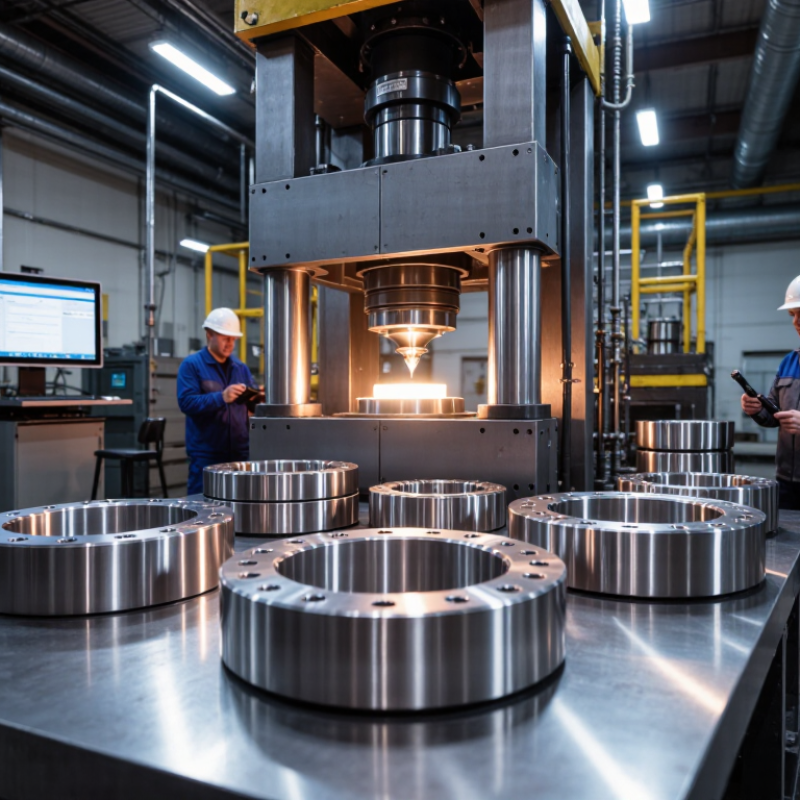
7 Best Stainless Steel Forgings Manufacturers Worldwide?

Global Stainless Steel Forging Standards: ASTM A182, EN 10204, and ISO 9001

Selecting stainless steel forging manufacturers requires more than comparing prices or production capacity. ASTM A182 defines requirements for forged stainless steel flanges, fittings, valves, and pressure parts. It covers chemistry, tensile strength, heat treatment, and testing. A mill certificate should show the heat number, grade, and mechanical results. Small details matter.

EN 10204 strengthens document control. Type 3.1 certification links test results to the delivered batch. Type 3.2 adds independent or purchaser-side validation. That traceability becomes practical on a factory floor, where each forged ring needs a clear identity. The World Stainless Association reported approximately 58.4 million tonnes of stainless steel production in 2023. More volume increases the need for disciplined records, not weaker checks.

ISO Survey 2023 recorded more than 1.26 million ISO 9001 certificates worldwide. Yet certification alone cannot prove forging quality. Auditors should examine calibration logs, furnace charts, non-destructive testing records, and corrective-action evidence. In my experience, suppliers often present polished procedures but incomplete batch trails. That gap deserves uncomfortable questions. Ask whether ASTM A182 testing covers the exact grade and product form. Check whether EN 10204 documents match the purchase order. Review real samples, not only certificates. A strong manufacturer can explain deviations clearly, although no quality system is perfect.

7 Best Stainless Steel Forgings Manufacturers Worldwide? — Global Stainless Steel Forging Standards: ASTM A182, EN 10204, and ISO 9001

Standards-based comparison of common stainless steel forging capability profiles. Company names and brand-specific claims are intentionally excluded.

Rank Anonymous Manufacturer Capability Profile Typical Forged Products Common ASTM A182 Grades EN 10204 Documentation ISO 9001 Quality Expectation Key Verification Points Typical Industries
1 High-integrity austenitic forging specialist
Designed for corrosion-resistant pressure components and demanding process environments.
Flanges, forged fittings, valve bodies, rings, nozzles and pressure-retaining components. F304/L, F316/L, F321 and F347. EN 10204 Type 3.1 material certificate; Type 3.2 when purchaser and independent inspection involvement are specified. Current ISO 9001 certification with documented control of purchasing, production, inspection and nonconforming outputs. Heat-number traceability, chemical analysis, tensile testing, hardness testing, dimensional inspection and solution annealing records. Chemical processing, oil and gas, water treatment, marine systems and general industrial equipment.
2 Duplex and super-duplex forging specialist
Focused on high strength and chloride corrosion resistance.
Flanges, valve components, hubs, forged rings and subsea pressure parts. F51/F60 for duplex 2205; F53 and F55 for super-duplex grades where specified. Type 3.1 certificate normally includes heat treatment, mechanical properties and chemical composition; Type 3.2 may be required for critical service. ISO 9001 system supported by controlled welding, heat-treatment and inspection procedures where applicable. Ferrite balance testing, solution annealing control, impact testing where required, corrosion testing and complete traceability. Offshore, subsea, desalination, petrochemical and marine applications.
3 Large-diameter ring and open-die forging producer
Suitable for oversized components requiring controlled grain flow and dimensional stability.
Large rings, forged discs, hubs, shells, flanges and custom open-die parts. F304/L, F316/L, F321, F347 and selected duplex grades. Type 3.1 certificate with product chemistry, mechanical test results and heat-treatment information; Type 3.2 for contractually critical orders. ISO 9001-based process control covering forging reduction, furnace calibration, inspection and final release. Maximum outside diameter, wall thickness, forging reduction ratio, ultrasonic testing and dimensional reports. Power generation, pressure vessels, industrial machinery, chemical plants and heavy engineering.
4 Precision closed-die forging producer
Optimized for repeatable dimensions, near-net shapes and reduced machining allowance.
Valve stems, compact bodies, connectors, couplings, instrument parts and fittings. F304/L, F316/L and other grades permitted by the applicable purchase specification. Type 3.1 certificate with dimensional inspection records and batch traceability; Type 3.2 only when required by the order. ISO 9001 certification with emphasis on process capability, gauge calibration and corrective-action control. Dimensional capability, surface condition, machining allowance, die maintenance, hardness and material identification. Instrumentation, sanitary equipment, food processing, medical equipment and industrial automation.
5 High-temperature stainless forging producer
Focused on elevated-temperature service and stabilized or heat-resistant austenitic grades.
Turbine fittings, exhaust components, high-temperature flanges, rings and thermal-process parts. F321, F347 and other ASTM A182 grades selected for the specified temperature and service conditions. Type 3.1 certificate with heat-treatment cycle and mechanical-property data; Type 3.2 may apply to safety-critical equipment. ISO 9001 quality controls with validated furnace monitoring and calibration records. Solution-treatment temperature, cooling method, grain structure, intergranular corrosion testing where specified and dimensional stability. Power generation, thermal processing, chemical production and high-temperature industrial systems.
6 Sanitary and hygienic forging producer
Prioritizes cleanable surfaces, controlled contamination and smooth finishing.
Sanitary fittings, clamps, process connectors, pump parts and hygienic valve components. F304/L and F316/L are common choices, subject to the customer specification. Type 3.1 certificate with heat traceability, chemical composition and mechanical properties; surface-finish records may be added. ISO 9001 system with documented cleaning, passivation, inspection and packaging controls. Surface roughness requirement, passivation records, visual inspection, dimensional conformity and contamination prevention. Food, beverage, pharmaceutical, biotechnology and clean-process industries.
7 Custom engineered forging and inspection partner
Suitable for complex specifications, prototype-to-production work and third-party inspection.
Custom flanges, valve parts, forged adapters, rings, shafts and engineered components. F304/L, F316/L, F321, F347, F51/F60 and other grades listed in the approved purchase order. Type 3.1 as the standard independent manufacturer declaration; Type 3.2 when witnessed or validated by the purchaser and an independent inspection body. ISO 9001 certification with contract review, design or drawing control, supplier evaluation and documented final release. Inspection and test plan, non-destructive testing, third-party witness points, drawing revision control and full material traceability. Engineering projects, infrastructure, energy, marine equipment and specialized process machinery.
Standards note: ASTM A182/A182M specifies forged or rolled alloy and stainless steel flange, forged fittings, valves and parts for pressure service. EN 10204 defines the types of inspection documents supplied with metallic products, including Type 3.1 and Type 3.2. ISO 9001 specifies requirements for a quality management system and does not by itself certify a specific product or material grade.

Seven Leading Manufacturers Compared by Capacity, Grades, and Global Reach

The seven leading stainless steel forging manufacturers differ most in capacity, material range, and export coverage. Large facilities often operate hydraulic presses above 10,000 tons, while smaller specialists focus on precise, low-volume parts. Capacity alone can mislead. A plant may have impressive equipment but limited heat-treatment space or inspection staff. In practical supplier reviews, I examine press size, furnace control, and monthly output together.

Their grade portfolios also vary. Common offerings include 304 and 316 stainless steel for corrosion-resistant equipment. More demanding applications may require 17-4 PH, 410, 420, duplex grades, or nickel-based alloys. Strong manufacturers provide heat numbers, mechanical test results, and traceable inspection records. Some can produce rings exceeding one meter in diameter; others excel at compact valve bodies and medical components. That difference affects tooling costs and delivery schedules.

Global reach depends on more than shipping. Look for regional warehouses, multilingual engineering support, and experience with export documentation. Certifications can support credibility, but they do not replace a factory visit or sample approval. My own assessment would include ultrasonic testing, dimensional reports, and evidence of repeat orders. I would also question vague capacity claims. They may reflect theoretical press limits, not reliable production.

Tips: Request a grade-specific sample, confirmed lead time, and recent inspection report. Compare usable capacity, not advertised capacity. Ask how rejected forgings are handled. A small supplier with clear communication may outperform a larger plant when specifications keep changing.

This comparison uses anonymized supplier profiles and publicly reported capability ranges for large stainless steel forgings. The chart compares approximate maximum single-piece forging capacity in metric tonnes; stainless grades and global reach are summarized below without displaying company or brand names.

Typical capability benchmarks: Profiles cover approximately 20–80 stainless and nickel-based grades, including common austenitic, martensitic, precipitation-hardening, and duplex families. Global reach is represented by service coverage across North America, Europe, and Asia-Pacific.

Material Benchmarks: 316L Requires 485 MPa Tensile Strength Under ASTM A182

When comparing the world’s best stainless steel forging manufacturers, tensile strength should be a core checkpoint. For 316L forgings, ASTM A182 requires a minimum tensile strength of 485 MPa. This value is not decorative data. It confirms that the material can resist pulling forces before failure.

Ask for the material test report, heat number, chemical composition, and heat-treatment records. The report should identify the 316L grade and reference ASTM A182 clearly.

Check the test temperature, specimen direction, and laboratory accreditation. A reliable manufacturer can also explain how solution annealing controls corrosion resistance and mechanical performance.

Do not trust a polished certificate alone. Traceability must connect the report to the forging, marking, and shipment documents. Dimensional inspection and surface checks matter too. Non-destructive testing may reveal laps, cracks, or internal discontinuities that tensile testing cannot detect.

Small details expose weak systems. Forging temperature, reduction ratio, and cooling practice can affect consistency. Some suppliers meet 485 MPa on one sample but struggle across larger batches. That deserves questions. A stronger evaluation compares multiple heat lots, not one impressive result. Manufacturers with disciplined records, independent testing, and transparent corrective actions usually offer more dependable ASTM A182 performance.

Manufacturing Capabilities: Closed-Die, Open-Die, Ring Rolling, and Machining

7 Best Stainless Steel Forgings Manufacturers Worldwide?

The best stainless steel forging manufacturers are judged by process control, not polished brochures. Closed-die forging suits repeatable components with complex shapes and tighter tolerances. Heated billets fill precision cavities under high pressure. Excess flash is trimmed before heat treatment and inspection.

Open-die forging remains valuable for large shafts, blocks, and custom parts. Skilled operators control reduction, temperature, and deformation across several passes. Ring rolling creates seamless rings with strong grain flow and consistent wall thickness. Buyers should request ultrasonic testing, material certificates, and complete heat-treatment records. Small details matter.

Machining completes the manufacturing chain. CNC turning, milling, drilling, and grinding can hold critical dimensions after forging distortion. Ask whether inspection uses calibrated CMM equipment and documented sampling plans. Traceability should follow each part from billet to final report. No plant is perfect. Even experienced teams can miss a minor surface indication or underestimate machining allowance. That is why practical audits, sample reviews, and technical discussions remain essential. A reliable supplier explains limitations clearly, shares process data, and supports corrective action when results fall short.

How to Evaluate Suppliers Using IATF 16949, NORSOK M-650, and Traceability

Choosing among the world’s best stainless steel forging manufacturers requires more than comparing machinery or quoted prices. In 2023, global crude steel production reached about 1.89 billion tonnes, according to World Steel Association data. That scale makes material identity and process control critical. Ask for heat numbers, billet certificates, forging routes, and final inspection records. Each record should connect to one shipment.

IATF 16949 is useful when automotive-level discipline matters. Check the certificate scope, audit status, and control of outsourced processes. Review evidence for APQP, FMEA, process capability, nonconforming product, and corrective actions. A supplier should show how a forged flange moves from furnace log to dimensional report. Sampling traceability is not enough. Test one real batch.

NORSOK M-650 requires deeper confidence for critical energy applications. Verify qualified manufacturing routes, approved personnel, testing procedures, and material-specific documentation. Request qualification records for the actual alloy, product form, size range, and heat-treatment condition. A generic approval may not cover your order. It is an easy mistake. The standard’s emphasis on manufacturer qualification supports this distinction.

The ISO Survey 2023 recorded more than one million ISO 9001 certificates worldwide, yet certification alone cannot prove forging capability. Visit the plant, inspect segregation areas, and compare furnace charts with certificates. Ask whether records are editable after approval. They sometimes are. An independent laboratory can confirm chemistry, tensile strength, hardness, and metallography. Supplier rankings should reward transparent evidence, not polished presentations.

Powder Coat Booths

For those larger-sized parts, or smaller quantity runs, we have 2 independent powder coat booths and ovens. The quality, durability and affordability of today’s powder coating finishes make this the process of choice for world-class companies.

Powder coating advantages over other forms of coating are many. Materials used in the Powder coating process can be metals and non-metals that come in a multitude of thicknesses, textures, colors, etc. Another of Powder coating’s biggest advantages over conventional coatings is its ability to create finishes in many different textures. Powder Coating Booths allow us the ability to apply these advantages to large products.

Wet Paint Line

Tri-State Fabricators runs a full-service conveyor line for painting. Wet painting can provide protection or decoration to many different part styles. From start to finish, every project is easier to undergo random and point-based inspection by our skilled painting team.

Advantages to our Wet Paint Line are these lines start with product prep and ends with a thorough inspection of a high quality finished product. Our ability to complete large and small projects with a superior finish and doing so in a timely and economical fashion. This passes along the savings in production to our customers. When powder coating ins not an option, our Wet Paint Line gets the job done right the first time.

Wet Paint Booths

When the parts get big and heavy we roll-out our custom paint racks and oversize booth. By utilizing our partnerships with all the major paint brands, we can match virtually any color with wet paint.

The advantages of having access to a Wet Paint Booth are many. Large projects of many different shapes can be loaded into the booth. The Wet Paint Booth offers an environment that is much more controlled than a typical parts painting operation.

Not only are they used because of their controlled environment, but they’re are also advantageous when it comes to applying paint to parts that are needed in industries that require specialty coatings such as medical, aerospace, etc.

Military CARC

Our military forces have some very high standards when it comes to the finish of their vehicles and equipment. From the first pre-treatment step to final coat, it takes a great deal of knowledge and experience to protect the men and women of our armed forces. They deserve only the best, and Tri-State Fabricators provides it.

All of our processes are closely monitored by our staff and management teams. Both of which are highly trained in the processes of metal fabrication and finishing. Tri-State Fabricators’ goal is to always fully satisfy each and every customer, including the military. We will always put a 110% into what we do.

Glass-Bead Blasting

Abrasive media blasting is an excellent way to remove old paint, rust, and increase the paint/powder adhesion. Glass beads produce a much smoother and brighter finish than angular abrasives; leaving the part clean yet without any dimensional change. Chemically inert and environmentally friendly, we can recycle our beads approximately 30 times; making them a more preferred method of metal cleaning or surface finishing.

Advantages to Glass Bead Blasting are many. Glass bead blast media is used when a project is needing rough surfaces need to become smooth for applications of coatings such as paint. It is typically used to clean paint and rust from a product surface without deforming the surface it is being used on. Overall, compared to many other blasting media, Glass Bead Blasting is a very economical choice and those savings are always passed on to our customers.

Part Washing

Tri-State Fabricators utilize a zinc phosphate wash to clean and etch the material to ensure the best paint adhesion possible. The unique design of our 3-stage wash system does the work like a 5-stage. From Cleaning and rinsing to conversion coating and post-treatment, Our Part Washing process is a complete service and works throughout the fabrication service and the finishing service.

Along with the previously mentioned benefits, Curing is a vital chemical reaction that leaves the product finish hard and relatively safe from mild abrasion and aggressive corrosion. This process can be done in more than one way; ambient air-dry or in curing ovens at temps that exceed 240°.

Burn-Off Oven

From fixing paint mistakes (someone else’s of course) to simply cleaning our paint line hooks, our burn-off oven is put to good use. After a quick burn-off, a little clean up, and a fresh coat of paint, your parts will look better than new.

Why does our Burn-Off Oven work so well? Because super heating the air around parts turns the materials into ashes. From paint and powder coatings to rubber and machining oils, high temps do the job without degrading the integrity of the part.

Masking

Masking is a vital part of producing high quality products. We have die-cut masking patterns to protect machined surfaces as well as a wide range of plugs and caps to protect threaded holes and bolts. We provide permanent and temporary masking.

Masking allows the selected sections of a product to be protected from a fabrication or finishing service. This can be with both chemicals when etching and tapes, paints when only finishing just a section of the product. Masking is great in aiding the customization process of a project.

Screen Printing

Screen printing is a photographic process that transfers artwork onto a porous nylon screen which allows colored ink to flow through the screen and be deposited on an aluminum or plastic component. We can generally have just about any design created onto a screen for your parts.

Some of the advantages of Screen Printing are, brand recognition for your business displaying on your products, assembly instructions, product warnings/hazards, etc. Tri-State Fabricators produces Screen Printing of the highest quality so you know it’s durable.

Metal Finishing

Metal Finishing is the art of treating the exterior portion of product, often metal but can also be made of other materials, so that the surface is clean and free of any debris. Then the process of applying coats or either paint of powder coat takes place. This coating process improves the quality of the product in both appearance and resistance to wear and corrosion.

Tri-State Fabricators, Inc., understands that a project typically isn’t complete until a high-quality finish has been added to your product. This is why our painting and powder coating teams continuously inspect the products throughout the Metal Finishing process.


