7 Best Wall Cladding Panels for Exterior Walls?
Choosing the best Wall Cladding Panels is not simply a matter of picking the most attractive finish. Exterior walls face rain, ultraviolet light, wind, temperature changes, insects, and accidental impact. A panel that performs well beside a dry coastal garden may fail on a wet, windy hillside.
Joseph Lstiburek, a respected building-science expert, offers a useful warning: “Water is the most destructive force on earth.” His observation should guide every exterior cladding decision. Good design begins with drainage, ventilation, sealed joints, compatible fixings, and a properly detailed weather-resistive barrier. Color and texture matter, but moisture management matters more.
This guide examines seven strong options, including fiber cement, metal, engineered wood, high-pressure laminate, PVC, Brick Veneer Panels, and stone-look systems. Each choice brings different strengths. Fiber cement can provide a crisp, durable appearance. Metal panels create sharp modern lines, yet may dent or show thermal movement. Engineered wood feels warmer, but needs disciplined maintenance. Some systems look convincing from the driveway and disappointing at the corner. That detail matters.
The comparison considers durability, installation complexity, maintenance, fire performance, moisture resistance, cost, and visual flexibility. It also recognizes an uncomfortable truth: there is no universal winner. Local climate, wall structure, installer experience, and long-term repair access can change the result. Read the rankings as practical guidance, not a substitute for project-specific specifications and professional review.
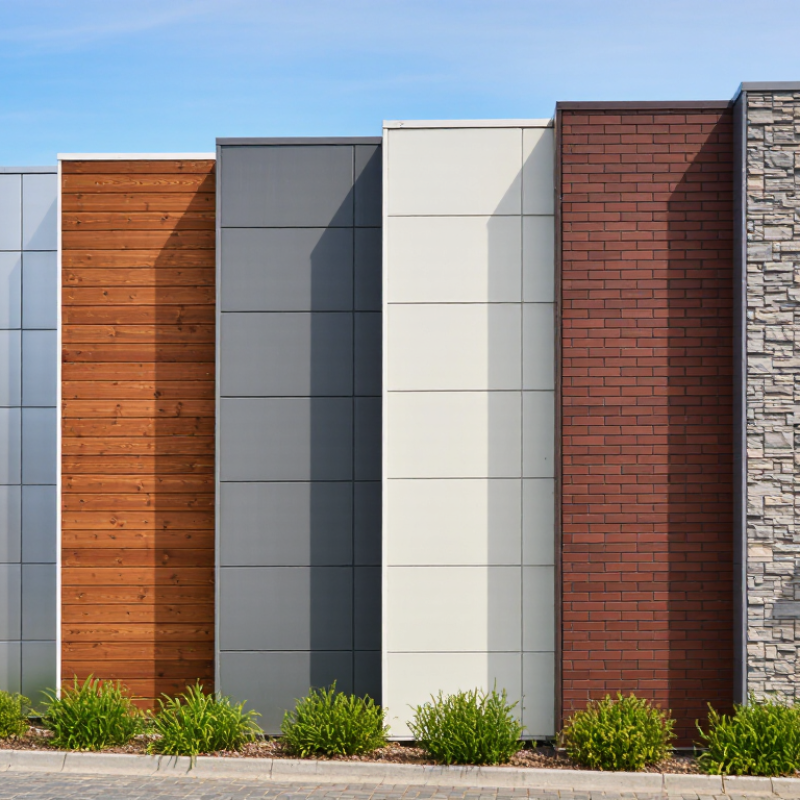
How to Rank Seven Exterior Cladding Panels by ASTM E84 and NFPA 285
Ranking seven exterior wall cladding panels requires more than comparing appearance, cost, or thickness. ASTM E84 measures flame spread and smoke developed under a controlled tunnel test. It does not approve a complete wall assembly. NFPA 285 examines flame propagation through multi-layer exterior wall systems, including insulation, membranes, joints, and window interfaces.
A practical seven-panel comparison may include fiber-cement, terracotta, solid aluminum, aluminum composite, high-pressure laminate, insulated metal, and rigid PVC panels. Fiber-cement and terracotta often perform strongly in ASTM E84 because they contain limited combustible material. Solid aluminum can also rank well, but its coating and backing still require review. Composite, laminate, insulated metal, and PVC panels need closer scrutiny. Their cores, adhesives, and air cavities can change the result significantly.
The ranking should use verified test evidence, not assumptions. ASTM International states that E84 results are comparative indicators, while NFPA 285 evaluates the complete construction. That distinction matters. NFPA’s Fire Loss in the United States report recorded about 1.39 million fires and 3,670 civilian fire deaths in 2023. Exterior fire performance deserves careful documentation. A panel passing E84 may still fail an NFPA 285 assembly review. The weak point is often the joint. Or the cavity. Engineers should request full-scale reports, field-of-application limits, and tested details before assigning a final rank. A tidy table can mislead.
7 Best Wall Cladding Panels for Exterior Walls
Ranking exterior cladding panel categories by ASTM E84 flame-spread performance and NFPA 285 evaluation requirements
| Panel Category | ASTM E84 FSI | ASTM E84 SDI | ASTM E84 Class | NFPA 285 |
| Mineral wool core metal panel | 0 | 0 | A | Assembly-specific |
| Fiber-cement panel | 0 | 0 | A | Assembly-specific |
| Aluminum honeycomb panel | 15 | 35 | A | Assembly-specific |
| FR mineral-filled composite panel | 20 | 150 | A | Assembly-specific |
| FR high-pressure laminate panel | 25 | 200 | A | Assembly-specific |
| PVC foam panel | 75 | 450 | B | Assembly-specific |
| Polyethylene-core aluminum composite panel | 350 | 450 | Not Class A–C | Assembly-specific |
Lower ASTM E84 flame-spread and smoke-developed indexes indicate better surface-burning performance. ASTM E84 Class A generally corresponds to a flame-spread index of 0–25, Class B to 26–75, and Class C to 76–200. NFPA 285 is an assembly test rather than a material-only rating, so the complete wall system, including insulation, air barriers, joints, and attachment details, must be evaluated.
Fiber-Cement and Metal Panels: Class A Fire Ratings and Wind Loads
Choosing the seven best wall cladding panels depends on fire performance, wind exposure, drainage, and installation quality. For exterior walls, fiber-cement and metal panels deserve close attention because both can support Class A fire-rated assemblies when tested as complete systems.
Fiber-cement panels are dense, stable, and commonly made with noncombustible materials. They can resist flame spread, but the rating depends on coatings, joints, insulation, and the wall backing. A Class A label should be verified through current test documentation, such as ASTM E84 results where applicable. Metal panels offer low maintenance and precise detailing. However, thin metal can dent, conduct heat, and fail at poorly protected penetrations.
Wind loads need equal care. A coastal project may face stronger suction than a sheltered inland building. Engineers should check panel span, fastener spacing, subframing, edge zones, and pressure differences around corners. One loose fastener can damage an otherwise sound façade. Manufacturers’ tables are useful, but they are not a substitute for project-specific calculations. The installer must also preserve drainage paths behind the panels.
This detail is often overlooked. On site, I would inspect screw seating, open joints, flashing laps, and sealant continuity before closing the wall. Mistakes happen, even on experienced crews. Independent review can catch them early. Local codes and tested assemblies should guide the final selection.
Wood and PVC/Vinyl Siding: Moisture Resistance, R-Value, and Expansion
7 Best Wall Cladding Panels for Exterior Walls?
Wood and PVC/vinyl siding behave differently when rain, humidity, and sunlight attack an exterior wall. Wood can create a warm, textured appearance, but it absorbs moisture through cut edges and unsealed joints. A small leak behind a trim board may remain hidden until swelling or staining appears. Proper flashing, a ventilated drainage gap, and regular paint or stain maintenance are essential. In wet climates, installation quality often matters more than the panel material itself.
PVC or vinyl siding resists rot, insects, and surface moisture with little routine maintenance. However, it is not waterproof by itself. Wind-driven rain can enter poorly overlapped seams or damaged penetrations. Leave the manufacturer’s required clearance around windows and corners. PVC also expands noticeably in direct sun. Fasteners should hold panels securely without restricting movement, or buckling can occur on a hot afternoon.
R-value deserves careful interpretation. Most standard wood and vinyl siding provide limited insulation, usually far less than dedicated continuous insulation. Their contribution depends on thickness, density, and the wall assembly behind them. A thicker insulated panel may improve thermal performance, but gaps at joints can reduce real-world results. This is where specifications can mislead. Check tested values, thermal bridging, and local climate requirements before choosing a seven-panel shortlist. A sample panel exposed to rain and afternoon heat can reveal practical weaknesses that a brochure misses.
Porcelain Panels: EN 13501-1 Fire Classes, Impact Strength, and Service Life
Porcelain panels deserve attention among the best exterior wall cladding options, but their fire performance depends on the complete wall assembly. Under EN 13501-1, products are classified from A1 to F, with smoke and flaming-droplet ratings added separately. A panel may achieve A1 or A2-s1,d0, yet adhesives, insulation, joints, and subframes can change the final result. The European Commission’s guidance on façade fire safety stresses assembly-level assessment, not isolated product claims.
Impact strength also needs practical testing. ISO 10545-5 measures a ceramic tile’s impact resistance through its coefficient of restitution, while EN 14411 defines requirements for ceramic tiles and panels. These tests do not perfectly reproduce a ladder, hailstone, or maintenance trolley striking a façade edge. That limitation matters. Specify tested panel thickness, fixing method, edge details, and impact category for the actual location. A lower wall beside a loading route needs different protection than an upper storey.
Service life should follow ISO 15686 principles, which connect durability to design, exposure, maintenance, and replacement planning. Low water absorption helps porcelain resist freeze-thaw damage, staining, and weathering, but it does not make joints or fixings maintenance-free. Field experience shows failures often begin at poorly drained connections. A sensible specification records expected service life for the panel and every supporting component. The honest answer is less impressive, but more reliable: there is no universal lifespan without project exposure data, inspection records, and installation quality.





