


A warehouse floor can look spacious until forklifts meet deep pallet rows, narrow aisles, and fast-moving stock. Choosing a Warehouse Racking System is therefore a design decision, not just a price comparison. The right structure must fit the building, load profile, handling equipment, and expected growth. Small details matter: pallet dimensions, beam levels, clearances, and the condition of the floor.
MHI and Deloitte’s 2024 Annual Industry Report found that 55% of surveyed supply-chain leaders planned to increase technology investment. That figure is not specific to racking, but it signals wider pressure to make warehouse operations more productive and adaptable. For global buyers, comparing selective, drive-in, pallet-flow, and automated systems means weighing density against access, throughput, installation, and maintenance. There is no universal winner.
MIT supply-chain expert Dr. Yossi Sheffi’s work emphasizes resilience: operations should be designed to withstand disruption, not only perform well under ideal conditions. Applied to rack selection, that means checking whether the layout can handle changing inventory and operating needs. This is a practical interpretation of his broader research, not a direct quotation. One caution: high-density storage can reduce access and complicate picking if the design misses real workflows. The guide ahead compares leading system types, highlights the trade-offs, and identifies the questions buyers should verify with qualified designers and suppliers. A good rack plan starts with measured loads and actual operating data. Not guesswork.
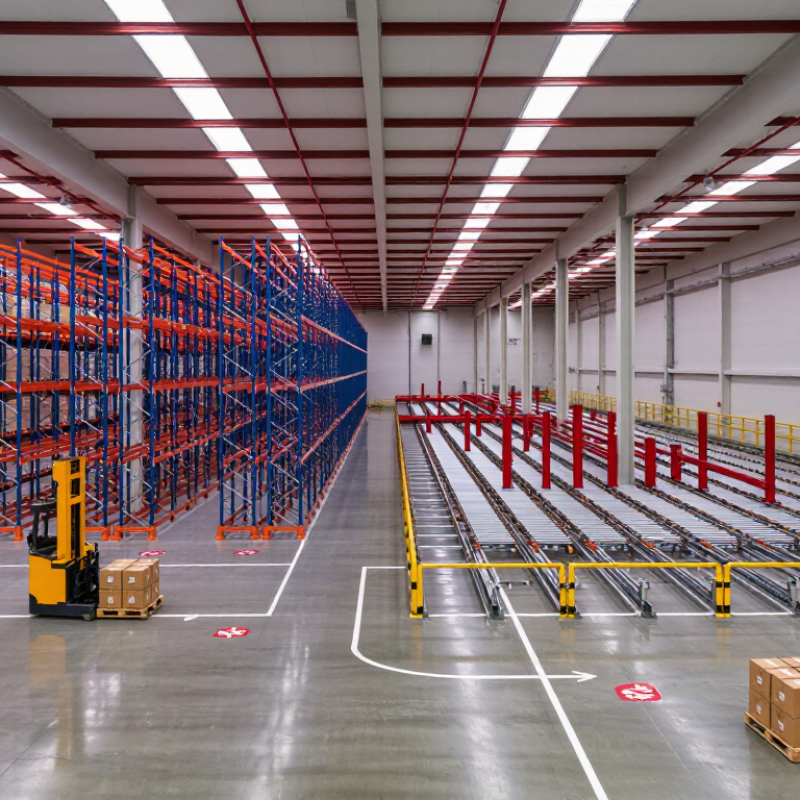
Warehouse racking should match the goods, handling equipment, and picking routine. Selective pallet racks offer direct access to each pallet, making them useful for varied stock. Drive-in racks store more pallets in less floor space but reduce access to individual loads. Push-back and pallet-flow systems suit higher-volume storage. Cantilever racks hold long items such as pipes or timber. Access matters.
Key terms help buyers compare layouts accurately. A bay is a storage section between uprights; beams support the pallet loads. Clear height means usable vertical space, while aisle width must suit the lift truck and its turning path. FIFO means first in, first out; LIFO means last in, first out. These methods affect product rotation. Load ratings depend on the rack configuration, beam levels, and installation details—not just the steel parts.
Picture a worker guiding a loaded truck into a narrow aisle on a busy shift. Small details matter. Check the floor condition, pallet dimensions, sprinkler clearance, and equipment turning space before finalizing a layout. Confirm that capacity labels match the installed configuration, and arrange qualified inspections after impact or visible damage. Requirements vary by site and region, so local engineering advice is sensible. A drawing can look perfect and still miss a real workflow problem.

Selective pallet racks suit warehouses that need direct access to every stored pallet. Each pallet position can be reached from an aisle without moving another load. That helps when orders include many SKUs, fast-moving items, or frequent replenishment. A worker can retrieve a specific carton pallet from the second beam level while neighboring loads remain untouched. RMI guidance on industrial steel storage racks emphasizes matching rack design and capacity to the actual loads and operating conditions. The trade-off is real: each rack row needs aisle space, so selective layouts generally store fewer pallets per square foot than deep-lane systems.
WERC’s 2023 DC Measures report lists median order-picking accuracy at 99.5%. That benchmark does not prove a rack type causes better accuracy, but clear pallet access can simplify identification and reduce unnecessary load moves. Still, density can be underestimated during planning. Aisles, turning space, columns, and staging areas all consume floor area. Before selecting a layout, map pallet dimensions, SKU counts, peak inventory, and equipment turning paths. Check beam ratings against loaded pallet weights, and review the layout when inventory patterns change. Selective racks are not automatically the safest or most efficient choice. They are a practical fit when access matters more than maximum storage density.
2026 Top Warehouse Racking Systems for Global Buyers?
Compare Double-Deep, Drive-In, Push-Back, and Pallet-Flow Systems
Choosing a rack system starts with the inventory, not the aisle plan. Double-deep racks store pallets two positions deep, reducing aisle space but hiding the rear pallet. They suit operations with repeat SKUs and compatible reach trucks. Drive-in racks use fewer aisles and can hold deep blocks of similar goods. Forklifts enter the lanes, so impact protection and careful driving matter. Access is limited. Both are usually best for last-in, first-out (LIFO) handling.
Push-back racks also operate LIFO, but carts let operators load several pallets from one aisle face. They offer denser storage with easier access than drive-in lanes, though cart condition and pallet consistency affect performance. Pallet-flow racks use gravity rollers to move pallets from the loading side to the picking side. That supports first-in, first-out (FIFO) rotation and faster picking, but damaged pallets can interrupt flow. Small details matter.
MHI’s 2024 Annual Industry Report found that 55% of respondents planned to increase investment in supply-chain technology. That points to growing interest in efficient operations, but it does not mean one rack type fits every site. Compare SKU count, pallet quality, order frequency, and forklift turning space. A clean spreadsheet can still miss real-world congestion. Pilot a lane and measure replenishment time before committing.
Comparative overview of Double-Deep, Drive-In, Push-Back, and Pallet-Flow systems.
Ratings use a qualitative 1–5 scale, where 5 indicates a stronger characteristic. They reflect typical system designs, not measured performance: actual storage density and pallet accessibility depend on layout, load dimensions, SKU mix, and operating practices. Drive-in and push-back systems are typically LIFO; pallet-flow systems are commonly configured for FIFO.
2026 Top Warehouse Racking Systems for Global Buyers?
A rack design should be checked against the standard used for its market, not chosen by comparing load ratings alone. ANSI MH16.1 covers the design, testing, and use of industrial steel storage racks in North America. EN 15512:2020 sets design requirements for adjustable pallet racking in Europe. Their methods and assumptions differ, so a design validated under one standard should not automatically be treated as compliant with the other. Check the current adopted edition, local building requirements, seismic conditions, and the rack’s actual configuration.
Review the details that affect real loads: beam levels, upright frames, pallet overhang, floor anchorage, and forklift impact protection. A small change in beam height can alter frame forces. Ask the supplier or design engineer for calculations tied to the exact layout, load units, and installation conditions. MHI’s 2024 Annual Industry Report found that 55% of surveyed companies planned to increase supply-chain technology investment. That trend makes clear documentation even more useful as facilities add automation and change workflows. The figure is not a rack-safety measure, though.
Look closely at the assumptions. A clean drawing can still miss uneven floors or damaged anchors. Verify load plaques after installation, and inspect frames for dents or leaning before reuse. Standards help structure the review; they do not replace competent engineering or site checks. One point is easy to overlook: mixed-standard projects need a clear, documented basis of design. That extra review takes time, but skipping it can create uncertainty later.
Warehouse racking should be specified from the goods outward, not from a catalogue photo. Record each pallet’s maximum weight, dimensions, and load pattern, then check beam ratings, upright capacity, and bay configuration together. A 1,000-kilogram pallet stored unevenly can create different demands than a centered, stable load. Keep capacity signs visible, and reassess after layout changes or impact damage.
Seismic performance depends on more than rack steel. Ask for calculations based on local ground conditions, building movement, stored-load height, and anchoring details. Have qualified local engineers verify the slab and connections. That gap matters. A rack that looks sturdy may still transfer forces into a weak floor or poorly detailed joint.
Automation changes the cost equation. Check aisle width, floor flatness, barcode or sensor workflows, guarding, and recovery procedures when equipment stops. Test the whole workflow. Compare purchase and installation costs with labor, inspections, energy, spare parts, software support, and downtime over the intended service life. The cheapest quote can become expensive if a minor fault blocks several aisles. Estimates are never perfect; model a realistic maintenance scenario, then leave room for assumptions to be wrong.


For those larger-sized parts, or smaller quantity runs, we have 2 independent powder coat booths and ovens. The quality, durability and affordability of today’s powder coating finishes make this the process of choice for world-class companies.
Powder coating advantages over other forms of coating are many. Materials used in the Powder coating process can be metals and non-metals that come in a multitude of thicknesses, textures, colors, etc. Another of Powder coating’s biggest advantages over conventional coatings is its ability to create finishes in many different textures. Powder Coating Booths allow us the ability to apply these advantages to large products.
Tri-State Fabricators runs a full-service conveyor line for painting. Wet painting can provide protection or decoration to many different part styles. From start to finish, every project is easier to undergo random and point-based inspection by our skilled painting team.
Advantages to our Wet Paint Line are these lines start with product prep and ends with a thorough inspection of a high quality finished product. Our ability to complete large and small projects with a superior finish and doing so in a timely and economical fashion. This passes along the savings in production to our customers. When powder coating ins not an option, our Wet Paint Line gets the job done right the first time.
When the parts get big and heavy we roll-out our custom paint racks and oversize booth. By utilizing our partnerships with all the major paint brands, we can match virtually any color with wet paint.
The advantages of having access to a Wet Paint Booth are many. Large projects of many different shapes can be loaded into the booth. The Wet Paint Booth offers an environment that is much more controlled than a typical parts painting operation.
Not only are they used because of their controlled environment, but they’re are also advantageous when it comes to applying paint to parts that are needed in industries that require specialty coatings such as medical, aerospace, etc.
Our military forces have some very high standards when it comes to the finish of their vehicles and equipment. From the first pre-treatment step to final coat, it takes a great deal of knowledge and experience to protect the men and women of our armed forces. They deserve only the best, and Tri-State Fabricators provides it.
All of our processes are closely monitored by our staff and management teams. Both of which are highly trained in the processes of metal fabrication and finishing. Tri-State Fabricators’ goal is to always fully satisfy each and every customer, including the military. We will always put a 110% into what we do.
Abrasive media blasting is an excellent way to remove old paint, rust, and increase the paint/powder adhesion. Glass beads produce a much smoother and brighter finish than angular abrasives; leaving the part clean yet without any dimensional change. Chemically inert and environmentally friendly, we can recycle our beads approximately 30 times; making them a more preferred method of metal cleaning or surface finishing.
Advantages to Glass Bead Blasting are many. Glass bead blast media is used when a project is needing rough surfaces need to become smooth for applications of coatings such as paint. It is typically used to clean paint and rust from a product surface without deforming the surface it is being used on. Overall, compared to many other blasting media, Glass Bead Blasting is a very economical choice and those savings are always passed on to our customers.
Tri-State Fabricators utilize a zinc phosphate wash to clean and etch the material to ensure the best paint adhesion possible. The unique design of our 3-stage wash system does the work like a 5-stage. From Cleaning and rinsing to conversion coating and post-treatment, Our Part Washing process is a complete service and works throughout the fabrication service and the finishing service.
Along with the previously mentioned benefits, Curing is a vital chemical reaction that leaves the product finish hard and relatively safe from mild abrasion and aggressive corrosion. This process can be done in more than one way; ambient air-dry or in curing ovens at temps that exceed 240°.
From fixing paint mistakes (someone else’s of course) to simply cleaning our paint line hooks, our burn-off oven is put to good use. After a quick burn-off, a little clean up, and a fresh coat of paint, your parts will look better than new.
Why does our Burn-Off Oven work so well? Because super heating the air around parts turns the materials into ashes. From paint and powder coatings to rubber and machining oils, high temps do the job without degrading the integrity of the part.
Masking is a vital part of producing high quality products. We have die-cut masking patterns to protect machined surfaces as well as a wide range of plugs and caps to protect threaded holes and bolts. We provide permanent and temporary masking.
Masking allows the selected sections of a product to be protected from a fabrication or finishing service. This can be with both chemicals when etching and tapes, paints when only finishing just a section of the product. Masking is great in aiding the customization process of a project.
Screen printing is a photographic process that transfers artwork onto a porous nylon screen which allows colored ink to flow through the screen and be deposited on an aluminum or plastic component. We can generally have just about any design created onto a screen for your parts.
Some of the advantages of Screen Printing are, brand recognition for your business displaying on your products, assembly instructions, product warnings/hazards, etc. Tri-State Fabricators produces Screen Printing of the highest quality so you know it’s durable.
Metal Finishing is the art of treating the exterior portion of product, often metal but can also be made of other materials, so that the surface is clean and free of any debris. Then the process of applying coats or either paint of powder coat takes place. This coating process improves the quality of the product in both appearance and resistance to wear and corrosion.
Tri-State Fabricators, Inc., understands that a project typically isn’t complete until a high-quality finish has been added to your product. This is why our painting and powder coating teams continuously inspect the products throughout the Metal Finishing process.

