2026 Top Sand Dredger Manufacturers and Suppliers?
Choosing a reliable Sand Dredger manufacturer requires more than comparing catalogue prices or pump capacities. The right supplier must understand sediment conditions, water depth, production targets, discharge distance, maintenance access, and local operating risks. A compact cutter suction dredger may suit a narrow river, while a large trailing suction hopper dredger may perform better in open-water reclamation. The difference becomes visible on site: unstable slurry, clogged pipelines, excessive fuel use, and unplanned downtime can quickly erase an attractive purchase price.
Dr. Cees van Rhee, a respected dredging engineer and professor, has often stressed the practical nature of dredging: “Every dredging project has its own requirements.” That principle guides this 2026 review of leading Sand Dredger manufacturers and suppliers. It examines engineering capability, dredging depth, production efficiency, component quality, customization, after-sales support, and documented project experience. Certifications and technical data matter, but they do not tell the whole story. A supplier’s response during a pump failure may reveal more than a polished brochure.
This guide is not a perfect ranking. Market information changes, and published performance figures may reflect ideal conditions. Some suppliers provide limited independent data. Buyers should request test records, reference projects, spare-parts policies, and realistic fuel estimates before signing a contract. We also consider emerging electric, remote-monitoring, and lower-emission solutions, while recognizing their higher initial costs and uneven field adoption. The goal is practical comparison, not exaggerated promotion: helping contractors, port authorities, mining companies, and environmental operators identify equipment that can keep moving sediment safely and consistently.
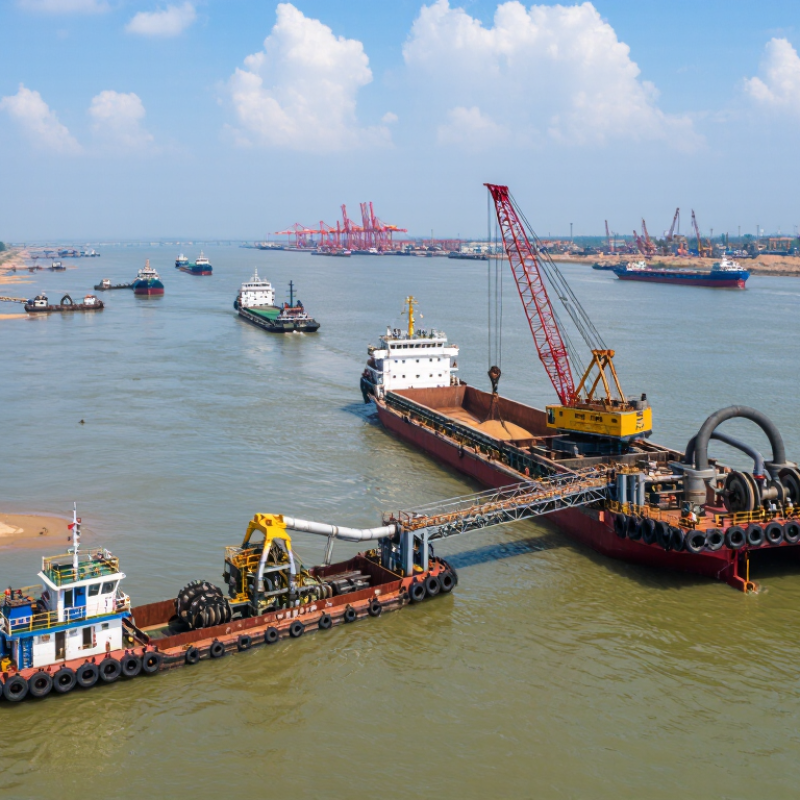
Sand Dredgers: Definition, Uses, and Main Equipment Types
A sand dredger is a vessel or floating machine designed to loosen, lift, and transport submerged sand. It commonly uses a suction pipe, dredge pump, discharge line, and positioning system. Some machines cut compacted layers before pumping them through a pipeline. Others collect loose sand inside a storage hopper and sail to a discharge area. The machine’s role depends on sediment density, water depth, production targets, and site access.
Cutter suction dredgers work well in firm deposits and confined construction zones. A rotating cutter head breaks the bed, while a pump moves the mixture ashore. Trailing suction hopper dredgers collect loose material during continuous sailing. Their hoppers support beach nourishment, reclamation, and offshore sand recovery projects.
Bucket ladder dredgers use linked buckets for controlled excavation in shallow or restricted areas. Jet suction dredgers add high-pressure water to loosen soft sand before suction.
Reliable selection begins with a survey, not a catalog photograph. Engineers measure grain size, contamination risk, wave conditions, pipeline distance, and required output. Experienced crews also inspect wear parts, pump seals, cutter teeth, and emergency shutdown systems.
A larger dredger is not automatically better. It may consume more fuel and struggle in narrow channels. Conversely, a small unit may lose efficiency on long discharge routes. Some project plans still underestimate weather delays and sediment variability. That mistake deserves review before equipment is mobilized.
Environmental monitoring should track turbidity and nearby aquatic habitats during operation.
Key Factors for Evaluating Sand Dredger Manufacturers in 2026
When evaluating sand dredger manufacturers in 2026, capacity should not be judged by brochure figures alone. The USGS Mineral Commodity Summaries 2025 estimated U.S. construction sand and gravel production at about 960 million metric tons in 2024. This demand requires stable output, not only impressive peak performance.
Ask for verified pump capacity, dredging depth, discharge distance, fuel consumption, and cutter or suction-pipe wear rates. These figures should match your soil tests and daily production target. A machine designed for soft sand may struggle with compacted layers. It happens. Request recent project references, factory acceptance records, and supervised field trials. The International Association of Dredging Companies emphasizes production planning, maintenance, and operator competence as major cost controls. Therefore, supplier expertise matters as much as equipment size.
Reliability also depends on lifecycle support. Compare spare-parts availability, response times, training, remote diagnostics, and repair procedures. The International Maritime Organization’s greenhouse-gas strategy increases pressure to measure fuel use and emissions across marine operations. Ask manufacturers for documented fuel data under comparable loads, rather than general efficiency claims. Total cost should include downtime, wear components, crew hours, transport, and end-of-life value. A lower quotation may still become expensive after one difficult season. Buyers should also review safety systems, environmental monitoring, and compliance documentation. Some evaluation sheets remain too simple; they often overlook weather delays and sediment variability. That weakness deserves correction before signing.
2026 Top Sand Dredger Manufacturers and Suppliers
Key Factors for Evaluating Sand Dredger Manufacturers in 2026
For 2026 procurement decisions, technical performance should be assessed together with operating cost, environmental compliance, reliability, service capability, and lifecycle support. The chart presents a normalized evaluation framework commonly used in industrial dredging tenders; weights should be adjusted to match project depth, sediment type, transport distance, production target, and local regulations.
Leading Sand Dredger Manufacturers and Suppliers by Region
2026 Top Sand Dredger Manufacturers and Suppliers: Leading by Region
Asia remains a major production center for sand dredgers, especially in China and India. Manufacturers there often provide cutter suction dredgers, slurry pumps, pipelines, and customized power systems. Buyers should inspect welding quality, cutter design, pump efficiency, and spare-part availability. Factory visits reveal details that brochures usually hide. Some suppliers offer attractive prices, but after-sales support may be uneven.
European manufacturers and suppliers are known for engineering precision, energy management, and environmental monitoring. Companies in the Netherlands, Belgium, Germany, and Italy commonly serve large marine, river, and port projects. Their equipment may include automated dredging controls, low-emission engines, and advanced positioning systems. This expertise often raises the purchase cost. Still, reliable documentation and long-term maintenance can reduce operational risk.
North American suppliers typically focus on project-specific dredging packages, rental fleets, and local service coverage. Manufacturers in the United States and Canada may support river restoration, aggregate recovery, and harbor maintenance. In the Middle East, regional suppliers often adapt equipment for heat, dust, and remote job sites. Turkish manufacturers also serve nearby markets with practical mid-sized dredgers and replacement components. No regional list stays perfect. Production capacity, certifications, delivery schedules, and service quality change each year. Buyers should verify test records, reference projects, warranty terms, and compliance requirements before signing contracts.
Pricing, Certifications, Delivery, and After-Sales Service Comparison
Pricing varies sharply with pump size, hull design, automation, and discharge distance. Public 2024 procurement reviews show small cutter suction dredgers often quoted between USD 150,000 and USD 600,000. Larger customized units can exceed USD 2 million. These figures are indicative, not guarantees. Ask for fuel consumption, spare-parts costs, and commissioning charges.
Certification separates a capable supplier from a persuasive salesperson. ISO’s 2023 Survey recorded more than 1.2 million ISO 9001 certificates worldwide, but certification alone cannot prove dredging performance. Request current quality, environmental, electrical, and classification documents. Check certificate scope and expiry dates. Some suppliers provide impressive files, yet omit project-specific testing.
Delivery needs written milestones. UNCTAD’s Review of Maritime Transport 2024 reported 2.4% growth in seaborne trade during 2023, while route disruptions continued to affect equipment logistics. A realistic contract should define factory testing, sea trials, export packing, and delay remedies. After-sales support matters most after muddy water enters the system. Look for remote diagnostics, local technicians, spare-parts stock, and response times under 48 hours. A two-year warranty sounds strong. It may exclude wear parts, operator errors, or poor sediment conditions. Review those exclusions carefully. Mistakes happen, even in well-managed projects.





