


What Are the 2026 Top Recessed Downlight Trends?

Recessed Downlight is entering 2026 as a practical lighting tool, not merely a ceiling accessory. Buyers now expect lower energy use, cleaner ceilings, and more flexible control. The International Energy Agency’s Energy Efficiency 2024 report continues to identify LED adoption and smart controls as important efficiency measures. Meanwhile, the U.S. Department of Energy’s solid-state lighting research guidance emphasizes efficacy, color quality, controls, and product reliability.

The direction is clear.

For 2026, leading trends will likely include glare-controlled optics, tunable white light, low-profile housings, connected dimming, and improved thermal management. These features matter in real spaces. A narrow beam can highlight a kitchen island, while a wider optic can soften a hotel corridor. A warm 2700K setting may suit a restaurant at night, while 4000K can support detailed retail work during the day.

Market forecasts from TrendForce and other lighting research firms also point toward continued LED growth and stronger demand for intelligent lighting systems. However, forecasts are not guarantees. Installation cost, driver compatibility, regional standards, and long-term maintenance can change the result.

That is the uncomfortable part.

A connected downlight may offer impressive control but create commissioning problems. A high-efficacy model may produce harsh glare if its shielding is poorly designed. This article examines the 2026 top Recessed Downlight trends through technical evidence, field experience, and realistic purchasing considerations. The goal is not to praise every new feature, but to identify which innovations can perform reliably above an actual ceiling.
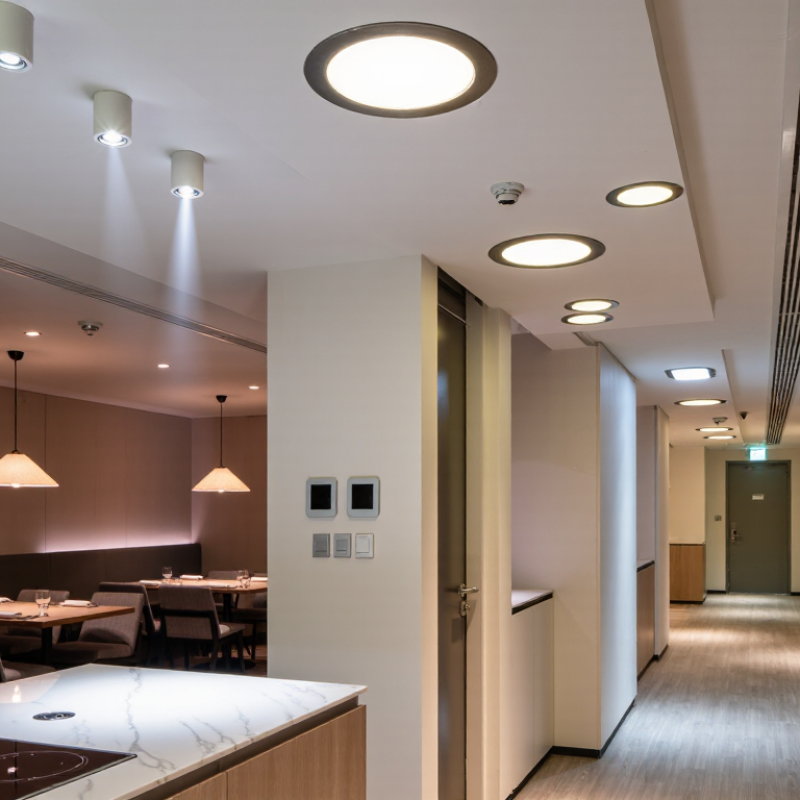
What Are the 2026 Top Recessed Downlight Trends?

Define the 2026 Baseline: LEDs Use 75% Less Energy and Last 25× Longer (DOE)

What Are the 2026 Top Recessed Downlight Trends?

In 2026, recessed downlights should be judged against a clear energy baseline. The U.S. Department of Energy reports that LEDs use about 75% less energy than incandescent lighting. They can also last up to 25 times longer. That difference changes everyday decisions. A kitchen light used for four hours nightly may need fewer replacements and create less heat above the ceiling.

This baseline is only the beginning. Current downlight designs increasingly combine efficient LED engines with lower glare, adjustable color temperature, and improved beam control. In real installations, a well-shielded trim can make a room feel calmer than a brighter, exposed source. Warm white settings often suit bedrooms, while neutral white can improve task visibility in kitchens and workshops. Small details matter.

Controls are becoming more practical, too. Occupancy sensors, dimming, and daylight response can reduce wasted operating hours. However, efficiency claims deserve careful checking. A fixture may use little power but still perform poorly if its light distribution is uneven. I have seen spaces with efficient lamps that required extra fixtures after installation. That mistake increases material use and weakens the original energy goal. Check lumen output, color consistency, glare ratings, and compatibility with existing wiring before choosing a retrofit downlight. LED progress is real, but good design still requires measurement and restraint.

What Are the 2026 Top Recessed Downlight Trends? - Define the 2026 Baseline: LEDs Use 75% Less Energy and Last 25× Longer (DOE)

Trend / Dimension 2026 Baseline Typical Measurable Data Practical Value How to Verify
LED energy efficiency LED remains the default technology for new recessed downlights. DOE states that residential LEDs use at least 75% less energy and last up to 25 times longer than incandescent lighting. A comparable 60 W incandescent lamp may be replaced by an LED using approximately 8–12 W. Lower electricity consumption, reduced heat output, and fewer replacement cycles. Review rated input watts, delivered lumens, lifetime, and the applicable DOE or efficiency certification documentation.
Long service life Long-life LED modules and integrated downlights are prioritized for difficult-to-access ceilings. Typical LED rated life is commonly 25,000–50,000 hours, depending on the product and operating conditions. Incandescent lamps are commonly rated around 1,000 hours. Lower maintenance requirements in residential, hospitality, retail, and commercial spaces. Check the stated lifetime basis, lumen-maintenance information, warranty period, and operating-temperature limits.
Higher efficacy Products are evaluated by delivered lumens per watt rather than wattage alone. A practical 2026 selection range is approximately 80–110 delivered lm/W for many residential and light-commercial recessed downlights. Provides more usable light from the same electrical load and supports energy-code compliance. Use the photometric report or specification sheet and divide delivered lumens by input watts.
Selectable color temperature Field-selectable or application-specific CCT is increasingly expected instead of one fixed color. Common choices include 2700 K, 3000 K, 3500 K, and 4000 K. Warm white is generally preferred for living areas; neutral white is common in work areas. Simplifies project specification and allows the light appearance to match different rooms and finishes. Confirm the measured or nominal CCT range and the available selection mechanism.
Improved color quality High-CRI lighting is favored where accurate appearance of people, food, artwork, and finishes matters. CRI 80 is a common minimum for general applications; CRI 90 or higher is a preferred target for premium residential, retail, hospitality, and display areas. Improves perceived color fidelity and reduces visual dullness caused by poor spectral quality. Check CRI, R9 where provided, chromaticity data, and the test standard used.
Smaller aperture formats 2-inch, 3-inch, 4-inch, and 6-inch apertures serve different beam, lumen, and ceiling-design requirements. Typical residential output ranges are approximately 500–1,000 lm for 3–4-inch products and approximately 800–1,500 lm for many 6-inch products. Supports cleaner ceilings, visual comfort, and more precise spacing in modern interiors. Verify cutout diameter, housing depth, delivered lumens, beam angle, and ceiling thickness compatibility.
Low-glare optical design Deep baffles, diffusers, and controlled beam distributions are used to reduce direct view of the LED source. Common beam options are approximately 40°–60° for general downlighting, with narrower beams used for accent applications. Reduces discomfort glare and improves visual quality in low-ceiling and screen-heavy spaces. Review beam angle, shielding angle, glare metrics when available, and the lighting layout.
Dimming and smart control readiness Smooth dimming and compatibility with common control systems are baseline expectations. Many residential products support 120 V forward-phase or reverse-phase dimming, with manufacturer-specific minimum and maximum load limits. Enables scene control, lower energy use during partial occupancy, and improved occupant comfort. Check the tested dimmer list, dimming range, flicker performance, startup behavior, and control protocol.
Airtight and IC-rated installation Airtight construction and insulation-contact suitability are important for recessed fixtures installed in insulated ceilings. Look for explicit airtight and IC-rated classifications, suitable operating temperature limits, and compliance with local electrical requirements. Helps reduce air leakage through the ceiling plane and supports safer installation near insulation. Confirm markings, installation instructions, safety certifications, and local code requirements.
Flicker and temporal-light quality Low-flicker operation is increasingly important in offices, educational spaces, healthcare settings, and areas recorded by cameras. Flicker percentage and flicker index should be reported where applicable; performance can change when the light is dimmed. Improves visual comfort and reduces the risk of visible modulation or camera banding. Request test data across the full dimming range rather than evaluating only at full output.
Connected and occupancy-aware control Wireless control, occupancy sensing, daylight response, and scheduling are growing options for larger projects. Control systems may use wired or wireless communication and can reduce operating hours through vacancy, occupancy, or daylight-based strategies. Supports energy management, automated scenes, and more responsive spaces. Verify interoperability, cybersecurity requirements, sensor coverage, commissioning steps, and standby power.

Reference basis: U.S. Department of Energy guidance on LED energy use and service life, together with commonly published lighting-performance metrics and installation classifications. Actual performance depends on the specific luminaire, driver, installation conditions, controls, and applicable local requirements.


Apply IES Metrics: 90+ CRI, R9, UGR, and Flicker Control

What Are the 2026 Top Recessed Downlight Trends?

In 2026, recessed downlights are moving beyond simple brightness. Specifiers now examine color quality, glare, and temporal light modulation. The U.S. Department of Energy reports that LED lighting can use at least 75% less energy than incandescent lighting. Efficiency still matters, but visual comfort decides whether a space feels premium.

Choose 90+ CRI for homes, galleries, hospitality areas, and detailed retail displays. Check R9 separately, because strong reds can appear dull despite a high general CRI. IES TM-30-20 provides deeper color evaluation through fidelity and gamut metrics. UGR should also stay low in offices and study areas, where exposed lenses may create harsh ceiling glare. IES LM-79 testing can verify photometric performance under controlled conditions. Do not trust a catalogue number alone. Real installations often differ.

Tips:

Request LM-79 data, R9 results, beam-angle details, and UGR calculations before approval. Ask for flicker measurements across dimming levels. IEEE 1789-2015 offers guidance for reducing health risks linked with LED flicker, while IEC testing methods help assess temporal modulation. A smooth 0–100% dimming claim may hide visible shimmer at low output. Test one sample beside a white wall, a wood surface, and a person’s face. Small details expose weak color tuning. I still find that “90 CRI” can sound more precise than it really is.

Evaluate Tunable White: 2700–6500 K, CCT, and Circadian Metrics (CIE)

Tunable white downlights are moving beyond simple dimming. A 2700–6500 K range can shift a room from warm evening light to a cooler daytime appearance. However, correlated colour temperature (CCT) does not measure biological impact. Two fixtures at 4000 K may produce different melanopic responses because their spectral power distributions differ.

CIE S 026/E:2018 defines α-opic quantities, including melanopic equivalent daylight illuminance (EDI). Designers should report melanopic EDI, not CCT alone, when discussing circadian-related performance. For example, a 4000 K setting may look neutral, yet its melanopic EDI depends on spectrum, illuminance, and viewing exposure. Context matters.

IES TM-30 evaluates colour fidelity and gamut using Rf and Rg, helping teams judge whether a high-CCT setting distorts skin, wood, or textiles. A practical specification might require 2700–6500 K, stable dimming, documented α-opic data, and measured performance at the occupied workplane. Controls should also support gradual transitions. Abrupt changes can feel artificial.

The weak point is often the schedule. A bright 6500 K scene at night may satisfy a screen or rendering, but it may not suit occupants. CIE metrics are useful, not magic. They describe exposure; they do not prove sleep or health outcomes. Field verification remains necessary. References: CIE S 026/E:2018; IES TM-30-24.

Trace Smart Control: DOE Finds 20–60% Savings From Lighting Controls

What Are the 2026 Top Recessed Downlight Trends?

Recessed downlights are moving beyond simple on-and-off switching. In 2026, practical designs will pair efficient LEDs with occupancy sensors, daylight response, and smoother dimming. The U.S. Department of Energy reports that lighting controls can reduce energy use by approximately 20–60%, depending on the building and control strategy.

That range matters in real rooms. A corridor may dim after several quiet minutes, while a conference room responds to movement and natural light. Near a bright window, the fixtures can reduce output without making the table feel gloomy. These small adjustments happen continuously. They also reduce unnecessary heat, which can ease cooling demand during warmer months.

The number is attractive, but it is not a promise. Savings depend on installation quality, operating schedules, sensor placement, and occupant behavior. A poorly calibrated sensor may switch lights off during a presentation. That feels efficient, but it quickly damages user trust. Commissioning should include evening tests, daylight checks, and feedback from the people using the space. Designers should also consider manual controls, visual comfort, glare, and maintenance access. Smart control is not automatically intelligent. It needs careful settings, regular review, and occasional correction.

What Are the 2026 Top Recessed Downlight Trends?

Trace smart control is becoming a defining trend in recessed downlighting. The U.S. Department of Energy reports that lighting controls can reduce lighting energy use by approximately 20% to 60%, depending on the application, control strategy, and operating conditions.

The chart shows the DOE-reported range of potential lighting-energy savings associated with lighting controls. Common recessed-downlight applications include occupancy sensing, daylight-responsive dimming, scheduling, and networked scene control.

Source: U.S. Department of Energy, lighting-controls energy-savings guidance.

Check Circularity: IEA Says Lighting Uses About 15% of Global Electricity

What Are the 2026 Top Recessed Downlight Trends?

Check Circularity: IEA Says Lighting Uses About 15% of Global Electricity

In 2026, recessed downlights are becoming smaller, smarter, and easier to maintain. That shift matters because lighting remains a major electricity demand. The International Energy Agency reports that lighting uses about 15% of global electricity. A small ceiling fixture can affect energy use across homes, offices, hotels, and retail spaces. But efficiency alone is not enough.

Designers are examining the full product lifecycle. Replaceable LED modules can reduce unnecessary disposal. Recyclable aluminum housings may support material recovery. Standardized parts can also simplify future repairs. This makes circularity more practical for installers and building owners. Yet circularity claims need evidence. A fixture can look sustainable while hiding glued components or difficult-to-separate materials. Specifications should mention service access, material content, and expected replacement procedures.

Smart dimming and occupancy sensors are also shaping recessed lighting. They reduce wasted electricity in empty rooms. However, extra electronics can complicate repair and increase component waste. The better 2026 specification may be quieter, not more complicated. Installers need accurate cutout sizes, low-glare optics, and stable color performance. On site, dust, ceiling thickness, and insulation often create unexpected problems. A fitting that saves energy but fails early is not truly efficient. The industry still needs clearer lifecycle data and more honest maintenance guidance.

Powder Coat Booths

For those larger-sized parts, or smaller quantity runs, we have 2 independent powder coat booths and ovens. The quality, durability and affordability of today’s powder coating finishes make this the process of choice for world-class companies.

Powder coating advantages over other forms of coating are many. Materials used in the Powder coating process can be metals and non-metals that come in a multitude of thicknesses, textures, colors, etc. Another of Powder coating’s biggest advantages over conventional coatings is its ability to create finishes in many different textures. Powder Coating Booths allow us the ability to apply these advantages to large products.

Wet Paint Line

Tri-State Fabricators runs a full-service conveyor line for painting. Wet painting can provide protection or decoration to many different part styles. From start to finish, every project is easier to undergo random and point-based inspection by our skilled painting team.

Advantages to our Wet Paint Line are these lines start with product prep and ends with a thorough inspection of a high quality finished product. Our ability to complete large and small projects with a superior finish and doing so in a timely and economical fashion. This passes along the savings in production to our customers. When powder coating ins not an option, our Wet Paint Line gets the job done right the first time.

Wet Paint Booths

When the parts get big and heavy we roll-out our custom paint racks and oversize booth. By utilizing our partnerships with all the major paint brands, we can match virtually any color with wet paint.

The advantages of having access to a Wet Paint Booth are many. Large projects of many different shapes can be loaded into the booth. The Wet Paint Booth offers an environment that is much more controlled than a typical parts painting operation.

Not only are they used because of their controlled environment, but they’re are also advantageous when it comes to applying paint to parts that are needed in industries that require specialty coatings such as medical, aerospace, etc.

Military CARC

Our military forces have some very high standards when it comes to the finish of their vehicles and equipment. From the first pre-treatment step to final coat, it takes a great deal of knowledge and experience to protect the men and women of our armed forces. They deserve only the best, and Tri-State Fabricators provides it.

All of our processes are closely monitored by our staff and management teams. Both of which are highly trained in the processes of metal fabrication and finishing. Tri-State Fabricators’ goal is to always fully satisfy each and every customer, including the military. We will always put a 110% into what we do.

Glass-Bead Blasting

Abrasive media blasting is an excellent way to remove old paint, rust, and increase the paint/powder adhesion. Glass beads produce a much smoother and brighter finish than angular abrasives; leaving the part clean yet without any dimensional change. Chemically inert and environmentally friendly, we can recycle our beads approximately 30 times; making them a more preferred method of metal cleaning or surface finishing.

Advantages to Glass Bead Blasting are many. Glass bead blast media is used when a project is needing rough surfaces need to become smooth for applications of coatings such as paint. It is typically used to clean paint and rust from a product surface without deforming the surface it is being used on. Overall, compared to many other blasting media, Glass Bead Blasting is a very economical choice and those savings are always passed on to our customers.

Part Washing

Tri-State Fabricators utilize a zinc phosphate wash to clean and etch the material to ensure the best paint adhesion possible. The unique design of our 3-stage wash system does the work like a 5-stage. From Cleaning and rinsing to conversion coating and post-treatment, Our Part Washing process is a complete service and works throughout the fabrication service and the finishing service.

Along with the previously mentioned benefits, Curing is a vital chemical reaction that leaves the product finish hard and relatively safe from mild abrasion and aggressive corrosion. This process can be done in more than one way; ambient air-dry or in curing ovens at temps that exceed 240°.

Burn-Off Oven

From fixing paint mistakes (someone else’s of course) to simply cleaning our paint line hooks, our burn-off oven is put to good use. After a quick burn-off, a little clean up, and a fresh coat of paint, your parts will look better than new.

Why does our Burn-Off Oven work so well? Because super heating the air around parts turns the materials into ashes. From paint and powder coatings to rubber and machining oils, high temps do the job without degrading the integrity of the part.

Masking

Masking is a vital part of producing high quality products. We have die-cut masking patterns to protect machined surfaces as well as a wide range of plugs and caps to protect threaded holes and bolts. We provide permanent and temporary masking.

Masking allows the selected sections of a product to be protected from a fabrication or finishing service. This can be with both chemicals when etching and tapes, paints when only finishing just a section of the product. Masking is great in aiding the customization process of a project.

Screen Printing

Screen printing is a photographic process that transfers artwork onto a porous nylon screen which allows colored ink to flow through the screen and be deposited on an aluminum or plastic component. We can generally have just about any design created onto a screen for your parts.

Some of the advantages of Screen Printing are, brand recognition for your business displaying on your products, assembly instructions, product warnings/hazards, etc. Tri-State Fabricators produces Screen Printing of the highest quality so you know it’s durable.

Metal Finishing

Metal Finishing is the art of treating the exterior portion of product, often metal but can also be made of other materials, so that the surface is clean and free of any debris. Then the process of applying coats or either paint of powder coat takes place. This coating process improves the quality of the product in both appearance and resistance to wear and corrosion.

Tri-State Fabricators, Inc., understands that a project typically isn’t complete until a high-quality finish has been added to your product. This is why our painting and powder coating teams continuously inspect the products throughout the Metal Finishing process.
