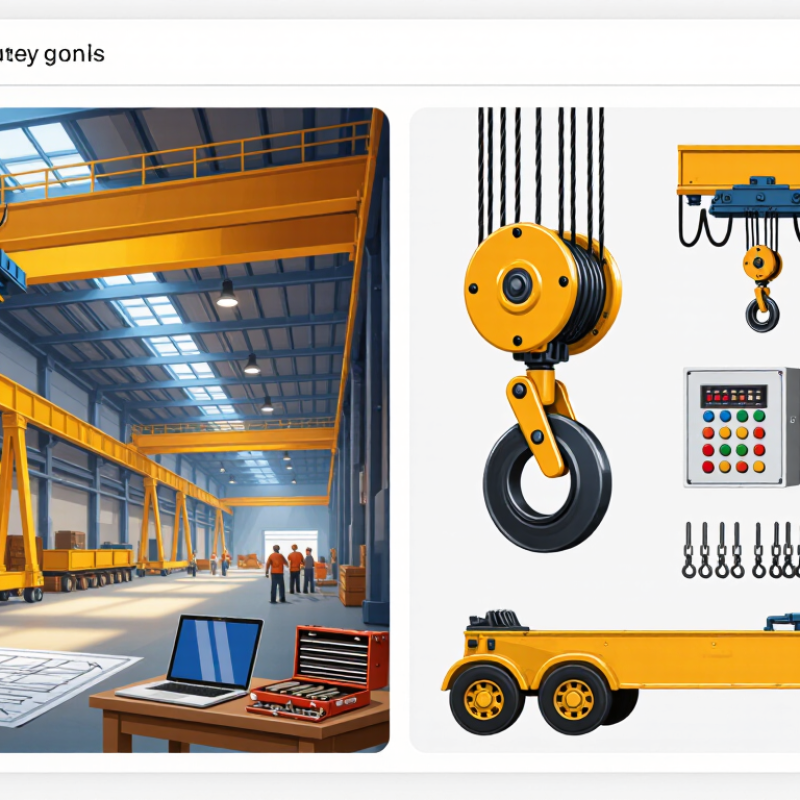
Choosing a reliable Bridge Crane manufacturer requires more than comparing prices or polished product photos. This 2026 guide examines leading manufacturers and suppliers through practical, evidence-based criteria. It considers design capability, lifting performance, component quality, service coverage, and customer feedback.
A bridge crane must match the building, duty cycle, load path, and working environment. A 20-ton crane for a steel workshop needs different controls and protection than a lighter unit in a warehouse. We review runway systems, hoists, end trucks, electrical controls, safety features, installation support, and spare-parts availability. Factory experience matters here. So does technical documentation.
The guide also considers supplier reliability after delivery. Response time can matter when a crane stops during a busy production shift. We look for inspection records, commissioning procedures, maintenance guidance, and transparent warranty terms. Independent certifications and documented projects strengthen a supplier’s credibility, but they should not replace careful technical review.
No ranking can remain perfect.
Market conditions change. Product lines change. Regional service quality can vary. Therefore, readers should confirm current specifications, lead times, certifications, and support arrangements before making a purchase. The strongest supplier is not always the largest. It is the one that understands the application, communicates clearly, and supports the equipment throughout its working life. This guide offers a practical starting point for that decision.
A bridge crane moves loads across a fixed runway inside a building or work area.
Its bridge travels along parallel rails, while a trolley carries the hoist across the span. This layout keeps lifting controlled and leaves valuable floor space open. In daily operation, trained workers inspect hooks, wire ropes, brakes, wheels, and limit devices before lifting begins. Small defects can become serious under repeated loads.
Common types include single-girder, double-girder, top-running, and under-running cranes.
Single-girder models suit lighter duties and moderate spans. Double-girder designs provide greater lifting capacity, headroom, and durability. Top-running cranes usually handle demanding production schedules, while under-running systems fit buildings with limited structural height. The correct choice depends on load weight, span, lift height, duty cycle, and available runway strength.
Bridge cranes support steel fabrication, machinery assembly, warehouses, shipbuilding, power facilities, and maintenance workshops.
A practical assessment should review building columns, electrical supply, travel speed, control methods, and operator visibility. Remote controls may improve access, but they still require clear communication and disciplined procedures. No design is perfect. An oversized crane can waste energy and space, while an undersized unit may suffer early wear. Real site measurements matter more than a neat specification sheet. Regular records also help reveal vibration, unusual noise, and changing production demands.
When evaluating bridge crane manufacturers in 2026, start with operating evidence, not polished brochures. Fortune Business Insights estimated the global overhead crane market at USD 4.85 billion in 2024. Its forecast reaches USD 6.85 billion by 2032, with a 4.4% compound annual growth rate. This expansion makes supplier quality more important, not less.
Ask for duty-class calculations aligned with ISO 4301-1. The supplier should explain lifting frequency, average load, travel distance, and expected service life. A credible manufacturer provides load charts, welding procedures, inspection records, and control-system documentation. Check twice. During a factory visit, inspect runway alignment, brake response, limit switches, cable routing, and pendant-control ergonomics. Small details often expose weak engineering.
Service capacity deserves equal attention. Request written response times, spare-parts availability, technician qualifications, and commissioning procedures. A 2024 industrial maintenance survey by Plant Engineering reported that unplanned downtime commonly costs manufacturers thousands of dollars per hour, depending on the facility. Therefore, a cheaper crane may become expensive after one failed brake or unavailable hoist motor. Ask for references from facilities with similar loads and duty cycles. Verify those references directly. I once focused too heavily on purchase price and overlooked installation training; that was a costly judgment. Suppliers should also explain how they test overload protection and document final acceptance. Claims without measurable records deserve skepticism.
2026 Top Bridge Crane Manufacturers and Suppliers Guide
Leading global bridge crane manufacturers and suppliers now serve factories, ports, warehouses, and energy facilities worldwide. Their strongest solutions begin with accurate site information, not a generic catalogue. Buyers should provide the rated load, span, lifting height, duty class, travel distance, and operating temperature.
An experienced supplier will review runway alignment, building clearance, power supply, and floor conditions before proposing equipment. For example, a 10-ton crane with a 20-meter span may require different wheel loads than a compact warehouse model. Ask for load charts, inspection records, welding procedures, and documented testing. Details matter.
Reliable manufacturers also support installation, operator training, spare parts, and scheduled maintenance after delivery. Modern systems may include overload protection, variable-speed drives, remote diagnostics, and energy-saving controls. However, digital features should not replace practical service access. A failed sensor can stop production. Verified compliance with applicable national standards remains essential.
Supplier comparisons can expose uncomfortable gaps. Some quotations look cheaper because they omit runway work, commissioning, or future maintenance. Our first shortlist might also be too narrow if it ignores regional service capacity. Buyers should check references from similar facilities and speak with technicians, not only sales teams. Clear documentation, realistic delivery dates, and responsive technical communication often reveal more than polished promises.
Choosing a bridge crane in 2026 requires more than comparing lifting capacity and price. Product quality starts with accurate steel fabrication, stable welding, and properly aligned wheels. Inspectors should review material certificates, weld records, and load-test results before installation. Test the details.
Safety depends on more than an emergency stop. A dependable crane should include overload protection, upper and lower limit switches, travel alarms, braking controls, and clearly marked rated capacity. Electrical cabinets need suitable protection against dust, moisture, and heat. Operators also need practical training, inspection checklists, and readable maintenance records. A strong safety design can still fail when daily inspections become rushed or unclear.
Customization should match the working environment, not only the building drawing. Buyers may require different spans, lifting heights, duty classifications, control methods, or variable-speed drives. Outdoor cranes may need weather-resistant coatings, sealed electrical components, and wind protection. Corrosive facilities demand careful material selection and coating checks. A useful supplier asks about load cycles, temperature, floor conditions, and future expansion. One overlooked detail can create expensive changes later. Specifications are often imperfect, so technical teams should challenge assumptions before production. Clearance measurements should be verified on site, because a few centimeters can affect access, maintenance, and safe hook movement.
| Crane Configuration | Typical Application | Product Quality Evidence to Request | Relevant Safety and Design References | Common Customization Options | Acceptance and Supplier-Qualification Checks |
|---|---|---|---|---|---|
| Top-Running Single-Girder Bridge Crane | General manufacturing, maintenance bays, warehouses, and material-handling areas where moderate lifting capacity and economical installation are priorities. |
|
| Span and lift height, pendant or radio control, variable-speed travel, low-headroom hoist, galvanized components, and indoor or outdoor protection. | Verify rated capacity, runway alignment, end-stop design, overload protection, emergency stop function, travel limits, and operational testing under the approved load plan. |
| Top-Running Double-Girder Bridge Crane | Heavy-duty production, steel processing, foundries, power facilities, and applications requiring greater hook height, span, or auxiliary lifting equipment. |
|
| Main and auxiliary hoists, independent or synchronized lifting, operator cabin, grab or magnet interface, service platforms, and tandem controls. | Check wheel loads against runway design, verify independent brake performance, confirm load-test procedures, review fatigue classification, and inspect access and guarding provisions. |
| Underhung or Under-Running Bridge Crane | Facilities with limited headroom, lighter-duty production lines, and buildings where the crane runway is supported from the roof structure. |
|
| Low-headroom hoist, curved runway sections where permitted, multiple crane systems, festoon or conductor-bar power, and restricted-height controls. | Obtain a structural engineer’s confirmation of roof and hanger capacity, verify clearances, inspect runway joints, and test anti-drop and end-stop provisions. |
| Outdoor Bridge Crane | Outdoor yards, shipyards, precast concrete plants, ports, storage areas, and process facilities exposed to weather. |
|
| Storm locks, rail clamps, anemometer, heating or anti-condensation devices, UV-resistant controls, stainless or coated components, and remote monitoring. | Verify wind-service and out-of-service loads, storm-warning logic, parking arrangements, coating thickness, enclosure protection, drainage, and emergency recovery procedures. |
| Explosion-Risk or Hazardous-Environment Crane | Selected chemical, pharmaceutical, petroleum, gas, and dust-risk areas where ignition-control requirements apply. |
|
| Non-sparking design features, certified motors and controls, grounding and bonding, sealed enclosures, special brakes, and corrosion-resistant finishes. | Match every component to the site zone or division, confirm certificate scope, review bonding continuity, verify temperature limits, and require installation by qualified personnel. |
| Process or Continuous-Duty Bridge Crane | Steel mills, foundries, paper plants, waste-processing facilities, and production environments requiring frequent or near-continuous crane operation. |
|
| High-cycle hoists, regenerative drives, redundant braking, heat shielding, automatic positioning, load weighing, and condition monitoring. | Compare expected starts per hour and operating time with rated duty, verify brake and motor thermal margins, review fatigue design, and establish inspection intervals. |
| Cleanroom or Hygienic Bridge Crane | Controlled manufacturing, electronics, pharmaceutical, food, and laboratory environments where contamination control is important. |
|
| Stainless or coated surfaces, sealed bearings, low-particle cable systems, cleanroom-compatible lubricants, and remote controls. | Confirm compatibility with the room classification and cleaning agents, inspect exposed surfaces, verify ingress protection, and approve materials before installation. |
| Smart or Automated Bridge Crane | High-throughput warehouses, steel storage, repetitive production, and facilities seeking position control, usage data, or reduced manual handling. |
|
| Automatic positioning, anti-sway control, collision avoidance, load identification, warehouse-management integration, geofencing, and remote diagnostics. | Test normal, fault, recovery, and loss-of-communication scenarios; verify safe states, access control, manual override, event logging, and operator training. |
| Low-Headroom or Restricted-Clearance Crane | Existing buildings, retrofit projects, production lines, and facilities where ceiling height or side clearances limit conventional crane arrangements. |
|
| Compact hoists, side-mounted drives, special end trucks, recessed electrification, custom hook approaches, and split installation packages. | Perform a three-dimensional clearance review, confirm maintenance access, verify hook travel, inspect structural interfaces, and document installation tolerances. |
| Supplier Documentation and Service Package | Applicable to every bridge-crane procurement, regardless of crane configuration or lifting capacity. |
|
| Operator training, preventive-maintenance contracts, periodic inspection support, remote diagnostics, critical-spares stock, and response-time commitments. | Use a documented pre-award checklist, verify references for comparable duty, confirm technician qualifications, define warranty exclusions, and establish post-installation support obligations. |

2026 bridge-crane purchasing should begin with total cost, not the lowest quotation. A standard indoor unit may cost roughly USD 15,000–60,000, while heavy-duty systems can exceed USD 150,000. Capacity, span, lifting height, duty class, controls, installation, and building reinforcement change the figure quickly. MarketsandMarkets identifies automation and connected maintenance as major overhead-crane market drivers through 2028. That suggests a higher upfront price may reduce downtime, but the claim needs site-specific proof.
Service support deserves equal attention. MHI’s 2024 Annual Industry Report found that 83% of material-handling professionals expected to maintain or increase technology investment. Suppliers should offer documented inspections, spare-parts availability, emergency response times, and technician qualifications.
Ask for a written preventive-maintenance schedule. Request two customer references with similar loads and operating hours. A five-year service cost comparison is more useful than a glossy brochure. My practical mistake was once treating response time as a promise; only a contract makes it measurable.
Tips:


For those larger-sized parts, or smaller quantity runs, we have 2 independent powder coat booths and ovens. The quality, durability and affordability of today’s powder coating finishes make this the process of choice for world-class companies.
Powder coating advantages over other forms of coating are many. Materials used in the Powder coating process can be metals and non-metals that come in a multitude of thicknesses, textures, colors, etc. Another of Powder coating’s biggest advantages over conventional coatings is its ability to create finishes in many different textures. Powder Coating Booths allow us the ability to apply these advantages to large products.
Tri-State Fabricators runs a full-service conveyor line for painting. Wet painting can provide protection or decoration to many different part styles. From start to finish, every project is easier to undergo random and point-based inspection by our skilled painting team.
Advantages to our Wet Paint Line are these lines start with product prep and ends with a thorough inspection of a high quality finished product. Our ability to complete large and small projects with a superior finish and doing so in a timely and economical fashion. This passes along the savings in production to our customers. When powder coating ins not an option, our Wet Paint Line gets the job done right the first time.
When the parts get big and heavy we roll-out our custom paint racks and oversize booth. By utilizing our partnerships with all the major paint brands, we can match virtually any color with wet paint.
The advantages of having access to a Wet Paint Booth are many. Large projects of many different shapes can be loaded into the booth. The Wet Paint Booth offers an environment that is much more controlled than a typical parts painting operation.
Not only are they used because of their controlled environment, but they’re are also advantageous when it comes to applying paint to parts that are needed in industries that require specialty coatings such as medical, aerospace, etc.
Our military forces have some very high standards when it comes to the finish of their vehicles and equipment. From the first pre-treatment step to final coat, it takes a great deal of knowledge and experience to protect the men and women of our armed forces. They deserve only the best, and Tri-State Fabricators provides it.
All of our processes are closely monitored by our staff and management teams. Both of which are highly trained in the processes of metal fabrication and finishing. Tri-State Fabricators’ goal is to always fully satisfy each and every customer, including the military. We will always put a 110% into what we do.
Abrasive media blasting is an excellent way to remove old paint, rust, and increase the paint/powder adhesion. Glass beads produce a much smoother and brighter finish than angular abrasives; leaving the part clean yet without any dimensional change. Chemically inert and environmentally friendly, we can recycle our beads approximately 30 times; making them a more preferred method of metal cleaning or surface finishing.
Advantages to Glass Bead Blasting are many. Glass bead blast media is used when a project is needing rough surfaces need to become smooth for applications of coatings such as paint. It is typically used to clean paint and rust from a product surface without deforming the surface it is being used on. Overall, compared to many other blasting media, Glass Bead Blasting is a very economical choice and those savings are always passed on to our customers.
Tri-State Fabricators utilize a zinc phosphate wash to clean and etch the material to ensure the best paint adhesion possible. The unique design of our 3-stage wash system does the work like a 5-stage. From Cleaning and rinsing to conversion coating and post-treatment, Our Part Washing process is a complete service and works throughout the fabrication service and the finishing service.
Along with the previously mentioned benefits, Curing is a vital chemical reaction that leaves the product finish hard and relatively safe from mild abrasion and aggressive corrosion. This process can be done in more than one way; ambient air-dry or in curing ovens at temps that exceed 240°.
From fixing paint mistakes (someone else’s of course) to simply cleaning our paint line hooks, our burn-off oven is put to good use. After a quick burn-off, a little clean up, and a fresh coat of paint, your parts will look better than new.
Why does our Burn-Off Oven work so well? Because super heating the air around parts turns the materials into ashes. From paint and powder coatings to rubber and machining oils, high temps do the job without degrading the integrity of the part.
Masking is a vital part of producing high quality products. We have die-cut masking patterns to protect machined surfaces as well as a wide range of plugs and caps to protect threaded holes and bolts. We provide permanent and temporary masking.
Masking allows the selected sections of a product to be protected from a fabrication or finishing service. This can be with both chemicals when etching and tapes, paints when only finishing just a section of the product. Masking is great in aiding the customization process of a project.
Screen printing is a photographic process that transfers artwork onto a porous nylon screen which allows colored ink to flow through the screen and be deposited on an aluminum or plastic component. We can generally have just about any design created onto a screen for your parts.
Some of the advantages of Screen Printing are, brand recognition for your business displaying on your products, assembly instructions, product warnings/hazards, etc. Tri-State Fabricators produces Screen Printing of the highest quality so you know it’s durable.
Metal Finishing is the art of treating the exterior portion of product, often metal but can also be made of other materials, so that the surface is clean and free of any debris. Then the process of applying coats or either paint of powder coat takes place. This coating process improves the quality of the product in both appearance and resistance to wear and corrosion.
Tri-State Fabricators, Inc., understands that a project typically isn’t complete until a high-quality finish has been added to your product. This is why our painting and powder coating teams continuously inspect the products throughout the Metal Finishing process.