


Agricultural Forklift selection is becoming more important as farms handle heavier loads, tighter schedules, and increasingly varied materials. Modern operations move seed bags, fertilizer pallets, feed, crates, and harvested crops across uneven ground. A forklift that performs well on concrete may struggle beside a muddy grain store.
Industry reports show strong momentum. The International Energy Agency reports continued growth in electric equipment across commercial transport and industrial applications. Grand View Research also identifies warehouse automation, battery development, and cleaner machinery as major material-handling trends. Meanwhile, FAO’s agricultural outlook highlights rising pressure to improve productivity while reducing resource waste. These findings support broader forklift choices, including rough-terrain, telehandler, electric, diesel, and compact counterbalance models.
The best choice is rarely the most powerful machine. It is the best match.
John Rosenberger, director of the Solutions and Support Center at The Raymond Corporation, has emphasized, “Safety is a continuous process, not a one-time purchase.” That principle matters in agricultural settings, where wet floors, loose soil, narrow sheds, and changing loads create daily risks. Buyers should examine rated capacity, lift height, tire design, visibility, turning radius, fuel access, and local service coverage.
Market estimates differ. Some reports measure forklifts broadly, while others exclude telehandlers or farm-specific equipment. That limitation deserves attention. A global buyer should compare specifications, operating costs, operator training, and maintenance support before trusting a headline forecast. In 2026, the strongest Agricultural Forklift strategy will combine practical field experience with verified data, not fashionable technology alone.
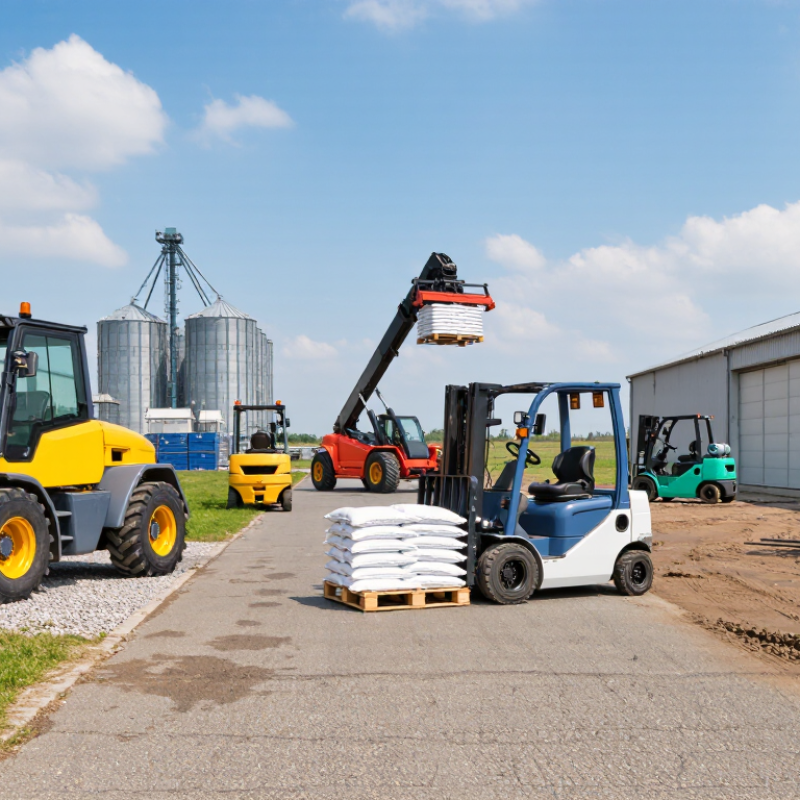
Agricultural forklifts move pallets, seed bags, feed, crates, and equipment across farms and warehouses. Counterbalance forklifts suit firm indoor floors and regular pallet work. Rough-terrain forklifts handle gravel, mud, slopes, and uneven yards. Telehandlers offer extra reach for stacking or loading trailers. However, reach alone does not guarantee safe performance.
Check the rated capacity at the real load center, not only the maximum advertised capacity. A wet feed pallet can weigh more than expected. Measure aisle width, doorway height, ramp gradients, and storage clearances before choosing a mast. Diesel power may suit long outdoor shifts, while electric models can reduce indoor emissions and noise. Battery charging space, weather protection, and local service support still matter. A perfect specification rarely exists.
Tips: Inspect the forklift with a typical load before purchase. Test braking, steering, visibility, mast movement, and attachment stability. Ask for maintenance records, operator manuals, spare-parts availability, and training support. Confirm that the machine meets applicable local safety and emissions requirements. Do not ignore soil conditions; one short site visit can reveal more than a detailed brochure. Some buyers focus heavily on purchase price, but downtime may cost more during harvest.

2026 Top Agricultural Forklift Types for Global Buyers
How to Classify Agricultural Forklift Types
Agricultural forklifts should be classified by working conditions, not appearance alone. A counterbalance forklift suits paved packing floors and pallet movement. Rough-terrain models handle gravel, mud, and uneven yards. Telehandlers add forward reach for stacked hay, bulk bags, and high storage. Compact electric units fit enclosed barns, where exhaust control and quiet operation matter.
Capacity is only one part of the classification. Buyers should record rated load, lift height, load center, tire type, turning radius, and attachment design. ISO 5053-1 provides a common language for powered industrial truck categories. OSHA reports about 85 annual forklift fatalities and 35,000 serious injuries in the United States. These figures show why stability and operator visibility must influence selection.
Power source creates another useful category: diesel, LPG, hybrid, and battery electric. A 2024 market assessment from Grand View Research projects steady global forklift growth through 2030, supported by warehouse expansion and material-handling demand. That growth does not mean every farm needs a larger machine. A 2.5-ton forklift may outperform a 4-ton unit in narrow poultry houses. Measure the aisle first.
Attachments deserve separate attention. Bale clamps, forks, buckets, and rotating carriages change the machine’s effective capacity. The original rating can become misleading. I have seen tidy specification tables hide this problem. Seasonal mud, cold batteries, and rushed loading can expose it quickly. Classification should remain practical, recorded, and reviewed after real field use.
| Forklift Type | Primary Classification | Typical Rated Capacity | Typical Lift Height | Powertrain Options | Best Agricultural Applications | Surface and Operating Conditions | Main Advantages | Important Buying Considerations |
|---|---|---|---|---|---|---|---|---|
| Compact Utility Forklift | Small, maneuverable counterbalance forklift for light-duty farm work | 1.0–2.5 tonnes | 2.5–5.0 m | Electric, diesel, LPG or gasoline | Seed bags, feed pallets, fertilizer, cartons and small implements | Warehouse floors, concrete yards, farm sheds and level hard surfaces | Compact turning radius, lower operating cost and easy indoor handling | Confirm ground clearance, mast height, aisle width and battery or fuel availability |
| Rough-Terrain Forklift | Heavy-duty forklift designed for uneven outdoor surfaces | 2.5–5.0 tonnes | 3.0–6.0 m | Diesel, typically with hydrostatic or torque-converter transmission | Hay bales, bulk bags, timber, irrigation equipment and palletized crops | Mud, gravel, compacted soil, slopes and outdoor construction-like farm areas | High ground clearance, large pneumatic tires and strong traction | Check axle oscillation, tire pattern, incline rating, weather protection and stability on slopes |
| Telehandler | Telescopic-boom handler for variable reach and height | 2.5–6.0 tonnes, depending on boom extension | 6–18 m | Diesel; some compact electric versions are available | Stacking hay and straw, loading grain, placing materials and handling attachments | Open fields, yards, barns, silage areas and uneven terrain | Combines reach, lift and attachment flexibility in one machine | Capacity decreases as reach increases; verify load chart, attachment compatibility and forward stability |
| High-Capacity Counterbalance Forklift | Industrial-class forklift for concentrated heavy loads | 5.0–10.0 tonnes | 3.0–6.0 m | Diesel or LPG | Large bulk bags, grain containers, heavy machinery and loaded trailers | Reinforced concrete, ports, processing plants and heavy-duty farm yards | High residual capacity and durable performance in demanding cycles | Requires stronger floors, wider aisles, adequate turning space and higher maintenance capacity |
| Electric Counterbalance Forklift | Low-emission forklift for indoor and clean-operating environments | 1.5–3.5 tonnes | 3.0–6.0 m | Lead-acid or lithium-ion battery | Produce packing, cold stores, food handling, seed rooms and enclosed warehouses | Smooth, firm floors; suitable for temperature-controlled or emission-sensitive areas | Quiet operation, zero tailpipe emissions and precise indoor maneuvering | Evaluate battery runtime, charging infrastructure, cold-temperature performance and water or dust protection |
| LPG or Dual-Fuel Forklift | Versatile counterbalance forklift for mixed indoor and outdoor use | 1.5–3.5 tonnes | 3.0–6.0 m | LPG, gasoline-LPG or diesel-LPG configurations | Packing houses, covered loading areas, pallet transfer and seasonal crop handling | Firm floors and ventilated indoor areas; moderate outdoor duty | Fast refueling, consistent performance and flexibility across work locations | Ensure ventilation, cylinder storage, emissions compliance and fuel supply continuity |
| Walkie Pallet Stacker | Pedestrian-operated lifting equipment for short-distance pallet work | 1.0–2.0 tonnes | 1.6–3.5 m | Battery electric | Seed and fertilizer storage, small warehouses, greenhouses and feed rooms | Level, smooth and dry floors with short travel distances | Low purchase cost, narrow turning area and simple operation | Not intended for rough terrain; verify pallet quality, ramp limits and aisle clearance |
| Tractor-Mounted Forklift | Forklift attachment or rear-mounted unit powered by an agricultural tractor | 1.0–2.5 tonnes | 2.0–4.0 m | Tractor diesel engine | Field loading, fertilizer bags, orchard bins, hay handling and seasonal tasks | Fields, orchards, farm tracks and areas where a dedicated forklift is not practical | Uses existing tractor power and reduces the need for a separate engine | Check tractor hydraulic flow, three-point hitch capacity, ballast, visibility and load stability |
| Specialty Bale and Bulk-Handling Forklift | Purpose-configured forklift with bale clamps, buckets, clamps or other agricultural attachments | 2.0–5.0 tonnes, depending on attachment and load center | 3.0–7.0 m | Diesel, LPG or electric, depending on the base machine | Round and square bales, bulk crop containers, compost, manure and loose materials | Farm yards, barns, storage areas and selected outdoor surfaces | Improves productivity by matching the handling tool to the agricultural load | Recalculate residual capacity, load-center distance, attachment weight and hydraulic requirements |
Agricultural forklift selection in 2026 depends on terrain, load shape, and daily travel distance.
Counterbalance forklifts suit packed yards, warehouses, and feed-storage buildings. Their rear steering helps tight turning, but loose soil can quickly reduce stability.
Electric models work well indoors because they produce no exhaust fumes. Charging space and battery downtime still need careful planning.
Rough-terrain forklifts handle gravel, mud, and uneven farm roads. Large pneumatic tires improve traction near fields and storage sheds.
Telescopic handlers add reach, making them useful for stacked hay, fertilizer bags, and loaded pallets. However, extending the boom changes the load chart.
A machine rated for three tonnes may lift far less at full reach. That detail is often missed.
Pallet trucks and compact forklifts support short-distance movement inside packing areas.
They are practical for crates, cartons, and smaller produce loads.
OSHA records about 85 fatal forklift incidents and 34,900 serious injuries annually in the United States, showing why training and site control matter (OSHA, Powered Industrial Trucks).
The FAO’s The State of Food and Agriculture 2022 also links suitable mechanization with improved efficiency and safer agricultural work.
Yet reports cannot replace a site inspection.
Wet concrete, sloped ground, poor visibility, and improvised attachments can defeat an otherwise suitable machine.
Buyers should verify capacity, attachment limits, operator visibility, maintenance support, and local safety requirements before ordering.
In 2026, agricultural buyers will compare electric forklifts, internal-combustion models, rough-terrain forklifts, and telehandlers. The right type depends on the farm’s surfaces and workload. Smooth warehouse floors suit electric machines with low noise and zero exhaust at the point of use. Muddy yards require deep-tread tires, higher ground clearance, and stable chassis design. Measure the heaviest load, not the average one. A 2,500-kilogram capacity may shrink when the load center moves forward.
Lift height also deserves careful checking. A tall mast can reach stacked produce, but it may reduce stability on uneven ground. Consider mast visibility, turning radius, wheelbase, and overhead clearance. Side-shifting forks can improve pallet placement. Bale clamps or forks may require a different rated capacity. Always verify the attachment’s effect on the load chart.
Battery capacity, charging time, and daily operating hours shape electric forklift selection. For combustion models, inspect fuel access, cooling performance, and filtration around dust and chaff. Rough-terrain machines should have protective underguards and reliable braking on slopes. Check service intervals before purchase. Local technicians and available parts often matter more than a low initial price. A pre-delivery inspection should include tires, hydraulic leaks, steering response, alarms, and the load-bearing structure. Keep records.
A spreadsheet helps, but it can still mislead. Real farm routes include rain, loose soil, narrow gates, and rushed operators. Test the forklift with representative loads. Leave room for mistakes. Specifications are useful only when they match daily conditions.
Typical rated lifting capacity benchmarks by forklift type. Values show the midpoint of common specification ranges and are intended for preliminary equipment selection.
Selection criteria: Compare rated capacity at the required load center, maximum lift height, terrain conditions, attachment compatibility, fuel or battery availability, operator visibility, service support, and total cost of ownership.
Global buyers should match forklift design to farm conditions, not only rated capacity.
Rough-terrain forklifts suit muddy yards, uneven fields, and gravel roads. Electric models work well in enclosed produce areas, where exhaust control matters. Telehandlers provide greater reach for stacked hay, feed, and bulk materials.
OSHA estimates that forklifts cause about 85 workplace deaths and 34,900 serious injuries annually in the United States. This figure makes operator training, visibility, and load stability purchasing requirements, not optional extras. Check the load chart with the actual attachment installed. A heavier bale clamp changes the safe capacity.
Safety performance depends on daily habits. Operators should inspect tires, forks, brakes, steering, warning alarms, and hydraulic leaks before each shift. ISO 3691-1 provides widely used safety requirements for industrial trucks, while local rules may add stricter provisions.
Agricultural sites need extra attention to slopes, wet concrete, fertilizer dust, and pedestrians near packing lines. Slow speeds help, but they do not solve poor traffic design. Clear separation works better.
Maintenance records should include battery condition, engine filters, mast rollers, chains, and tire wear. FAO reports that agricultural losses remain significant across global food supply chains, so reliable material handling protects more than equipment.
A useful admission: no checklist catches everything. Seasonal servicing is sometimes planned too late, especially before harvest. Then small leaks become expensive downtime.
Buy accessible service points, documented spare-parts support, and technicians familiar with local climate conditions.


For those larger-sized parts, or smaller quantity runs, we have 2 independent powder coat booths and ovens. The quality, durability and affordability of today’s powder coating finishes make this the process of choice for world-class companies.
Powder coating advantages over other forms of coating are many. Materials used in the Powder coating process can be metals and non-metals that come in a multitude of thicknesses, textures, colors, etc. Another of Powder coating’s biggest advantages over conventional coatings is its ability to create finishes in many different textures. Powder Coating Booths allow us the ability to apply these advantages to large products.
Tri-State Fabricators runs a full-service conveyor line for painting. Wet painting can provide protection or decoration to many different part styles. From start to finish, every project is easier to undergo random and point-based inspection by our skilled painting team.
Advantages to our Wet Paint Line are these lines start with product prep and ends with a thorough inspection of a high quality finished product. Our ability to complete large and small projects with a superior finish and doing so in a timely and economical fashion. This passes along the savings in production to our customers. When powder coating ins not an option, our Wet Paint Line gets the job done right the first time.
When the parts get big and heavy we roll-out our custom paint racks and oversize booth. By utilizing our partnerships with all the major paint brands, we can match virtually any color with wet paint.
The advantages of having access to a Wet Paint Booth are many. Large projects of many different shapes can be loaded into the booth. The Wet Paint Booth offers an environment that is much more controlled than a typical parts painting operation.
Not only are they used because of their controlled environment, but they’re are also advantageous when it comes to applying paint to parts that are needed in industries that require specialty coatings such as medical, aerospace, etc.
Our military forces have some very high standards when it comes to the finish of their vehicles and equipment. From the first pre-treatment step to final coat, it takes a great deal of knowledge and experience to protect the men and women of our armed forces. They deserve only the best, and Tri-State Fabricators provides it.
All of our processes are closely monitored by our staff and management teams. Both of which are highly trained in the processes of metal fabrication and finishing. Tri-State Fabricators’ goal is to always fully satisfy each and every customer, including the military. We will always put a 110% into what we do.
Abrasive media blasting is an excellent way to remove old paint, rust, and increase the paint/powder adhesion. Glass beads produce a much smoother and brighter finish than angular abrasives; leaving the part clean yet without any dimensional change. Chemically inert and environmentally friendly, we can recycle our beads approximately 30 times; making them a more preferred method of metal cleaning or surface finishing.
Advantages to Glass Bead Blasting are many. Glass bead blast media is used when a project is needing rough surfaces need to become smooth for applications of coatings such as paint. It is typically used to clean paint and rust from a product surface without deforming the surface it is being used on. Overall, compared to many other blasting media, Glass Bead Blasting is a very economical choice and those savings are always passed on to our customers.
Tri-State Fabricators utilize a zinc phosphate wash to clean and etch the material to ensure the best paint adhesion possible. The unique design of our 3-stage wash system does the work like a 5-stage. From Cleaning and rinsing to conversion coating and post-treatment, Our Part Washing process is a complete service and works throughout the fabrication service and the finishing service.
Along with the previously mentioned benefits, Curing is a vital chemical reaction that leaves the product finish hard and relatively safe from mild abrasion and aggressive corrosion. This process can be done in more than one way; ambient air-dry or in curing ovens at temps that exceed 240°.
From fixing paint mistakes (someone else’s of course) to simply cleaning our paint line hooks, our burn-off oven is put to good use. After a quick burn-off, a little clean up, and a fresh coat of paint, your parts will look better than new.
Why does our Burn-Off Oven work so well? Because super heating the air around parts turns the materials into ashes. From paint and powder coatings to rubber and machining oils, high temps do the job without degrading the integrity of the part.
Masking is a vital part of producing high quality products. We have die-cut masking patterns to protect machined surfaces as well as a wide range of plugs and caps to protect threaded holes and bolts. We provide permanent and temporary masking.
Masking allows the selected sections of a product to be protected from a fabrication or finishing service. This can be with both chemicals when etching and tapes, paints when only finishing just a section of the product. Masking is great in aiding the customization process of a project.
Screen printing is a photographic process that transfers artwork onto a porous nylon screen which allows colored ink to flow through the screen and be deposited on an aluminum or plastic component. We can generally have just about any design created onto a screen for your parts.
Some of the advantages of Screen Printing are, brand recognition for your business displaying on your products, assembly instructions, product warnings/hazards, etc. Tri-State Fabricators produces Screen Printing of the highest quality so you know it’s durable.
Metal Finishing is the art of treating the exterior portion of product, often metal but can also be made of other materials, so that the surface is clean and free of any debris. Then the process of applying coats or either paint of powder coat takes place. This coating process improves the quality of the product in both appearance and resistance to wear and corrosion.
Tri-State Fabricators, Inc., understands that a project typically isn’t complete until a high-quality finish has been added to your product. This is why our painting and powder coating teams continuously inspect the products throughout the Metal Finishing process.

