2026 Best Dynamic Compaction Equipment for Global Buyers

For global buyers, choosing the best Dynamic Compaction Equipment in 2026 is not a matter of selecting the largest crane or heaviest tamper. The right system must match the ground, the project footprint, and the required improvement depth. FHWA’s Ground Modification Methods Reference Manual (NHI-16-027 and NHI-16-028) explains how soil type, groundwater, impact energy, and treatment layout shape method selection. These details matter on site: a wet fill, a loose granular layer, and a confined urban parcel do not respond alike. Even the best machine cannot compensate for a poor ground investigation.

Louis Menard pioneered dynamic compaction. His work is commonly summarized by this practical principle: apply impact energy to suitable ground to improve its engineering performance. This is a paraphrase, not a verified verbatim quotation. That distinction matters when equipment claims sound certain. Buyers should compare drop-weight capacity, crane stability, cycle time, monitoring systems, service access, and local parts support—not headline specifications alone. Look for documented project results and independent geotechnical verification. Check the details.

This guide evaluates equipment for varied project conditions and buyer priorities, drawing on established engineering guidance rather than unsupported rankings. No single model is best everywhere. Some selection criteria may also be easy to overlook, especially maintenance logistics and noise constraints near occupied sites. We examine those trade-offs directly, so procurement teams can ask sharper questions before committing capital.
2026 Best Dynamic Compaction Equipment for Global Buyers

Dynamic Compaction Basics: Typical 10–40 t Rams and 10–30 m Drop Heights

2026 Best Dynamic Compaction Equipment for Global Buyers

Dynamic Compaction Basics: Typical 10–40 t Rams and 10–30 m Drop Heights

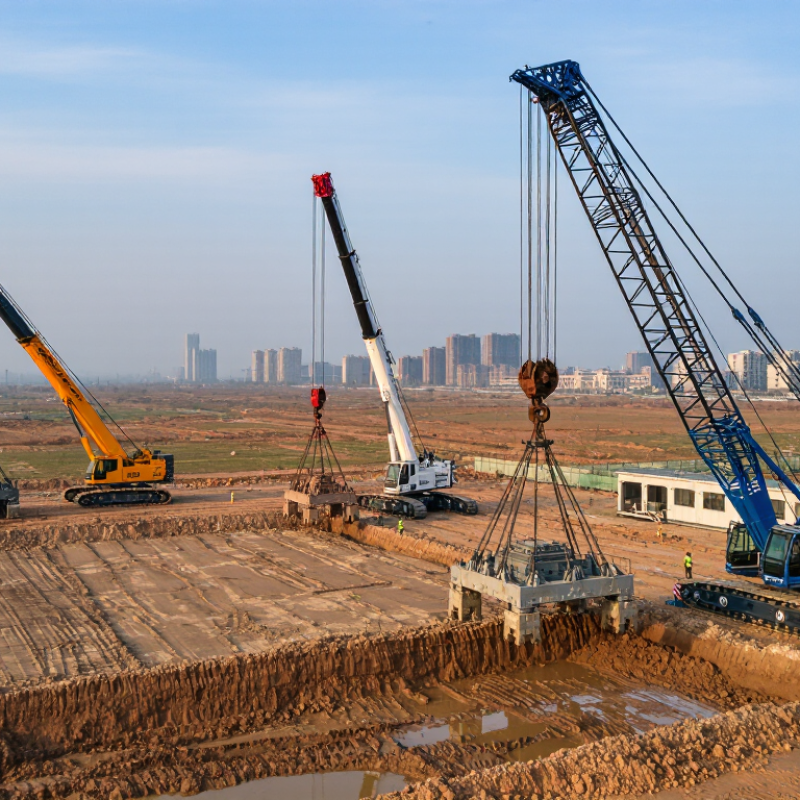
Dynamic compaction densifies loose ground by repeatedly dropping a heavy steel ram. Typical equipment uses 10–40 t rams and drop heights of 10–30 m. These figures describe a broad operating range, not a universal recipe. A 20 t ram dropped from 20 m delivers substantial impact energy, but soil response depends on more than energy alone. Grain size, moisture, groundwater, fill thickness, and nearby structures all influence the result. Crews mark an impact grid, record crater depth, and adjust the sequence when settlement varies. Small changes matter.

Tips: Check groundwater and buried utilities before setting the drop pattern. Keep people outside the controlled impact area, and monitor vibration near sensitive structures. Record ram mass, drop height, and crater response for each pass. Measure, then adjust.

A specification sheet can look tidy while actual ground conditions remain messy. Trial drops help confirm whether the planned energy suits the site. Very high drops may increase vibration or create deep craters, while lighter settings can require more passes. The best setup balances treatment depth, production rate, and surrounding constraints. Engineers should review monitoring results and revise the grid or sequence when field behavior differs from predictions. Even a carefully planned treatment can leave uneven zones, so verification testing remains important before the next construction stage.

Dynamic Compaction Basics: Theoretical Impact Energy

Typical equipment uses 10–40 t rams and drop heights of about 10–30 m. This chart compares theoretical impact energy for different ram masses at a fixed 20 m drop height.

Calculated using E = m × g × h, with g = 9.81 m/s². These values are theoretical gravitational potential energy; actual energy transferred to the ground varies with site and equipment conditions.

Site Screening: Granular Soils and Common Improvement Depths of 5–10 m

2026 Best Dynamic Compaction Equipment for Global Buyers

Dynamic compaction can suit loose granular soils when the target improvement depth is about 5–10 m. Start with a site investigation, not an equipment shortlist. Boreholes or cone penetration tests can help reveal loose layers, dense seams, and groundwater levels. Clean sands and gravels often respond well, while silty or clay-rich layers may limit energy transfer. Conditions vary sharply across a site. A single test point can miss a weak pocket.

Plan trial drops before full production. Record drop height, tamper weight, spacing, crater depth, and ground movement. Watch for excessive vibration near buildings, buried services, or sensitive structures. If groundwater sits close to the surface, pore pressure and drainage need careful review. Improvement depth is an estimate, not a guarantee; verify results with post-treatment testing. The first grid is rarely perfect, so adjust spacing and energy when field data disagree with the design.

Tips: Keep a simple drop log, and photograph the surface after each pass. Check for heave between craters. Small changes matter. Don’t treat a neat crater pattern as proof of uniform improvement; testing should confirm the ground response.

Energy Design: Estimate Depth with D ≈ 0.5√(W×H), Using Metric Units

For dynamic compaction equipment planning, the estimate D ≈ 0.5√(W×H) offers a quick way to gauge treatment depth. Here, D is estimated depth in metres, W is tamper mass in metric tonnes, and H is drop height in metres. Treat the result as an early screening value, not a guaranteed field outcome. Soil does not behave like a neat equation.

For example, a 10-tonne tamper dropped from 20 metres gives an estimated depth of about 7 metres. Keep the units consistent; entering kilograms instead of tonnes changes the result substantially. The coefficient is empirical, so local soil conditions and project experience matter. A loose granular layer, buried fill, or shallow groundwater can all affect the response.

Check the ground before selecting equipment. Review borehole records, inspect the working platform, and confirm that the crane and drop zone can safely support the planned operation. During compaction, record drop height, impact points, and settlement measurements. These details help compare the estimate with actual site performance. The formula is useful, but blunt. I would revisit the assumptions when measured settlement differs from expectations, rather than forcing the site to fit the calculation.

2026 Equipment Comparison: Match Crane Duty to About 1–12 MN·m Impact Energy

Dynamic compaction buyers should compare impact energy with crane duty, not treat the MN·m figure as a complete equipment specification. The FHWA Ground Improvement Methods Reference Manual (NHI-06-019/020, 2006) describes tamper masses of about 5–30 tonnes and drop heights of 10–30 metres. Using E = mgh, that corresponds to roughly 0.5–8.8 MN·m per drop. A 1–12 MN·m comparison therefore spans routine work and demanding high-energy applications. Check the crane’s rated capacity at the actual working radius, including the tamper, rigging, and operating setup. Radius matters. So does the duty cycle.

At the upper end, 12 MN·m from a 30-metre drop implies a theoretical tamper mass near 41 tonnes, before rigging is counted. Crane selection must follow load charts and the complete lift configuration, not energy alone. Ground conditions also change the practical choice: loose fill, nearby structures, and required treatment depth can alter drop patterns and productivity. Small details matter. A neat energy table can still mislead, because site variability rarely fits clean comparison rows. That comparison is imperfect. Review geotechnical data and trial-drop results before committing to a machine class; the right match is the one that delivers the target energy safely and consistently at the required radius.

Performance Checks: Verify Ground Improvement with ASTM D5778 CPT or D1586 SPT

2026 Best Dynamic Compaction Equipment for Global Buyers

Performance Checks: Verify Ground Improvement with ASTM D5778 CPT or D1586 SPT

Dynamic compaction equipment delivers impact energy, but field verification shows whether the ground responded as intended. Establish baseline conditions before treatment, then repeat tests at planned locations and depths. Keep test points consistent where practical. Small layout changes can make comparisons less useful.

ASTM D5778 cone penetration testing provides a near-continuous profile of cone resistance, sleeve friction, and, when measured, pore pressure. It can reveal soft layers between impact points. ASTM D1586 standard penetration testing provides samples and blow counts at discrete intervals. Account for equipment and procedure, and use energy-corrected N60 values when appropriate. The methods are not interchangeable.

Timing matters. In saturated fine-grained soils, excess pore pressure may need time to dissipate after impacts. Testing too soon can misrepresent improvement. Gravel, cobbles, or variable fill may also obstruct CPT or distort SPT results. Not every site gives a neat answer. Compare results with the project’s specified acceptance criteria, groundwater conditions, and baseline data; do not rely on one isolated high reading. Document coordinates, test depths, dates, and any refusal or unusual response, so the engineer can judge whether more testing is needed.


Powder Coat Booths

For those larger-sized parts, or smaller quantity runs, we have 2 independent powder coat booths and ovens. The quality, durability and affordability of today’s powder coating finishes make this the process of choice for world-class companies.

Powder coating advantages over other forms of coating are many. Materials used in the Powder coating process can be metals and non-metals that come in a multitude of thicknesses, textures, colors, etc. Another of Powder coating’s biggest advantages over conventional coatings is its ability to create finishes in many different textures. Powder Coating Booths allow us the ability to apply these advantages to large products.

Wet Paint Line

Tri-State Fabricators runs a full-service conveyor line for painting. Wet painting can provide protection or decoration to many different part styles. From start to finish, every project is easier to undergo random and point-based inspection by our skilled painting team.

Advantages to our Wet Paint Line are these lines start with product prep and ends with a thorough inspection of a high quality finished product. Our ability to complete large and small projects with a superior finish and doing so in a timely and economical fashion. This passes along the savings in production to our customers. When powder coating ins not an option, our Wet Paint Line gets the job done right the first time.

Wet Paint Booths

When the parts get big and heavy we roll-out our custom paint racks and oversize booth. By utilizing our partnerships with all the major paint brands, we can match virtually any color with wet paint.

The advantages of having access to a Wet Paint Booth are many. Large projects of many different shapes can be loaded into the booth. The Wet Paint Booth offers an environment that is much more controlled than a typical parts painting operation.

Not only are they used because of their controlled environment, but they’re are also advantageous when it comes to applying paint to parts that are needed in industries that require specialty coatings such as medical, aerospace, etc.

Military CARC

Our military forces have some very high standards when it comes to the finish of their vehicles and equipment. From the first pre-treatment step to final coat, it takes a great deal of knowledge and experience to protect the men and women of our armed forces. They deserve only the best, and Tri-State Fabricators provides it.

All of our processes are closely monitored by our staff and management teams. Both of which are highly trained in the processes of metal fabrication and finishing. Tri-State Fabricators’ goal is to always fully satisfy each and every customer, including the military. We will always put a 110% into what we do.

Glass-Bead Blasting

Abrasive media blasting is an excellent way to remove old paint, rust, and increase the paint/powder adhesion. Glass beads produce a much smoother and brighter finish than angular abrasives; leaving the part clean yet without any dimensional change. Chemically inert and environmentally friendly, we can recycle our beads approximately 30 times; making them a more preferred method of metal cleaning or surface finishing.

Advantages to Glass Bead Blasting are many. Glass bead blast media is used when a project is needing rough surfaces need to become smooth for applications of coatings such as paint. It is typically used to clean paint and rust from a product surface without deforming the surface it is being used on. Overall, compared to many other blasting media, Glass Bead Blasting is a very economical choice and those savings are always passed on to our customers.

Part Washing

Tri-State Fabricators utilize a zinc phosphate wash to clean and etch the material to ensure the best paint adhesion possible. The unique design of our 3-stage wash system does the work like a 5-stage. From Cleaning and rinsing to conversion coating and post-treatment, Our Part Washing process is a complete service and works throughout the fabrication service and the finishing service.

Along with the previously mentioned benefits, Curing is a vital chemical reaction that leaves the product finish hard and relatively safe from mild abrasion and aggressive corrosion. This process can be done in more than one way; ambient air-dry or in curing ovens at temps that exceed 240°.

Burn-Off Oven

From fixing paint mistakes (someone else’s of course) to simply cleaning our paint line hooks, our burn-off oven is put to good use. After a quick burn-off, a little clean up, and a fresh coat of paint, your parts will look better than new.

Why does our Burn-Off Oven work so well? Because super heating the air around parts turns the materials into ashes. From paint and powder coatings to rubber and machining oils, high temps do the job without degrading the integrity of the part.

Masking

Masking is a vital part of producing high quality products. We have die-cut masking patterns to protect machined surfaces as well as a wide range of plugs and caps to protect threaded holes and bolts. We provide permanent and temporary masking.

Masking allows the selected sections of a product to be protected from a fabrication or finishing service. This can be with both chemicals when etching and tapes, paints when only finishing just a section of the product. Masking is great in aiding the customization process of a project.

Screen Printing

Screen printing is a photographic process that transfers artwork onto a porous nylon screen which allows colored ink to flow through the screen and be deposited on an aluminum or plastic component. We can generally have just about any design created onto a screen for your parts.

Some of the advantages of Screen Printing are, brand recognition for your business displaying on your products, assembly instructions, product warnings/hazards, etc. Tri-State Fabricators produces Screen Printing of the highest quality so you know it’s durable.

Metal Finishing

Metal Finishing is the art of treating the exterior portion of product, often metal but can also be made of other materials, so that the surface is clean and free of any debris. Then the process of applying coats or either paint of powder coat takes place. This coating process improves the quality of the product in both appearance and resistance to wear and corrosion.

Tri-State Fabricators, Inc., understands that a project typically isn’t complete until a high-quality finish has been added to your product. This is why our painting and powder coating teams continuously inspect the products throughout the Metal Finishing process.



