


Crystals are not one uniform wholesale category. Amethyst, clear quartz, rose quartz, agate, and labradorite differ in color consistency, durability, processing, and buyer appeal. For 2026, wholesale buyers need to assess more than popular names. They should compare supplier reliability, grading practices, minimum order quantities, packaging, and the consistency of samples against bulk shipments. A vivid sample is not a guarantee of a uniform lot.
Grand View Research estimated the global gemstone market at USD 32.38 billion in 2023 and projected a 6.2% compound annual growth rate from 2024 to 2030. Its report covers gemstones broadly, including jewelry applications; it does not measure demand for crystal décor or wholesale mineral specimens specifically. That distinction matters. The figure offers market context, not a direct sales forecast for any crystal type. Still, market forecasts are not purchase orders.
This guide compares crystal types through practical buying criteria: recognizable appearance, availability, finish options, and likely fit across retail and décor channels. It also considers trade-offs. Amethyst may be familiar to shoppers, while less common stones can create a distinctive display but bring uneven color or supply. Buyers should request clear product specifications, current photographs, and written confirmation of material and treatments. Where supplier information is incomplete, pause and verify. The best choice is rarely the most dramatic stone alone; dependable quality and repeatable sourcing matter just as much.
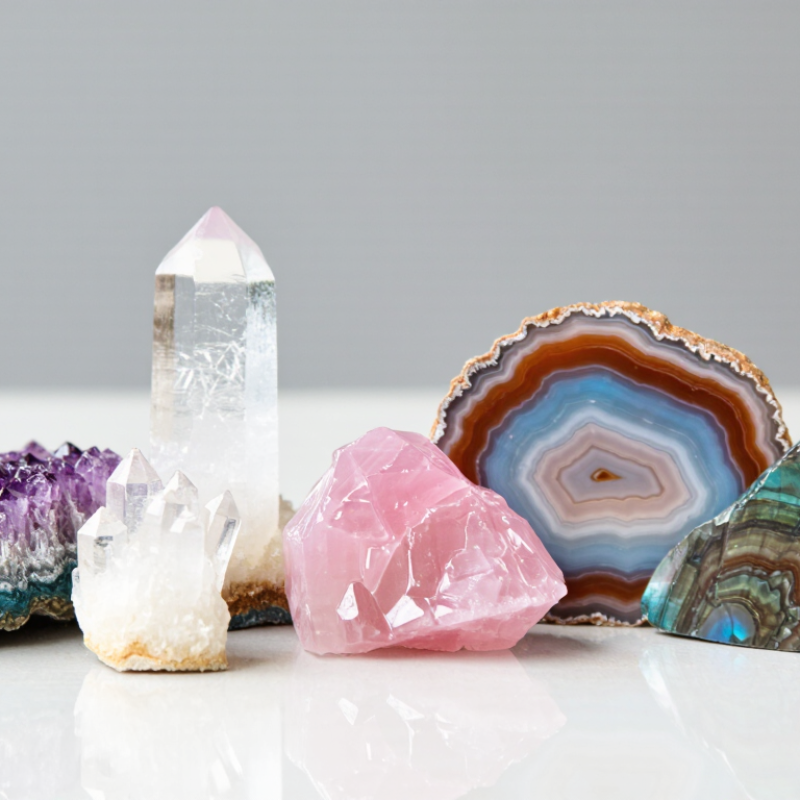
2026 Best Crystal Types for Wholesale Buyers
Build a wholesale shortlist around Mohs hardness, which measures scratch resistance from 1 to 10. It helps compare everyday handling needs, but it does not predict every breakage risk. Quartz, including amethyst and many agates, rates about 7 and suits buyers seeking harder stones. Fluorite rates 4, while calcite rates 3. These softer choices may need more careful packing and display.
Match ratings to the way customers will use each item. For frequently handled pieces, consider quartz varieties and inspect polished surfaces for chips or scratches. For decorative collections, fluorite and calcite offer different colors and forms, but their lower ratings call for protective dividers in wholesale cartons. Selenite, a gypsum variety, is especially soft at about 2. Keep it away from harder stones. Small scratches add up.
Mohs ratings are a starting point, not a complete quality grade. Cleavage, internal fractures, shape, and finishing can affect how a piece withstands impact. A hard crystal can still chip if it has a weak edge. Compare samples from several pieces in a batch, and ask suppliers how stones are sorted and packed. I would not build a buying decision around one number alone; that shortcut is tempting, but incomplete.

Amethyst and citrine are both quartz, with a Mohs hardness of 7. That makes them suitable for many everyday jewelry designs, though hardness measures scratch resistance, not resistance to impact. A sharp knock can still chip a faceted edge. Amethyst ranges from pale lilac to deep violet; citrine typically runs from soft yellow to golden brown. Check color consistency across a parcel, since shade affects how well stones match in finished pieces.
Ask for specifics. Commercial citrine may be heat-treated amethyst, so buyers should request clear treatment disclosures and record them with purchase details. This is a practical sourcing step, not a judgment on value: treatment can be acceptable when accurately described. Compare sample stones under neutral light, then inspect them again under the lighting used in your showroom.
Agate usually measures 6.5–7 on the Mohs scale, close to quartz, but its banding and translucency vary widely. Look for chips along cut edges, uneven polish, and color that appears concentrated in cracks. Hardness alone does not tell the whole story. I would not choose a lot from a single attractive specimen; reviewing several pieces can reveal variation that the sample hides. Ask suppliers how they grade, disclose, and pack each variety before setting order expectations.
For a color-led wholesale collection, fluorite and calcite offer broad visual range without relying on unusual shapes. Fluorite, at Mohs 4, often appears in clear greens, purples, and banded combinations. Its color zoning can make matched sets lively, though it also makes exact pair-matching difficult. Inspect pieces under neutral light; strong shop lighting may hide cloudy areas or uneven polish. Color sells first. But fluorite has distinct cleavage, so chips can occur if parcels are packed loosely.
Calcite, Mohs 3, brings saturated yellows, oranges, blues, and soft whites, often with a waxy-looking luster. It scratches easily and reacts with acids, so avoid rough contact and acidic cleaners. For wholesale buying, request consistent size ranges, clear grading notes, and photos of representative lots rather than one ideal specimen. Ask how pieces are protected in transit; individual sleeves or padded dividers can reduce abrasion. Still, color is not a quality grade by itself. Cloudy or uneven pieces may suit affordable mixed trays, but only when that variation is disclosed. A small sample order is prudent. I would not overpromise uniformity.
| Buying Dimension | Fluorite | Calcite | Wholesale Collection Consideration |
|---|---|---|---|
| Mohs hardness | 4 | 3 | Both are relatively soft compared with quartz (Mohs 7). Plan for protective packaging and advise customers to keep pieces away from harder minerals and abrasive surfaces. |
| Crystal system | Isometric (cubic) | Trigonal | Crystal form can add visual variety to a display, but individual specimens vary in shape, finish and degree of crystal development. |
| Common color range | Colorless, purple, green, blue, yellow and color combinations; color may vary within a specimen. | Colorless, white, gray, yellow, orange, pink, red, green and brown, depending on the specimen. | Use specimen-specific descriptions and photographs. Color is variable, so avoid promising an exact shade across a wholesale lot. |
| Transparency and appearance | Can range from transparent to translucent or opaque; banding and zoning may occur. | Can range from transparent to opaque; crystal habit and surface finish affect appearance. | Sort and grade by visible characteristics such as color, clarity, banding, form and finish rather than mineral name alone. |
| Cleavage and handling | Perfect octahedral cleavage in four directions; can break along cleavage planes. | Perfect rhombohedral cleavage in three directions; can split into rhombohedral pieces. | Use individual compartments or cushioning in transit. Inspect edges and corners, especially on faceted or naturally formed pieces. |
| Approximate specific gravity | About 3.18 | About 2.71 | Useful as a reference when comparing similar-sized specimens, but it is not a substitute for identification or lot inspection. |
| Fluorescence | Some specimens fluoresce under ultraviolet light, often blue or violet; response varies. | Some specimens fluoresce under ultraviolet light; color and intensity vary. | If fluorescence is part of the product description, verify the actual pieces under the stated UV wavelength and disclose that not all specimens respond. |
| Care considerations | Handle gently and avoid impact, abrasion and prolonged exposure to strong direct sunlight, which may affect color in some specimens. | Handle gently; avoid acids, which react with calcite, and avoid abrasive cleaning. | Provide care instructions appropriate to the specific product form. Do not imply that every specimen has identical light or handling sensitivity. |
| Color-led merchandising | Suitable for a palette organized around purple, green, blue and multicolor zoning. | Offers a broad palette, including neutral, warm and pastel tones. | Build assortments around documented color groups and consistent grading. Treat these as merchandising suggestions, not guarantees of lot uniformity. |
Buyer note: Mineral properties and appearance can vary between specimens. Confirm grade, dimensions, finish, color range and packaging requirements against the actual lot before placing a wholesale order.
For wholesale buyers, topaz and corundum offer high hardness, but they behave differently in handling. Topaz ranks 8 on the Mohs scale; corundum ranks 9. That difference matters for scratch resistance, yet Mohs hardness is not a measure of impact strength. Topaz has pronounced cleavage, so a sharp knock may cause damage even when its surface resists scratches. Corundum has no cleavage and is generally a sturdier choice for pieces exposed to frequent wear. Small details matter.
When comparing lots, inspect representative stones under neutral light. Check color consistency, visible inclusions, cutting quality, and any chips near edges or corners. Ask suppliers for clear disclosure of identity and known treatments, plus consistent grading criteria across the shipment. A bright sample can look excellent alone, then feel less uniform beside the full parcel. I would not rely on hardness alone; it is useful, but it cannot replace careful inspection or a clear return agreement.
Tips: Request several pieces from the actual lot, not only a showcase sample. Use a loupe and soft cloth during inspection, and document mismatches before accepting delivery. Recheck your criteria after each order; a grading checklist can still miss what matters to your customers.
For wholesale buyers, a crystal’s name is only a starting point. Ask suppliers to state the mineral species, trade name, and common look-alikes separately. A label such as “blue agate” may describe appearance, not a precise mineral identity.
Treatment records matter. Request written disclosure of dyeing, heating, coating, impregnation, or other enhancement, including the method used when known. Compare the disclosure with close-up photos taken in neutral light. Vivid color around drilled holes can be a clue, but it is not proof. Keep invoices and batch notes together, especially when treatment affects pricing or display labels.
Lot consistency is practical, not merely cosmetic. Request measurements for several pieces, not just one selected sample. Compare color, translucency, fracture patterns, and average weight. For a 500-piece order, sample from different cartons; one attractive pouch can hide variation. Sampling has limits. Ask for dated photos, lot numbers, and a retained reference specimen. If supplier data are incomplete, narrow the order or pause rather than fill gaps with assumptions. Wording can change between batches; that deserves a question, though it may be clerical drift. A certificate is not a guarantee. Check that it identifies the actual lot and the tests performed.
Compare Mohs hardness ranges for common crystal materials. Hardness is a useful material reference, not proof of mineral identity or treatment.
Supplier checks: Request mineral identity documentation, written disclosure of any treatments, and consistent identification and treatment records for each lot. Mohs hardness is a relative scratch scale; results can vary within a material.


For those larger-sized parts, or smaller quantity runs, we have 2 independent powder coat booths and ovens. The quality, durability and affordability of today’s powder coating finishes make this the process of choice for world-class companies.
Powder coating advantages over other forms of coating are many. Materials used in the Powder coating process can be metals and non-metals that come in a multitude of thicknesses, textures, colors, etc. Another of Powder coating’s biggest advantages over conventional coatings is its ability to create finishes in many different textures. Powder Coating Booths allow us the ability to apply these advantages to large products.
Tri-State Fabricators runs a full-service conveyor line for painting. Wet painting can provide protection or decoration to many different part styles. From start to finish, every project is easier to undergo random and point-based inspection by our skilled painting team.
Advantages to our Wet Paint Line are these lines start with product prep and ends with a thorough inspection of a high quality finished product. Our ability to complete large and small projects with a superior finish and doing so in a timely and economical fashion. This passes along the savings in production to our customers. When powder coating ins not an option, our Wet Paint Line gets the job done right the first time.
When the parts get big and heavy we roll-out our custom paint racks and oversize booth. By utilizing our partnerships with all the major paint brands, we can match virtually any color with wet paint.
The advantages of having access to a Wet Paint Booth are many. Large projects of many different shapes can be loaded into the booth. The Wet Paint Booth offers an environment that is much more controlled than a typical parts painting operation.
Not only are they used because of their controlled environment, but they’re are also advantageous when it comes to applying paint to parts that are needed in industries that require specialty coatings such as medical, aerospace, etc.
Our military forces have some very high standards when it comes to the finish of their vehicles and equipment. From the first pre-treatment step to final coat, it takes a great deal of knowledge and experience to protect the men and women of our armed forces. They deserve only the best, and Tri-State Fabricators provides it.
All of our processes are closely monitored by our staff and management teams. Both of which are highly trained in the processes of metal fabrication and finishing. Tri-State Fabricators’ goal is to always fully satisfy each and every customer, including the military. We will always put a 110% into what we do.
Abrasive media blasting is an excellent way to remove old paint, rust, and increase the paint/powder adhesion. Glass beads produce a much smoother and brighter finish than angular abrasives; leaving the part clean yet without any dimensional change. Chemically inert and environmentally friendly, we can recycle our beads approximately 30 times; making them a more preferred method of metal cleaning or surface finishing.
Advantages to Glass Bead Blasting are many. Glass bead blast media is used when a project is needing rough surfaces need to become smooth for applications of coatings such as paint. It is typically used to clean paint and rust from a product surface without deforming the surface it is being used on. Overall, compared to many other blasting media, Glass Bead Blasting is a very economical choice and those savings are always passed on to our customers.
Tri-State Fabricators utilize a zinc phosphate wash to clean and etch the material to ensure the best paint adhesion possible. The unique design of our 3-stage wash system does the work like a 5-stage. From Cleaning and rinsing to conversion coating and post-treatment, Our Part Washing process is a complete service and works throughout the fabrication service and the finishing service.
Along with the previously mentioned benefits, Curing is a vital chemical reaction that leaves the product finish hard and relatively safe from mild abrasion and aggressive corrosion. This process can be done in more than one way; ambient air-dry or in curing ovens at temps that exceed 240°.
From fixing paint mistakes (someone else’s of course) to simply cleaning our paint line hooks, our burn-off oven is put to good use. After a quick burn-off, a little clean up, and a fresh coat of paint, your parts will look better than new.
Why does our Burn-Off Oven work so well? Because super heating the air around parts turns the materials into ashes. From paint and powder coatings to rubber and machining oils, high temps do the job without degrading the integrity of the part.
Masking is a vital part of producing high quality products. We have die-cut masking patterns to protect machined surfaces as well as a wide range of plugs and caps to protect threaded holes and bolts. We provide permanent and temporary masking.
Masking allows the selected sections of a product to be protected from a fabrication or finishing service. This can be with both chemicals when etching and tapes, paints when only finishing just a section of the product. Masking is great in aiding the customization process of a project.
Screen printing is a photographic process that transfers artwork onto a porous nylon screen which allows colored ink to flow through the screen and be deposited on an aluminum or plastic component. We can generally have just about any design created onto a screen for your parts.
Some of the advantages of Screen Printing are, brand recognition for your business displaying on your products, assembly instructions, product warnings/hazards, etc. Tri-State Fabricators produces Screen Printing of the highest quality so you know it’s durable.
Metal Finishing is the art of treating the exterior portion of product, often metal but can also be made of other materials, so that the surface is clean and free of any debris. Then the process of applying coats or either paint of powder coat takes place. This coating process improves the quality of the product in both appearance and resistance to wear and corrosion.
Tri-State Fabricators, Inc., understands that a project typically isn’t complete until a high-quality finish has been added to your product. This is why our painting and powder coating teams continuously inspect the products throughout the Metal Finishing process.

