


The 2026 search for reliable Wooden Chess Board manufacturers begins with more than appearance. Global buyers need verified materials, stable production, and dependable export performance. A board may look elegant under showroom lighting, yet warp after one humid season. That detail matters.
Grand View Research identifies board games as a growing global leisure market, supported by family entertainment, education, and premium hobby spending. Its market estimates differ from other research firms because product categories and regional coverage are not identical. This is worth remembering. Market growth does not automatically prove manufacturing quality.
Material sourcing deserves equal attention. The FAO’s Global Forest Products Facts and Figures reports show the continuing importance of international wood production and trade. For responsible procurement, buyers should request species information, moisture-control procedures, and traceable documentation. FSC certification can strengthen credibility, although certification claims still require verification through valid certificates and supply-chain records.
Experience often exposes the hidden costs. A warped walnut board can create returns, while uneven squares can damage a retailer’s reputation. Professional manufacturers should explain kiln drying, sanding tolerances, coating systems, packaging tests, and replacement policies. They should also provide clear samples before large orders.
Factory visits, independent inspections, and batch photographs remain useful evidence. So do honest answers about production limits. No supplier is perfect. Some manufacturers may offer beautiful prototypes but struggle with repeat consistency. Others may provide strong quality control but limited customization.
This guide evaluates leading manufacturers for global buyers in 2026. It considers craftsmanship, responsible sourcing, export readiness, customization, pricing transparency, and after-sales support. The goal is practical comparison, not exaggerated promotion.
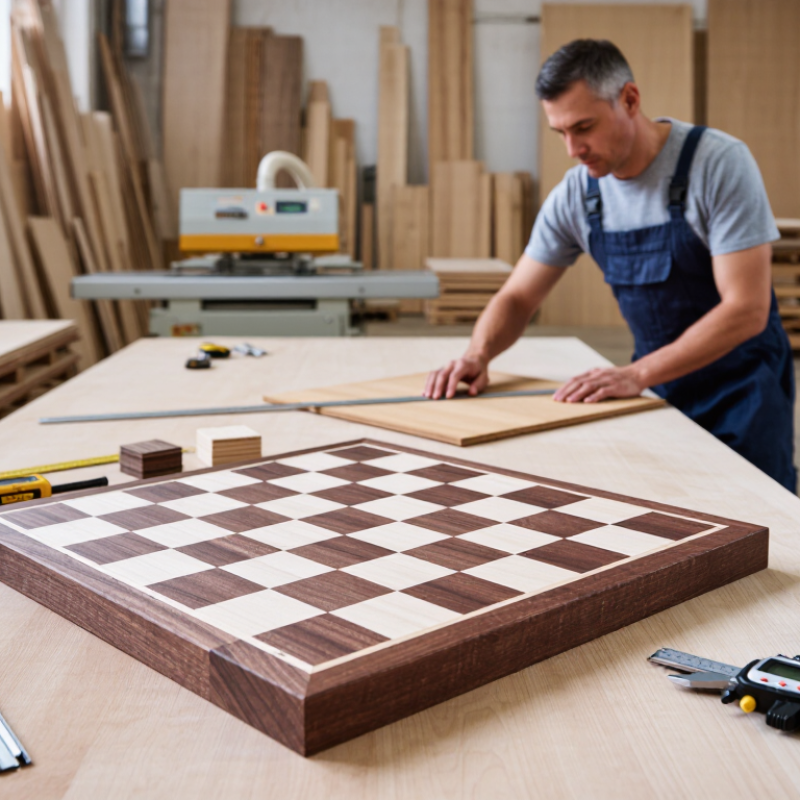
A high-quality wooden chess board manufacturer proves its ability through materials, process control, and consistent inspection. Experienced buyers should examine the wood’s moisture level before production. Poorly dried timber may warp after shipment or crack in a dry room. The board should feel stable, with even squares, clean edges, and a smooth surface without strong chemical odors. Grain selection also matters. Natural variation is acceptable, but large knots near the playing area can reduce durability.
Reliable manufacturers provide clear samples, production drawings, and measurable quality standards. They should explain how boards are cut, joined, sanded, finished, and packed. During factory evaluations, check whether workers inspect every board or only random pieces. Ask for moisture records and packaging tests. A strong supplier can trace materials and correct defects without hiding them. No workshop is flawless. The real test is how openly it handles mistakes.
Tips: Request a pre-production sample. Compare its dimensions with the approved drawing. Press gently near each corner and watch for movement. Check whether the finish feels uniform under natural light. Confirm carton protection before placing a large order. Ask how replacement claims are documented. A low price may look attractive, but weak packaging can turn savings into losses. Even experienced buyers sometimes focus too much on appearance. That is worth reconsidering.

For global buyers, wooden chess boards should be judged by manufacturing control, not appearance alone. The USDA Forest Products Laboratory’s Wood Handbook explains that wood changes dimension as moisture content changes. Reliable factories therefore kiln-dry hardwood, usually near 6–8% moisture for indoor products, then condition the pieces before machining. Climate still matters. A board made for a dry warehouse may react differently in a humid home.
Modern production often combines CNC routing with careful hand finishing. CNC equipment keeps square size and border spacing consistent. Workers then inspect grain direction, sand edges, and apply thin, even coatings. I would request moisture readings from several boards, not one sample. One measurement proves very little. Warping checks should include flat-surface testing after packaging and temperature changes.
Material traceability is equally important. The FAO Global Forest Resources Assessment 2020 reported that forests covered about 31% of global land and that roughly 420 million hectares disappeared between 1990 and 2020. Buyers should ask for species identification, legal origin documents, and chain-of-custody evidence where certified timber is specified. Formaldehyde emissions from composite components should also meet the destination market’s requirements. A solid-wood board can still contain questionable veneer adhesive. Finish safety deserves attention too, especially when boards may be handled by children. Industry testing helps, but factory records and independent inspection remain necessary.
2026 Best Wooden Chess Board Manufacturers for Global Buyers?
How to Evaluate Global Suppliers and Customization Options
Choosing a wooden chess board manufacturer requires more than comparing catalog prices. Experienced buyers should inspect wood species, moisture control, machining accuracy, and surface finishing. Ask for evidence. Request recent product photos, quality records, material documentation, and a physical sample before placing a large order. Samples reveal flaws. Check whether squares align cleanly, pieces sit firmly, and hinges or drawers operate without rough edges.
Supplier reliability also depends on production capacity and communication. Ask about minimum order quantities, sample fees, lead times, packaging tests, and replacement procedures. A factory may promise flexible customization, but its technical response matters more. Can it provide drawings for board dimensions, engraving depth, color matching, and inlay placement? Written specifications reduce misunderstandings between purchasing teams and production staff. Independent inspections can verify quantities, finish consistency, carton strength, and labeling before shipment.
Customization often increases risk. Extra stains may hide natural grain, while thin veneers can separate after temperature changes. Discuss acceptable color variation in advance. That detail is easy to overlook. A supplier with strong experience should explain limitations honestly, rather than promise every design without qualification. Buyers should also review ethical sourcing statements and applicable product-safety requirements for their destination markets. I have found that the cheapest quotation is rarely the clearest one. Still, a higher price does not automatically prove better workmanship. Compare measurable details, test results, and response quality before deciding.
This chart presents a practical 100-point evaluation framework for global buyers comparing wooden chess board suppliers in 2026. Quality and compliance, customization capability, production consistency, export readiness, and total cost are weighted according to their importance in international sourcing decisions.
Leading Wooden Chess Board Manufacturers for 2026
For global buyers, leading wooden chess board manufacturers must offer more than attractive grain. They need stable timber, accurate squares, and repeatable finishing. A board should lie flat after shipment, not curl beside a sunny window. Experienced buyers should request moisture readings, sample photos, and packaging tests before placing large orders. Small details matter. Square alignment matters.
Fortune Business Insights estimates the global board games market will grow from about USD 13 billion in 2023 to more than USD 25 billion by 2030. This growth supports wider demand for premium chess products, but market forecasts differ by definition. That uncertainty deserves attention. Manufacturers serving 2026 buyers should document material sources, production capacity, inspection procedures, and export experience. FSC-certified timber may support responsible purchasing, although certification alone does not prove excellent craftsmanship.
Reliable suppliers should explain wood species, veneer thickness, lacquer composition, and tolerance standards in plain English. Buyers can compare a 50-board trial order before approving thousands of units. The World Chess Federation reported 199 affiliated national federations in 2024, showing the game's broad international reach. However, global reach does not guarantee consistent quality. A handmade board may contain slight color variation, and that is not always a defect. Excessive warping, rough edges, or uneven inlays are different problems. Manufacturers that record humidity conditions and final inspections appear better prepared for international distribution.
For global buyers, a wooden chess board is more than a playing surface. Pricing depends on wood species, kiln-drying, square precision, finish, packaging, and order volume. A low quote may exclude export cartons, inspection fees, or destination charges. Request a complete landed-cost sheet. It should separate product price, tooling, inland transport, freight, insurance, duties, and taxes. Confirm currency validity before production begins. Exchange rates can shift quickly. Small detail, big impact.
Certification should match the destination market and product design. Ask for wood-origin documents, treatment records, material declarations, and accurate commercial invoices. If the board uses metal parts, paints, or adhesives, request relevant safety information. Wooden packaging may require approved treatment marks. Do not accept generic certificates without checking the issuer, scope, and expiry date. Requirements vary by country. A valid document may still fail to cover the actual shipment.
Shipping affects both cost and damage risk. Confirm carton dimensions, gross weight, stacking limits, and moisture protection before booking. Sea freight suits larger orders, while air freight reduces delivery time but raises costs. Use corner protection, sealed inner bags, and humidity indicators during long transit. Agree on inspection timing and claims evidence in writing. Photos help, but they cannot replace a signed inspection report. One practical lesson remains uncomfortable: seasonal port delays can defeat an otherwise careful schedule. Build buffer days.


For those larger-sized parts, or smaller quantity runs, we have 2 independent powder coat booths and ovens. The quality, durability and affordability of today’s powder coating finishes make this the process of choice for world-class companies.
Powder coating advantages over other forms of coating are many. Materials used in the Powder coating process can be metals and non-metals that come in a multitude of thicknesses, textures, colors, etc. Another of Powder coating’s biggest advantages over conventional coatings is its ability to create finishes in many different textures. Powder Coating Booths allow us the ability to apply these advantages to large products.
Tri-State Fabricators runs a full-service conveyor line for painting. Wet painting can provide protection or decoration to many different part styles. From start to finish, every project is easier to undergo random and point-based inspection by our skilled painting team.
Advantages to our Wet Paint Line are these lines start with product prep and ends with a thorough inspection of a high quality finished product. Our ability to complete large and small projects with a superior finish and doing so in a timely and economical fashion. This passes along the savings in production to our customers. When powder coating ins not an option, our Wet Paint Line gets the job done right the first time.
When the parts get big and heavy we roll-out our custom paint racks and oversize booth. By utilizing our partnerships with all the major paint brands, we can match virtually any color with wet paint.
The advantages of having access to a Wet Paint Booth are many. Large projects of many different shapes can be loaded into the booth. The Wet Paint Booth offers an environment that is much more controlled than a typical parts painting operation.
Not only are they used because of their controlled environment, but they’re are also advantageous when it comes to applying paint to parts that are needed in industries that require specialty coatings such as medical, aerospace, etc.
Our military forces have some very high standards when it comes to the finish of their vehicles and equipment. From the first pre-treatment step to final coat, it takes a great deal of knowledge and experience to protect the men and women of our armed forces. They deserve only the best, and Tri-State Fabricators provides it.
All of our processes are closely monitored by our staff and management teams. Both of which are highly trained in the processes of metal fabrication and finishing. Tri-State Fabricators’ goal is to always fully satisfy each and every customer, including the military. We will always put a 110% into what we do.
Abrasive media blasting is an excellent way to remove old paint, rust, and increase the paint/powder adhesion. Glass beads produce a much smoother and brighter finish than angular abrasives; leaving the part clean yet without any dimensional change. Chemically inert and environmentally friendly, we can recycle our beads approximately 30 times; making them a more preferred method of metal cleaning or surface finishing.
Advantages to Glass Bead Blasting are many. Glass bead blast media is used when a project is needing rough surfaces need to become smooth for applications of coatings such as paint. It is typically used to clean paint and rust from a product surface without deforming the surface it is being used on. Overall, compared to many other blasting media, Glass Bead Blasting is a very economical choice and those savings are always passed on to our customers.
Tri-State Fabricators utilize a zinc phosphate wash to clean and etch the material to ensure the best paint adhesion possible. The unique design of our 3-stage wash system does the work like a 5-stage. From Cleaning and rinsing to conversion coating and post-treatment, Our Part Washing process is a complete service and works throughout the fabrication service and the finishing service.
Along with the previously mentioned benefits, Curing is a vital chemical reaction that leaves the product finish hard and relatively safe from mild abrasion and aggressive corrosion. This process can be done in more than one way; ambient air-dry or in curing ovens at temps that exceed 240°.
From fixing paint mistakes (someone else’s of course) to simply cleaning our paint line hooks, our burn-off oven is put to good use. After a quick burn-off, a little clean up, and a fresh coat of paint, your parts will look better than new.
Why does our Burn-Off Oven work so well? Because super heating the air around parts turns the materials into ashes. From paint and powder coatings to rubber and machining oils, high temps do the job without degrading the integrity of the part.
Masking is a vital part of producing high quality products. We have die-cut masking patterns to protect machined surfaces as well as a wide range of plugs and caps to protect threaded holes and bolts. We provide permanent and temporary masking.
Masking allows the selected sections of a product to be protected from a fabrication or finishing service. This can be with both chemicals when etching and tapes, paints when only finishing just a section of the product. Masking is great in aiding the customization process of a project.
Screen printing is a photographic process that transfers artwork onto a porous nylon screen which allows colored ink to flow through the screen and be deposited on an aluminum or plastic component. We can generally have just about any design created onto a screen for your parts.
Some of the advantages of Screen Printing are, brand recognition for your business displaying on your products, assembly instructions, product warnings/hazards, etc. Tri-State Fabricators produces Screen Printing of the highest quality so you know it’s durable.
Metal Finishing is the art of treating the exterior portion of product, often metal but can also be made of other materials, so that the surface is clean and free of any debris. Then the process of applying coats or either paint of powder coat takes place. This coating process improves the quality of the product in both appearance and resistance to wear and corrosion.
Tri-State Fabricators, Inc., understands that a project typically isn’t complete until a high-quality finish has been added to your product. This is why our painting and powder coating teams continuously inspect the products throughout the Metal Finishing process.

