


Choosing the best Spray Hose in 2026 is not simply a matter of comparing prices. Global buyers need a hose that performs reliably in real working conditions. A greenhouse operator may need gentle, even misting, while a construction team may require stronger flow and abrasion resistance. The right choice depends on water pressure, spray pattern, temperature, length, fittings, and daily handling.
Small details can decide performance. A hose dragged across concrete may develop surface damage quickly. A lightweight model can feel comfortable, yet collapse under higher pressure. Reinforced layers, flexible materials, secure connectors, and clear pressure ratings deserve careful attention. Buyers should also check chemical compatibility when the hose handles approved cleaning or agricultural solutions. Product data must be verified, not assumed. Supplier testing, traceable specifications, and responsive after-sales support provide stronger evidence than attractive catalog images.
There is no perfect hose for every market. That is worth remembering. Climate, transport conditions, storage practices, and local equipment can change the result. Some manufacturers publish impressive burst-pressure figures but explain little about long-term fatigue. This guide compares common Spray Hose types through practical use, technical performance, maintenance needs, and purchasing risks. It also considers how exporters and distributors can assess samples before placing large orders. A careful trial may reveal stiffness, leaking joints, or uncomfortable handling. Those findings are inconvenient, but valuable. Reliable buying decisions often begin with questioning attractive claims and measuring what happens in actual use.
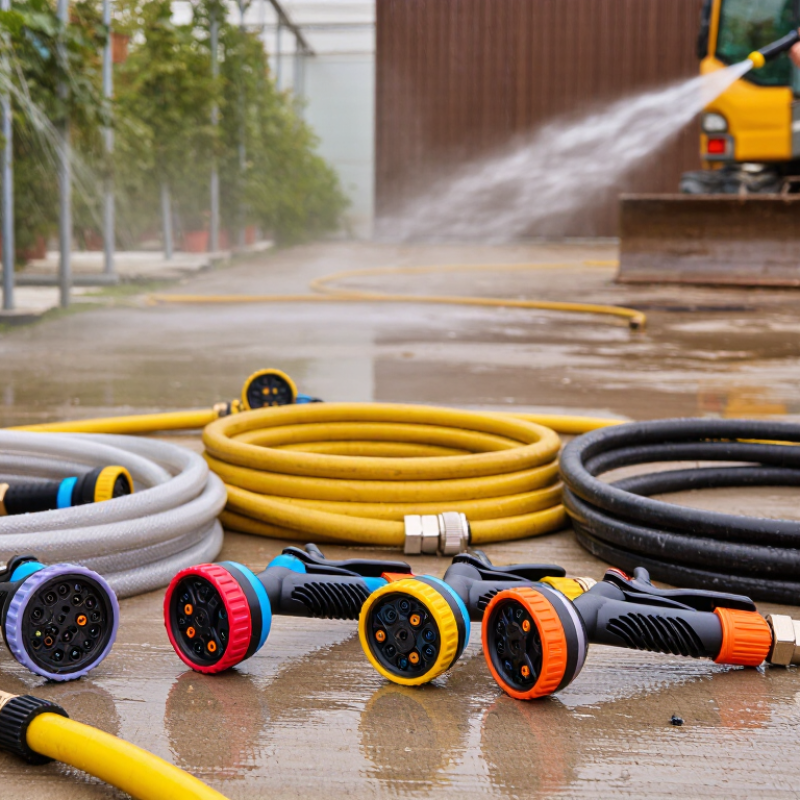
A spray hose is a flexible tube that carries water or another approved liquid to a spray nozzle. It helps operators direct liquid across a garden, workshop, farm, or cleaning area. Unlike a simple water hose, a spray hose often works with a trigger gun, adjustable nozzle, or pressure-controlled system.
Its inner tube must match the liquid being used. Water applications commonly need flexible PVC or rubber construction, while heavier work may require reinforced layers and stronger fittings. Check working pressure, temperature range, bend radius, and connection size before purchasing. A hose can feel durable but still fail near the coupling. That detail is easy to miss.
In practical use, the hose should unwind smoothly without sharp kinks. A lightweight type suits short cleaning tasks, while a reinforced type handles longer distances and frequent movement. For agricultural spraying, confirm chemical compatibility and follow the liquid manufacturer’s instructions. Do not assume one hose fits every chemical. I have seen buyers choose by color and appearance, then discover swelling after repeated use. That was preventable.
Global buyers should also inspect thread standards, labeling, test records, and local safety requirements. Storage matters too. Keep the hose away from direct sunlight, sharp edges, and extreme heat. Drain it after use when freezing conditions are possible. Small habits improve service life, although they cannot repair an unsuitable hose.

A practical comparison of common spray hose constructions, operating conditions, and suitable applications.
| Spray Hose Type | What It Is | Typical Pressure Range | Typical Temperature Range | Common Uses | Main Advantages | Important Selection Notes |
|---|---|---|---|---|---|---|
| Thermoplastic Spray Hose | A lightweight hose made from thermoplastic materials, commonly reinforced with textile braid. | Approximately 100–300 bar, depending on diameter and reinforcement. | Generally about −40°C to +60°C; verify the exact fluid rating. | Pressure washers, agricultural spraying, light hydraulic controls, and portable cleaning equipment. | Low weight, small bend radius, good handling, and resistance to many oils and chemicals. | Choose a model with a compatible inner tube and sufficient abrasion protection for outdoor use. |
| Rubber Spray Hose | A flexible elastomer hose with textile or wire reinforcement for demanding service conditions. | Approximately 100–400 bar, depending on construction and reinforcement. | Commonly about −40°C to +100°C; some specialized designs support higher temperatures. | Industrial washing, construction-site cleaning, agricultural chemicals, and general fluid spraying. | Excellent flexibility, impact resistance, and performance in variable outdoor conditions. | Check resistance to ozone, sunlight, solvents, pesticides, and the specific cleaning fluid. |
| PVC Spray Hose | A PVC hose, often reinforced with polyester yarn, designed for economical liquid transfer and spraying. | Approximately 20–100 bar, depending on wall thickness and reinforcement. | Typically about −10°C to +60°C. | Garden spraying, low-to-medium pressure agriculture, irrigation accessories, and general-purpose washing. | Cost-effective, lightweight, easy to clean, and widely available in many sizes. | Avoid excessive heat, sharp bending, and chemicals that can soften or swell PVC. |
| Wire-Reinforced Spray Hose | A hose reinforced with one or more layers of steel wire to withstand higher pressure and impulse loading. | Approximately 200–700 bar; the safe working pressure must be confirmed from the product rating. | Commonly about −40°C to +100°C, subject to hose material and fluid type. | High-pressure cleaning, industrial spray systems, water-jetting equipment, and heavy-duty maintenance. | High pressure capability, strong impulse resistance, and improved crush resistance. | It is heavier and less flexible; use compatible couplings and never exceed the rated working pressure. |
| Chemical-Resistant Spray Hose | A hose with an inner tube selected to handle particular acids, alkalis, solvents, fertilizers, or pesticides. | Approximately 10–250 bar, depending on the chemical service and hose structure. | Often about −30°C to +80°C; chemical and temperature ratings must be checked together. | Crop protection, fertilizer application, chemical processing, and controlled liquid dispensing. | Reduced risk of swelling, cracking, or contamination when correctly matched to the fluid. | Fluid concentration, exposure time, operating temperature, and permeation are critical factors. |
| Food-Grade Spray Hose | A hose manufactured with materials intended for contact with specified food or beverage products. | Approximately 10–80 bar, depending on the construction and application. | Usually about −30°C to +100°C; cleaning and sterilization limits vary. | Food processing, beverage production, dairy cleaning, and hygienic liquid transfer. | Smooth, cleanable bore and suitability for regulated sanitary environments when properly certified. | Confirm the required food-contact regulation, cleaning chemicals, sterilization method, and fitting material. |
| Hot-Water Spray Hose | A heat-resistant hose designed for pressurized hot water and cleaning solutions. | Approximately 50–300 bar, depending on temperature, diameter, and reinforcement. | Typically about −40°C to +150°C; steam service requires a dedicated steam-rated hose. | Commercial kitchens, industrial sanitation, vehicle cleaning, and equipment washdown. | Maintains flexibility and pressure performance during repeated hot-water cleaning cycles. | Do not substitute a hot-water hose for a steam hose; verify thermal shock, cleaning-agent, and scald-protection requirements. |
Global buyers are likely to favor thermoplastic spray hoses in 2026, especially for agriculture, sanitation, and light industrial work. Their smooth inner walls support steady flow and reduce residue buildup. They are also lighter than many rubber alternatives, which matters during long spraying shifts. A 30-meter coil should remain manageable for one worker. Kink resistance will remain a major buying factor.
Rubber spray hoses will continue leading in demanding environments. They tolerate repeated bending, vibration, and rough ground better than many lightweight designs. Operators using high-pressure cleaning equipment often prefer their flexible feel and strong outer cover. However, rubber can add shipping weight and raise handling costs. Buyers should verify working pressure, burst pressure, temperature range, and chemical compatibility before ordering.
PVC hoses may expand in price-sensitive markets. They suit occasional spraying and general water use, but cold weather can make them stiff. That weakness is easy to overlook. Reinforced thermoplastic hoses may offer the most balanced option for global distribution, combining lower weight with reliable pressure performance. Still, no type wins everywhere. Local climate, storage habits, nozzle design, and repair skills can change the result. In field evaluations, abrasion tests and bend-cycle checks often reveal more than product labels. I would not select a hose from pressure figures alone; connector security and long-term flexibility deserve equal attention.
For global buyers, spray hose selection starts with the fluid, not the price. PVC is light, economical, and suitable for general water spraying. Rubber tolerates abrasion and repeated flexing better. Thermoplastic polyurethane offers strong wear resistance, but it may cost more. Check temperature, pressure, chemical exposure, and sunlight before comparing quotations.
Design changes field performance. A smooth inner tube reduces flow loss and residue buildup. Textile braid supports moderate pressure, while spiral reinforcement handles tougher pulsing conditions. Layflat designs save storage space, but they can kink near sharp bends. Measure the required bend radius. A small mistake there can shorten service life.
According to Grand View Research’s 2024 industrial hose market assessment, demand is projected to grow at roughly 5% annually through 2030. MarketsandMarkets reports a lower growth estimate, near 3%, because market definitions differ. This gap deserves attention. It shows why buyers should not trust one forecast alone. Independent testing should confirm burst pressure, working pressure, abrasion resistance, and coupling retention. ISO 1307 provides a useful reference for hose dimensions and tolerances, although it does not replace application testing. In practice, a hose that survives laboratory pressure may still fail beside a hot pump or rough concrete floor. I have seen specifications look perfect on paper, then struggle during daily bending. Procurement teams should record actual temperature, spray distance, bend frequency, and replacement intervals before approving a large shipment.
2026 Best Spray Hose Type for Global Buyers?
Global buyers should match the spray hose to the medium, pressure, temperature, and movement—not only the fitting size. Grand View Research estimated the industrial hose market above USD 13 billion in 2023, showing broad demand across processing and infrastructure. That demand does not make one hose universal. For agricultural water and fertilizer solutions, EPDM or thermoplastic constructions can work, but chemical compatibility requires the exact concentration and temperature. Solvent-based coatings need a chemically resistant inner tube, often PTFE or specialized rubber, with an outer cover suited to abrasion. Food and beverage lines require documented hygienic materials, smooth bores, and cleaning conditions specified by the processor. Do not copy a catalog temperature blindly. Steam, sunlight, pulsation, and bending can reduce real service life.
Construction spraying needs a cover that tolerates dragging over concrete, while high-pressure cleaning demands verified working pressure and impulse performance. ISO 18752 classifies hose performance by pressure, impulse, and application categories; buyers can use it as a clearer comparison framework. For long hose runs, pressure loss matters: a narrow bore may deliver a sharp jet but waste pump energy. Measure the actual flow rate. Specify burst pressure, minimum bend radius, electrical resistance, coupling method, and replacement intervals before ordering. One practical weakness remains: buyers often select from nominal pressure alone. That shortcut can fail under heat, chemicals, or repeated flexing. Rechecking the duty cycle after installation is wiser, even when the first test looks perfect.
Typical maximum working-pressure ranges by industry and operating conditions
Reinforced PVC hoses are commonly selected for general agriculture and light-duty cleaning because of their flexibility and moderate pressure capability. Synthetic-rubber hoses are preferred for mining and construction applications that require higher abrasion resistance and pressure performance. Food-processing hoses should be selected with the required food-contact compliance, temperature rating, and sanitation procedure in mind. Actual limits depend on hose construction, fluid temperature, chemical compatibility, fittings, and the manufacturer’s rated working pressure.
Global buyers should judge spray hoses by working conditions, not appearance alone. A smooth outer cover may look reliable, yet it can hide weak reinforcement or poor chemical resistance. Check the fluid, operating pressure, temperature range, and expected bending frequency before choosing a hose type. These details decide whether rubber, thermoplastic, or another construction is suitable.
Ask for clear technical data. The hose should show working pressure, burst pressure, temperature limits, inner diameter, and recommended fittings. Confirm that the connection matches your spray equipment without forced twisting. A loose coupling can leak; an over-tightened one can damage the hose. Request batch traceability and test records when possible. These documents support quality control across different warehouses and climates.
Field checks also matter. Bend the hose to its stated minimum radius and inspect the cover for cracking, flattening, or exposed reinforcement. Weight matters during long spraying tasks. A stronger hose is not always the better choice if workers cannot handle it safely. I have seen purchasing teams focus on price, then replace hoses early because abrasion was underestimated. That mistake is easy to repeat. Store samples in heat, cold, and sunlight before placing a large order. Real conditions can reveal weaknesses that a catalog never shows.


For those larger-sized parts, or smaller quantity runs, we have 2 independent powder coat booths and ovens. The quality, durability and affordability of today’s powder coating finishes make this the process of choice for world-class companies.
Powder coating advantages over other forms of coating are many. Materials used in the Powder coating process can be metals and non-metals that come in a multitude of thicknesses, textures, colors, etc. Another of Powder coating’s biggest advantages over conventional coatings is its ability to create finishes in many different textures. Powder Coating Booths allow us the ability to apply these advantages to large products.
Tri-State Fabricators runs a full-service conveyor line for painting. Wet painting can provide protection or decoration to many different part styles. From start to finish, every project is easier to undergo random and point-based inspection by our skilled painting team.
Advantages to our Wet Paint Line are these lines start with product prep and ends with a thorough inspection of a high quality finished product. Our ability to complete large and small projects with a superior finish and doing so in a timely and economical fashion. This passes along the savings in production to our customers. When powder coating ins not an option, our Wet Paint Line gets the job done right the first time.
When the parts get big and heavy we roll-out our custom paint racks and oversize booth. By utilizing our partnerships with all the major paint brands, we can match virtually any color with wet paint.
The advantages of having access to a Wet Paint Booth are many. Large projects of many different shapes can be loaded into the booth. The Wet Paint Booth offers an environment that is much more controlled than a typical parts painting operation.
Not only are they used because of their controlled environment, but they’re are also advantageous when it comes to applying paint to parts that are needed in industries that require specialty coatings such as medical, aerospace, etc.
Our military forces have some very high standards when it comes to the finish of their vehicles and equipment. From the first pre-treatment step to final coat, it takes a great deal of knowledge and experience to protect the men and women of our armed forces. They deserve only the best, and Tri-State Fabricators provides it.
All of our processes are closely monitored by our staff and management teams. Both of which are highly trained in the processes of metal fabrication and finishing. Tri-State Fabricators’ goal is to always fully satisfy each and every customer, including the military. We will always put a 110% into what we do.
Abrasive media blasting is an excellent way to remove old paint, rust, and increase the paint/powder adhesion. Glass beads produce a much smoother and brighter finish than angular abrasives; leaving the part clean yet without any dimensional change. Chemically inert and environmentally friendly, we can recycle our beads approximately 30 times; making them a more preferred method of metal cleaning or surface finishing.
Advantages to Glass Bead Blasting are many. Glass bead blast media is used when a project is needing rough surfaces need to become smooth for applications of coatings such as paint. It is typically used to clean paint and rust from a product surface without deforming the surface it is being used on. Overall, compared to many other blasting media, Glass Bead Blasting is a very economical choice and those savings are always passed on to our customers.
Tri-State Fabricators utilize a zinc phosphate wash to clean and etch the material to ensure the best paint adhesion possible. The unique design of our 3-stage wash system does the work like a 5-stage. From Cleaning and rinsing to conversion coating and post-treatment, Our Part Washing process is a complete service and works throughout the fabrication service and the finishing service.
Along with the previously mentioned benefits, Curing is a vital chemical reaction that leaves the product finish hard and relatively safe from mild abrasion and aggressive corrosion. This process can be done in more than one way; ambient air-dry or in curing ovens at temps that exceed 240°.
From fixing paint mistakes (someone else’s of course) to simply cleaning our paint line hooks, our burn-off oven is put to good use. After a quick burn-off, a little clean up, and a fresh coat of paint, your parts will look better than new.
Why does our Burn-Off Oven work so well? Because super heating the air around parts turns the materials into ashes. From paint and powder coatings to rubber and machining oils, high temps do the job without degrading the integrity of the part.
Masking is a vital part of producing high quality products. We have die-cut masking patterns to protect machined surfaces as well as a wide range of plugs and caps to protect threaded holes and bolts. We provide permanent and temporary masking.
Masking allows the selected sections of a product to be protected from a fabrication or finishing service. This can be with both chemicals when etching and tapes, paints when only finishing just a section of the product. Masking is great in aiding the customization process of a project.
Screen printing is a photographic process that transfers artwork onto a porous nylon screen which allows colored ink to flow through the screen and be deposited on an aluminum or plastic component. We can generally have just about any design created onto a screen for your parts.
Some of the advantages of Screen Printing are, brand recognition for your business displaying on your products, assembly instructions, product warnings/hazards, etc. Tri-State Fabricators produces Screen Printing of the highest quality so you know it’s durable.
Metal Finishing is the art of treating the exterior portion of product, often metal but can also be made of other materials, so that the surface is clean and free of any debris. Then the process of applying coats or either paint of powder coat takes place. This coating process improves the quality of the product in both appearance and resistance to wear and corrosion.
Tri-State Fabricators, Inc., understands that a project typically isn’t complete until a high-quality finish has been added to your product. This is why our painting and powder coating teams continuously inspect the products throughout the Metal Finishing process.

