2026 Best Industrial Fans How to Choose the Right One?
Choosing the right Industrial Fans in 2026 requires more than comparing airflow ratings or advertised motor power. A fan that performs well in a clean warehouse may fail in a dusty foundry, humid food plant, or heat-intensive workshop. The U.S. Department of Energy identifies fan systems as important industrial energy users and recommends evaluating the complete system, including motors, controls, ductwork, filters, and operating schedules. This practical approach matters because a small pressure loss can force a large fan to consume unnecessary electricity. Efficiency begins with accurate measurements.
Recent market studies also show why buyers should examine forecasts carefully. Grand View Research and MarketsandMarkets both report continued growth in the industrial ventilation and fan sectors, driven by manufacturing expansion, workplace-air-quality requirements, and energy-efficiency investment. However, their market estimates differ because they define products and regions differently. That difference deserves attention. No single fan wins every plant. The best choice depends on required airflow, static pressure, temperature, noise limits, corrosion exposure, maintenance access, and control strategy. ASHRAE guidance further emphasizes ventilation effectiveness and acceptable indoor conditions, not merely fan volume.
This guide explains how to compare axial, centrifugal, high-volume low-speed, and explosion-resistant designs for real operating environments. Picture a production line with hot air trapped above machinery, or a warehouse where dust settles on an unprotected motor. The correct specification can improve comfort, reliability, and operating cost. Yet selection is not perfectly predictable. Field conditions often challenge catalog data. Careful site surveys, verified performance curves, and total-cost analysis remain essential for a dependable 2026 decision.
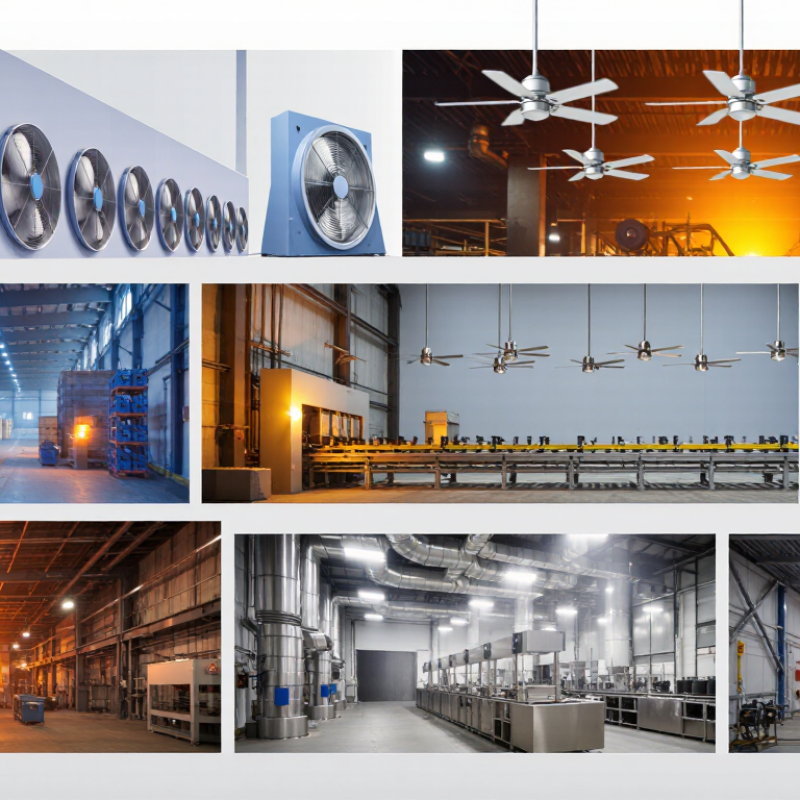
Industrial Fan Basics: Airflow, Static Pressure, and Fan Laws
Choosing an industrial fan starts with understanding airflow and static pressure, not just motor size. Airflow describes the volume of air moved, usually measured in cubic metres per hour or cubic feet per minute. Static pressure is the resistance the fan must overcome. Duct bends, filters, grilles, and dampers all add resistance.
A fan with high airflow may perform poorly in a restrictive system. Check the required airflow at the actual operating pressure. A practical assessment should include duct dimensions, filter loading, air temperature, and installation clearance. Measure where possible. Guessing from room size alone is a common mistake.
Fan laws help compare operating changes. For the same fan, airflow generally changes in proportion to speed. Pressure changes with the square of speed, while power changes roughly with the cube. A small speed increase can therefore create a large energy demand. These relationships become less reliable when air density, blade angle, or system resistance changes. Real sites are rarely perfect.
I would also review the duty point on the fan curve. Avoid selecting a fan at its extreme range. Noise, vibration, and unstable airflow may follow. A slightly oversized fan with proper speed control can be useful, but oversizing is not automatically safer. It may waste energy and complicate balancing. The right choice depends on measured resistance, required airflow, operating hours, and maintenance access.
Choose Axial or Centrifugal Fans by Duty and Operating Conditions
The right industrial fan depends on duty, not appearance. Axial fans suit applications needing high airflow with relatively low static pressure. They work well for warehouse ventilation, equipment cooling, and air movement through open spaces. Their straight-through design can save space and simplify installation. Centrifugal fans are better when air must overcome long ducts, filters, dampers, or process resistance. They generate higher pressure and often handle complex airflow paths more reliably.
Measure the resistance.
Operating conditions can change the selection. Dusty air may require a protected impeller and easier cleaning access. Hot air demands careful motor, bearing, and material checks. Moisture can affect corrosion resistance and electrical protection. Review the fan curve at the actual airflow and static pressure, not at the advertised maximum volume. A quiet fan at low resistance may become noisy when a dirty filter restricts the system. That detail is often missed.
I have seen installations fail because engineers selected airflow first and checked pressure later. The fan delivered volume in open testing, yet the duct system received too little air. Check temperature, altitude, duty cycle, noise limits, and available power before approval. Variable-speed control can improve adjustment, but it cannot fix an undersized fan. Leave practical access for inspection and cleaning. Perfect calculations are rare; field conditions usually expose something overlooked.
Size Fans Using AMCA 210 Airflow and Static-Pressure Test Data
2026 Best Industrial Fans: How to Choose the Right One?
Fan selection should begin with measured airflow and static pressure, not motor horsepower. AMCA 210 defines laboratory methods for testing fan airflow, pressure, power, and efficiency. Use performance data tested under this standard when comparing equipment. A fan rated at 50,000 cubic feet per minute may fail if the duct system needs higher pressure. Plot the required duty point against the fan curve. Then check whether the operating point stays near peak efficiency.
The U.S. Department of Energy’s 2014 Motor Systems Market Assessment found that motor-driven equipment used about 68% of U.S. industrial electricity. Fan systems therefore deserve careful sizing. Oversizing can increase purchase costs, noise, and throttling losses. Undersizing may leave hot process areas poorly ventilated. Real ducts are messier than test rooms. Dust, filters, bends, dampers, and elevation can change resistance. Apply air-density corrections when temperature or altitude differs from test conditions. I still see teams choosing fans from catalog airflow alone. That shortcut is convenient, but unreliable.
Tips: Record airflow, static pressure, temperature, and system resistance at the installation point. Ask for AMCA 210 test data, not only nominal capacity. Leave a modest adjustment range, but avoid excessive safety margins. DOE guidance on fan-system optimization also recommends measuring the complete system before replacing equipment. Recheck readings after installation. The first calculation may be wrong.
Compare Efficiency with AMCA 208 Fan Energy Index (FEI) and kW
2026 Best Industrial Fans: How to Choose the Right One?
Choosing an industrial fan should begin with measured duty, not catalog size. Record airflow, static pressure, operating hours, and available electrical supply. Then compare the Fan Energy Index, or FEI, under the same conditions. AMCA 208 defines FEI as a ratio comparing reference electrical input with the fan’s actual electrical input. A higher FEI generally indicates better energy performance at that operating point.
Do not compare FEI alone. Check input power in kW, because electricity bills are paid in kilowatt-hours. For example, a fan delivering 10,000 cfm at 2 inches of static pressure may show a strong FEI but still require more kW if its motor or drive operates poorly. Look at the complete fan system. Include the motor, controller, speed setting, inlet conditions, and pressure losses from dampers or filters. Small duct restrictions can quietly increase power demand.
Use the fan curve and verify the real operating point after installation. Field readings matter. A clean test result may change when filters load with dust. That is easy to overlook. Select a fan that meets required airflow without excessive oversizing. Oversized equipment often runs below its efficient range, wasting energy through throttling. I have seen specifications focus on peak efficiency while ignoring partial-load operation. That choice can look excellent on paper, but disappointing over a full production year. Compare FEI, kW, controls, maintenance access, and expected runtime together.
2026 Best Industrial Fans: How to Choose the Right One?
Compare fan efficiency using the AMCA 208 Fan Energy Index (FEI) and electrical input power at a common duty point of 10 m³/s airflow and 750 Pa total pressure.
A higher FEI indicates better energy performance, while lower kW means lower electrical demand for the same operating duty. Use certified AMCA 208 data and the actual system operating point for final fan selection.





