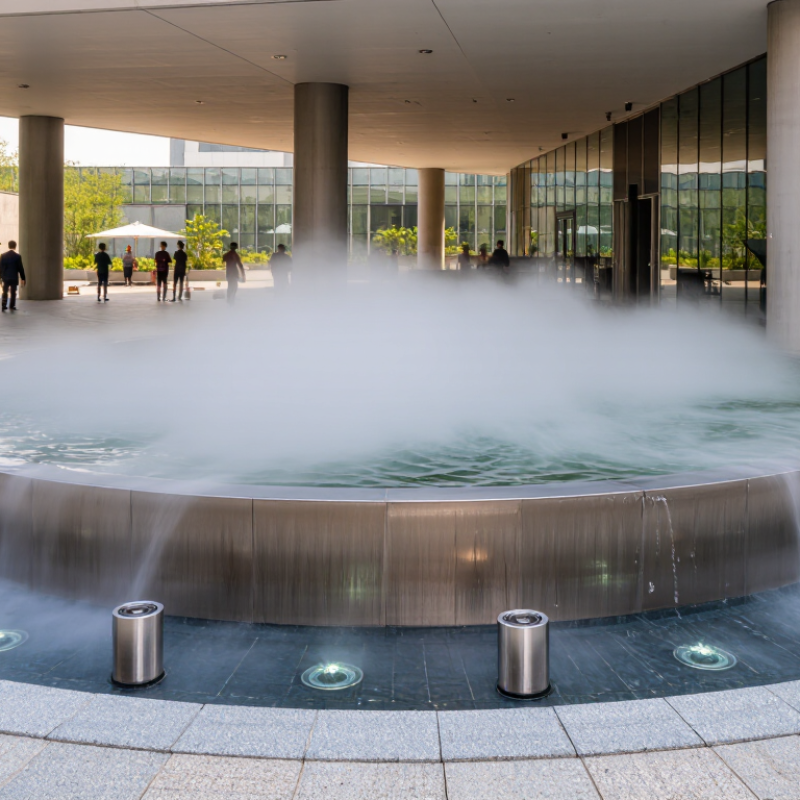
Fog Fountain design is entering a more experience-driven market. The Global Wellness Institute’s 2024 Global Wellness Economy Monitor valued wellness spending at $6.3 trillion in 2023. It projects nearly $9 trillion by 2028. This growth supports demand for immersive water features in hotels, resorts, retail spaces, and private gardens.
“Fog is a cloud at ground level,” explains meteorologist Paul Knight of Penn State. His observation clarifies the core difference between ordinary fountains and mist-producing systems. A Fog Fountain combines water movement, ultrasonic atomization, lighting, and controlled airflow. The result can feel like a cool veil above a shallow basin. It can also become a maintenance problem.
This guide compares ultrasonic, chilled-mist, and hybrid Fog Fountain types for global buyers. Each type behaves differently in humid coastal climates, dry continental regions, and cold outdoor environments. Buyers should examine particle control, pump reliability, water filtration, noise output, and replacement-part availability. Electrical safety and local installation requirements also deserve close attention. ASHRAE guidance on indoor humidity and ventilation provides a useful technical reference, while public-health guidance on decorative water systems highlights cleaning and microbial-control practices.
There is no single best model.
The right choice depends on location, visitor exposure, operating hours, and maintenance skill. My practical view is less glamorous: a dramatic fog effect cannot compensate for blocked nozzles, hard-water scale, or weak after-sales support. This 2026 overview therefore focuses on performance, serviceability, visual impact, and responsible purchasing decisions across international markets.
A fog fountain combines a water basin, ultrasonic or high-pressure mist generator, lighting, piping, and control equipment. Its visible fog forms when fine water droplets enter moving air above the basin. Some models use ultrasonic discs, while others rely on high-pressure nozzles. Each design affects noise, droplet size, maintenance, and energy use. The basin should include stable supports, accessible filters, and safe drainage. A small access panel can save hours during cleaning.
During operation, treated water passes through the selected misting system and returns to the reservoir. Sensors may monitor water level, temperature, and pump protection. In a shopping center, the fountain may create a cool visual feature near an entrance. In a garden, it can soften hard edges and highlight evening lighting. Exhibition halls often prefer compact units with adjustable output. Local humidity matters. Dense fog may disappear quickly in dry outdoor air. Indoor installations need ventilation to control condensation and slippery floors.
Tips: Check voltage, plug standards, drainage, and safety certifications before ordering internationally. Ask for spare discs, nozzles, seals, and cleaning instructions. Test water quality first. Mineral deposits can block small outlets and reduce fog consistency. I have found that attractive lighting sometimes hides weak maintenance access. That is a design problem worth questioning. Plan a weekly inspection, even when the fountain appears clean. No system stays perfect.
Ultrasonic fog fountains create fine mist through high-frequency vibration. They suit indoor atriums, quiet gardens, and small display pools. Their mist looks soft and cloud-like, with low mechanical noise. However, mineral buildup can reduce output. Regular water treatment remains essential.
High-pressure fog fountains use pumps and narrow nozzles to produce sharper jets. They work well in plazas, hotel entrances, and large landscape projects. Hybrid systems combine water jets, lighting, and fog effects. They offer stronger visual depth, but require careful drainage and pump sizing. The 2024 Global Water Intelligence market analysis highlights rising demand for efficient water management in public spaces. UN-Water’s 2024 report also stresses growing pressure on freshwater resources. These findings make recirculating designs more practical for global buyers. They are not automatically low-maintenance.
Tips: Ask suppliers for evaporation-loss data, nozzle flow rates, and filter replacement cycles. Check local humidity conditions before selecting equipment. ASHRAE guidance warns that uncontrolled moisture can encourage condensation and surface damage. A fog system may look impressive in a dry climate, yet perform poorly near cold glass. I would also request a test video under real wind conditions. Studio demonstrations can mislead. Sodium-free treatment is usually safer for metal parts, but every project still needs a qualified water-quality review.
Ultrasonic fog fountains suit small indoor displays and quiet hospitality spaces. Their mist is fine, soft, and visually dense near the basin. A 40–60 watt unit often covers 2–5 square meters, depending on airflow and humidity. Output drops quickly in dry rooms. High-pressure nozzle fountains create stronger plumes and wider outdoor coverage. Typical pumps use 300–900 watts, but they can serve larger areas with less visible softness. Air-assisted systems produce dramatic, taller fog columns, although their compressors increase noise and energy demand.
Coverage should be measured at the actual installation height, not only from supplier charts. Wind can scatter fog within seconds. In field tests, a sheltered fountain kept a more stable plume than a stronger outdoor unit. That result surprised us. Output also depends on water temperature, mineral content, and nozzle diameter. Fine nozzles look elegant, but they clog more easily. Larger nozzles sacrifice detail for reliability.
Energy use is only one part of operating cost. Ultrasonic models usually need frequent water-level checks and disc cleaning. High-pressure systems require filter changes, pump inspection, and careful nozzle flushing. Use a washable pre-filter where water quality is uncertain. Hard water leaves white scale on nearby surfaces. Reverse-osmosis water may reduce deposits, but it can raise operating costs. Confirm voltage, replacement-part access, drainage, and local service support before purchase. A fountain that performs well in a showroom may become demanding after three humid months.
When selecting a fog fountain for global environments, begin with climate, water quality, and maintenance access. Dry inland sites need fine nozzles and efficient pumps because evaporation is rapid. Coastal locations require corrosion-resistant fittings and sealed electrical housings. Cold regions need drainable lines, insulated reservoirs, and freeze protection. Cold changes everything.
Humidity also affects visual performance. In tropical climates, heavy mist can linger near walkways and reduce visibility. Choose adjustable output, timed cycles, and airflow clearance. The 2024 United Nations World Water Development Report states that agriculture accounts for roughly 70% of global freshwater withdrawals. This supports using recirculating tanks, filtration, and low-flow controls instead of constant spraying. Water savings still depend on cleaning discipline.
Indoor installations need another approach. Verify ventilation, floor drainage, noise limits, and nearby electronics before ordering. The World Health Organization’s Guidelines for Drinking-water Quality stress microbial control, which matters when water sits in warm reservoirs. Use treated water where appropriate, but follow local requirements. I have seen buyers focus on plume height and ignore service access. That is an expensive mistake. A slightly smaller fountain may perform better when filters, pumps, and nozzles can be reached safely. Check the enclosure rating against IEC 60529, and request documented flow, power, and operating-temperature data. Supplier claims are useful, but measured site conditions are better.
2026 Best Fog Fountain Types for Global Buyers
Installation, Safety Standards, and International Buying Considerations
Fog fountains generally use ultrasonic discs, high-pressure nozzles, or hybrid systems. Ultrasonic models create dense mist inside compact indoor basins. Nozzle systems suit larger outdoor displays and longer operating periods. Hybrid designs offer flexibility, but they need more controls and maintenance. Choose by basin size, climate, water quality, and expected daily runtime. A small indoor unit should not be treated like a public plaza installation. That mistake is common.
Installation requires a level, waterproof base and accessible drainage. Keep electrical parts above splash level. Use residual-current protection, suitable grounding, and the correct local voltage. Enclosures should match the environment, with an appropriate IP rating for water exposure. Safety requirements vary between countries, so buyers should verify applicable IEC, EN, UL, or national rules with a qualified electrician. Certificates alone do not guarantee safe installation. One practical lesson is simple: paperwork cannot replace testing.
Tips: Request wiring diagrams, spare-part lists, noise data, and water-treatment guidance before ordering. Confirm whether the unit supports hard water, freezing temperatures, or continuous operation. Ask about customs documents and replacement parts. Inspect the first shipment carefully. A perfect installation is rare, and even experienced teams can overlook drainage or access space. Clean mist chambers regularly, because mineral deposits reduce output and may create uneven fog.
| Fog Fountain Type | Working Principle | Typical Water Condition | Installation Requirements | Main Safety Considerations | Applicable Standards and Checks | Best Applications | International Buying Considerations |
|---|---|---|---|---|---|---|---|
| Ultrasonic Mist Fountain | Piezoelectric transducers convert high-frequency electrical energy into fine water droplets that appear as cool mist. | Clean, low-mineral water is preferred. Hard water can create scale and reduce mist output. | Install the transducer at the specified water depth, keep the control unit dry, and provide a stable water-level system. | Use a low-voltage isolated power supply where required. Prevent dry running, water ingress, and contact with moving or energized parts. | Check electrical safety against the destination-market requirements. Use enclosure protection assessed under IEC 60529 where relevant and verify electromagnetic compatibility requirements. | Indoor displays, decorative bowls, exhibition features, and small architectural water installations. | Confirm input voltage, frequency, plug type, replacement transducer availability, water-quality requirements, and spare-part support. |
| High-Pressure Fog Nozzle Fountain | A high-pressure pump forces water through fine nozzles to produce a dense spray or fog effect. | Filtered water is normally required. Nozzle orifice size determines sensitivity to suspended particles. | Requires a pump, filter, pressure-rated tubing, nozzle layout, drainage, and access for cleaning and maintenance. | Protect users from high-pressure discharge. Include pressure relief, guards, non-slip surfaces, and protection against leaks and hose failure. | Assess the electrical assembly, pump protection, pressure components, hose ratings, grounding, and enclosure ingress protection for the installation environment. | Large outdoor plazas, themed environments, landscape features, and cooling-oriented public installations. | Check operating pressure, flow rate, nozzle material, filtration grade, pump duty cycle, local water regulations, and shipping restrictions for pressure equipment. |
| Air-Assisted Fog Fountain | Compressed air atomizes water into small droplets through a two-fluid nozzle, creating a controllable fog effect. | Filtered water is recommended; compressed air must be dry and reasonably clean to protect the nozzle system. | Needs an air compressor or centralized air supply, regulators, water filtration, drainage, and separate air and water lines. | Control stored pneumatic energy, hose whip, excessive noise, and accidental discharge. Install pressure relief and isolation valves. | Verify electrical safety for compressors and controls, pressure ratings for pneumatic components, grounding, and local machinery or workplace-safety requirements. | Stage effects, visitor attractions, landscape features, and installations requiring adjustable fog density. | Confirm compressor compatibility, air consumption, operating pressure, local noise limits, metric or imperial fittings, and availability of replacement seals. |
| Dry-Ice Fog Fountain | Solid carbon dioxide sublimates in warm water and produces a low-lying fog that stays close to the floor. | Warm water is used in a suitable container. Dry ice must be handled and stored according to supplier and local requirements. | Requires a ventilated area, insulated handling tools, a suitable fog basin, drainage, and controlled access during operation. | Carbon dioxide can accumulate in low or enclosed areas and displace oxygen. Use ventilation, carbon-dioxide monitoring where appropriate, and protective gloves for handling dry ice. | Follow local occupational safety, ventilation, gas-monitoring, event-safety, and pressure-container rules where applicable. Do not seal dry ice in a container. | Short-duration theatrical effects, events, photography, and supervised indoor or outdoor performances. | Check dry-ice availability, transportation rules, storage temperature, event permits, ventilation requirements, and local restrictions on carbon-dioxide use. |
| Heated Water Fog Fountain | Heated water or steam is released and condenses in cooler air, forming a visible vapor or fog effect. | Water quality depends on the heater design; mineral deposits may require descaling or treated water. | Needs thermal insulation, temperature controls, drainage, heat-resistant surfaces, and adequate ventilation. | Protect against burns, hot surfaces, steam exposure, overheating, and dry operation. Install thermostatic control and an independent over-temperature cut-off. | Check applicable heating-appliance, electrical, thermal, grounding, and pressure-safety requirements. Pressure vessels require additional local compliance where applicable. | Indoor architectural features, controlled theatrical displays, and installations requiring warm vapor rather than cold mist. | Confirm rated voltage, heater power, thermal protection, water treatment, insulation requirements, energy consumption, and destination-market certification needs. |
| Waterfall or Spillway Fog Fountain | Fog equipment is integrated with falling or cascading water to combine mist with a visual waterfall effect. | Recirculated water should pass through filtration and require regular cleaning to limit scale and biological growth. | Requires a structural basin, waterproofing, pump and return line, overflow protection, access panels, and coordinated fogger placement. | Manage slip hazards, electrical separation, water stagnation, sharp edges, and safe access for maintenance. Prevent overflow into electrical compartments. | Assess electrical equipment near water, bonding and residual-current protection as required locally, enclosure protection under IEC 60529, and structural drainage design. | Hotels, shopping centers, public landscapes, museums, and architectural water walls. | Review site load limits, drainage capacity, local water use rules, climate exposure, anti-freeze provisions, customs classification, and installation labor requirements. |
| Floating Fog Fountain | A floating platform carries fog modules and sometimes lighting, allowing the effect to operate on a pond or large basin. | Open water may contain sediment or biological contaminants; filtration and routine water treatment are important. | Needs buoyancy calculations, tethering, anti-tilt design, protected cable routing, service access, and a safe shore connection. | Prevent electrical contact with water, unauthorized access, platform instability, cable damage, and entanglement. Consider wind, waves, and public reach zones. | Verify low-voltage design, grounding or isolation strategy, residual-current protection where required, marine or outdoor enclosure protection, and local water-feature rules. | Ponds, resort landscapes, public parks, entertainment venues, and large decorative basins. | Confirm flotation capacity, anchoring method, wind and temperature limits, cable length, water chemistry, transport dimensions, and local environmental permits. |
| Interactive Sensor-Controlled Fog Fountain | Sensors, timers, or control software adjust fog output in response to movement, programmed scenes, or environmental conditions. | Water quality depends on the selected fog technology; filtration and scheduled sanitation are recommended for recirculating systems. | Requires sensors, control cabinets, communication wiring, software configuration, drainage, and protected maintenance access. | Use fail-safe shutdown, emergency stop functions, protected wiring, safe separation from visitors, and cybersecurity controls for networked systems. | Check EMC, electrical safety, machine-control functionality where applicable, ingress protection, wireless-radio requirements, and data-privacy obligations for connected sensors. | Interactive museums, retail environments, public art, visitor attractions, and smart landscape installations. | Confirm language support, communication protocols, software update policy, remote-access security, data handling, technical documentation, and local service capability. |



For those larger-sized parts, or smaller quantity runs, we have 2 independent powder coat booths and ovens. The quality, durability and affordability of today’s powder coating finishes make this the process of choice for world-class companies.
Powder coating advantages over other forms of coating are many. Materials used in the Powder coating process can be metals and non-metals that come in a multitude of thicknesses, textures, colors, etc. Another of Powder coating’s biggest advantages over conventional coatings is its ability to create finishes in many different textures. Powder Coating Booths allow us the ability to apply these advantages to large products.
Tri-State Fabricators runs a full-service conveyor line for painting. Wet painting can provide protection or decoration to many different part styles. From start to finish, every project is easier to undergo random and point-based inspection by our skilled painting team.
Advantages to our Wet Paint Line are these lines start with product prep and ends with a thorough inspection of a high quality finished product. Our ability to complete large and small projects with a superior finish and doing so in a timely and economical fashion. This passes along the savings in production to our customers. When powder coating ins not an option, our Wet Paint Line gets the job done right the first time.
When the parts get big and heavy we roll-out our custom paint racks and oversize booth. By utilizing our partnerships with all the major paint brands, we can match virtually any color with wet paint.
The advantages of having access to a Wet Paint Booth are many. Large projects of many different shapes can be loaded into the booth. The Wet Paint Booth offers an environment that is much more controlled than a typical parts painting operation.
Not only are they used because of their controlled environment, but they’re are also advantageous when it comes to applying paint to parts that are needed in industries that require specialty coatings such as medical, aerospace, etc.
Our military forces have some very high standards when it comes to the finish of their vehicles and equipment. From the first pre-treatment step to final coat, it takes a great deal of knowledge and experience to protect the men and women of our armed forces. They deserve only the best, and Tri-State Fabricators provides it.
All of our processes are closely monitored by our staff and management teams. Both of which are highly trained in the processes of metal fabrication and finishing. Tri-State Fabricators’ goal is to always fully satisfy each and every customer, including the military. We will always put a 110% into what we do.
Abrasive media blasting is an excellent way to remove old paint, rust, and increase the paint/powder adhesion. Glass beads produce a much smoother and brighter finish than angular abrasives; leaving the part clean yet without any dimensional change. Chemically inert and environmentally friendly, we can recycle our beads approximately 30 times; making them a more preferred method of metal cleaning or surface finishing.
Advantages to Glass Bead Blasting are many. Glass bead blast media is used when a project is needing rough surfaces need to become smooth for applications of coatings such as paint. It is typically used to clean paint and rust from a product surface without deforming the surface it is being used on. Overall, compared to many other blasting media, Glass Bead Blasting is a very economical choice and those savings are always passed on to our customers.
Tri-State Fabricators utilize a zinc phosphate wash to clean and etch the material to ensure the best paint adhesion possible. The unique design of our 3-stage wash system does the work like a 5-stage. From Cleaning and rinsing to conversion coating and post-treatment, Our Part Washing process is a complete service and works throughout the fabrication service and the finishing service.
Along with the previously mentioned benefits, Curing is a vital chemical reaction that leaves the product finish hard and relatively safe from mild abrasion and aggressive corrosion. This process can be done in more than one way; ambient air-dry or in curing ovens at temps that exceed 240°.
From fixing paint mistakes (someone else’s of course) to simply cleaning our paint line hooks, our burn-off oven is put to good use. After a quick burn-off, a little clean up, and a fresh coat of paint, your parts will look better than new.
Why does our Burn-Off Oven work so well? Because super heating the air around parts turns the materials into ashes. From paint and powder coatings to rubber and machining oils, high temps do the job without degrading the integrity of the part.
Masking is a vital part of producing high quality products. We have die-cut masking patterns to protect machined surfaces as well as a wide range of plugs and caps to protect threaded holes and bolts. We provide permanent and temporary masking.
Masking allows the selected sections of a product to be protected from a fabrication or finishing service. This can be with both chemicals when etching and tapes, paints when only finishing just a section of the product. Masking is great in aiding the customization process of a project.
Screen printing is a photographic process that transfers artwork onto a porous nylon screen which allows colored ink to flow through the screen and be deposited on an aluminum or plastic component. We can generally have just about any design created onto a screen for your parts.
Some of the advantages of Screen Printing are, brand recognition for your business displaying on your products, assembly instructions, product warnings/hazards, etc. Tri-State Fabricators produces Screen Printing of the highest quality so you know it’s durable.
Metal Finishing is the art of treating the exterior portion of product, often metal but can also be made of other materials, so that the surface is clean and free of any debris. Then the process of applying coats or either paint of powder coat takes place. This coating process improves the quality of the product in both appearance and resistance to wear and corrosion.
Tri-State Fabricators, Inc., understands that a project typically isn’t complete until a high-quality finish has been added to your product. This is why our painting and powder coating teams continuously inspect the products throughout the Metal Finishing process.