


2026 Best Epoxy Resin 3D Printing Machines for Buyers

Choosing the right resin printer in 2026 requires more than comparing resolution numbers. Buyers must examine print speed, build volume, curing consistency, software control, maintenance, and long-term operating costs. Epoxy Resin 3d Printing can produce smooth prototypes, detailed models, dental patterns, jewelry designs, and functional test parts. However, impressive specifications do not guarantee reliable production.

This guide evaluates the best epoxy resin 3D printing machines through practical buyer concerns. We consider real workflow details, including resin handling, failed prints, cleaning time, odor control, and replacement components. A printer may deliver 8K detail, yet still frustrate users with weak supports or unstable exposure settings. Small issues matter. They become expensive over time.

Our recommendations aim to support informed purchasing decisions rather than promote one universal machine. Different users need different strengths. A hobbyist may value simple setup and affordable materials, while a studio may prioritize repeatability and service support. Professional buyers should also verify manufacturer documentation, regional availability, safety guidance, and warranty conditions. These factors are sometimes overlooked.

Testing conditions can influence every result. Resin brands, room temperature, calibration methods, and model geometry all affect print quality. Therefore, no ranking should be treated as permanent truth. We may also identify machines that look excellent on paper but need further field testing. That honesty matters. The best choice balances detail, reliability, safety, training requirements, and total ownership cost. This overview provides a clear starting point for buyers comparing modern resin printing equipment with realistic expectations.
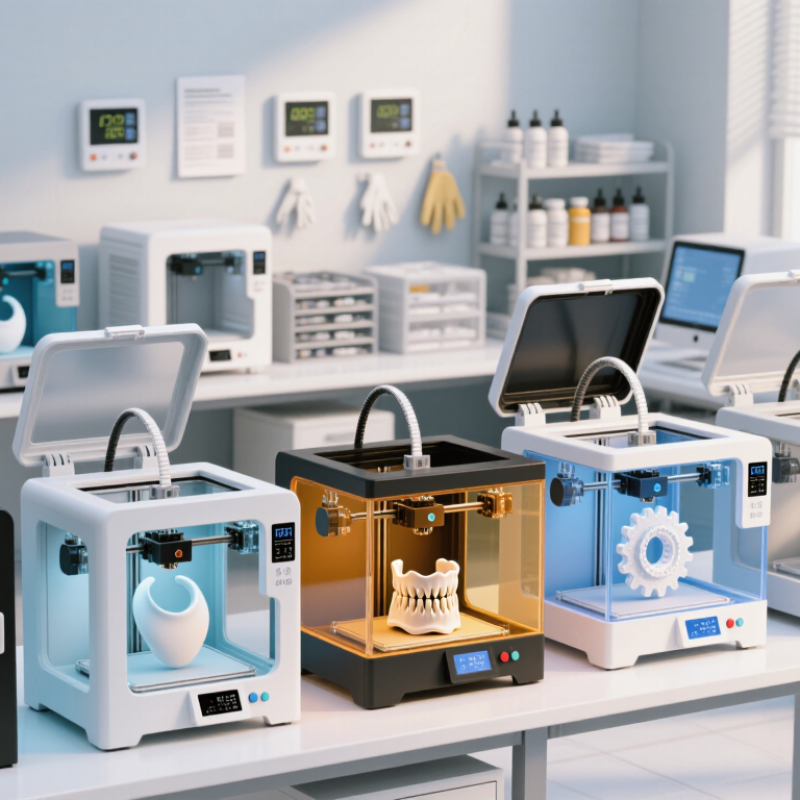
2026 Best Epoxy Resin 3D Printing Machines for Buyers

Photopolymer Resin Printing Explained: SLA, DLP, and MSLA at 405 nm

At 405 nm, photopolymer resin printers cure liquid resin with controlled ultraviolet light. The process looks simple, but exposure accuracy strongly affects strength, detail, and surface quality. SLA uses a focused laser that traces each layer. It offers dependable detail and smooth curves, though printing can take longer. DLP projects an entire layer through a digital light device. This can improve speed, but projected pixels may appear on angled surfaces. MSLA also cures full layers, using an LCD mask over an array of 405 nm LEDs. It often delivers an attractive balance between speed, detail, and machine cost.

For buyers comparing epoxy resin 3D printing machines, inspect more than advertised resolution. Check light uniformity, resin compatibility, build-platform stability, and replacement-part access. A 50-micrometer pixel does not guarantee a 50-micrometer feature. Exposure testing remains essential. I usually print a small calibration model before producing functional parts, adjusting exposure in short steps. Thin walls can become brittle when overcured, while underexposure leaves soft edges and weak supports. I still overcure delicate sections sometimes. That mistake is useful.

Resin temperature also matters. Cooler material flows slowly and may trap small bubbles beneath the platform. A stable workspace, measured exposure settings, and careful washing produce more repeatable results. Operators should follow the resin supplier’s handling guidance, wear suitable protective equipment, and cure finished parts fully. These habits support reliable output, even when the machine’s specifications look impressive.


Key Buying Metrics: 25–100 μm Layers, Build Volume, Speed, and Accuracy

Buying an epoxy resin 3D printing machine requires more than chasing the smallest layer number. A 25 μm layer can capture fine lettering, but it may increase exposure cycles and production time. At 100 μm, larger parts often print faster with acceptable surface quality. The right choice depends on part geometry, resin behavior, and post-processing needs.

Wohlers Report 2024 valued the global additive manufacturing market at $20.035 billion in 2023, with 13.5% year-on-year growth. That expansion increases buyer pressure, but market growth does not guarantee suitable accuracy. Check dimensional test results, not only manufacturer claims. A machine should maintain stable tolerances across the entire platform, especially near the corners. I would request printed calibration parts before purchase.

Build volume must match real workflows. A 200 × 120 × 200 mm chamber may suit prototypes, but repeated small parts can benefit more from usable platform area. Speed figures also need careful reading. Some suppliers measure only exposure time, excluding lifting, resin settling, washing, and curing. That can make hourly output look unrealistically high. ASTM ISO 52900 terminology helps compare additive manufacturing processes, while independent inspection reports provide stronger evidence than promotional charts. Accuracy is affected by pixel size, optical alignment, resin shrinkage, temperature, and operator settings. Small errors matter. A 50 μm specification may still produce a visibly loose assembly if compensation is poorly calibrated.

Desktop to Industrial Systems: Comparing 50–150 mm/h Resin Printing Throughput

2026 Best Epoxy Resin 3D Printing Machines for Buyers

Desktop to Industrial Systems: Comparing 50–150 mm/h Resin Printing Throughput

Epoxy resin 3D printers now advertise 50–150 mm/h throughput, but that figure needs careful interpretation. Desktop systems often reach 50–80 mm/h with small parts and optimized settings. Larger machines may sustain 100–150 mm/h across wider build areas. However, speed changes with layer height, resin viscosity, exposure time, and model shape. A tall hollow housing prints differently from a dense mechanical bracket.

In practical evaluations, throughput should include setup, failed prints, washing, and post-curing. A machine producing 120 mm/h may lose time through frequent vat cleaning or slow platform movement. Examine layer consistency near sharp corners and narrow channels. Check whether the manufacturer reports vertical build speed or completed part volume. These are not the same measurement. I would also print a repeatable test model for several cycles. One successful run proves little.

Tips: Compare printed volume per hour, not only advertised height. Test at your intended 25–100 micron layer range. Record resin temperature and exposure settings. Inspect five consecutive parts for warping, surface ripples, and dimensional drift. Industrial systems usually offer better monitoring and larger vats, while desktop units may provide lower material waste and simpler maintenance. The fastest option may not be the most productive. That distinction is easy to miss.

2026 Best Epoxy Resin 3D Printing Machines for Buyers - Desktop to Industrial Systems: Comparing 50–150 mm/h Resin Printing Throughput

System Category Typical Printing Technology Typical Build Volume Typical Vertical Throughput Common Layer Thickness Typical XY Resolution Light Source Epoxy Resin Compatibility Best-Fit Applications Key Buying Considerations
Desktop MSLA / LCD Masked stereolithography using a monochrome LCD and an array of UV LEDs 130–220 × 70–140 × 130–250 mm 50–80 mm/h peak 0.025–0.100 mm 0.035–0.070 mm 405 nm UV LED array Selected 405 nm epoxy-based resins Prototypes, miniatures, dental models, small functional parts Low purchase cost and good detail; actual speed depends strongly on layer exposure, resin viscosity, lift height, and cooling.
Desktop DLP Digital light processing with a projector exposing complete layers at once 120–250 × 70–140 × 100–250 mm 60–100 mm/h peak 0.025–0.100 mm 0.035–0.100 mm 405 nm UV DLP projector DLP-qualified epoxy photopolymers Small precision components, jewelry patterns, dental and engineering prototypes Consistent exposure and long optical life; check pixel-size accuracy, projector calibration, and resin cure depth.
Prosumer Large-Format MSLA Large-area masked stereolithography with a monochrome LCD panel 250–350 × 140–200 × 250–400 mm 50–90 mm/h peak 0.050–0.150 mm 0.050–0.100 mm 405 nm UV LED array Epoxy-based resins with validated exposure profiles Pattern making, display parts, architectural models, medium-size prototypes Higher productivity per build than small desktop units; vat rigidity, film replacement, and resin heating are important.
Industrial SLA Laser-based stereolithography that traces each layer with a focused UV laser 250–750 × 250–750 × 200–600 mm 50–150 mm/h peak 0.050–0.150 mm 0.075–0.150 mm 355–405 nm UV laser, depending on system configuration Engineering epoxy photopolymers and filled formulations Production prototypes, casting patterns, housings, ducts, and tooling aids High surface quality and material range; compare laser power, recoating time, resin handling, and post-processing capacity.
Industrial DLP High-power digital projection exposing an entire layer simultaneously 200–600 × 110–350 × 200–500 mm 80–150 mm/h peak 0.030–0.100 mm 0.060–0.150 mm 365–405 nm UV projector High-temperature and engineering-grade epoxy resins Batch production, dental components, precision tooling, and repeatable end-use parts Fast layer exposure and strong repeatability; verify optical uniformity, thermal management, and validated material profiles.
Industrial Continuous / High-Speed Vat Photopolymerization Specialized vat-photopolymerization process designed to reduce peel and separation delays 250–600 × 140–350 × 200–500 mm 100–150 mm/h peak 0.050–0.150 mm 0.075–0.150 mm UV projection or controlled UV illumination system Only resins approved for the specific continuous process High-throughput prototyping, short-run parts, and multi-part production jobs Throughput is highly process-dependent; evaluate resin replenishment, separation forces, build-platform limits, and cleaning automation.
Buyer’s note: Throughput values are typical peak vertical-speed ranges for compatible resin profiles, not guaranteed production rates. Final output depends on layer height, exposure and lift settings, part orientation, support density, vat temperature, resin viscosity, build height, and post-processing time. Confirm the manufacturer’s validated material data before purchasing.

Resin Performance and Safety: ASTM D638, ISO 10993, and UV Post-Curing

Choosing a 2026 epoxy resin 3D printing machine requires more than checking resolution and build volume. Resin performance depends on exposure accuracy, temperature stability, washing, and UV post-curing. A machine with inconsistent light output may create parts that look identical but perform differently.

ASTM D638 helps evaluate tensile strength and elongation using standardized plastic specimens. It does not certify a resin or machine by itself. Buyers should print several specimens, record layer height and exposure settings, and test them under controlled conditions. Small changes matter. A cool workshop, trapped solvent, or incomplete curing can distort results. I would not treat one impressive tensile value as reliable evidence.

ISO 10993 is more demanding when printed parts contact the human body. It covers biological evaluation, including irritation, sensitization, and cytotoxicity. A resin described as “biocompatible” still needs evidence for its intended use and post-processing method. UV post-curing is critical because it reduces residual reactive material and improves stability. Follow the resin supplier’s validated time, wavelength, and temperature range. Excessive curing can make parts brittle, while insufficient curing may leave a tacky surface. My own buying judgment can become too optimistic here. A convenient curing box is useful, but measurable output is better. Look for controlled UV intensity, even exposure, ventilation, and repeatable temperature records. Keep those records.

2026 Machine Rankings: Cost per Part, Reliability, Workflow, and Support

For buyers comparing epoxy resin 3D printing machines in 2026, cost per part deserves more than a resin-price check. The 2024 Wohlers industry report valued global additive manufacturing at $20.035 billion in 2023, growing 13.5%. That expansion increases options, but not necessarily value. Calculate resin, support material, electricity, cleaning time, curing, labor, and failed builds. A machine producing a $4 part can become a $9 part after handling and rework.

Reliability appears in ordinary moments: stable vat temperature, repeatable exposure, clean recoating, and consistent dimensional accuracy across a full build plate. Track at least 50 consecutive jobs before trusting marketing claims. Keep a failure log. It will reveal more than a showroom sample. AM Research’s 2024 market analysis separates polymer additive manufacturing into production-focused applications, where uptime and throughput matter more than headline resolution.

Workflow can decide the ranking. Look for automated calibration, clear resin profiles, barcode-based job records, and simple washing and curing steps. Support should include response times, spare-part availability, training, and documented maintenance intervals. ISO/ASTM 52920 guidance stresses controlled processes and traceability, yet many buyers still ignore operator time. That is a mistake. My own evaluation would score support heavily, while admitting one weakness: long-term reliability is difficult to judge without a year of production data. A polished demo proves little.

Powder Coat Booths

For those larger-sized parts, or smaller quantity runs, we have 2 independent powder coat booths and ovens. The quality, durability and affordability of today’s powder coating finishes make this the process of choice for world-class companies.

Powder coating advantages over other forms of coating are many. Materials used in the Powder coating process can be metals and non-metals that come in a multitude of thicknesses, textures, colors, etc. Another of Powder coating’s biggest advantages over conventional coatings is its ability to create finishes in many different textures. Powder Coating Booths allow us the ability to apply these advantages to large products.

Wet Paint Line

Tri-State Fabricators runs a full-service conveyor line for painting. Wet painting can provide protection or decoration to many different part styles. From start to finish, every project is easier to undergo random and point-based inspection by our skilled painting team.

Advantages to our Wet Paint Line are these lines start with product prep and ends with a thorough inspection of a high quality finished product. Our ability to complete large and small projects with a superior finish and doing so in a timely and economical fashion. This passes along the savings in production to our customers. When powder coating ins not an option, our Wet Paint Line gets the job done right the first time.

Wet Paint Booths

When the parts get big and heavy we roll-out our custom paint racks and oversize booth. By utilizing our partnerships with all the major paint brands, we can match virtually any color with wet paint.

The advantages of having access to a Wet Paint Booth are many. Large projects of many different shapes can be loaded into the booth. The Wet Paint Booth offers an environment that is much more controlled than a typical parts painting operation.

Not only are they used because of their controlled environment, but they’re are also advantageous when it comes to applying paint to parts that are needed in industries that require specialty coatings such as medical, aerospace, etc.

Military CARC

Our military forces have some very high standards when it comes to the finish of their vehicles and equipment. From the first pre-treatment step to final coat, it takes a great deal of knowledge and experience to protect the men and women of our armed forces. They deserve only the best, and Tri-State Fabricators provides it.

All of our processes are closely monitored by our staff and management teams. Both of which are highly trained in the processes of metal fabrication and finishing. Tri-State Fabricators’ goal is to always fully satisfy each and every customer, including the military. We will always put a 110% into what we do.

Glass-Bead Blasting

Abrasive media blasting is an excellent way to remove old paint, rust, and increase the paint/powder adhesion. Glass beads produce a much smoother and brighter finish than angular abrasives; leaving the part clean yet without any dimensional change. Chemically inert and environmentally friendly, we can recycle our beads approximately 30 times; making them a more preferred method of metal cleaning or surface finishing.

Advantages to Glass Bead Blasting are many. Glass bead blast media is used when a project is needing rough surfaces need to become smooth for applications of coatings such as paint. It is typically used to clean paint and rust from a product surface without deforming the surface it is being used on. Overall, compared to many other blasting media, Glass Bead Blasting is a very economical choice and those savings are always passed on to our customers.

Part Washing

Tri-State Fabricators utilize a zinc phosphate wash to clean and etch the material to ensure the best paint adhesion possible. The unique design of our 3-stage wash system does the work like a 5-stage. From Cleaning and rinsing to conversion coating and post-treatment, Our Part Washing process is a complete service and works throughout the fabrication service and the finishing service.

Along with the previously mentioned benefits, Curing is a vital chemical reaction that leaves the product finish hard and relatively safe from mild abrasion and aggressive corrosion. This process can be done in more than one way; ambient air-dry or in curing ovens at temps that exceed 240°.

Burn-Off Oven

From fixing paint mistakes (someone else’s of course) to simply cleaning our paint line hooks, our burn-off oven is put to good use. After a quick burn-off, a little clean up, and a fresh coat of paint, your parts will look better than new.

Why does our Burn-Off Oven work so well? Because super heating the air around parts turns the materials into ashes. From paint and powder coatings to rubber and machining oils, high temps do the job without degrading the integrity of the part.

Masking

Masking is a vital part of producing high quality products. We have die-cut masking patterns to protect machined surfaces as well as a wide range of plugs and caps to protect threaded holes and bolts. We provide permanent and temporary masking.

Masking allows the selected sections of a product to be protected from a fabrication or finishing service. This can be with both chemicals when etching and tapes, paints when only finishing just a section of the product. Masking is great in aiding the customization process of a project.

Screen Printing

Screen printing is a photographic process that transfers artwork onto a porous nylon screen which allows colored ink to flow through the screen and be deposited on an aluminum or plastic component. We can generally have just about any design created onto a screen for your parts.

Some of the advantages of Screen Printing are, brand recognition for your business displaying on your products, assembly instructions, product warnings/hazards, etc. Tri-State Fabricators produces Screen Printing of the highest quality so you know it’s durable.

Metal Finishing

Metal Finishing is the art of treating the exterior portion of product, often metal but can also be made of other materials, so that the surface is clean and free of any debris. Then the process of applying coats or either paint of powder coat takes place. This coating process improves the quality of the product in both appearance and resistance to wear and corrosion.

Tri-State Fabricators, Inc., understands that a project typically isn’t complete until a high-quality finish has been added to your product. This is why our painting and powder coating teams continuously inspect the products throughout the Metal Finishing process.
