2026 Best Dishwasher Stamping Die Manufacturers?
Choosing a Dishwasher Stamping Die manufacturer in 2026 is not simply a matter of comparing press capacity or quoted prices. The die must form thin sheet metal consistently, protect visible surfaces, and withstand long production runs. A small mismatch can leave a flange uneven or a panel marked. Details matter.
Efficiency expectations shape these parts. The U.S. EPA’s ENERGY STAR dishwasher criteria report that certified models are about 12% more energy-efficient and 30% more water-efficient than standard models. The U.S. Department of Energy’s dishwasher test-procedure and standards documents provide a technical framework for assessing appliance performance. These sources do not prescribe die designs. Still, they help explain why appliance makers value repeatable forming, reliable fit, and stable production quality. Better process control can help suppliers meet demanding specifications, though tooling alone cannot guarantee finished-appliance efficiency.
This guide compares manufacturers through practical signals: engineering support, material and process knowledge, die-life expectations, inspection methods, and after-sales service. Ask how a supplier controls springback, checks critical dimensions, and manages changes between prototype and production. Request evidence, not just confident claims. A polished sample is useful. A documented process is stronger.
There is a caveat. Public information on individual manufacturers is uneven, and advertised capabilities may not reflect performance on your exact part. Treat this comparison as a starting point, then verify claims with drawings, trials, and references. The best choice depends on your geometry, volume, and quality targets—not a ranking alone.
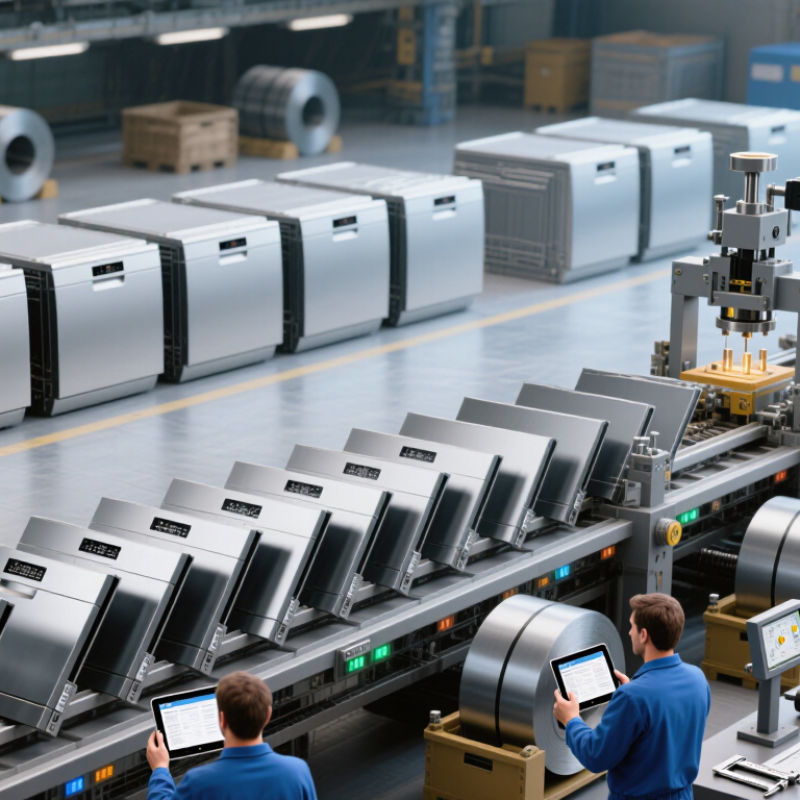
What Is a Dishwasher Stamping Die and How Does It Work?
A dishwasher stamping die is a matched set of hardened tools that shapes sheet metal inside a press. It may produce door panels, brackets, and metal tub components. Not every dishwasher part is stamped; some designs use molded materials. That distinction matters.
During a press cycle, a sheet or metal coil is positioned between the die’s upper and lower sections. The press closes, and punches and shaped surfaces cut, bend, or draw the metal into form. A progressive die can perform several operations as the strip advances station by station. Alignment and controlled clearance help keep edges clean and dimensions consistent. Small changes matter. Too much force can cause tearing, while poor support may leave wrinkles or uneven bends.
A reliable die needs careful setup and regular inspection. Technicians check wear, feeding accuracy, and part dimensions, often using gauges and visual checks for burrs or surface marks. A smooth press stroke is not proof of a good part. The tooling can repeat a shape thousands of times, but it cannot correct a poorly designed blank or neglected maintenance. There is always some trade-off between speed and finish. That part deserves honest review.
Which Components of a Dishwasher Are Made with Stamping Dies?
A dishwasher contains more stamped metal than its smooth exterior suggests. Deep-drawn stainless steel can form an inner door panel and, in some designs, the tub. The outer door, base pan, kick plate, hinge arms, mounting brackets, and motor supports may also be stamped. Small but critical parts include latch plates and rack-support pieces. Blanking cuts the outline; piercing creates holes; bending and embossing add strength. Not every model uses the same materials. Some tubs are plastic, and spray arms are commonly molded rather than stamped.
Material choice matters. The World Stainless Association’s Stainless Steel in Figures 2024 reports global stainless-steel production in 2023.
58.4 million tonnes
of global stainless-steel production in 2023.
That scale does not tell a die maker which grade or thickness to use. It does show why forming capability across stainless grades matters. A poorly controlled draw can leave wrinkles, thinning, or sharp edges around a door panel. Small errors add up.
Design reviews should check springback, corrosion exposure, and assembly fit, not just press tonnage. A blind spot remains: public industry reports rarely separate dishwasher stampings from wider appliance production, so component-level demand is difficult to verify.
How to Evaluate Dishwasher Stamping Die Manufacturers in 2026
How to Evaluate Dishwasher Stamping Die Manufacturers in 2026
In 2026, evaluate manufacturers by how clearly they connect die design to your dishwasher parts. Share drawings, material grades, target output, and critical dimensions. Ask how they manage deep draws, springback, and burrs on stainless-steel panels. Specific answers matter. Request sample inspection reports and details from a production trial, not just attractive presentation slides. Check whether the team can explain press capacity, coil feeding, sensor placement, and maintenance access. These details affect repeatability and downtime.
Tips: Ask to review a recent trial-run record. Compare measurements at several points, including corners and formed edges. Confirm who handles design changes and how revisions are documented.
A capable supplier should discuss risks before cutting steel, including difficult radii, material variation, and tool wear. Ask about expected die life, spare inserts, repair response, and operator training. Where possible, speak with customers using similar part sizes and production volumes. One caveat: a neat report cannot guarantee stable output on your line. Your own press, material batch, and setup can change results. Arrange a production-representative trial and record the conditions. If a proposal leaves assumptions vague, ask for them in writing. I would not treat the lowest quote as the safest choice; the real cost may appear later in rework or downtime.
What Manufacturing Capabilities Distinguish Leading Die Makers?
Leading dishwasher stamping die makers can translate a part drawing into a tool that runs reliably at production speed. They assess material grade, sheet thickness, forming depth, and press capacity before fixing the die layout. For stainless-steel panels or brackets, simulation can reveal thinning, wrinkles, and springback before steel is cut. The predictions still need shop-floor testing.
Look for in-house machining, precise grinding, and a controlled tryout process. During trials, technicians should check dimensions across multiple parts, inspect cut edges for burrs, and adjust forming stations where needed. Samples can mislead. A few clean parts do not prove stable output over a full shift. Ask how the maker tracks tool wear, changeovers, and corrective adjustments.
Useful capabilities also include sensor integration, spare inserts, and documented maintenance intervals. These details help teams detect misfeeds or gradual dimensional drift before scrap accumulates. Ask for measurement records and a clear plan for validating the die on the intended press and material batch. Even experienced engineers can miss a setup difference between presses. That is worth discussing early. A capable supplier should explain trade-offs plainly, including cycle time, tool life, and any features that may be difficult to maintain.
2026 Best Dishwasher Stamping Die Manufacturers? What Manufacturing Capabilities Distinguish Leading Die Makers?
Material expertise is one practical differentiator: die makers should account for the forming behavior of the stainless steels used in appliance parts. The chart shows specified chromium and nickel composition limits for common stainless grades—not manufacturer performance scores.
Source: ASTM A240/A240M composition requirements for stainless steel plate, sheet, and strip. Values are weight percentages; the 430 nickel bar shows the specified maximum.
How Are New Technologies Shaping Dishwasher Stamping Dies?
Dishwasher panels look simple, but each broad surface must resist dents, vibration, and visible waviness. New design tools are helping manufacturers build stamping dies that control these details more consistently. Simulation software can model metal flow before a die is cut. Engineers can adjust draw depth, blank shape, and material thickness to reduce tearing and springback. That matters. A small change near a panel corner can affect the fit of the entire door.
Sensors are also changing production. Press load monitors can flag unusual force patterns, while in-die sensors track part position during each stroke. Laser scanning then compares formed panels with digital measurements, including flatness around hinges and edges. These checks help teams spot drift earlier, rather than waiting for a finished appliance to fail inspection. Modular die sections and faster tool-setting systems can also shorten changeovers when panel designs evolve. Small gains add up.
Surface treatments and improved tool steels may extend die life, especially where repeated contact creates wear. Still, technology cannot replace careful setup or experienced die maintenance. A sensor may show that force changed, but a technician must determine whether the cause is lubrication, material variation, or tool damage. Digital predictions can also miss real factory conditions. That is worth remembering. Reliable results come from combining accurate data with practical trials, measured parts, and regular tool checks.





