


Choosing a 2026 Ready Concrete Batching Plant for sale is not just a capacity decision. It affects delivery timing, batch consistency, fuel use, and the daily workload of operators. The Global Cement and Concrete Association’s Concrete Future roadmap estimates that about 14 billion cubic metres of concrete are produced worldwide each year. The International Energy Agency reports that cement production generates roughly 7% of global CO₂ emissions. These figures show the scale of the industry, but they do not tell buyers which plant suits a particular site.
Concrete scientist Professor Karen Scrivener has described concrete as “the most widely used material in the world after water.” That perspective makes reliable production important. Buyers should examine rated output, mixer design, weighing accuracy, aggregate moisture control, automation, and access to replacement parts. A high output figure looks persuasive on a brochure. It may not reflect actual performance with local materials, frequent recipe changes, or limited maintenance staff.
Still, a large market figure can hide a small site’s real constraints. Space matters. So does the distance between aggregate bins, the control room, and the truck-loading point. Ask suppliers for documented performance data and references from comparable projects, rather than relying on headline capacity alone. A plant can be technically advanced yet poorly matched to its operator. This guide compares practical features and buying considerations for selecting a Ready Concrete Batching Plant in 2026. It also leaves room for a less convenient truth: the best specification on paper is not always the easiest plant to run every day.
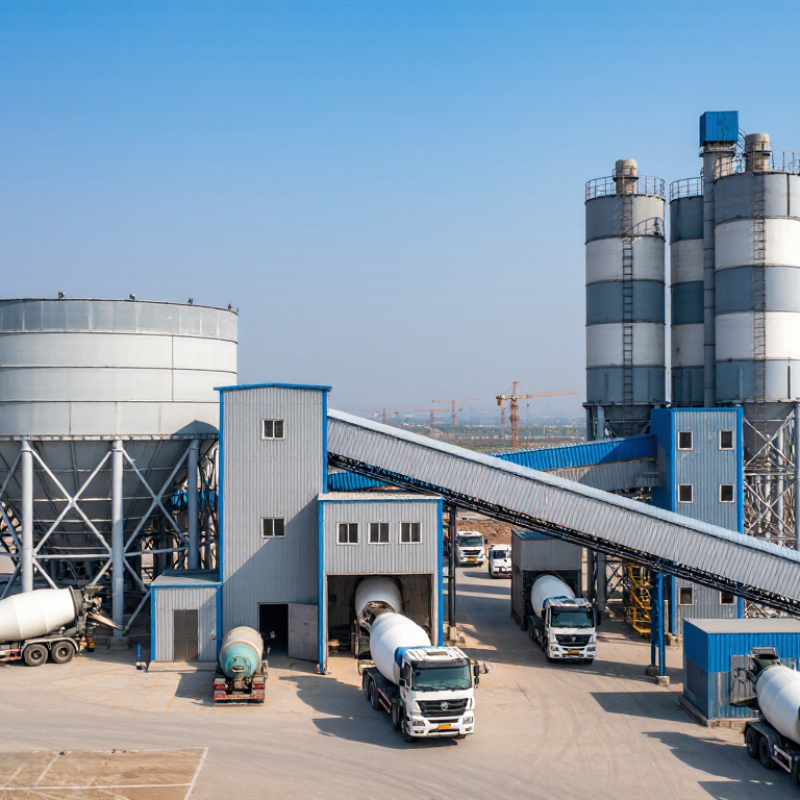
2026 Best Ready Concrete Batching Plant for Sale
What Is a Ready Concrete Batching Plant?
A ready concrete batching plant is a facility that produces concrete in measured batches for delivery to construction sites. It stores and weighs ingredients such as sand, gravel, cement, water, and approved admixtures. The control system adjusts quantities to match a specified mix design. Accuracy matters: a small change in water can affect workability and strength.
Plant designs vary. Some mix concrete centrally before loading it into transit mixers. Others weigh the ingredients at the plant and mix them inside the truck during delivery. The terminology can be confusing. That distinction matters when comparing capacity, transport distance, and site requirements.
A typical plant includes aggregate bins, a conveyor, cement silos, a water system, a mixer or truck-loading point, and operator controls. During production, operators check moisture levels, batch records, and equipment condition. These checks help keep batches consistent, though they cannot remove every variable. Weather, material quality, and delivery delays still affect results. Before selecting a plant, consider the required hourly output, available space, access for delivery trucks, and maintenance support. A high-capacity setup may look efficient on paper, but it can be a poor fit for a small or irregular project.

2026 Best Ready Concrete Batching Plant for Sale
How Does a Ready Concrete Batching Plant Work?
A ready concrete batching plant turns separate ingredients into a measured, workable mix. Aggregate is stored in bins, while cementitious materials sit in enclosed silos. A control system weighs each ingredient, then releases it into a mixer or transit mixer. Water and admixtures are metered in as the batch is prepared. Small errors matter.
Aggregate moisture needs close attention. A damp sand pile can add more water than the mix design allows, so operators check moisture readings and adjust the batch water. ASTM C94/C94M sets requirements for ready-mixed concrete, including production and delivery. The standard helps define consistent practice, but plant settings still need proper calibration and trained oversight. Real sites are rarely perfect.
The Global Cement and Concrete Association’s Concrete Future overview estimates that about 14 billion cubic metres of concrete are produced worldwide each year. That scale makes accurate weighing and reliable material flow important. Once mixing is complete, concrete is discharged for delivery within its workable time. Then the clock starts. Operators monitor batch records, mixer condition, and discharge consistency; a blocked chute or neglected cleanout can disrupt the next load.
2026 Best Ready Concrete Batching Plant for Sale
Which Plant Types and Capacities Suit Different Projects?
Small housing sites, repairs, and remote jobs often suit a mobile batching plant rated around 25–60 m³ per hour. It can be relocated as work advances, but frequent setup and uneven aggregate supply may reduce real output. For steady urban construction, a stationary plant rated around 60–120 m³ per hour is usually a more practical fit. It supports repeatable mixes and shorter truck-loading cycles. Large infrastructure projects may need 120 m³ per hour or more, especially when several pours run daily. Bigger is not always better.
Capacity labels can mislead. Rated output is typically a best-case figure, not a guaranteed hourly delivery rate. Allow for moisture variation, changeovers, cleaning, and truck availability. The Global Cement and Concrete Association estimates that roughly 14 billion cubic metres of concrete are produced each year worldwide, showing the scale of demand—but local project schedules should guide plant selection, not global averages. A careful buyer should also check mixer size, aggregate storage, cement-silo capacity, and access for concrete trucks.
Tips: Estimate peak hourly demand from the pour plan, then leave operating headroom. Ask suppliers for production figures using your actual mix and cycle time. Small detail, big difference. I would still verify the figures with a site trial; paper capacity can look overly tidy.
A ready concrete batching plant for sale in 2026 should match the site’s actual workload, not just its advertised output. Check rated capacity against the expected hourly demand, then allow for loading delays, truck queues, and mix changes. A plant that looks fast on paper may struggle during a wet morning rush. Ask for documented production data and inspect the mixer, aggregate bins, and conveyor wear points. Small details matter.
Reliable controls should record batch weights and flag deviations clearly. Calibration access should be straightforward, with load cells and water meters reachable without awkward dismantling. Ask how the system handles power interruptions and whether operators can retrieve batch records afterward. Simple screens help. But a complicated interface can still hide poor process design, so request a live demonstration using a representative mix.
Consider dust collection, noise levels, drainage, and safe access around moving equipment. These features affect daily operation, not just site appearance. Check whether the layout fits available space and leaves room for maintenance; crowded service areas often create avoidable delays. Confirm what installation support, operator training, and spare-part documentation are included in the sale. Supplier claims deserve verification. A local inspection by a qualified technician can reveal leaks, worn liners, or inconsistent weighing that photographs may miss.
| Plant Configuration | Indicative Rated Capacity | Mixing Arrangement | Typical Strengths | Key Features to Check | Best Suited For |
|---|---|---|---|---|---|
| Mobile wet-mix plant | Approximately 25–90 m³/h | Concrete is mixed in a central mixer before discharge into transit mixers. | Relatively quick relocation; modular equipment can reduce transport and setup complexity. | Transport dimensions and weight, setup requirements, mixer capacity, aggregate-bin arrangement, and availability of local service support. | Temporary projects, remote sites, and contractors who need to move production between locations. |
| Compact stationary wet-mix plant | Approximately 25–60 m³/h | Centralized batching and mixing, often with a smaller storage and feeding system. | Space-efficient layout and straightforward operation for lower-volume production. | Aggregate-bin capacity, cement-storage provision, access for delivery vehicles, dust control, and room for future expansion. | Small ready-mix operations, constrained sites, and projects with moderate daily demand. |
| Medium stationary wet-mix plant | Approximately 60–120 m³/h | Central mixer combines accurately weighed aggregates, cementitious materials, water, and admixtures. | Balances production volume, batching control, and the ability to supply several regular customers. | Independent weighing systems, moisture measurement or correction, mixer access for maintenance, and automated batch records. | Established ready-mix businesses and regional construction markets with consistent demand. |
| High-output stationary wet-mix plant | Approximately 120–240 m³/h | High-capacity central mixing, commonly supported by larger storage, feeding, and truck-loading systems. | Designed for sustained output when materials, truck dispatch, and site logistics can keep pace. | Verified cycle time, number and capacity of aggregate bins, cement-silo arrangement, truck-loading capacity, backup systems, and maintenance access. | Large infrastructure projects and high-volume markets with reliable material supply and fleet capacity. |
| Dry-batch ready-mix plant | Approximately 60–180 m³/h, depending on configuration | Materials are weighed and loaded into the transit mixer; final mixing takes place in the truck drum. | Can use a simpler plant layout because there is no central concrete mixer. | Truck loading accuracy, batching sequence, moisture compensation, transit-mixer availability, and procedures for consistent mixing during transport. | Markets where truck mixing is established and transit mixers can reliably complete the required mixing cycle. |
Buying note: Capacity figures are indicative ranges, not guaranteed output. Actual production depends on the plant configuration, concrete mix, aggregate moisture, batch cycle, loading and dispatch time, and operating conditions. Confirm the rated capacity, applicable local requirements, installation scope, and service arrangements in the equipment specification before purchase.
2026 Best Ready Concrete Batching Plant for Sale
Comparing suppliers starts with your actual production needs, not the largest capacity listed in a brochure. Estimate hourly output, aggregate types, site access, and expected shifts. Ask suppliers for verified production figures under conditions similar to yours. A plant rated at 60 cubic meters per hour may deliver less when material moisture, loading delays, or mix changes slow the cycle. Details matter.
Compare the full delivered cost. Include transport, foundations, electrical work, water systems, commissioning, operator training, and spare parts. Request an itemized quotation and clarify what is excluded. Installation can require a level, reinforced base and enough room for truck movement, aggregate storage, and maintenance access. Check available power and water before placing an order. Retrofitting these services can be surprisingly costly.
Tips: Ask for a site layout drawing and installation schedule before signing. Confirm which components are included, how remote support works, and how quickly common wear parts can be supplied. Speak with a recent customer if possible. A supplier’s estimate is useful, but it is still an estimate; leave room for weather, ground conditions, and commissioning adjustments.
Cost and installation comparison for a typical 60 m³/h stationary ready-mix concrete batching plant.
The planning benchmark shows the main budget categories buyers should compare in supplier quotations. Equipment cost normally represents the largest portion, while civil works, installation, electrical systems, and commissioning can significantly affect the final project price. Actual costs vary according to automation level, aggregate storage capacity, site conditions, local labor rates, transport distance, and regional regulations.


For those larger-sized parts, or smaller quantity runs, we have 2 independent powder coat booths and ovens. The quality, durability and affordability of today’s powder coating finishes make this the process of choice for world-class companies.
Powder coating advantages over other forms of coating are many. Materials used in the Powder coating process can be metals and non-metals that come in a multitude of thicknesses, textures, colors, etc. Another of Powder coating’s biggest advantages over conventional coatings is its ability to create finishes in many different textures. Powder Coating Booths allow us the ability to apply these advantages to large products.
Tri-State Fabricators runs a full-service conveyor line for painting. Wet painting can provide protection or decoration to many different part styles. From start to finish, every project is easier to undergo random and point-based inspection by our skilled painting team.
Advantages to our Wet Paint Line are these lines start with product prep and ends with a thorough inspection of a high quality finished product. Our ability to complete large and small projects with a superior finish and doing so in a timely and economical fashion. This passes along the savings in production to our customers. When powder coating ins not an option, our Wet Paint Line gets the job done right the first time.
When the parts get big and heavy we roll-out our custom paint racks and oversize booth. By utilizing our partnerships with all the major paint brands, we can match virtually any color with wet paint.
The advantages of having access to a Wet Paint Booth are many. Large projects of many different shapes can be loaded into the booth. The Wet Paint Booth offers an environment that is much more controlled than a typical parts painting operation.
Not only are they used because of their controlled environment, but they’re are also advantageous when it comes to applying paint to parts that are needed in industries that require specialty coatings such as medical, aerospace, etc.
Our military forces have some very high standards when it comes to the finish of their vehicles and equipment. From the first pre-treatment step to final coat, it takes a great deal of knowledge and experience to protect the men and women of our armed forces. They deserve only the best, and Tri-State Fabricators provides it.
All of our processes are closely monitored by our staff and management teams. Both of which are highly trained in the processes of metal fabrication and finishing. Tri-State Fabricators’ goal is to always fully satisfy each and every customer, including the military. We will always put a 110% into what we do.
Abrasive media blasting is an excellent way to remove old paint, rust, and increase the paint/powder adhesion. Glass beads produce a much smoother and brighter finish than angular abrasives; leaving the part clean yet without any dimensional change. Chemically inert and environmentally friendly, we can recycle our beads approximately 30 times; making them a more preferred method of metal cleaning or surface finishing.
Advantages to Glass Bead Blasting are many. Glass bead blast media is used when a project is needing rough surfaces need to become smooth for applications of coatings such as paint. It is typically used to clean paint and rust from a product surface without deforming the surface it is being used on. Overall, compared to many other blasting media, Glass Bead Blasting is a very economical choice and those savings are always passed on to our customers.
Tri-State Fabricators utilize a zinc phosphate wash to clean and etch the material to ensure the best paint adhesion possible. The unique design of our 3-stage wash system does the work like a 5-stage. From Cleaning and rinsing to conversion coating and post-treatment, Our Part Washing process is a complete service and works throughout the fabrication service and the finishing service.
Along with the previously mentioned benefits, Curing is a vital chemical reaction that leaves the product finish hard and relatively safe from mild abrasion and aggressive corrosion. This process can be done in more than one way; ambient air-dry or in curing ovens at temps that exceed 240°.
From fixing paint mistakes (someone else’s of course) to simply cleaning our paint line hooks, our burn-off oven is put to good use. After a quick burn-off, a little clean up, and a fresh coat of paint, your parts will look better than new.
Why does our Burn-Off Oven work so well? Because super heating the air around parts turns the materials into ashes. From paint and powder coatings to rubber and machining oils, high temps do the job without degrading the integrity of the part.
Masking is a vital part of producing high quality products. We have die-cut masking patterns to protect machined surfaces as well as a wide range of plugs and caps to protect threaded holes and bolts. We provide permanent and temporary masking.
Masking allows the selected sections of a product to be protected from a fabrication or finishing service. This can be with both chemicals when etching and tapes, paints when only finishing just a section of the product. Masking is great in aiding the customization process of a project.
Screen printing is a photographic process that transfers artwork onto a porous nylon screen which allows colored ink to flow through the screen and be deposited on an aluminum or plastic component. We can generally have just about any design created onto a screen for your parts.
Some of the advantages of Screen Printing are, brand recognition for your business displaying on your products, assembly instructions, product warnings/hazards, etc. Tri-State Fabricators produces Screen Printing of the highest quality so you know it’s durable.
Metal Finishing is the art of treating the exterior portion of product, often metal but can also be made of other materials, so that the surface is clean and free of any debris. Then the process of applying coats or either paint of powder coat takes place. This coating process improves the quality of the product in both appearance and resistance to wear and corrosion.
Tri-State Fabricators, Inc., understands that a project typically isn’t complete until a high-quality finish has been added to your product. This is why our painting and powder coating teams continuously inspect the products throughout the Metal Finishing process.

